
What if your dream retirement trip to Italy ended with a medical bill that cost more than the entire vacation? It’s a scary thought that keeps many travelers awake at night, especially when you realize a single hospital stay in Europe can cost up to $50,000 in 2026. We understand how overwhelming it feels to navigate complex rules while you’re supposed to be relaxing. You deserve to feel secure and protected, no matter where your passport takes you. Our goal is to remove that anxiety so you can focus on making memories.
We’re here to clear up the confusion and show you exactly how medicare and traveling abroad what’s covered on your next adventure. Whether you’re worried about filling a prescription in Paris or needing an emergency room in Tokyo, we’ll explain the limits of your current plan and how to fill the gaps. We will walk you through the differences between Medigap and Advantage travel rules for 2026 and provide a simple checklist to ensure your coverage is ready for takeoff. You can move from a state of uncertainty to total confidence before you even board the plane.
Key Takeaways
- Learn why Original Medicare coverage generally ends at the U.S. border and which specific territories are still included in your 2026 plan.
- Discover how certain Medigap plans provide a vital safety net for emergency care during the first 60 days of your international trip.
- We will show you exactly how medicare and traveling abroad what’s covered when it comes to emergency hospital stays and unexpected medical crises.
- Find out how to get your travel vaccines for a $0 copay in 2026 and why you must fill your prescriptions before leaving the country.
- Use our simple five-step checklist to ensure your health coverage is just as ready for your adventure as your passport.
Does Medicare Cover You Outside the United States?
Imagine you are standing on the deck of a cruise ship or crossing a scenic bridge into a neighboring country. You are the same person, but your health coverage just stayed behind. We often meet travelers who assume their red, white, and blue card is a global pass for healthcare. In reality, the Medicare program is designed to protect you while you are on American soil. Once you step across that invisible line into a foreign country, your Original Medicare coverage essentially stops. This basic rule applies to both Part A and Part B, leaving a significant gap for those who love to explore.
The reality of medical billing in 2026 adds another layer of complexity. Even in rare situations where coverage might apply, foreign hospitals are not required to file claims with the U.S. government. You will likely have to pay the entire bill out of pocket at the time of service. This can be a terrifying prospect when you are dealing with a medical crisis in a language you don’t speak. Understanding medicare and traveling abroad what’s covered is the first step toward moving from a state of uncertainty to one of total confidence.
What is Considered ‘Outside the U.S.’ in 2026?
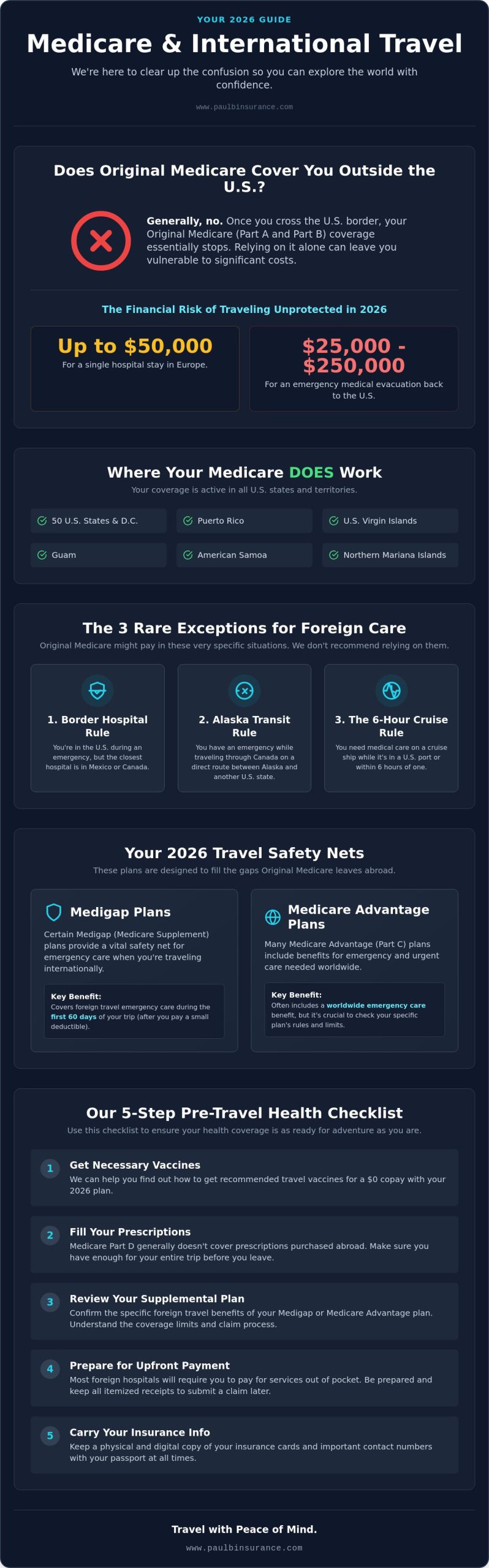
It helps to know exactly where the “border” lies for your insurance. Your coverage follows you through all 50 states and the District of Columbia. It also remains active in U.S. territories like Puerto Rico, the U.S. Virgin Islands, Guam, American Samoa, and the Northern Mariana Islands. However, the rules get specific once you hit the water. If you are on a cruise ship, you are only covered if the ship is in a U.S. port or within six hours of one. Beyond that window, you are in international territory, and Original Medicare will not pay for your care.
The Financial Risk of Traveling Without a Supplement
The stakes are higher in 2026 than many people realize. An emergency medical evacuation back to the United States can cost between $25,000 and $250,000 depending on your location and the complexity of your needs. Your Medicare card is a vital tool at home, but it is not a passport to global healthcare. Relying on it alone in London or Tokyo can jeopardize your retirement savings. To ensure you have a safety net, we often recommend looking into Medicare Supplement Plans or specific Medicare Advantage Plans that offer worldwide emergency benefits. Knowing medicare and traveling abroad what’s covered ensures that a sudden illness doesn’t turn into a financial disaster.
The 3 Rare Exceptions Where Medicare Pays for Foreign Care
While we’ve established that your coverage generally stops at the border, there are three “golden rules” where Original Medicare might actually help. These exceptions are quite narrow. They are designed for specific geographic hurdles rather than general vacationing. Knowing medicare and traveling abroad what’s covered in these rare moments can save you from a massive bill, but you shouldn’t rely on them as your primary travel strategy. We want you to have the facts so you aren’t caught off guard during a crisis.
- The Border Hospital Rule: You’re in the U.S. when a medical emergency happens, but the nearest hospital capable of treating you is across the border in Canada or Mexico.
- The Alaska Transit Rule: You’re traveling through Canada on the most direct route between Alaska and the lower 48 states and require emergency care.
- The 6-Hour Cruise Rule: You have a medical emergency while on a cruise ship that is within six hours of a U.S. port.
The catch is that even in these scenarios, Medicare only pays for the specific services it covers back home. You’ll still be responsible for your usual deductibles and coinsurance. Because these rules are so technical and specific, many of our clients find that Medigap and Medicare Advantage for travel provide a much more reliable safety net for their 2026 adventures. It’s often easier to have a plan that covers you regardless of which side of the border you’re on.
Emergency Care Near the Canadian and Mexican Borders
If you live or travel near the border, Medicare looks at “closest” in a very literal way. It isn’t about which hospital you prefer or which one has the best reviews. It’s about physical distance and the ability to treat your specific emergency. If a U.S. hospital is even a few miles further away than a Canadian one, Medicare may approve the foreign claim. However, this only applies to emergencies. You cannot cross the border for a scheduled surgery or a routine check-up and expect Medicare to pay. You’ll need clear documentation from the ambulance or attending physician to prove that the foreign facility was the only logical choice for your immediate safety.
Cruising and Medicare: The 6-Hour Rule
Cruising is a favorite way to see the world in 2026, but it carries unique insurance risks. Your coverage is tied to a ticking clock. As long as the ship is within six hours of a U.S. port, you’re technically covered for emergencies. The moment that ship sails into deeper waters, your Original Medicare protection vanishes. Onboard infirmaries are notoriously expensive and they almost never bill Medicare directly. We recommend checking your ship’s itinerary and registry before you leave. If you’re planning a voyage that spends days at sea, it’s a good idea to review your supplemental coverage to ensure you aren’t left with a five-figure bill from the ship’s doctor.
Medigap vs. Medicare Advantage: Your 2026 Travel Safety Nets
We want to help you move from feeling vulnerable to feeling empowered on your next trip. When you look at medicare and traveling abroad what’s covered, the choice usually falls between two paths. Both offer protection, but they work in very different ways. One thing we must be honest about is the “reimbursement reality.” Even with a great plan in 2026, foreign hospitals rarely bill U.S. insurance companies directly. You will likely need to pay the medical bill yourself using a high-limit credit card. You then submit the receipts and paperwork to your plan for reimbursement once you return home. This is a vital piece of the puzzle that many people miss until they are standing at a hospital desk in a foreign country.
Choosing the right safety net depends on how often you travel and where you plan to go. We are here to simplify these options so you can make a choice that brings you peace of mind. Whether you prefer the standardized benefits of a supplement or the added perks of an advantage plan, we will ensure you understand the limits of your 2026 coverage before you board your flight.
How Medigap Protects You Overseas
Many frequent flyers view Medicare Supplement Insurance as the gold standard for international security. Specifically, Medigap Plans C, D, E, F, G, M, and N include a foreign travel emergency benefit. This benefit covers 80% of the cost for emergency care that begins during the first 60 days of your trip. You’ll need to meet a small $250 annual deductible first. It’s important to remember that these plans have a lifetime maximum benefit of $50,000. Once you reach that limit, the travel benefit does not reset. For most travelers, this provides a reliable layer of security that removes the fear of a massive medical bill.
Medicare Advantage and Global Emergencies
Medicare Advantage plans often include “world-wide emergency” coverage as an added perk in 2026. However, these benefits are not standardized like Medigap plans. We always urge our clients to review their specific Summary of Benefits before they head to the airport. Some plans might cover a true emergency room visit but exclude “urgent care” centers. This distinction matters if you have a minor injury that needs attention but isn’t life-threatening. To help you compare these options, you can use our Medicare Advantage Guide to see how different plans handle global crises. Knowing medicare and traveling abroad what’s covered under your specific plan ensures that your peace of mind travels with you across every border.
Managing Prescriptions and Vaccines for Your 2026 Trip
We know the sinking feeling of realizing your pill bottle is nearly empty while you’re thousands of miles from home. It’s a stressful situation that can quickly overshadow your vacation. The hard truth is that Medicare Part D plans cannot pay for prescriptions filled at pharmacies outside the United States. If you run out of your maintenance medication in Rome or Tokyo, you’ll have to pay the full price at the local pharmacy. Understanding medicare and traveling abroad what’s covered includes knowing these pharmacy limits before you leave the house. We want to help you avoid these expensive surprises by planning your refills well in advance.
While drug coverage stops at the border, 2026 has brought a major victory for travelers regarding preventative care. Thanks to recent updates, your Part D plan now covers all vaccines recommended by the Advisory Committee on Immunization Practices (ACIP) with a $0 copay. This means you can get protected against tropical diseases without worrying about the cost. We are here to guide you through these rules so you can travel with confidence and health.
Preparing Your Meds Before You Leave
Timing your refills is the most important step in your pre-trip preparation. We recommend requesting a “travel exception” from your insurance provider if you’ll be gone for an extended period. This often allows you to secure a 90-day supply of your maintenance medications so you don’t run out mid-journey. You should also keep every medication in its original labeled bottle to avoid issues with foreign customs. It’s helpful to have a written list of the generic names for your drugs, as brand names often vary by country. For more details on how these rules work, you can explore our Medicare Part D guide to see the 2026 refill requirements.
Getting Your Travel Vaccines at No Cost
In 2026, your Part D plan is a powerful tool for global health. If your destination requires protection against Yellow Fever, Japanese Encephalitis, or Chikungunya, these ACIP-recommended shots are covered at no cost to you. We suggest visiting your doctor at least six weeks before your departure date. Some vaccines require multiple doses to be fully effective, and your body needs time to build immunity. Knowing medicare and traveling abroad what’s covered ensures you aren’t paying out of pocket for these vital shots at a travel clinic. If you’re planning a trip, review your Medicare Part D plan with us to see if your specific medications are eligible for an extended refill.
How to Ensure Peace of Mind on Your Next Adventure
Preparing for an international journey in 2026 should be a time of excitement, not a period of high stress. We believe that the right preparation turns a state of uncertainty into one of total confidence. By now, you have a much clearer picture of medicare and traveling abroad what’s covered, from the 60-day limit on supplements to the $0 copay for travel vaccines. However, knowing the rules is only half the battle. The other half is having a structured plan to ensure those rules work in your favor when you’re thousands of miles from home.
Carrying your Medicare card alone isn’t enough when you’re in a city like London or Tokyo. While that card is your key to care in the U.S., foreign hospitals don’t recognize it as a guarantee of payment. They often require payment upfront before they begin treatment. This is why we advocate for a multi-layered approach that includes your 2026 health plan and potentially a private travel insurance policy as a secondary shield. This extra layer is especially vital for medical evacuation, which we previously noted can cost up to $250,000 depending on your location.
Your Pre-Trip Medicare Checklist
We’ve simplified the preparation process into five essential steps for every traveler in 2026. Following this list will help you avoid the most common pitfalls we see our clients face.
- Step 1: Review your 2026 Evidence of Coverage (EOC). Rules for Advantage plans can change annually. Verify your current “world-wide emergency” benefit before you pack.
- Step 2: Print your ID cards. Don’t rely solely on a smartphone app. Have physical copies of your Medicare Supplement or Advantage card in your carry-on.
- Step 3: Confirm your benefit limits. Check if you’ve used any of your $50,000 lifetime Medigap travel benefit on previous trips.
- Step 4: Arrange your 90-day medication supply. Contact your Part D provider for a travel exception at least three weeks before departure.
- Step 5: Save international claim forms. Download the claim forms for your specific plan so you know exactly what documentation you’ll need from a foreign doctor.
Why We Advocate for Independent Planning
We don’t work for the insurance companies; we work for you and your travel dreams. As independent experts, we have the freedom to compare over 40 different carriers to find the specific protections you need for 2026. A restricted representative might only offer one or two options, but we look at the whole picture to ensure your safety net is secure. Our mission is to protect and empower you, removing the anxiety from the complex world of international insurance. If you want to move from a state of distress to one of absolute certainty, contact us today for a simple, expert review of your travel coverage. We’ll make sure you’re protected so you can focus on the journey ahead.
Embark on Your Next Journey with Certainty
Your retirement should be filled with discovery, not the constant worry of “what if.” We have explored the critical details of how your coverage changes once you leave U.S. soil. From the 60-day emergency window provided by many Medigap plans to the $0 copay for travel vaccines in 2026, you now have the tools to plan effectively. Understanding medicare and traveling abroad what’s covered ensures that you can focus on the sights and sounds of a new culture rather than the fine print of an insurance policy. To further simplify your travel mornings, you can also visit Advanced PMU to explore Powder Brows for a low-maintenance beauty solution that keeps you looking your best throughout your trip.
We are here to be your personal advocate in this journey. As independent brokers, we represent over 40 carriers and provide personalized support across 34 states. We keep our guidance updated with the latest 2026 regulations so you never have to navigate these complex systems alone. Let us help you travel with confidence; get a free Medicare travel coverage review today! You deserve a partner who prioritizes your peace of mind over high-pressure tactics. We look forward to helping you protect your health and your travel dreams.
Frequently Asked Questions
Does Medicare Part B cover me on a cruise ship?
Medicare Part B only covers you on a cruise ship if the doctor is legally allowed to provide services and the ship is in a U.S. port or within six hours of one. If you’re sailing in international waters beyond that six-hour window, your Part B coverage stops. We recommend checking your ship’s itinerary carefully before you sail to identify any gaps in your protection.
Will my Medigap plan pay the hospital in Italy directly?
No, your Medigap plan will not pay a foreign hospital directly. You’ll need to pay the medical bill yourself at the time of service and then submit the itemized receipts for reimbursement once you return to the United States. This is why we suggest carrying a credit card with a high limit for your 2026 travels to handle unexpected expenses.
Can I buy a Part D plan that works in Europe?
There are no Medicare Part D plans that provide coverage for pharmacies in Europe or any other foreign country. These plans are strictly for use within the United States and its territories. You’ll need to fill your prescriptions before you leave or be prepared to pay the full local price at a pharmacy while you’re abroad.
What happens if I need a medical evacuation back to the U.S.?
Medicare and Medigap plans generally do not cover the cost of a medical evacuation back to the United States. This is a significant gap in medicare and traveling abroad what’s covered that many travelers overlook. You would likely be responsible for the entire cost of the flight and medical staff unless you have a separate travel insurance policy in place.
Is travel medical insurance different from Medicare?
Yes, travel medical insurance is a private policy that offers specific protections Medicare does not, such as medical evacuation and trip cancellation. While your 2026 Medicare supplement may cover some emergency care, a private travel policy acts as a secondary layer of security. We can help you look at your itinerary to decide if this extra protection is right for your specific trip.
Should I keep my Medicare coverage if I move abroad permanently in 2026?
If you move abroad permanently in 2026, you must continue paying your Part B premiums to keep your Medicare enrollment active. While it won’t cover you in your new home country, keeping it ensures you have immediate coverage when you return to the U.S. to visit. For retirees considering a move to Australia, consulting with local property experts like youraustralianproperty.com.au can simplify the relocation process. If you drop it and decide to move back later, you may face late enrollment penalties that last a lifetime.
Does Medicare cover dental emergencies while traveling abroad?
Original Medicare does not cover dental emergencies, regardless of whether you’re at home or abroad. If you have a separate dental insurance plan, you should check if it includes any international emergency benefits. Most standard Medicare plans will leave you responsible for the full cost of a foreign dentist visit for a cracked tooth or infection.
How do I file a claim for emergency care I received in another country?
To file a claim for foreign emergency care, you must gather all itemized bills and medical reports from the foreign provider. You will then submit these documents along with a standard claim form to your Medigap or Advantage plan provider. Knowing medicare and traveling abroad what’s covered means being prepared to handle this paperwork once you’re back on American soil to ensure you get your reimbursement.

Article by
Paul Barrett
Paul Barrett, CMIP is the founder of The Modern Medicare Agency, an independent Medicare-only brokerage based in Melville, NY. With 18 years of Medicare-exclusive experience, a CMIP designation, and more than 5,000 clients served across 37 states, Paul is one of the most credentialed independent Medicare specialists on Long Island — and one of the most direct.
He represents 40+ carriers with no quotas and no allegiances, which means his recommendations are based entirely on what fits each client's specific situation. He is the author of Medicare Mastery Unlocked and host of the Wise Guys Retirement Talk podcast. His content is grounded in primary sources, real carrier intelligence, and 18 years of watching what happens when people get Medicare right — and when they don't.
📞 631-358-5793 | paulbinsurance.com