
What if the most stressful part of your Medicare plan, the dreaded “donut hole,” simply didn’t exist anymore? It’s a question many of our clients are asking now that we’ve entered 2026. We understand that even with positive changes, the new $2,100 out-of-pocket cap and the maximum $615 deductible can feel confusing. It’s perfectly normal to feel a bit of anxiety about whether your fixed income can keep up with your medications. We want to replace that worry with a clear, simple plan for your health and your wallet. In this guide, we’ll share effective medicare part d coverage gap strategies to help you navigate these updates with total confidence.
You’ll learn exactly how the elimination of the coverage gap affects your monthly costs and how to benefit from the first round of government-negotiated drug prices. We’ll also explain how the Medicare Prescription Payment Plan can help you spread out your expenses so you never face a surprise at the pharmacy counter. Our goal is to provide a straightforward path to lower bills and the peace of mind that comes from knowing you aren’t overpaying for the care you need. We’ve done the homework for you, so you can focus on staying healthy.
Key Takeaways
- Learn how the new $2,100 out-of-pocket limit provides a vital safety net that stops your drug costs for the rest of the year once you hit the cap.
- Discover practical medicare part d coverage gap strategies to navigate the 2026 changes and keep your monthly pharmacy bills predictable and manageable.
- Explore how the Medicare Prescription Payment Plan allows you to spread your out-of-pocket costs into steady monthly installments instead of paying a large sum at the pharmacy.
- Understand why a professional review of your plan’s formulary is essential to ensure your specific medications are still covered at the best possible price.
- See how we do the heavy lifting by comparing over 40 different insurance carriers to find the one plan that fits your unique health needs and budget.
Understanding the Medicare Part D Coverage Gap in 2026
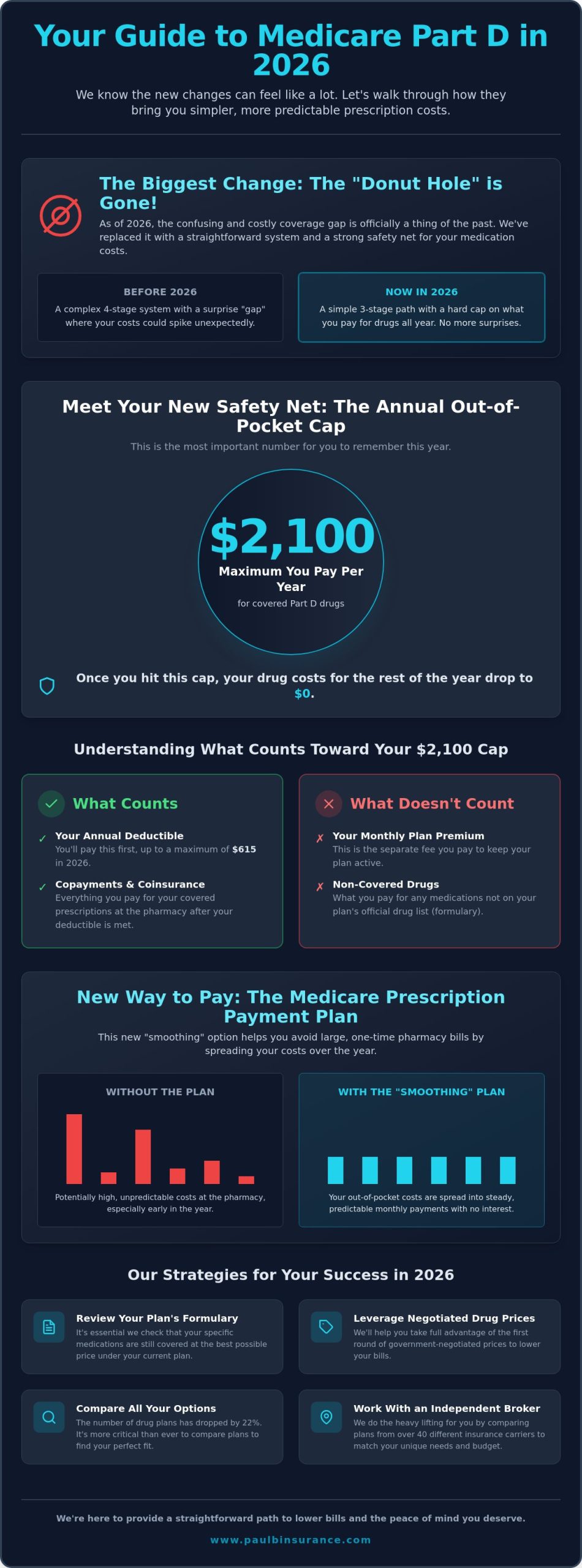
For years, many of our clients lived in fear of the “donut hole,” a phase where drug costs spiked unexpectedly. We remember the stress in our neighbors’ voices when they reached that invisible line and suddenly had to pay a much larger share of their medication bills. Understanding the Medicare Part D Coverage Gap helps us appreciate how far we’ve come since those days. As of 2026, we can finally say that the donut hole is officially a thing of the past. This shift represents one of the most significant improvements to senior healthcare in decades. It replaces a confusing, fluctuating system with a predictable limit on what you pay at the pharmacy.
What Happened to the Donut Hole?
The Inflation Reduction Act (IRA) redesigned the entire drug coverage landscape to protect you from high costs. In the old days, you would move through several phases, including a gap where you were responsible for a large percentage of the drug’s price. Now, the system has been streamlined into three clear stages: the deductible, the initial coverage phase, and the catastrophic phase. This change is a major win for anyone managing chronic conditions like cancer, diabetes, or heart failure. Instead of falling into a “hole,” you now move toward a safety net that stops your spending once you reach a certain point. We believe this provides the security you deserve after years of hard work.
The 2026 $2,100 Out-of-Pocket Cap Explained
The most important number to remember this year is $2,100. The $2,100 out-of-pocket cap is the absolute maximum you will pay for covered drugs in 2026. Once you and your plan have spent this amount on covered medications, your cost for the rest of the year drops to $0. This includes your annual deductible, which has a maximum limit of $615 in 2026, and any copays or coinsurance you pay during the initial coverage phase. It’s a straightforward promise of protection that we are proud to help our clients navigate.
It’s equally important to understand what does not count toward that $2,100 limit. Your monthly plan premiums and the cost of any drugs not covered by your plan’s formulary are excluded from this calculation. Because of this, choosing the right plan is more critical than ever. If you want to see how these changes affect your specific medications, we can help you review your Medicare Part D options to ensure every drug you take counts toward your limit.
Even with these improvements, you still need a plan of action. The number of stand-alone drug plans has decreased by about 22% since last year, meaning your old plan might look very different today. Using smart medicare part d coverage gap strategies, like checking for newly negotiated drug prices, can help you reach that $2,100 cap slower or manage your monthly cash flow more effectively. We are here to do that heavy lifting for you, ensuring you find the most cost-effective path through this new landscape.
Strategies to Manage Your Prescription Costs Effectively
Finding a way to fit prescription costs into a monthly budget is one of the biggest challenges we see our clients face. Even with the new $2,100 out-of-pocket limit we discussed earlier, those initial months of the year can still feel heavy on your wallet. We believe that the best way to handle these expenses is to have a clear plan before you ever reach the pharmacy counter. By using specific medicare part d coverage gap strategies, you can take the surprise out of your healthcare spending and enjoy the peace of mind you deserve.
One of the most helpful tools available this year is the result of recent changes to Medicare Part D that focus on affordability. These reforms were designed to ensure that no one has to choose between their medicine and their groceries. We are here to help you understand how to use these new rules to your advantage.
The Medicare Prescription Payment Plan (M3P)
The Medicare Prescription Payment Plan is a new “smoothing” option that helps you manage your cash flow. Instead of paying a large deductible or high copay all at once at the pharmacy, this plan allows you to spread those costs into monthly installments over the rest of the calendar year. It’s like a payment plan with no interest. We find this strategy is most beneficial for people who take high-cost medications and usually hit their out-of-pocket limit early in the year. To get started, you must opt into the program through your insurance carrier. It’s not automatic, so we recommend contacting your provider or letting us help you with the paperwork to ensure you’re enrolled for the start of the year.
Optimizing Your Pharmacy Network
Where you fill your prescriptions matters just as much as what you take. Most plans have a network of “preferred” pharmacies where they’ve negotiated lower prices for you. If you go to a “standard” pharmacy, you might pay significantly more for the exact same medication. We also suggest looking into mail-order services. Many carriers offer a 90-day supply for the price of a 60-day supply if you use their home delivery system. If you prefer to shop locally, we always recommend checking the status of your favorite Melville pharmacy every year, as networks can change. If you’re feeling overwhelmed by these choices, we can help you compare Part D plans to find the one that works best for your specific medications and preferred pharmacy.
Taking these small, proactive steps can keep your costs below the cap longer and prevent a huge bill in January. We are committed to making this process simple and stress-free for you. If you’d like to see a personalized breakdown of your potential savings, we invite you to connect with our team for a quick review of your options.
How to Compare Part D Plans for Maximum Savings
We believe the most effective medicare part d coverage gap strategies start with a thorough comparison of every plan available in your area. In 2026, the landscape has changed significantly, with about 22% fewer stand-alone drug plans than we saw just a year ago. This means the plan you’ve relied on for years might not be the best fit for your current medications. We take the stress out of this process by looking past the flashy marketing and focusing on the actual numbers that affect your bank account.
Many of our clients feel overwhelmed by the sheer volume of choices. It’s easy to get lost in the fine print. We simplify this by focusing on your “Total Annual Cost.” This is the only number that truly matters. It combines your premiums, deductibles, and copays into one clear figure. By running these numbers, we help you see the path from January 1st to the $2,100 out-of-pocket limit with total clarity. If you want to explore the basics of these choices, you can learn more about Medicare Part D plans through our dedicated guide.
Decoding the Formulary and Tiers
Every plan uses a formulary, which is just a list of the drugs they agree to cover. These medications are organized into tiers, typically numbered 1 through 5. Tier 1 usually contains low-cost generics, while Tier 5 is reserved for high-cost specialty drugs. We’ve seen cases where the same medication is a Tier 2 drug on one plan and a Tier 4 drug on another. This single difference can cost you hundreds of dollars before you hit the cap. We also look for “prior authorization” requirements and “step therapy” rules. These are hurdles that can delay your access to medicine. We help you identify these “speed bumps” early so you can talk to your doctor and avoid pharmacy counter surprises.
Calculating Your Total Annual Out-of-Pocket Cost
Don’t let a $0 monthly premium fool you. While it sounds like a great deal, these plans often have higher copays or a larger deductible. In 2026, the maximum annual deductible is $615. To find your real cost, we use a simple formula: multiply your monthly premium by 12, add your deductible, and then add your estimated copays until you reach the $2,100 safety net. This calculation is one of the most reliable medicare part d coverage gap strategies because it reveals the hidden costs of “cheap” plans.
The official guidelines on costs in the coverage gap show how much these details impact your wallet. We use professional software to compare your specific list of medications across more than 40 different carriers. This ensures we find the plan that offers the lowest total cost for your unique needs. Our goal is to provide you with the security of knowing you’ve made the smartest choice possible for your health and your budget.
Proactive Steps to Lower Your Medication Expenses
While the new $2,100 out-of-pocket limit offers a fantastic safety net, we believe the best approach is to keep your costs as far below that cap as possible. Reaching the catastrophic phase means you’ve already spent a significant amount of your hard-earned money. By using proactive medicare part d coverage gap strategies, we can often help you lower your monthly bills right from the start of the year. We want to ensure you have every tool available to keep your healthcare affordable and your mind at ease.
Sometimes, the best strategy involves looking at your coverage as a whole. For many of our clients, pairing a strong drug plan with a Medicare Supplement plan provides the most comprehensive protection against high medical costs. This combination can help you manage the gaps that standard Medicare leaves behind, giving you a more predictable monthly budget.
Applying for the Extra Help Program
The Extra Help program, also known as the Low Income Subsidy, is a federal resource that helps pay for Part D premiums, deductibles, and copays. Thanks to recent reforms, more people qualify for the full version of this benefit in 2026. If your annual income is below 150% of the federal poverty level and your assets meet certain limits, you could see your drug costs drop significantly. We’ve seen this program reduce premiums to $0 and bring copays down to just a few dollars. You can apply through the Social Security Administration, and we are happy to help you understand the requirements so you can avoid the headache of navigating the paperwork alone.
Generic vs. Brand Name: The Conversation to Have
One of the simplest ways to save money is to talk with your doctor about Tier 1 medications. These are typically high-quality generics that work exactly like their brand-name counterparts but at a fraction of the cost. Generics can often cost 80% less than brands. When you visit your physician, ask if there is a “therapeutic alternative” in a lower tier on your plan’s formulary. Switching from a Tier 3 brand-name drug to a Tier 1 generic can sometimes save you enough money to prevent you from ever hitting your deductible or out-of-pocket limit. We find that most doctors are more than happy to help you find these savings when they know it’s a priority for you.
Beyond these steps, we also recommend looking into Patient Assistance Programs (PAPs). These are programs run by drug manufacturers to help people who may not qualify for government help but still find their medications expensive. We can help you search for these programs based on the specific prescriptions you take. If you’re ready to see which of these medicare part d coverage gap strategies will save you the most money this year, we invite you to schedule a free plan review with our team today.
Why an Independent Broker is Your Best Strategy
We understand that choosing a plan in 2026 feels like a high-stakes puzzle. With the new $2,100 out-of-pocket cap and the maximum $615 deductible, the rules have changed, and the options have narrowed. Implementing the right medicare part d coverage gap strategies shouldn’t feel like a part-time job for you. That is where we come in. There is a vital difference between a captive agent and an independent broker like Paul Barrett. A captive agent works for one specific insurance company. They are required to fit your needs into their limited box. We do the opposite. We work for you, not the carriers.
Our team uses professional, specialized software to analyze every available plan in your specific zip code. Because we are independent, we compare options from over 40 different carriers to find the one that actually covers your medications at the lowest cost. We don’t just look at the brand name of the insurance company. We look at the math. Why a Medicare Broker makes the process simple is because we provide an unbiased view of the entire market, ensuring you never feel pressured into a plan that isn’t a perfect fit.
We Do the Homework So You Don’t Have To
Comparing dozens of carriers is exhausting and confusing. We simplify this journey into a clear, logical choice. We handle the heavy lifting, from checking drug tiers to verifying which pharmacies in Melville are considered preferred. If you decide to use the Medicare Prescription Payment Plan (M3P) to spread out your costs, we can help you with that enrollment process too. We want to remove the technical hurdles so you can enjoy the peace of mind that comes from expert verification. Our support doesn’t end once you sign up. We are your dedicated advocates year-round, ready to help if your medications change or if you receive a confusing letter from your provider.
Ready for a Stress-Free 2026? Let’s Talk
We invite you to schedule a simple, no-obligation review of your current drug list. This consultation is a safe space to ask questions and get honest answers. To make our time together as accurate as possible, please have your current prescription bottles or a list from your pharmacy ready. We will run the numbers together and show you exactly how the 2026 changes will impact your wallet. Our mission is to protect your health and your financial security. We’ve helped countless neighbors find the best medicare part d coverage gap strategies for their unique lives, and we would be honored to do the same for you. Let’s move from a state of uncertainty to one of total confidence together.
Take Control of Your 2026 Healthcare Budget
The landscape of 2026 offers more protection than ever before. We’ve seen how the new $2,100 out-of-pocket cap acts as a vital safety net, ensuring your spending stops once you hit that limit. We also explored how tools like the Medicare Prescription Payment Plan can keep your monthly budget steady and predictable. These medicare part d coverage gap strategies are designed to remove the fear of the unknown and replace it with a clear, manageable path forward. You don’t have to wonder if you’re making the right choice when you have a dedicated partner by your side.
You don’t have to navigate these complex changes alone. We provide personalized formulary analysis at no cost to you, comparing options from over 40 carriers to find your best fit. Our team is here to offer year-round support, acting as your advocate whenever you have a question or a concern. We want to help you move from a place of confusion to a state of total certainty about your coverage. Schedule your free 2026 Part D review with Paul Barrett today. We are ready to help you protect both your health and your wallet. You deserve the peace of mind that comes from knowing you have an expert in your corner.
Frequently Asked Questions
Is the Medicare donut hole gone in 2026?
Yes, the Medicare donut hole was officially eliminated on December 31, 2024. You no longer have to worry about a sudden spike in costs while you’re in a “gap.” Instead, you move directly from your initial coverage phase into the catastrophic phase once you reach the annual limit. This shift is a central part of the new medicare part d coverage gap strategies we use to help you save money.
What is the maximum out-of-pocket for Medicare Part D in 2026?
The maximum out-of-pocket limit for covered drugs in 2026 is $2,100. This is a slight increase from the $2,000 limit we saw in 2025. Once you reach this threshold through your deductible and copays, you pay $0 for all covered prescriptions for the remainder of the calendar year. This cap provides a vital safety net for those managing chronic health conditions and high medication costs.
Can I change my Part D plan if my medication costs go up?
Generally, you can only change your plan during the Annual Enrollment Period or if you qualify for a Special Enrollment Period. If your costs rise because your health needs changed or your plan changed its formulary, we can help you look for an exception or a qualifying event. Otherwise, it’s vital to choose a plan with a robust formulary from the start to ensure your medications remain affordable all year long.
How do I sign up for the Medicare Prescription Payment Plan?
You must contact your insurance carrier directly to opt into this “smoothing” program. It’s not an automatic benefit, so you need to tell your plan that you want to pay your out-of-pocket costs in monthly installments. We often help our clients with this process to ensure they don’t face high bills in January. This plan is especially helpful for managing the $615 maximum deductible you might face early in the year.
Does the $2,100 cap include my monthly plan premiums?
No, the $2,100 cap only applies to your out-of-pocket costs for covered drugs, such as your deductible and copays. Your monthly plan premiums and the cost of any medications not on your plan’s formulary do not count toward this limit. Understanding these exclusions is a key part of effective medicare part d coverage gap strategies that we use to protect your wallet from unexpected pharmacy expenses.
What happens if I reach the $2,100 limit in the middle of the year?
If you hit the $2,100 limit mid-year, your cost for covered prescriptions drops to $0 for the rest of 2026. This provides immense peace of mind for those with high-cost medications. You’ll continue to receive your medicine at the pharmacy, but your plan and the government will cover the full cost. This is why reaching the cap earlier can sometimes be a benefit for your overall annual healthcare budget.
Are all drugs covered under the new $2,100 out-of-pocket cap?
Only drugs that are included on your specific plan’s formulary count toward the cap. If you take a medication that isn’t covered or if you pay for a drug entirely out-of-pocket at a non-network pharmacy, those costs won’t help you reach the safety net. We always recommend a thorough formulary check during enrollment to avoid these expensive gaps in coverage. We can run these comparisons for you across 40 different carriers.
Is there ‘Extra Help’ available for people who can’t afford the $2,100 cap?
Yes, the “Extra Help” program is specifically designed for people with limited income and resources. In 2026, eligibility has expanded to help more seniors pay for their premiums and deductibles. If you qualify, your out-of-pocket costs will be significantly lower than the $2,100 cap, often reducing copays to just a few dollars. We can help you check your eligibility and navigate the application process at no cost to you.

Article by
Paul Barrett
Paul Barrett, CMIP is the founder of The Modern Medicare Agency, an independent Medicare-only brokerage based in Melville, NY. With 18 years of Medicare-exclusive experience, a CMIP designation, and more than 5,000 clients served across 37 states, Paul is one of the most credentialed independent Medicare specialists on Long Island — and one of the most direct.
He represents 40+ carriers with no quotas and no allegiances, which means his recommendations are based entirely on what fits each client's specific situation. He is the author of Medicare Mastery Unlocked and host of the Wise Guys Retirement Talk podcast. His content is grounded in primary sources, real carrier intelligence, and 18 years of watching what happens when people get Medicare right — and when they don't.
📞 631-358-5793 | paulbinsurance.com