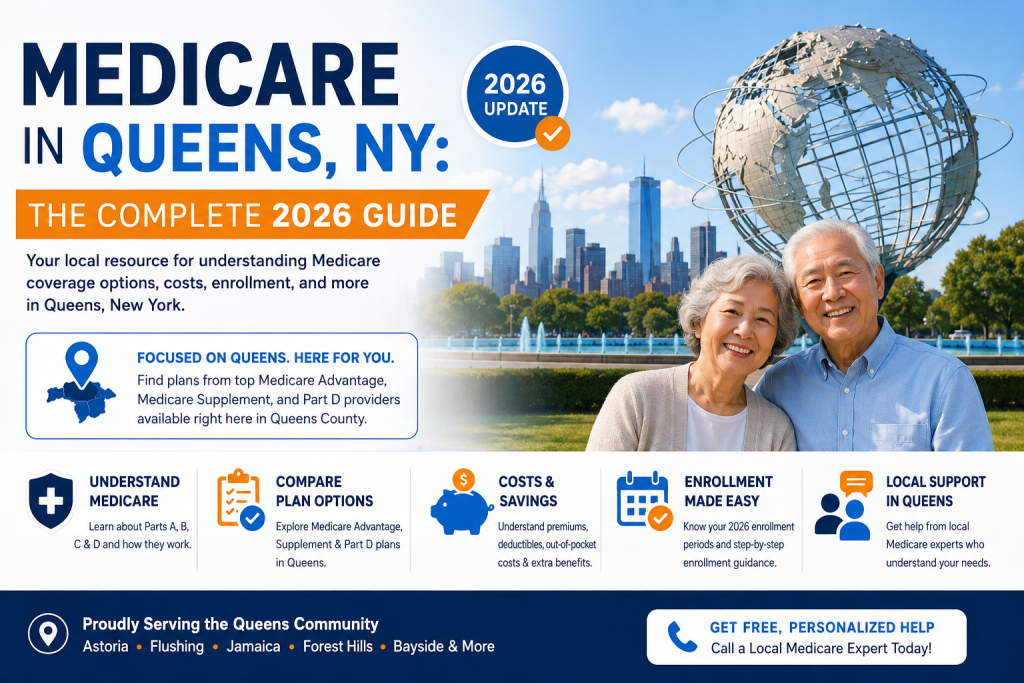
Medicare in Queens, NY: The Complete 2026 Guide
By Paul Barrett, CMIP | The Modern Medicare Agency | Melville, NY 18+ years Medicare-exclusive experience | Licensed in 37 states | 40+ carriers Last updated: July 2026
Queens is one of the largest and most diverse Medicare markets in the country — 37 traditional Medicare Advantage plans, real Medigap competition, and a genuinely complicated set of hospital systems (NewYork-Presbyterian Queens, Mount Sinai Queens, Elmhurst Hospital, Long Island Jewish, Jamaica Hospital, and more) that don’t all work with every plan the same way. This guide covers the whole picture in one place: every Medicare Advantage plan and price, real Medigap rates, what’s actually changing in 2026, and where you’re covered.
I’m independent — I represent more than 40 carriers, so nothing here is written to steer you toward one company or coverage type. It’s written so you understand the real landscape before you decide.
KEY TAKEAWAYS
- Queens County plans cover all of Queens — Astoria, Flushing, Jamaica, Elmhurst, Kew Gardens, and every other neighborhood in the borough draw from the exact same set of 37 Medicare Advantage plans. Medicare plan service areas are set by county, not by neighborhood or ZIP code.
- Queens has three coverage paths: Original Medicare (with or without a Medigap policy), Medicare Advantage (37 traditional plans in 2026, 20 of them $0-premium), or a Special Needs Plan if you qualify.
- PPO plans in Queens average a lower monthly premium than HMO plans — $22.99 versus $42.90 — the opposite of what most people assume walking in.
- Real Medigap Plan G rates in Queens range from $372.50/month (UnitedHealthcare/AARP) to $840.28/month (Bankers Conseco) for identical, federally standardized coverage.
- A live network situation is worth knowing about right now: UnitedHealthcare and NewYork-Presbyterian are in a contract dispute affecting NewYork-Presbyterian Queens, with coverage extended only through July 31, 2026. Separately, Mount Sinai’s primary care providers are not currently accepting new Healthfirst Medicare Advantage patients — relevant since Healthfirst is Queens’ largest Medicare Advantage carrier.
QUEENS COUNTY COVERAGE: ONE SET OF PLANS, EVERY NEIGHBORHOOD
Here’s a question I get constantly: “Are the plans different in Jamaica than they are in Flushing? Does Elmhurst have different options than Astoria?”
The answer is no. Medicare Advantage and Part D plan service areas are set at the county level, not by neighborhood or ZIP code. Queens is entirely within Queens County, so every plan available in this guide is available to residents throughout the borough, including:
Astoria, Long Island City, Sunnyside, Woodside, Jackson Heights, Corona, East Elmhurst, Elmhurst, Rego Park, Forest Hills, Maspeth, Middle Village, Ridgewood, Flushing, College Point, Whitestone, Bayside, Little Neck, Oakland Gardens, Fresh Meadows, Glen Oaks, Floral Park, Bellerose, Queens Village, Hollis, Cambria Heights, Saint Albans, Jamaica, Springfield Gardens, Rosedale, Kew Gardens, Richmond Hill, South Richmond Hill, Woodhaven, Ozone Park, South Ozone Park, Howard Beach, Far Rockaway, Arverne, Rockaway Park, and Breezy Point.
What does vary by neighborhood is which hospitals and doctors are practically convenient for you, and which of those providers happen to be in-network with the plan you’re considering. A Flushing resident and a Far Rockaway resident can enroll in the exact same Healthfirst or Aetna plan — but the Flushing resident’s realistic network might center on NewYork-Presbyterian Queens or Flushing Hospital, while the Far Rockaway resident’s centers on a different set of providers entirely. Same plan, same premium, same benefits — different practical experience depending on where you actually go for care. This is exactly why “what’s the best plan in Queens” is the wrong question; “what’s the best plan for my doctors, in my part of Queens” is the right one.
YOUR THREE MAIN COVERAGE PATHS
Original Medicare (Parts A and B) is the federal program itself — hospital insurance plus medical insurance. It’s accepted by the vast majority of doctors and hospitals nationwide, with no network to navigate. On its own, it doesn’t cap your annual out-of-pocket costs and doesn’t include prescription drug coverage, which is why most people on Original Medicare pair it with a Medigap policy and a standalone Part D plan.
Medicare Advantage (Part C) bundles your Part A, Part B, and usually Part D coverage through a private carrier, built around a network — HMO, PPO, or HMO-POS. Many Queens plans charge $0 or a low monthly premium. In exchange, your access is generally limited to the plan’s network, and your annual out-of-pocket costs vary depending on how much care you use, up to a yearly maximum.
Medigap (Medicare Supplement) works alongside Original Medicare, picking up most of the coinsurance, copays, and deductibles Original Medicare leaves you owing. You keep full access to any doctor nationwide who accepts Medicare, with no network and no referrals — for a real monthly premium. New York’s guaranteed-issue rule means you can generally apply for a Medigap policy year-round, not just during a single enrollment window, regardless of your health.
PART ONE: MEDICARE ADVANTAGE IN QUEENS
Queens has 37 traditional Medicare Advantage plans in 2026, with roughly 86,500 residents already enrolled — more total enrollment than Brooklyn, making Queens one of the largest Medicare Advantage markets in New York City.
MEDICARE ADVANTAGE: FAST FACTS
What You’re Looking At | The 2026 Number |
Total Medicare Advantage plans available | 37 traditional MA plans* |
Plans with a $0 monthly premium | 20 |
Average premium (across all plan types) | $29.91/month |
Average out-of-pocket maximum | $8,678/year |
Average Rx deductible (plans with drug coverage) | $531.94/year |
Plans rated 4 stars or higher | 10 (27%) |
Average CMS star rating | 3.57 |
Plan types available | HMO (12 plans), PPO (14 plans), HMO-POS (11 plans) |
Total Medicare Advantage enrollment in Queens | 86,500 |
*This 37-plan count reflects standard, non-Special-Needs Medicare Advantage plans. Special Needs Plans (D-SNP, C-SNP, I-SNP) are offered separately.
QUEENS BY PLAN TYPE: PPO BEATS HMO ON PRICE
HMO | PPO | HMO-POS | |
Total plans | 12 | 14 | 11 |
Beneficiaries enrolled | 38,630 | 33,712 | 14,158 |
Average monthly premium | $42.90 | $22.99 | $24.56 |
$0-premium plans available | 5 | 9 | 6 |
Average out-of-pocket maximum | $9,192 | $8,564 | $8,264 |
Plans without Part D coverage | 0 | 2 | 4 |
Most enrolled plan | Healthfirst 65 Plus Plan — 18,957 members | AARP Medicare Advantage from UHC NY-0012 — 11,218 members | AARP Medicare Advantage from UHC NY-0005 — 4,861 members |
If you’ve been told HMOs are the “budget option” and PPOs cost more, Queens’ real numbers say the opposite — PPO premiums average nearly half of HMO premiums here.
STAR RATINGS IN QUEENS
Rating Category | Number of Plans | Percent of Plans |
5 Stars | 2 | 5% |
4 Stars (includes 5 Stars) | 10 | 27% |
3 Stars | 27 | 73% |
Below 3 Stars | 0 | 0% |
Average Rating | 3.57 |
Several $0-premium plans in Queens carry only 3.0-star ratings, while some of the strongest-rated plans carry real monthly costs. “Lowest premium” and “best plan” are two different questions.
EVERY PPO PLAN IN QUEENS
Health Plan Name | Premium/Mo | MOOP | Rx Deductible |
Aetna Medicare Eagle Giveback | $0 | $9,250 | N/A |
Aetna Medicare Elite | $0 | $9,250 | $615 |
AARP Medicare Advantage from UHC NY-0012 | $0 | $8,900 | $600 |
HealthSpring True Choice | $0 | $6,800 | $250 |
Humana Direct Choice Giveback | $0 | $9,250 | $475 |
Humana USAA Honor Giveback | $0 | $4,950 | N/A |
HumanaChoice H5970-028 | $0 | $9,250 | $615 |
Wellcare Giveback Open | $0 | $9,250 | $615 |
Wellcare Simple Open | $0 | $9,250 | $615 |
Aetna Medicare Elite Extra | $44 | $9,250 | $615 |
Healthfirst Signature (PPO) | $55 | $9,250 | $615 |
Wellcare Assist Open | $59 | $9,250 | $530 |
Aetna Medicare Enhanced | $60 | $9,250 | $615 |
Aetna Medicare Enhanced Extra | $104 | $6,750 | $615 |
EVERY HMO PLAN IN QUEENS
Health Plan Name | Premium/Mo | MOOP | Rx Deductible |
Healthfirst 65 Plus Plan | $0 | $9,250 | $615 |
Healthfirst Signature (HMO) | $0 | $9,250 | $615 |
Aetna Medicare Signature Care | $0 | $9,250 | $615 |
Humana Gold Plus Giveback H3533-027 | $0 | $9,250 | $615 |
Humana Gold Plus H3533-033 | $0 | $8,550 | $615 |
Humana Gold Plus H3533-035 | $22 | $9,250 | $615 |
Healthfirst Increased Benefits Plan | $24 | $9,250 | $615 |
VNS Health EasyCare | $25 | $9,250 | $500 |
MetroPlus Platinum Plan | $59 | $9,250 | $615 |
VillageCareMAX Medicare Select Advantage Plan | $59 | $9,250 | $615 |
Aetna Medicare Enhanced (HMO) | $74 | $9,250 | $615 |
EmblemHealth VIP Gold Plus | $252 | $9,250 | $200 |
EVERY HMO-POS PLAN IN QUEENS
Health Plan Name | Premium/Mo | MOOP | Rx Deductible |
Anthem Veteran 2 | $0 | $6,800 | N/A |
Anthem Veteran | $0 | $6,800 | N/A |
AARP Medicare Advantage Patriot No Rx NY-MA3 | $0 | $6,700 | N/A |
Wellcare Fidelis Patriot Simple | $0 | $9,250 | N/A |
Wellcare Simple | $0 | $9,250 | $615 |
Elderplan Flex | $0 | $7,550 | $375 |
Anthem Medicare Advantage 2 | $34 | $9,250 | $240 |
Anthem Medicare Advantage | $44 | $9,250 | $150 |
Wellcare Assist | $51 | $9,250 | $590 |
Elderplan Extra Help | $59 | $7,550 | $375 |
AARP Medicare Advantage from UHC NY-0005 | $82 | $9,250 | $520 |
WHO OFFERS MEDICARE ADVANTAGE IN QUEENS
- Healthfirst — A New York-based, not-for-profit plan with a dominant local presence. Its 65 Plus Plan alone covers nearly 22% of all Queens Medicare Advantage enrollment.
- Aetna and UnitedHealthcare (AARP) — The two largest national carriers by enrollment in Queens, both offering multiple $0-premium PPO options.
- Humana — Offers several Giveback-style plans (including a Part B premium reduction) across both HMO and PPO categories.
- MetroPlus Health Plan — Affiliated with NYC Health + Hospitals, relevant if you already receive care through Elmhurst Hospital or another public hospital in Queens.
- Elderplan and VNS Health — Both NYC-focused carriers with plans designed for people who qualify for both Medicare and Medicaid.
PART TWO: MEDIGAP IN QUEENS
If you’d rather see any doctor nationwide who accepts Medicare, without worrying about networks, referrals, or whether your hospital is still in-network next year, Medigap is worth serious consideration — and New York offers some of the strongest consumer protections for it in the country.
THE BIGGEST ADVANTAGE NEW YORK GIVES YOU: GUARANTEED ISSUE, YEAR-ROUND
In most states, you get one guaranteed window to buy a Medigap policy without medical underwriting — the 6 months starting when you’re 65 and enrolled in Part B. Miss it, and insurers can review your health history, charge you more, or deny you outright.
New York does it differently. State law requires community-rated, guaranteed-issue Medigap coverage on a continuous, year-round basis — meaning you generally cannot be denied a policy or charged more due to your health, regardless of when you apply.
HOW MEDIGAP WORKS, IN PLAIN ENGLISH
Medigap plans are sold by private insurers but standardized by the federal government — a Plan G from one carrier covers the exact same benefits as a Plan G from another. The only real differences between carriers are price, customer service, and financial stability. Medigap works alongside Original Medicare, picking up costs like coinsurance, copays, and deductibles that Original Medicare leaves you responsible for. It does not include prescription drug coverage — you’ll need a separate Part D plan — and it doesn’t include dental, vision, or hearing.
REAL 2026 MEDIGAP RATES FOR QUEENS
Queens falls within New York’s “NYC Proper” rating region — the same DFS-defined region as Brooklyn, Manhattan, the Bronx, and Staten Island. These rates come directly from the New York Department of Financial Services’ official June 2026 rate filing and apply equally across all five boroughs.
Plan G (most comprehensive option for new enrollees):
Carrier | Monthly Premium |
UnitedHealthcare (AARP Program) | $372.50 |
Aetna Life Insurance | $406.26 |
EmblemHealth | $432.09 |
Globe Life Insurance | $461.00 – $516.00 |
Mutual of Omaha | $511.36 |
Transamerica Financial | $444.83 |
Humana | $647.27 |
Bankers Conseco | $840.28 |
High Deductible Plan G (same coverage, higher deductible, lower premium):
Carrier | Monthly Premium |
EmblemHealth | $67.69 |
Globe Life Insurance | $91.00 – $102.00 |
Humana | $111.19 |
Plan N (lower premium, small copays):
Carrier | Monthly Premium |
UnitedHealthcare (AARP Program) | $299.00 |
EmblemHealth | $314.77 |
Transamerica Financial | $417.31 |
Humana | $458.83 |
Globe Life Insurance | $450.00 – $504.00 |
Bankers Conseco | $523.54 |
A pattern worth noticing immediately: on Plan G alone, the gap between the cheapest carrier (UnitedHealthcare at $372.50) and the most expensive (Bankers Conseco at $840.28) is more than double — for identical, federally standardized coverage. This is exactly why comparing carriers matters as much as comparing plan letters. Plan G covers everything except the Part B deductible ($283 in 2026); Plan N covers the same core benefits but adds small copays (up to $20 for office visits, up to $50 for ER visits that don’t result in admission) in exchange for a typically lower premium.
MEDICARE ADVANTAGE VS. MEDIGAP: THE CORE TRADE-OFF
Feature | Medicare Advantage | Medigap |
Provider access | Usually limited to a network | Any doctor nationwide who accepts Medicare |
Monthly premium | Often $0-$60 in Queens | $299-$840+ depending on plan letter and carrier |
Cost predictability | Varies by how much care you use, up to a max | Highly predictable |
Drug coverage | Usually included | Requires a separate Part D plan |
Network risk | Real — see current developments below | None |
If you’ve been following the UnitedHealthcare/NewYork-Presbyterian situation or the Mount Sinai/Healthfirst detail below, this table shows exactly why Medigap appeals to people who want to remove that kind of network risk entirely.
WHAT’S ACTUALLY CHANGING IN QUEENS FOR 2026
UnitedHealthcare and NewYork-Presbyterian. These two are in an active contract dispute. In-network access for most UnitedHealthcare Medicare Advantage members has been extended only through July 31, 2026, and NewYork-Presbyterian Queens and its Queens Medical Group practices are explicitly named among the facilities that would go out-of-network if no new agreement is reached. If that happens, affected members could see this qualify them for a Special Enrollment Period.
Mount Sinai and Healthfirst. Separately, Mount Sinai’s own published 2026 participation list states that its primary care providers are not currently accepting new Healthfirst Medicare Advantage patients. This matters more in Queens than elsewhere, since Healthfirst’s 65 Plus Plan is Queens’ single most-enrolled Medicare Advantage plan.
New rules for dual-eligible (D-SNP) members. As of January 1, 2026, CMS ended the federal program that automatically extended healthy food and home utility benefits to every D-SNP member nationwide. Using an OTC-style card for groceries or utilities now requires separately qualifying for a program called SSBCI, which means a doctor needs to confirm you have an eligible chronic condition.
Statewide plan scaling. UnitedHealthcare, Humana, and Aetna have all reduced the number of states and counties they serve for 2026 as they focus on profitability — a trend worth watching each Annual Enrollment Period.
Federal scrutiny over AI-driven denials. In July 2026, Senators Richard Blumenthal (D-CT) and Josh Hawley (R-MO) sent letters to UnitedHealthcare, Humana, and CVS Health (Aetna’s parent) demanding records on their use of artificial intelligence to deny or delay prior authorization requests for rehabilitative and post-acute care, following a federal Office of Inspector General report finding those three insurers denied post-hospital care requests 51% to 80% of the time — notably higher than other insurers.
SPECIAL NEEDS PLANS IN QUEENS
If you qualify for both Medicare and Medicaid, manage a qualifying chronic condition, or live in (or need the level of care of) a long-term care facility, a Special Needs Plan is worth a dedicated look. Healthfirst’s Life Improvement Plan is the dominant D-SNP carrier across New York City’s boroughs, and Queens’ large, diverse population means SNP eligibility and enrollment patterns here are genuinely significant — this deserves its own full breakdown, which we’ll cover in a dedicated Queens Special Needs Plans guide.
WHEN TO ENROLL
Enrolling for the first time: Your Initial Enrollment Period runs 7 months — 3 months before your 65th birthday month, your birthday month, and 3 months after. Missing this window means waiting for the General Enrollment Period (January 1 – March 31), likely with penalties.
Changing Medicare Advantage plans: The Annual Enrollment Period runs October 15 – December 7 each year. There’s also a Medicare Advantage Open Enrollment Period from January 1 – March 31, when you can switch to a different Medicare Advantage plan or move back to Original Medicare.
Enrolling in or switching Medigap: Thanks to New York’s guaranteed-issue rule, you’re not limited to a single enrollment window the way most states require.
Special situations: Moving, losing coverage, or a network change like the UnitedHealthcare/NewYork-Presbyterian situation above can all qualify you for a Special Enrollment Period outside the normal windows.
PAUL’S HONEST TAKE
Queens is a genuinely strong Medicare market — real plan choice on both the Medicare Advantage and Medigap side, real carrier competition, and enough $0-premium options that cost alone rarely has to be the deciding factor. But “lots of options” isn’t the same as “easy decision,” and it doesn’t matter which neighborhood you’re in — Astoria, Jamaica, Flushing, or Far Rockaway all draw from the same 37 plans, so the decision comes down to your specific doctors and hospital, not your ZIP code. Between the UnitedHealthcare/NewYork-Presbyterian situation, the Mount Sinai/Healthfirst detail, and the real spread in Medigap pricing, there’s more happening in Queens’ Medicare landscape this year than a plan comparison chart alone will show you. My honest recommendation: don’t pick a plan based on premium or a commercial you saw — pick it based on your specific doctors, your specific hospital, and your specific prescriptions, checked against what’s actually happening in the network right now.
FREQUENTLY ASKED QUESTIONS
No. Medicare Advantage and Part D plans are approved at the county level, and all of Queens is one county. The exact same 37 Medicare Advantage plans are available whether you live in Jamaica, Flushing, Astoria, Elmhurst, or anywhere else in Queens. What varies is which hospitals and doctors are practically convenient to you, and whether they’re in-network with the plan you choose.
Medicare Advantage often costs less monthly and includes extra benefits, but ties you to a network — a real consideration given the current UnitedHealthcare/NewYork-Presbyterian situation and the Mount Sinai/Healthfirst detail. Medigap costs more monthly but removes network risk entirely, and New York’s guaranteed-issue rule makes it more accessible here than in most states.
20 of the 37 standard plans have a $0 monthly premium. Across all plan types, the average premium is $29.91/month, though PPO plans average $22.99/month while HMO plans average $42.90/month.
Based on New York’s official June 2026 rate filing for the NYC Proper region, Plan G premiums range from $372.50/month with UnitedHealthcare to $840.28/month with Bankers Conseco, depending on carrier.
If no new agreement is reached by July 31, 2026, NewYork-Presbyterian Queens and its Queens Medical Group practices become out-of-network for most UnitedHealthcare Medicare Advantage members starting August 1, 2026. This can qualify affected members for a Special Enrollment Period.
Possibly. As of January 1, 2026, a federal CMS rule ended automatic food and utility benefits for all D-SNP members nationwide. You now need to separately qualify with a documented chronic condition through a process called SSBCI. Confirm your specific qualification status directly with your carrier.
Want a real answer for your specific doctors, prescriptions, and hospital — not a generic recommendation?
Call or text 631-358-5793. No pressure, no cost, just a real answer based on your situation.
RELATED READING
- Medicare Advantage Plans in Queens, NY: The Complete 2026 Guide
- Medicare in Brooklyn, NY: The Complete 2026 Guide (Pillar Page)
- HMO vs. PPO Medicare Advantage in Brooklyn, NY: The Real 2026 Numbers
- Medicare Advantage vs. Medigap in Brooklyn, NY: The Real 2026 Cost Comparison
- Medicare Supplement (Medigap) Plans in Brooklyn, NY: The Complete 2026 Guide
- Special Needs Plans (D-SNP, C-SNP, I-SNP) in Brooklyn, NY: The Complete 2026 Guide
- Medicare Supplement Plan G: Complete 2026 Guide for New Medicare Enrollees
SOURCES
- Medicare.gov Plan Finder
- Medicare.org — Medicare Advantage Plans in Queens County, NY
- CMS.gov — Medicare Advantage State/County Penetration Data
- New York State Department of Financial Services — Medicare Supplement Insurance Rate Plans (June 2026)
- NewYork-Presbyterian — UnitedHealthcare In-Network Coverage Changes (updated June 29, 2026)
- Mount Sinai — Medicare-Participating Medicare Advantage Plans (updated 12/31/2025)
- Healthfirst — Changes to Medicare in 2026 (D-SNP/OTC benefit rules)
- STAT News — Medicare Advantage insurers face new bipartisan scrutiny over AI and care denials (July 2026)