




Medigap rating methods are the three ways an insurer is allowed to set your premium: community-rated, issue-age-rated and attained-age-rated. The method decides whether your age pushes the price up after you buy. Benefits for a given lettered plan are the same from every insurer, so the pricing method and the rate are what separate one policy from another. This guide explains each method with the federal example figures, shows which states restrict them, and gives you the questions to ask before you sign.
TL;DR
- Every Medigap policy is priced one of three ways: community-rated, issue-age-rated or attained-age-rated.
- Community-rated and issue-age-rated premiums are not raised because you get older. Attained-age premiums rise as you do.
- Your state decides which methods are allowed, so the same plan letter can be priced differently depending on where you live.
- The cheapest first-year quote is not always the cheapest over ten or twenty years. Ask for rates at older ages before you decide.
- “Rating method” is a pricing term. It is not a star rating of an insurer.
Table of Contents
- Rating method versus a rating of an insurer
- The three rating methods at a glance
- Community-rated pricing
- Issue-age-rated pricing
- Attained-age-rated pricing
- Which methods your state allows
- What else changes a Medigap premium
- Worked example: choosing between methods
- Questions to ask before you sign
- Our perspective
- See your options side by side
- FAQ
- Sources
Rating method versus a rating of an insurer
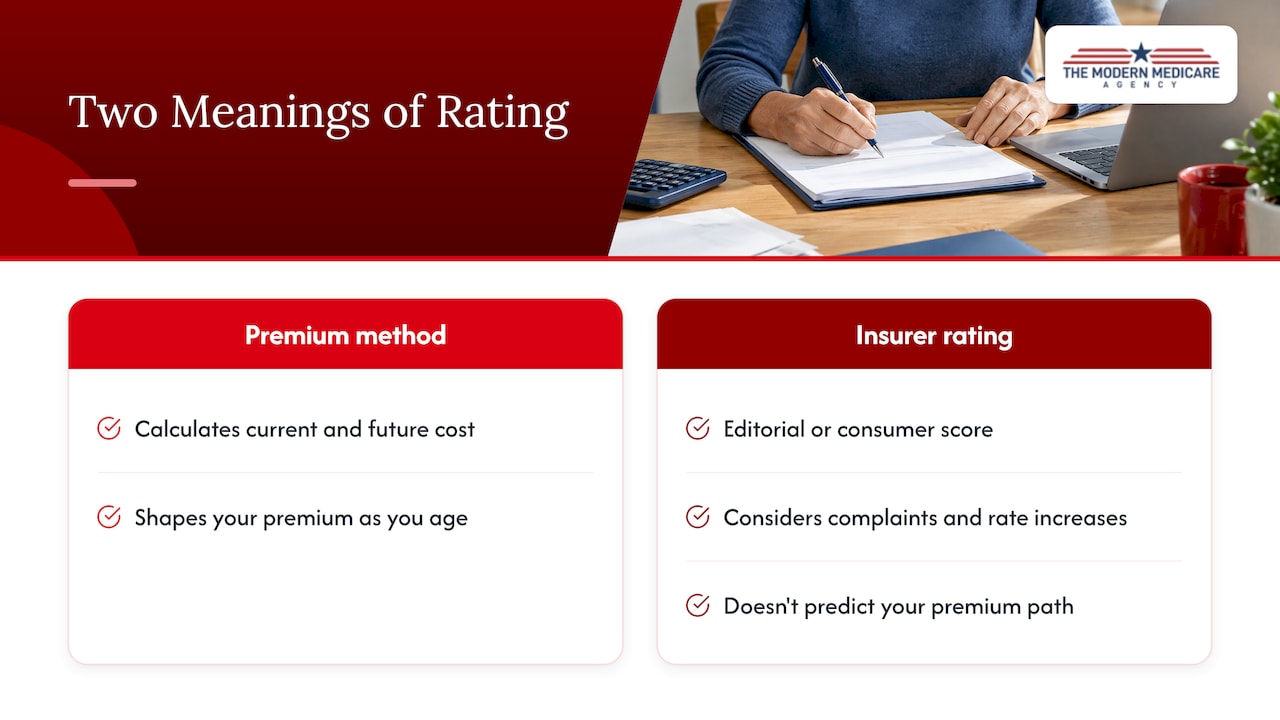
The phrase causes confusion because it can mean two different things.
A premium rating method is how the company calculates what you pay now and what you may pay later. Medicare’s official guide says each Medigap policy is priced in one of three ways, and that the method affects your cost today and in the future (Medicare.gov, Choosing a Medigap Policy).
An insurer rating is an editorial or consumer score. Review sites generally build these from things like complaint records, how often rates have gone up and how a company handles claims. Those scores say something about the company. They tell you nothing about how your own premium will behave as you age. Two highly rated insurers can use completely different rating methods, and a lower-rated one may use the method that suits you better.
So if you searched for the “highest rated Medigap insurance,” start with the pricing method, then look at the company. The method is the part that shapes your budget year after year.
One more fact makes this simpler. For a given lettered plan, such as Plan G, benefits are standardized, so the policy difference is price (Medicare.gov). That is why the way price is built matters so much.
The three rating methods at a glance
| Method | Also called | What sets your premium | Does aging raise it? | Typical pattern |
|---|---|---|---|---|
| Community-rated | No-age-rated | The same rate for everyone on the policy, regardless of age | No | Steady starting price, can rise with inflation and other factors |
| Issue-age-rated | Entry-age-rated | Your age on the day you buy | No | Lower if you buy younger, locked to your entry age |
| Attained-age-rated | None | Your age this year | Yes | Lowest at first, can become the highest later |
The federal example below puts numbers on this. All figures come from the CMS guide.
| Age | Community-rated | Issue-age-rated | Attained-age-rated |
|---|---|---|---|
| 65 | $165/month | $145/month | $120/month |
| 66 | $165/month | $145/month | $126/month |
| 67 | $165/month | $145/month | $132/month |
| 72 (buying at 72) | $165/month | $175/month | Higher than at 65 |
The attained-age figures for ages 65 to 67 and the 72-year-old comparison are illustrative figures from CMS, not quotes. The point they make is that the attained-age buyer starts lowest and then climbs every year.
Community-rated pricing
With community rating, the same premium is generally charged to everyone who holds the same policy, regardless of age. In the CMS example, a 65-year-old and a 72-year-old both pay $165 a month. Premiums can still go up because of inflation and other factors, but not because you have another birthday (KFF).
Who it suits: people who want the most predictable curve over a long retirement, and people who buy at an older age, since they are not charged more for it.
Watch for: a community-rated policy often starts higher than an attained-age quote for a 65-year-old. That gap is the price of not having age built into the rate. Some states also let insurers vary community-rated premiums by smoking status or residential area, so “same for everyone” is not always literal.
Issue-age-rated pricing
Issue-age rating, also called entry-age rating, sets your premium by the age you were when you bought the policy. Buy younger and the premium is lower. It does not rise because you get older, though it can rise for inflation and other factors (Medicare.gov). The Kansas Department of Insurance describes it the same way: your premium is always based on the age you were when you purchased, but it can be adjusted for other factors (Kansas Medicare Supplement Shopper’s Guide).
In practice, this means the day you enroll is the age that gets locked in. Someone who enrolls at 65 is locked in at the 65 rate. Someone who waits until 72 is locked in at the 72 rate. That is one reason the timing of your first Medigap purchase matters, and why our guide on guaranteed issue rights for Medigap is worth reading before you choose a date.
Who it suits: new Medicare enrollees who want a lower starting price than community rating without the yearly age step of attained-age rating.
Attained-age-rated pricing
Attained-age rating bases your premium on your current age, so it goes up as you get older. Federal guidance notes it may be the least expensive at first and can eventually become the most expensive (Medicare.gov). Kansas notes that if you buy at 65 under an attained-age policy, you may see a premium increase each year (Kansas Department of Insurance).
The California Department of Insurance explains that these policies are usually less expensive in the first year, but premiums increase automatically as you enter new age brackets. Add inflation and medical cost increases, and the result can be exceptionally steep increases at older ages. California law also requires a notice on each policy disclosing automatic age-based increases (California Department of Insurance).
Attained-age is also the most common method. One summary of federal data puts it at roughly 69 percent of Medigap plans (LegalClarity, citing ASPE). That means a lot of the quotes you see online will be attained-age quotes, with the lowest entry prices.
Who it suits: buyers who plan to hold coverage for a limited time, or who have confirmed that the projected premiums at 75, 80 and beyond still fit their budget.
Why the cheapest quote can mislead
An attained-age Plan G can look especially attractive to a younger buyer, because she is priced at her current age. As years pass, age becomes another force pushing the premium up, and an issue-age policy that starts higher can narrow the gap. No method is automatically cheapest over a lifetime, because future carrier-wide increases cannot be known. What the method does tell you is whether aging itself is built into the rate path (24/7 Wall St.).
For a deeper walk through that tradeoff, see our explainer on attained-age, issue-age and community rating.
Which methods your state allows
Medicare is federal, but Medigap policies are insurance products regulated by the states. States set certain rules, including how premiums are set (KFF). According to KFF’s October 2026 analysis:
- 37 states and D.C. allow any rating system.
- Nine states (Arkansas, Connecticut, Idaho, Massachusetts, Maine, Minnesota, New York, Vermont and Washington) require community rating for policyholders 65 and older.
- Four states (Arizona, Florida, Georgia and Missouri) permit issue-age rating but prohibit attained-age rating.
Some examples show how different the local picture can be:
- Idaho: Medigap policies sold after March 1, 2022 are community-rated. Premiums can rise for inflation or the pool’s healthcare costs, not because you get older. Rates for women and men must be the same, and smokers and non-smokers can be charged differently (Idaho Department of Insurance).
- Washington: Premiums must be equal for all policyholders under a standardized plan, with exceptions for things like spousal discounts, payment frequency and method, and two pools that separate Medicare eligibility by age from eligibility by disability or end-stage renal disease (Washington SHIBA workbook).
- Nebraska: The majority of plans are attained-age rated. In 2025, a Plan G at age 65 ranged from $94 to $680 a month, and a high-deductible Plan G from $32 to $97 (Nebraska Department of Insurance).
That Nebraska spread is a reminder of how much room there is between carriers in a single state. The range alone is a reason to compare several quotes.
In states that allow a mix, policyholders may be able to choose which rating type applies, though insurers might not offer every type (KFF). Ask for each option that is available where you live.
What else changes a Medigap premium
The rating method is the biggest long-term lever, but not the only one. Medicare’s guide lists other things that can affect cost: whether the company offers discounts (for women, non-smokers, married people, paying yearly, electronic funds transfer or holding multiple policies), whether it uses medical underwriting, whether it sells Medicare SELECT policies that may require you to use certain providers, and whether it offers a high-deductible option for Plans F or G. For 2026, the high-deductible option means paying the first $2,950 in deductibles, copayments and coinsurance before the policy pays, plus a separate $250 deductible for foreign travel emergency care (Medicare.gov).
Our page on what factors affect Medicare Supplement premiums covers these in more detail, and the underwriting questions to expect explain when health answers can change your offer.
How rate increases are approved
Premiums do not rise at will. In Indiana, for example, the Department of Insurance must approve premium rates for all Medicare Supplement policies, and increases are approved based on a loss ratio, meaning the company must show actuarially that it would take a loss without the increase (Indiana SHIP). Rules differ by state, so your own state’s insurance department is the place to confirm the process where you live.
Increases also do not all happen in January. A new rate can start on a policy anniversary, after a birthday, or on another date allowed by the carrier’s state filing (24/7 Wall St.). If you want to see how this plays out, our guide on why Medicare Supplement premiums rise walks through the causes.
Worked example: choosing between methods
Using the CMS figures, picture a buyer at 65. The attained-age policy costs $120 a month, issue-age $145 and community-rated $165. Attained-age looks like a $45 monthly saving over community rating. But that saving shrinks every year as the attained-age premium steps up by age, while the other two do not step up for age. Eventually the lines can cross.
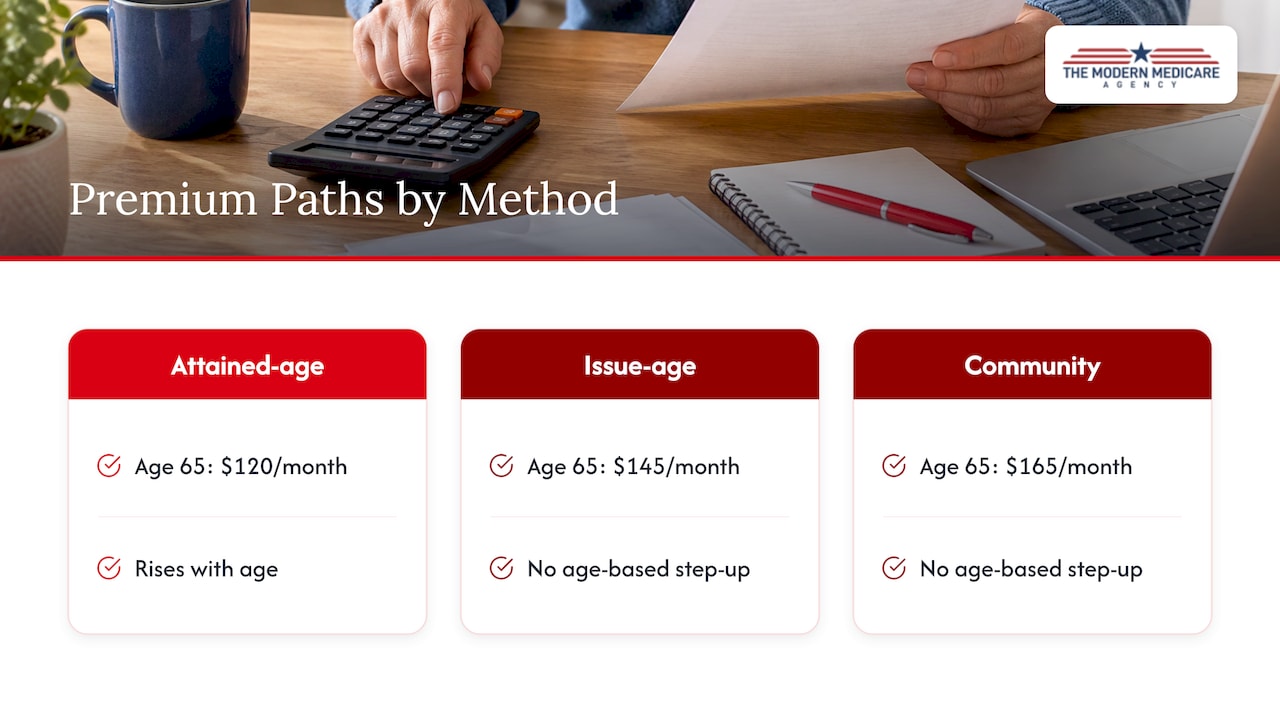
Where they cross depends on the carrier’s age bands and its future rate increases, and neither can be known today. That is why the right question is not “which is cheapest now?” but “what does this policy cost at 70, 75 and 80, and can I carry that?”
A buyer who plans to keep the policy for life, and who has a fixed retirement income, may prefer the flatter curve of community or issue-age rating. A buyer who has a short horizon, or who has a clear plan for reviewing coverage regularly, may be comfortable with attained-age. Either can be a sound choice when it is made with the full picture.
If you are still working or on retiree coverage and planning ahead, this retiree health insurance before Medicare resource can help you think through the years before your Medigap decision.
Questions to ask before you sign
Medicare’s guide gives the central question to put to any insurer: do you price this policy using community rating, issue-age rating or attained-age rating? Then ask: “I’m _ years old. What would my premium be under this policy?” For an attained-age policy, also ask how often the premium increases due to age and whether it increased in the last three years due to inflation or other reasons (Medicare.gov).
A short checklist for any quote:
- Get the rating method in writing.
- For attained-age coverage, request the current rates at several older ages, so you can see how much of the curve comes from age.
- Check your state’s switching protections before assuming you can replace the policy later if the premium climbs (24/7 Wall St.).
- Compare the same plan letter across carriers, since benefits are identical and price is the difference.
- Ask about discounts you qualify for, such as household, payment method or non-smoker rates.
If you want to compare the most popular plans side by side, see Plan G vs Plan N, or our look at Plan G cost in 2026.
Our perspective
We built our practice on education first, because it is hard to make a good choice when you do not understand your options. Medigap pricing is the clearest example. Two people can buy the same Plan G, with the same benefits, and live very different premium stories ten years later, simply because of how the rate was built.
Since 2007, we have seen the same pattern: the lowest number on the first quote gets the attention, and the rating method gets a footnote. We want that reversed. As independent agents with access to 40+ carriers, we can lay out the community, issue-age and attained-age options available in your state side by side, so you choose with the long view in front of you.
Our approach is simple. We ask about your budget, your health and how long you expect to keep the policy. Then we show you what each option may look like at 65, at 75 and beyond. No pressure, just a clear picture, and an annual coverage checkup so your plan keeps fitting your life.
Paul
See your options side by side
If you are turning 65, leaving employer coverage or unhappy with your current plan, we can pull quotes from multiple carriers and show you each one’s rating method and projected premium path. Start with our Medicare Supplement (Medigap) plans page, or contact us through Paul B Insurance for a personalized plan review.

Our reviews are built around education first, and they continue year-round, not just on enrollment day.
FAQ
How are Medigap plans rated?
There are two meanings. Premiums are “rated” by one of three methods: community, issue-age or attained-age. Separately, review sites score insurers on factors such as complaints and rate history. The pricing method is the one that determines how your own premium behaves over time.
Which Medigap rating method is best?
None wins for everyone. Community-rated and issue-age-rated premiums are not raised for age, while attained-age usually starts lowest but rises with each birthday. The best fit depends on how long you will keep the policy, your budget and which methods your state allows.
Can I choose my rating method?
In some states, yes. Depending on state rules, insurers may apply a mix of rating systems and policyholders can choose which type applies, though insurers may not offer every type (KFF). In states that require community rating, there is only one method.
Will my Medigap premium go up even with community rating?
It can. Community-rated premiums may rise for inflation and other factors, but not because of your age. Increases are filed with and, in many states, approved by the state insurance department, so your state’s regulator can tell you how it works locally.
Sources
- Choosing a Medigap Policy (Medicare.gov)
- Key Facts About Medigap Enrollment and Premiums for Medicare Beneficiaries (KFF)
- Medicare Supplement Shopper’s Guide (Kansas Department of Insurance)
- Long Term Care and Medicare Supplement Rating Methodology (California Department of Insurance)
- Medicare Supplement Plan G in Ohio: Premiums and Coverage (LegalClarity)
- Medigap Plan G is identical by law (24/7 Wall St.)
- Your Medigap Premium Went Up Again (24/7 Wall St.)
- Shopper’s Guide to Medicare (Idaho Department of Insurance)
- SHIBA Medicare Supplement Insurance (Medigap) workbook (Washington)
- Medicare Supplement Fact Sheet (Nebraska Department of Insurance)
- SHIP: Medicare Supplement Plans (Indiana Department of Insurance)
Recommended
- Attained Age vs. Issue Age vs. Community Rating: Why Medigap Pricing Matters
- Medicare Supplement Rate Increases by Company in 2026: Who Raised Rates the Most?
- What Factors Affect Medicare Supplement Premiums: Understanding Key Influences
- Why Medicare Supplement Premiums Increase And What You Can Do (2026)