
The new $2,100 out-of-pocket cap for 2026 is designed to protect your wallet, but it has also made choosing a drug plan feel more like a high-stakes math puzzle than a simple choice. If you are wondering how to find the best part d plan for my prescriptions, you are likely feeling the weight of these new regulations and the fear that your essential medications might be dropped from coverage. It’s completely natural to feel frustrated by complex jargon when all you want is the security of knowing your health is protected.
I understand that stress, and I want to help you replace that anxiety with total confidence. You can secure the lowest costs for your specific medications through a simple, guided process that cuts through the noise. This article provides a clear, step-by-step path to compare your 2026 options and take advantage of the new negotiated prices on common drugs like Eliquis and Jardiance. We will walk through exactly how to navigate the upcoming enrollment period so you can move from a state of uncertainty to one of absolute certainty.
Key Takeaways
- Learn how the new $2,100 out-of-pocket cap for 2026 changes your strategy and why sticking with your 2025 plan might lead to higher costs.
- Discover a simple five-step process for how to find the best part d plan for my prescriptions by organizing your medication list and comparing pharmacy options.
- Understand why a plan’s drug list and tier structure are more important for your savings than just looking at the lowest monthly premium.
- Avoid the “auto-renewal” trap and other common pitfalls that can leave you with unexpected bills or missing coverage for your essential medications.
- See how an independent broker can compare over 40 different carriers to provide you with an unbiased, personalized analysis of your lowest total costs.
Understanding the 2026 Medicare Part D Landscape
The year 2026 brings some of the most significant changes we’ve seen since the Medicare Part D program began. For years, the system felt like it was designed to be confusing, with different phases and shifting costs that were hard to track. Now, new laws are finally putting a hard limit on what you have to spend. While these changes are mostly good news, they mean your current plan might look very different next year. If you’re searching for how to find the best part d plan for my prescriptions, you need to look past the monthly premium and focus on how these new rules affect your specific medicine cabinet.
The biggest headline is the new out-of-pocket spending limit. In previous years, there was technically no limit to how much you could spend if you needed very expensive specialty drugs. That’s changing. For 2026, once you hit a certain amount, your plan takes over the rest. This creates a safety net that simply didn’t exist before. However, because insurance companies are now responsible for more of these costs, they are changing how they categorize certain medications to protect their own bottom lines. It’s a trade-off that requires a bit more attention during your search.
The End of the Donut Hole
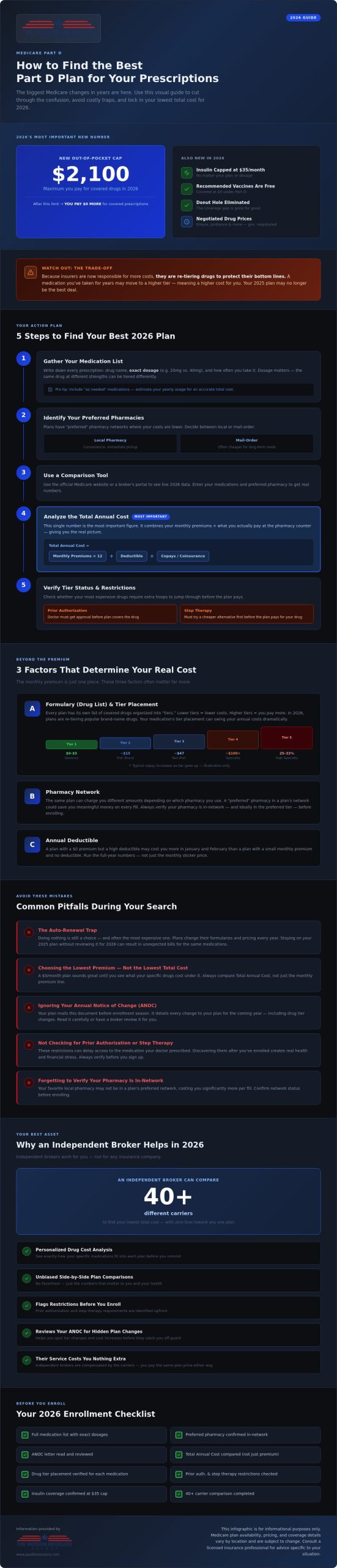
Many seniors remember the “donut hole” as a period of high anxiety. It was that middle phase where you suddenly had to pay a much higher percentage for your pills until you reached a certain threshold. In 2026, that gap is officially a thing of the past. This makes it much easier to plan your monthly budget because your costs will be more predictable throughout the year. The $2,100 out-of-pocket limit is the maximum a senior will pay for covered drugs in 2026. Once you reach that number, you won’t pay a penny more for covered prescriptions for the rest of the year.
Formulary Shifts You Need to Watch
Because the government is now negotiating prices for popular drugs like Eliquis and Jardiance, insurance carriers are getting more selective. They might move a drug you’ve taken for years to a “higher tier,” which means a higher cost for you. This is why you must read your Annual Notice of Change (ANOC) carefully when it arrives in the mail. You should also know that the Inflation Reduction Act has already made life easier for many by capping insulin at $35 a month and making most recommended vaccines free. These are great wins for your health. However, they require you to be more diligent during the Medicare Part D enrollment period to ensure your specific pharmacy and medications are still part of the best deal available to you.
5 Steps to Find the Best Part D Plan for Your Prescriptions
Finding a plan shouldn’t feel like a guessing game. It’s about having a clear strategy. If you’re wondering how to find the best part d plan for my prescriptions, following these five steps will help you move from confusion to clarity. This structured approach ensures you don’t miss the small details that often lead to big expenses later in the year.
- Step 1: Gather your current medication list. Write down every prescription you take. Include the exact dosage (like 20mg or 40mg) and how often you take it.
- Step 2: Identify your preferred pharmacies. Some plans have “preferred” networks where costs are lower. Decide if you prefer a local corner store or the convenience of mail-order.
- Step 3: Use a comparison tool. You can use the official Medicare website or a broker’s portal to see live 2026 data.
- Step 4: Analyze the “Total Annual Cost.” This is the most important number. It combines your monthly premiums with what you’ll actually pay at the pharmacy counter.
- Step 5: Verify tier status and restrictions. Check if your most expensive drugs require “prior authorization” or “step therapy” before the plan will pay for them.
Organizing Your Prescription Data
Exact dosages are vital. A plan might cover a 20mg tablet at a low cost but charge much more for a 40mg version of the same drug. This happens because of how tiers are assigned. Generics are almost always cheaper, but for brand-name drugs, the cost-sharing can vary wildly between plans. If you take medications “as needed,” like for migraines or allergies, estimate your yearly usage so the system can calculate an accurate total cost. If this feels like a lot to manage, you can always request a personalized drug cost analysis to see exactly how your meds fit into each plan.
Using the Comparison Tools Effectively
Start by entering your zip code. Plan availability changes based on where you live. When the results appear, filter them by “lowest total out-of-pocket cost” rather than just the lowest premium. A $0 premium plan might actually be the most expensive option if it doesn’t cover your specific medications well. Also, pay attention to star ratings. These ratings reflect how other members feel about the plan’s customer service and pharmacy access. Knowing how to find the best part d plan for my prescriptions means looking at the data, but it also means choosing a company that treats you with respect when you call for help.
Beyond the Premium: The 3 Factors That Determine Your Real Cost
Many people pick a plan based on the monthly premium. It is the easiest number to see. However, that number is often the least important part of the equation. If you want to know how to find the best part d plan for my prescriptions, you have to look at what happens when you actually hand your insurance card to the pharmacist. Your real cost is the sum of your premiums, your annual deductible, and your copays at the counter. Focusing only on a low premium is a common mistake that can lead to high bills later in the year.
The first factor is the drug formulary. This is simply the list of drugs a plan agrees to cover. If your specific medication isn’t on that list, you might be responsible for the full retail price. Before you enroll, you should use Medicare’s official Plan Finder tool to ensure every one of your medications is included. Even if a drug is covered, you must check for “utilization management” rules. These are hurdles like prior authorization, where your doctor must prove the drug is necessary, or step therapy, where you have to try a cheaper drug before the plan pays for the expensive one.
Decoding the Tier System
Plans group drugs into tiers to determine your cost-sharing. Tiers 1 and 2 usually consist of preferred generics. These are your best friends because they often have very low or even $0 copays. Tiers 3 and 4 include brand-name and specialty drugs. These medications are much more expensive and usually require you to pay a percentage of the cost rather than a flat fee. If a necessary drug is placed in a high tier, don’t lose hope. You can work with your doctor to ask the insurance company for a “tiering exception,” which could lower your out-of-pocket cost if the drug is medically necessary.
The Power of Preferred Pharmacies
Where you buy your medicine matters as much as what you buy. Most plans have a network of “preferred” pharmacies where they’ve negotiated lower prices. If you use a pharmacy that is “standard” or “out-of-network,” you will likely pay significantly more for the exact same pill. You should also consider the benefits of 90-day mail-order supplies. Many carriers offer deep discounts for mail-order because it saves them money on processing. You can learn more about Medicare Part D basics to see how choosing the right pharmacy network can save you hundreds of dollars over the course of 2026.
Common Pitfalls to Avoid During Your Search
Searching for insurance can feel like walking through a minefield. You are bombarded with TV ads promising extra benefits and lower costs, but these commercials don’t know what is in your medicine cabinet. If you want to know how to find the best part d plan for my prescriptions, the first step is learning what to ignore. Many people fall into the trap of auto-renewing their current plan because it feels easier. In 2026, this is a risky move. Plan lists change every year. A drug that was covered in 2025 might be dropped or moved to a more expensive tier in 2026. Setting it and forgetting it could cost you thousands.
Another common mistake is overlooking Medicare Advantage plans that include drug coverage. These plans often combine your medical and pharmacy benefits into one package, which some people find much simpler to manage. While they aren’t the right choice for everyone, they are worth considering if you want all your benefits under one roof. You can see how these options compare by comparing Medicare Advantage vs. Supplement plans. The goal is to find the structure that gives you the most peace of mind and fits your specific health needs.
The “Cheapest Plan” Trap
It is tempting to sort your search results by the lowest monthly premium. We all want to save money. However, the plan with the lowest premium often has the most restrictive list of covered drugs. You have to calculate your break-even point. This means looking at your total costs for the year, including your deductible and copays. In 2026, the out-of-pocket maximum is $2,100. A plan with a slightly higher premium might actually save you money if it covers your expensive medications more generously before you hit that cap. Don’t let a low monthly price tag blind you to the total cost at the pharmacy counter.
Missing the Enrollment Deadlines
Timing is everything. The Annual Enrollment Period runs from October 15 to December 7. This is your primary window to make changes for the coming year. If you miss this date, you could be stuck with a plan that doesn’t fit your needs for an entire twelve months. Even worse, if you go too long without drug coverage, you’ll face a late enrollment penalty. This penalty is a permanent addition to your monthly bill that sticks with you for life. If you have recently moved or lost other coverage, you might qualify for a Special Enrollment Period. To ensure you don’t miss a thing, request a personalized plan review before the deadline passes.
Why an Independent Broker Is Your Best Asset in 2026
Choosing a plan for 2026 shouldn’t feel like a lonely journey through a maze of fine print. With the new $2,100 out-of-pocket limit and the complex shifts in how drugs are categorized, there are more moving parts than ever before. Trying to figure out how to find the best part d plan for my prescriptions on your own can lead to mistakes that cost you money and unnecessary stress. This is where an independent broker becomes your most valuable partner. We are here to act as your calm, patient guide, removing the anxiety from a process that often feels designed to confuse.
Unlike an agent who works for just one insurance company, we have access to over 40 different carriers. We don’t have a favorite brand. Instead, we shop the entire market to see which company offers the best deal for your specific medications. Because we are independent, our advice is completely unbiased and focused entirely on your needs. We work for you, not the insurance companies. This ensures that you aren’t just another number in a database, but a person whose health and budget are being protected by an expert advocate.
Our support doesn’t end on December 7 when the enrollment period closes. We provide year-round advocacy for every client. If you arrive at the pharmacy in the middle of July and hear that your medication isn’t being covered correctly, we are the ones you call. We handle the difficult phone calls and the paperwork so you don’t have to. This “peace of mind” factor is the real value of having a professional in your corner. We move you from a state of uncertainty to a state of absolute certainty.
The Modern Medicare Agency Approach
Paul Barrett and the team at The Modern Medicare Agency believe in keeping things simple. We take the “medicine cabinet math” and do the heavy lifting for you so you can focus on enjoying your life. We are committed to clear, jargon-free communication that makes sense the first time you hear it. You can learn more about why use a Medicare broker? to see how a trusted advisor can save you time and protect your retirement savings from unexpected costs.
Getting Started is Simple
Getting the help you need is incredibly straightforward. We offer a no-cost consultation because the insurance carriers pay us for our work, not you. This means you get expert, personalized advice without any extra fees. Before our first call, simply have your current medication list and your pharmacy preferences ready. We will walk through the 2026 options together until we find the perfect fit. It’s time to stop worrying about your drug costs and start feeling secure. Let us find your best Part D plan today and take the first step toward a stress-free 2026.
Taking Control of Your 2026 Prescription Costs
The changes coming in 2026 are significant. While the new $2,100 out-of-pocket limit offers a much-needed safety net, the way you reach that cap depends entirely on your plan’s specific rules. You now understand that the lowest premium isn’t always the best deal. Success comes down to checking your drug tiers and choosing a preferred pharmacy that keeps your costs low. Knowing how to find the best part d plan for my prescriptions is about looking at the big picture of your health and your budget together.
You don’t have to navigate these complex regulations by yourself. Paul Barrett and his team provide expert guidance and personalized support in over 34 states. As independent brokers, we have access to more than 40 carriers. This allows us to find the specific coverage that fits your unique medicine cabinet. We are here to remove the confusion and replace it with the peace of mind you deserve. Take the first step toward a secure and predictable year. Get a Personalized Prescription Cost Analysis for 2026 today. You have worked hard for your retirement, and we are honored to help you protect it.
Frequently Asked Questions
What is the maximum I will pay for prescriptions in 2026?
You will pay a maximum of $2,100 for covered prescriptions in 2026. This is the new annual out-of-pocket limit established by the Inflation Reduction Act. Once you reach this amount, your Part D plan pays 100% of the cost for your covered medications for the remainder of the year. This provides a critical safety net that protects your savings from high-cost specialty drugs.
How do I know if my specific drugs are covered by a Part D plan?
You can verify coverage by reviewing a plan’s formulary, which is the official list of medications they agree to pay for. Every insurance company updates this list annually, so a drug covered last year might not be covered now. If you are researching how to find the best part d plan for my prescriptions, an independent broker can run a personalized analysis to ensure every one of your medications is on the list.
Can I change my Part D plan if my doctor prescribes a new medication mid-year?
Generally, you cannot switch plans mid-year simply because your prescriptions have changed. You must typically wait for the Annual Enrollment Period that begins each October to make a move. However, you might qualify for a Special Enrollment Period if you move to a new zip code or lose other health coverage. It is always a good idea to check with your doctor for generic alternatives if a new medication isn’t on your current plan’s list.
Is there a penalty for not signing up for Part D when I first turn 65?
Yes, you will face a permanent late enrollment penalty if you go 63 days or more without creditable drug coverage. This penalty is a percentage added to your monthly premium, and it stays with you for as long as you have Medicare. Even if you don’t take many medications now, enrolling in a low-cost plan when you are first eligible is a smart way to avoid these lifelong extra charges.
Do I need a separate Part D plan if I have a Medicare Advantage plan?
Most Medicare Advantage plans already include prescription drug coverage, so you don’t need to buy a separate plan. In fact, if you try to join a standalone Part D plan while you have an Advantage plan, you might be automatically disenrolled from your medical coverage. If you have Original Medicare and a Supplement plan, then you would typically add a standalone Part D plan to cover your medicine cabinet.
What is a “preferred pharmacy” and how does it save me money?
A preferred pharmacy is a store that has a special contract with your insurance plan to provide drugs at the lowest possible price. When you use these specific locations, your copays are often much lower than they would be at a “standard” pharmacy in the same network. When you are learning how to find the best part d plan for my prescriptions, checking the pharmacy network is just as important as checking the drug list itself.
How does the Part D deductible work in 2026?
The deductible is the amount you must pay out of your own pocket before your insurance plan starts sharing the costs. Some plans have a $0 deductible for Tier 1 and Tier 2 medications, meaning your coverage starts immediately for those drugs. For higher-tier medications, you will pay the full negotiated price until you meet the deductible. After that, you will only be responsible for a copay or a percentage of the drug’s cost.
Can an independent broker help me apply for “Extra Help” with drug costs?
Yes, an independent broker can help you understand if you qualify for the federal “Extra Help” program and assist you with the application. This program is designed for seniors with limited income and resources to help pay for premiums, deductibles, and copays. We can guide you through the paperwork and ensure you are taking advantage of every resource available to lower your healthcare expenses in 2026.

Article by
Paul Barrett
Paul Barrett, CMIP is the founder of The Modern Medicare Agency, an independent Medicare-only brokerage based in Melville, NY. With 18 years of Medicare-exclusive experience, a CMIP designation, and more than 5,000 clients served across 37 states, Paul is one of the most credentialed independent Medicare specialists on Long Island — and one of the most direct.
He represents 40+ carriers with no quotas and no allegiances, which means his recommendations are based entirely on what fits each client's specific situation. He is the author of Medicare Mastery Unlocked and host of the Wise Guys Retirement Talk podcast. His content is grounded in primary sources, real carrier intelligence, and 18 years of watching what happens when people get Medicare right — and when they don't.
📞 631-358-5793 | paulbinsurance.com