



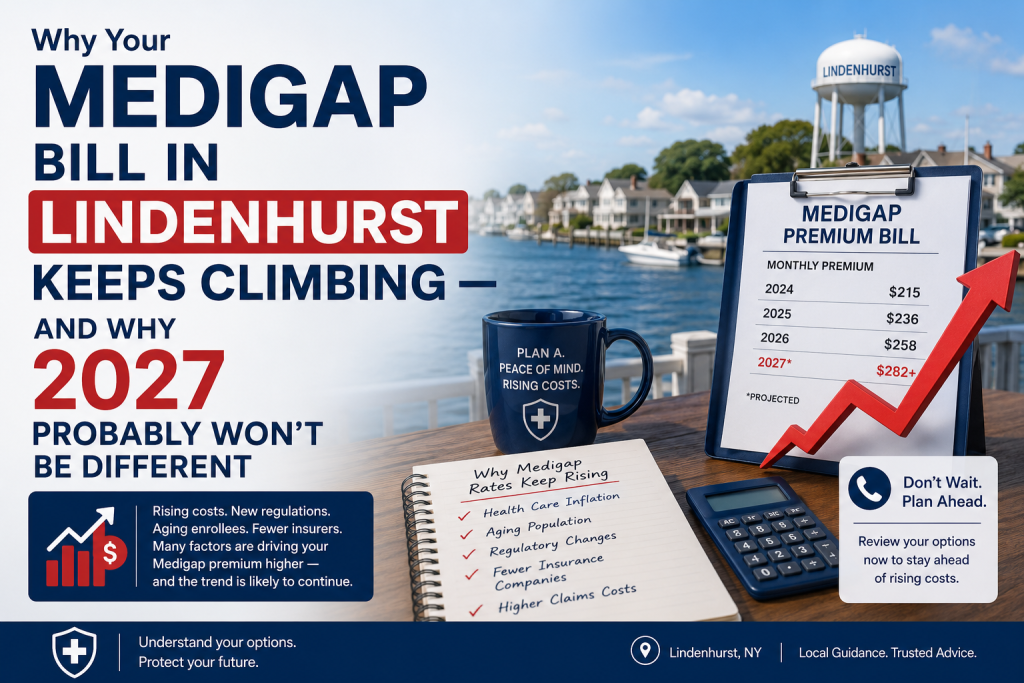
If your Medicare Supplement premium jumped again this year, you’re not imagining it and you’re not alone. Here’s what’s actually driving it, why Lindenhurst doesn’t have the competitive market it looks like on paper, and what it really costs a couple to carry Medicare, Part D, and Medigap side by side.
Grab a coffee. Let’s talk honestly about something that’s been showing up in a lot of mailboxes on the South Shore lately: a Medigap renewal notice with a number on it that makes you do a double take.
If you’re in Lindenhurst, Copiague, or anywhere else on this stretch of Suffolk County’s South Shore and you’ve watched your Medicare Supplement premium jump 10%, 15%, even 20% in the last renewal cycle, this article is for you. I’m not going to sugarcoat where things are headed, but I am going to explain exactly why it’s happening, because understanding the “why” is the first step to actually doing something about it.
What’s actually happened to Medigap rates the last few years
Let’s start with the number that made headlines across New York this year. UnitedHealthcare — which insures the AARP Medicare Supplement plans and is by a wide margin the largest Medigap carrier operating in this state — received approval from the New York Department of Financial Services for a 17.8% rate increase on its Plan G policies for 2026. That’s the largest single-year increase DFS has approved for UHC in recent memory, and it wasn’t an outlier. It was part of a much broader pattern.
Industry people who track this closely have been blunt about the shift. Chalen Jackson, VP for government affairs at Integrity, a national health insurance distribution firm, put it this way earlier this year: five years ago, a Medigap carrier raising rates more than 10% was unusual. Now it’s unusual to see an increase come in under 10%, and increases north of 20% aren’t rare anymore either. That’s not a one-carrier problem. It’s become the norm across the industry — and New York’s structure makes it worse, which we’ll get to in a minute.
Is a double-digit increase likely again for 2027?
Based on everything filed so far, yes — that’s the honest, non-sales-pitch answer. Carriers file their rate requests with state insurance departments well before the increases take effect, and the early 2026 filings for Plan G — the most commonly purchased Medigap plan — already ranged from just over 12% to more than 26% before any state review or negotiation. New York’s Department of Financial Services does push back on requested increases (DFS approved 2026 health insurance rate actions that were lower than what carriers originally asked for, saving consumers real money in aggregate), but “lower than requested” and “single digits” have not been the same thing lately.
Layer on top of that what’s happening with Medicare’s core costs. The 2026 Medicare Trustees Report — the government’s own official projection, released in June 2026 — puts the standard Part B premium at $209.50/month for 2027, up from $202.90 this year. That’s officially a modest 3.25% bump. But two things are worth knowing before you relax about that number:
- Trustees Report projections have a track record of running low. Independent forecasters, pointing to that pattern, expect the actual 2027 Part B premium could land closer to $216–$219 once CMS finalizes it in November.
- Part B cost growth is the engine behind Medigap pricing. Medigap plans pay claims tied directly to Medicare-approved amounts for Part A and Part B services. When Part B utilization and provider payments rise, Medigap’s claims costs rise right along with it — carriers don’t set premiums in a vacuum.
On the drug side, two 2027 numbers are already locked in, not projected: the Part D out-of-pocket cap rises from $2,100 to $2,400, and the standard Part D deductible rises from $615 to $700. Those are finalized under CMS’s Contract Year 2027 Part D rule.
Bottom line for 2027: Nothing about the current trend — carrier filings, Medicare’s own utilization data, or the structural cost drivers behind Part D — points toward a quiet year. Plan on another meaningful increase and be pleasantly surprised if it’s smaller than expected, rather than the other way around.
The real problem in Lindenhurst: there isn’t much of a market
Here’s the part most Medigap guides skip, and it’s the part that matters most if you’re trying to actually do something about your premium. New York’s DFS rate table for the Long Island region lists roughly eight to ten Medigap carriers. On paper, that looks like a competitive market with plenty of shopping to do. In practice, it isn’t — and the gap between what’s listed and what’s actually accessible to a Lindenhurst resident working with an independent broker is significant.
One thing worth being clear on before we go further: in New York, Medigap plans are standardized by federal law. A Plan G is a Plan G — the deductibles, coinsurance, and coverage gaps it fills are identical no matter which company sells it. So when carriers differ, they’re not differing on coverage. They’re differing on price, customer service, and financial strength. That’s exactly why the competition question matters so much — if the product is identical everywhere, the only thing left to compete on is price, and a thin market means less pressure to keep that price down.
| Carrier | What the table shows | The reality |
|---|---|---|
| UnitedHealthcare (AARP) | Long Island’s lowest-priced Plan G and Plan N carrier | Dominant by a wide margin — commonly estimated at 70%+ of New York’s Medigap market. Being the cheapest option in a market you also control that much of tells you something about how thin the real competition is. |
| Aetna | Plan G listed at $406.26/month, Long Island region | Currently not accepting individual Medigap enrollments in New York. The rate is published; you can’t actually buy it. |
| Transamerica | Plan G listed at $444.83/month, Long Island region | As of 2026, only enrolls through specific affiliated associations — not open to the general public. |
| EmblemHealth | Plan N listed at $314.77/month | Paper-only enrollment process, limited agent access, lower financial strength rating than the major national carriers. |
| Bankers Conseco / Globe Life | Plan G priced well above $460–$840/month | Technically available, priced so far above the market it functions as enrollment suppression rather than real competition. |
Once you remove the carriers that aren’t taking new individual applicants, the one that requires association membership you probably don’t have, and the ones priced double what the market leader charges, Lindenhurst residents are functionally choosing between UnitedHealthcare and a very short list of secondary options. That’s not a competitive market disciplining prices downward. That’s closer to a market where the biggest player can raise rates because there’s genuinely nowhere else for most people to go.
Why New York’s rules make this worse, not better
New York is one of only four states — alongside Connecticut, Massachusetts, and Maine — that requires insurers to accept Medigap applicants essentially year-round, regardless of health status, rather than only during a narrow initial enrollment window. That’s genuinely good for consumers with health conditions who’d otherwise be locked out. But it also means New York’s risk pool skews toward people who enrolled later in life or with pre-existing conditions, and combined with New York’s continuous, no-underwriting enrollment structure, that produces real adverse selection pressure that pushes rates up statewide. It’s one of the honest reasons New York’s Medigap premiums are consistently among the highest in the country before any single-year spike even happens.
I’m not going to tell you to panic, and I’m not going to tell you it’s fine. Both are wrong. What I will tell you is this: don’t assume the carrier you’ve had for ten years is still your best option just because switching feels like a hassle. New York’s continuous open enrollment is actually a gift here — you’re not locked in the way people in most other states are. If your Plan G premium jumped 15–18% this cycle, it’s worth a real conversation about whether a High-Deductible Plan G makes more sense for your situation, or whether shopping the same plan letter across carriers gets you meaningfully lower without giving up any of the federally standardized coverage. I say this even though it sometimes means a lower commission for me — the plan should fit you, not the other way around.
What this actually costs a couple, month to month
This is where the abstract percentages become a real number on a real budget, and it’s the part that gets skipped most often. Medicare isn’t priced per household — it’s priced per person. If you and your spouse are both on Original Medicare with Medigap, you are paying two full sets of premiums, not one.
Here’s what that looks like using confirmed 2026 figures for a couple both on Medicare:
| Cost | Per person / month | Couple / month |
|---|---|---|
| Part B premium (standard, 2026) | $202.90 | $405.80 |
| Part D premium (national average range) | ~$35–$40 | ~$70–$80 |
| Medigap Plan N, Long Island region (UHC, lowest-priced example) | $299.00 | $598.00 |
| Approximate combined monthly total | ~$1,075–$1,085 | |
| Plan G premiums run higher than Plan N — for reference, Aetna’s published Long Island Plan G rate is $406.26/person before any 2026–2027 increase is applied. A couple on Plan G with a carrier other than the market’s lowest-cost option can easily clear $1,300–$1,500/month combined for Part B, Part D, and Medigap alone — before any out-of-pocket costs. | ||
Now project that forward. If Part B moves to the trustees’ projected $209.50 in 2027, that’s another $13.20/month for the couple right there — before Medigap renews at whatever increase gets approved. If Medigap follows even a conservative 10–12% bump on top of that, a couple’s combined monthly cost for these three pieces alone could climb by $70–$100/month or more heading into 2027. That’s real money against a Social Security COLA that’s typically landed in the 2.5–2.8% range the last couple of years — meaning the COLA increase and the Medicare cost increase are often racing each other, and Medicare frequently wins.
This is exactly why so many couples on Long Island feel like they’re falling behind even though nothing dramatic has “happened” — it’s the compounding of Part B, Part D, and Medigap all rising in the same direction, every year, for two people at once.
Frequently asked questions
Medigap premiums are set at the pool level, not the individual level. Your rate reflects the claims experience and cost trends of everyone in your plan and rating area — including rising Medicare Part B utilization, provider payment increases, and in New York specifically, the adverse selection effect of continuous guaranteed-issue enrollment. Whether you personally filed a claim this year doesn’t change your premium.
In many cases, yes — New York’s continuous open enrollment rules allow you to apply for a different Medigap plan or carrier without health questions in a way most other states don’t permit outside a narrow initial window. This is genuinely one of the more consumer-friendly features of New York’s Medigap market, and it’s worth using if your current rate has become hard to justify.
This is the part that trips people up most: in New York, Medigap plans are standardized by federal law. A Plan G from UnitedHealthcare, Aetna, or EmblemHealth covers exactly the same benefits — same deductibles, same coinsurance, same coverage gaps filled. There is no “better” Plan G. The only real differences between carriers are the price, the company’s customer service and claims-paying reputation, and its financial strength rating. UnitedHealthcare has consistently ranked among the two lowest-priced Plan G and Plan N carriers on Long Island for years, not just this cycle — which is part of why it’s captured such a large share of the market here. But being priced well isn’t the same as being priced competitively in a healthy market: it’s worth understanding that UHC builds an enrollment discount into its starting premium that erodes over time, so always compare what a rate looks like at age 70, 75, and 80, not just what you’d pay on day one.
Medicare Advantage plans work differently — they typically have $0 or low premiums but use copays, coinsurance, and provider networks instead of the flat monthly cost structure Medigap uses, plus an annual out-of-pocket maximum. It’s a genuinely different trade-off, not a simple upgrade or downgrade, and the right answer depends on your health situation, providers, and travel habits far more than it depends on which one has a smaller headline premium increase.
Not sure what this means for your specific plan and carrier?
Every situation is different, and the only way to know if you’re paying more than you need to is to actually run the comparison. I’ll walk through it with you — no pressure, no scripts.
Call 631-358-5793
Or email medicare@paulbinsurance.com
Sources
- New York State Department of Financial Services — 2026 Community Rated Medicare Supplement Premium Comparison Tables, Long Island rating region (updated June 1, 2026)
- New York State Department of Financial Services — Summary of 2026 Requested and Approved Rate Actions
- KFF Health News / CBS News — “Medigap premiums leap, and consumers have few alternatives” (April 2026)
- Centers for Medicare & Medicaid Services — 2026 Medicare Parts A & B Premiums and Deductibles fact sheet
- 2026 Medicare Trustees Report (released June 9, 2026) — Part B premium projections through 2034
- Centers for Medicare & Medicaid Services — Contract Year 2027 Part D Final Rule (out-of-pocket cap and deductible)
- CMS / KFF — 2026 Part D enrollment, premiums, and market concentration data