




You can have Medicare before you start collecting Social Security. The two programs are separate, and your decision about when to claim Social Security has no effect on when you become eligible for Medicare. What it does affect is how you enroll and how your premiums get paid.

Here’s the short version: if you’re already receiving Social Security retirement or disability benefits at least four months before your 65th birthday, Medicare enrolls you automatically. If you’re not collecting benefits yet, you must sign up yourself during a specific window. Miss that window, and you could face permanent premium penalties.
This article is for three groups in particular:
- People turning 65 who are delaying Social Security to maximize their future benefit
- People under 65 receiving Social Security Disability Insurance (SSDI)
- Anyone keeping employer coverage past 65 and unsure how that changes their Medicare timing
Pro Tip: Many people delay Social Security to increase their monthly benefit — you can do that while still enrolling in Medicare at 65 to avoid coverage gaps. The two decisions are independent.
Table of Contents
- Who can get Medicare before age 65?
- Automatic enrollment: what happens if you’re already on Social Security before 65
- Not collecting Social Security at 65? Here’s how to sign up
- How premiums, billing, and late-enrollment penalties work
- Coverage choices after you get Medicare
- Common mistakes and a 6-step checklist
- When to get professional help and how Paulbinsurance can assist
- Key Takeaways
- What 17 years of Medicare consults taught me
- Paulbinsurance helps you get Medicare right the first time
- Authoritative sources and where to go next
Who can get Medicare before age 65?
Most people think Medicare starts at 65. That’s true for the standard path, but three specific situations allow Medicare coverage before that birthday.

SSDI and the 24-month rule. If you receive disability benefits through Social Security, you qualify for Medicare after 24 months of receiving those payments. Because SSDI itself has a five-month waiting period before cash payments begin, the practical wait from the onset of disability is closer to 29 months. The Social Security Administration (SSA) and the Centers for Medicare & Medicaid Services (CMS) jointly administer these rules.
ALS (Lou Gehrig’s disease). This is the one major exception to the 24-month wait. People diagnosed with ALS qualify for Medicare the same month their SSDI benefits begin. No waiting period.
End-Stage Renal Disease (ESRD). If you require regular dialysis or have had a kidney transplant, you can qualify for Medicare at any age. The timing depends on when dialysis starts or when the transplant occurs, and ESRD follows its own separate eligibility path from SSDI.
A few other notes worth knowing:
- Medicare coverage tied to SSDI can end if disability benefits stop for medical or earnings reasons, though extension rules exist in some cases
- Puerto Rico residents receive Part A automatically under disability but must actively sign up for Part B
- For the under-65 disability path, see Paulbinsurance’s guide on Medicare eligibility under 65
Automatic enrollment: what happens if you’re already on Social Security before 65
If Social Security retirement or disability payments start at least four months before your 65th birthday, CMS enrolls you automatically in both Part A and Part B. You don’t fill out any forms.
About three months before your coverage begins, SSA mails a Welcome to Medicare packet with your red, white, and blue Medicare card. That packet also explains how to decline Part B if you have other qualifying coverage, such as employer insurance.
What you receive automatically:
- Part A (hospital insurance) — premium-free for most people with at least 40 quarters of Medicare-covered work
- Part B (medical insurance) — included unless you opt out
Two exceptions to the automatic Part B rule:
- Puerto Rico residents get Part A automatically but must sign up for Part B separately
- People living outside the U.S. may receive Part A but should confirm Part B enrollment directly with SSA
Example timeline: Say your 65th birthday is October 15. If you’ve been receiving SSDI since January, your Medicare coverage starts October 1, and your Welcome packet arrives a few months before coverage starts. Coverage begins the first of your birthday month regardless of the exact date.
Not collecting Social Security at 65? Here’s how to sign up
If you’re delaying Social Security to grow your benefit, you must actively apply for Medicare yourself. The Initial Enrollment Period (IEP) is your primary window, and it’s seven months total.
How the IEP breaks down:
- Three months before the month you turn 65
- The month you turn 65
- Three months after the month you turn 65
Sign up in the first three months and coverage starts the first day of your birthday month. Sign up in month four (your birthday month) or later, and coverage is delayed by one to three months.
How to apply:
- Online at SSA.gov (fastest option, available 24/7)
- By phone at 1-800-772-1213
- In person at your local Social Security office (bring ID)
Documents to have ready:
- Birth certificate or U.S. passport
- Social Security number
- Proof of U.S. citizenship or lawful permanent residency
- W-2s or self-employment tax returns if you need to verify work history for premium-free Part A
Special Enrollment Periods (SEPs) for employer coverage. If you or your spouse are still working and covered by an employer group health plan, you can delay Part B without penalty. Once that employer coverage ends, you get a limited Special Enrollment Period to sign up for Part B. Miss the eight-month window and the penalty clock starts. For a deeper look at delaying without penalty, Paulbinsurance covers the rules at can you delay Medicare without penalty.
| Enrollment Window | When It Opens | Coverage Start | Penalty Risk |
|---|---|---|---|
| IEP (months 1–3) | 3 months before 65th birthday month | First day of birthday month | None |
| IEP (month 4) | Birthday month | 1 month delay | None if enrolled |
| IEP (months 5–7) | 1–3 months after birthday month | 2–3 month delay | None if enrolled |
| SEP (employer coverage) | When employer coverage ends | Month after SSA receives forms | None if within the SEP window |
| General Enrollment Period | January 1 through March each year | July 1 | Penalty applies |
How premiums, billing, and late-enrollment penalties work
Part A is premium-free for most people who worked at least 40 quarters in Medicare-covered employment. Part B requires a monthly premium regardless of when you claim Social Security.
How billing works depends on whether you’re collecting Social Security:
- Collecting Social Security: Part B premiums are deducted automatically from your monthly benefit check
- Not yet collecting: you receive quarterly bills directly from Medicare and must pay them yourself
That quarterly billing surprises a lot of new enrollees. If you miss a payment, your coverage can lapse. Set up automatic bank payments through Medicare.gov as soon as your coverage starts.
IRMAA surcharges. Higher-income beneficiaries pay more for Part B and Part D through the Income-Related Monthly Adjustment Amount. SSA uses your IRS tax return from two years prior to enrollment to calculate the surcharge. If your income dropped significantly since then (retirement, for example), you can request a reconsideration using SSA Form SSA-44.
The Part B late-enrollment penalty. If you miss your IEP and don’t qualify for an SEP, your Part B premium increases by 10% for every full 12-month period you were eligible but not enrolled. That penalty is permanent — it stays with you for as long as you have Part B. For a practical breakdown of how to avoid it, see Paulbinsurance’s guide on avoiding Medicare late penalties.
Example: Miss two full years of Part B enrollment without a qualifying SEP and your base premium goes up 20% — permanently.
Coverage choices after you get Medicare
Enrolling in Medicare is step one. Choosing how you get your coverage is step two, and it matters just as much.
Original Medicare (Parts A & B) pays directly for hospital and medical services on a fee-for-service basis. You can see any provider who accepts Medicare nationwide. There’s no annual out-of-pocket maximum, which is why many people add a Medigap (Medicare Supplement) policy to cap their exposure.
Medicare Advantage (Part C) bundles Parts A, B, and usually Part D into a single private plan. Plans often include dental, vision, and hearing benefits that Original Medicare doesn’t cover. The trade-off is a provider network and prior authorization requirements. You must have both Part A and Part B before joining an Advantage plan. You cannot hold both a Medicare Advantage plan and a Medigap policy simultaneously.
Part D prescription drug coverage is separate under Original Medicare. Sign up when you first get Medicare to avoid the Part D late-enrollment penalty, which also accumulates permanently. Check formularies carefully before choosing a plan — the drug list varies significantly between carriers. Paulbinsurance’s Part D guide walks through the comparison process.
Medigap for people under 65 on disability. Federal law does not require insurers to sell Medigap to beneficiaries under 65, though some states do mandate it. Availability, pricing, and underwriting rules vary significantly by state. If you’re under 65 and on Medicare through SSDI, this is one area where working with an independent agent makes a real difference — Paulbinsurance has a dedicated resource on Medigap options under 65.
Common mistakes and a 6-step checklist
The most expensive Medicare mistakes are almost always timing mistakes. Here are the ones that come up most often.
Top mistakes to avoid:
- Assuming Medicare auto-enrolls you when you turn 65 (it only does if you’re already collecting Social Security)
- Missing the IEP because you thought you had more time
- Dropping employer coverage without confirming SEP eligibility first
- Ignoring quarterly Part B bills when not on Social Security and letting coverage lapse
- Signing up for COBRA after leaving a job and assuming it counts as qualifying coverage for SEP purposes (it doesn’t)
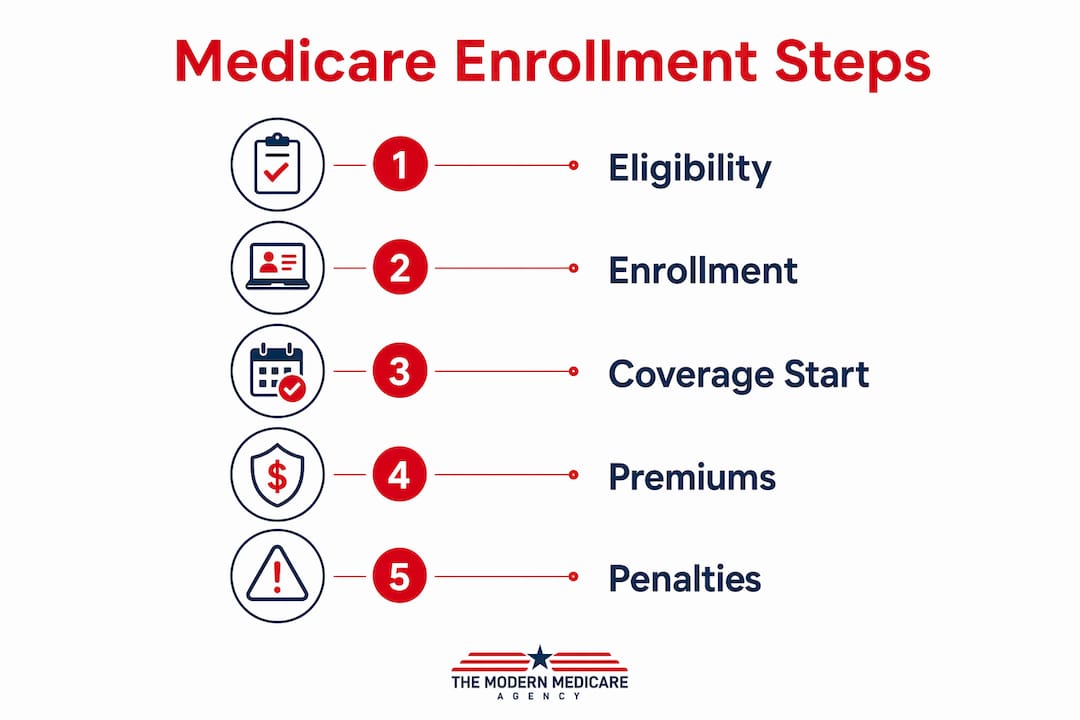
Your 6-step checklist:
- Confirm your eligibility path. Are you turning 65, on SSDI, or qualifying through ESRD or ALS? Each path has different timing.
- Identify your IEP dates. Mark the first and last day of your seven-month window on your calendar now.
- Decide whether to keep employer coverage. If you or your spouse are still working, confirm whether your employer plan qualifies for SEP protection before you do anything.
- Enroll in Part A and Part B. Apply online at SSA.gov, by phone, or in person. Have your documents ready.
- Choose your coverage type. Decide between Original Medicare plus Medigap/Part D, or Medicare Advantage. Compare provider networks, formularies, and out-of-pocket maximums.
- Set up premium payment. If you’re not on Social Security yet, set up direct payment through Medicare.gov to avoid missed bills.
Documents to gather before you apply: birth certificate or passport, Social Security card, and W-2s or 1099s if you need to verify work history for premium-free Part A.
When to get professional help and how Paulbinsurance can assist
Medicare’s rules are federal, but the plan choices you make after enrollment are highly local and personal. An independent Medicare agent doesn’t sell you one company’s products — they compare options across carriers and explain the trade-offs without a stake in which plan you pick.
What Paulbinsurance does for clients:
- Reviews your eligibility path and confirms your IEP or SEP dates
- Compares Medigap vs. Medicare Advantage based on your doctors, prescriptions, and budget
- Helps with enrollment paperwork and explains the billing setup
- Explains Medigap availability for under-65 disability beneficiaries by state
- Provides ongoing support when plans change or life circumstances shift
What to bring to a consult:
- Your Medicare card (if you already have one)
- A list of your current medications and doctors
- Your most recent tax return (for IRMAA review)
- Any employer coverage documents if you’re still working
The consult is educational first. You’ll leave knowing your enrollment window, your coverage options, and what each one costs — before you commit to anything.
Pro Tip: If you’re within six months of your 65th birthday and haven’t confirmed your IEP dates, schedule a consult now. The window closes faster than most people expect, and there’s no do-over once you miss it.
Key Takeaways
Medicare eligibility is independent of Social Security: you can enroll in Medicare at 65 while delaying Social Security, and you must do so actively if you aren’t already collecting benefits.
| Point | Details |
|---|---|
| Medicare and Social Security are separate | Delaying Social Security does not delay Medicare eligibility or create a penalty. |
| Auto-enrollment requires prior benefit receipt | You’re enrolled automatically only if Social Security payments started at least 4 months before your 65th birthday. |
| IEP is 7 months total | The window opens 3 months before your birthday month and closes 3 months after — missing it triggers a permanent penalty. |
| Quarterly bills surprise new enrollees | If you’re not on Social Security when Medicare starts, you’ll receive quarterly Part B bills, not automatic deductions. |
| Paulbinsurance for plan guidance | Paulbinsurance’s independent agents compare Medigap, Advantage, and Part D options and help confirm your enrollment timing at no cost to you. |
What 17 years of Medicare consults taught me
The single most common mistake I see is people conflating Medicare enrollment with Social Security claiming. They’re related programs, but they run on different clocks. Plenty of clients have come to me after missing their IEP because they thought they’d sign up for both at the same time when they “retired.” By then, the penalty window had already passed.
The second thing I’d push back on is the assumption that Medicare Advantage is always the simpler or cheaper choice. For someone who’s been on SSDI for two years and finally hits Medicare eligibility, the Medigap market in their state may be limited or expensive. That’s not a reason to panic — it’s a reason to know your options before the enrollment window opens, not after.
If you’re navigating this for the first time, the rules feel like a lot. They’re not, once you know your specific path. The IEP dates, the billing setup, the coverage choice — each one has a clear answer for your situation. You just need someone to walk through it with you.
Paulbinsurance helps you get Medicare right the first time
Sorting out Medicare enrollment timing, premium billing, and plan selection on your own is doable — but the cost of a mistake (a permanent penalty, a coverage gap, or the wrong plan for your doctors) is real. Paulbinsurance offers free educational consults with independent agents who specialize in Medicare and have since 2007.

Whether you’re turning 65, on SSDI, or keeping employer coverage past 65, the team at Paulbinsurance will confirm your enrollment window, compare your plan options across carriers, and walk you through the paperwork. No pressure, no obligation — just clear answers.
For readers under 65 on disability, the Medigap options for disabled beneficiaries under 65 page is a good starting point. Ready to compare Advantage vs. supplement options? Start with Paulbinsurance’s Medicare Advantage and supplement comparison to see what fits your situation. Call, schedule online, or request an in-person appointment — and bring your medication list and any employer coverage documents.
Authoritative sources and where to go next
Use these official resources to verify enrollment rules, check your IEP dates, or start your application:
- Medicare.gov — How Medicare works, coverage basics, and plan comparison tools
- SSA.gov/medicare — Enrollment gateway, premium billing, and Welcome to Medicare packet information
- CMS.gov — Part A & B enrollment — Official auto-enrollment rules and eligibility triggers
- Medicare.gov — When to sign up — IEP dates, SEP rules, and penalty details
- HHS.gov — Medicare eligibility — SSDI, ALS, and ESRD eligibility rules
- Paulbinsurance.com — First-time enrollment guide — Step-by-step enrollment checklist with document requirements
- Paulbinsurance.com — Coordinate Medicare and Social Security — How the two programs interact for billing and enrollment
State-specific Medigap rules vary. Confirm your state’s guaranteed-issue protections directly with your state insurance commissioner’s office or through an independent agent before your enrollment window opens.
This article provides general information about Medicare enrollment rules and is not a substitute for personalized advice. Confirm your specific eligibility dates, premium amounts, and plan options with SSA, CMS, or a licensed Medicare agent.