
Medicare Plan F is the most comprehensive Medigap policy available, covering every gap in Original Medicare cost-sharing. The short answer: if you were first eligible for Medicare before January 1, 2020, you can still buy or keep Plan F. If you became eligible after that date, Plan F is closed to you, and Plan G is almost always the better move.
Here is what you need to know before deciding:
- Plan F covers everything: Part A and Part B deductibles, coinsurance, excess charges, skilled nursing facility coinsurance, hospice costs, the first three pints of blood, and foreign travel emergencies.
- New enrollees cannot buy it: The Medicare Access and CHIP Reauthorization Act (MACRA) closed Plan F to anyone first eligible for Medicare on or after January 1, 2020.
- Current holders can keep it: If you already have Plan F, your coverage is guaranteed renewable.
- The cost trade-off matters: Plan F carries the highest premiums of any Medigap plan, and the premium gap versus Plan G often exceeds the Part B deductible Plan F uniquely covers.
- Switching later has real risks: Moving from Plan F to another Medigap plan can trigger medical underwriting unless you have a specific guaranteed-issue right.
Read on for the full cost breakdown, a Plan F vs. Plan G comparison, and a practical decision checklist.
Table of Contents
- What does Medicare Plan F actually cover?
- Who can buy Plan F, and what are the enrollment rules?
- How much does Plan F cost in 2026?
- Plan F vs. Plan G and other Medigap options
- How to shop for Plan F: a step-by-step process
- Is Plan F right for you? A practical decision guide
- Why work with an independent Medicare agent?
- Key Takeaways
- The real risk most Plan F articles skip
- Get a free Plan F comparison from Paulbinsurance
- Useful sources and recommended reading
What does Medicare Plan F actually cover?
Plan F covers all nine standardized Medigap benefits, making it the only Medigap policy that leaves you with zero out-of-pocket costs for Medicare-approved services. Benefits are standardized by CMS, which means the coverage is identical regardless of which insurer sells it.
Here is the complete list:
- Medicare Part A coinsurance and hospital costs up to an additional 365 days after Medicare benefits are exhausted
- Medicare Part A deductible ($1,676 per benefit period in 2026)
- Skilled nursing facility coinsurance (days 21–100)
- Hospice care coinsurance or copayment
- Medicare Part B coinsurance or copayment
- Medicare Part B deductible ($257 in 2026)
- Medicare Part B excess charges (the amount a provider can charge above Medicare’s approved amount)
- First three pints of blood each year
- Foreign travel emergency coverage (up to plan limits, typically 80% after a deductible)
Plan F does not cover anything Original Medicare excludes. Prescription drugs, dental, vision, hearing, and long-term care are all outside its scope. For drug coverage, you still need a separate Medicare Part D plan.

Who can buy Plan F, and what are the enrollment rules?
The eligibility rules for Plan F are straightforward but frequently misunderstood.
The core rule: Plan F is only available to people who were first eligible for Medicare before January 1, 2020. “First eligible” means the date you turned 65 or, if under 65, the date you qualified due to disability or end-stage renal disease. If that date falls on or after January 1, 2020, Plan F is not an option for you.
Guaranteed-issue rights that allow switching without underwriting
Even eligible beneficiaries cannot always switch plans freely. Guaranteed-issue rights are narrow and specific:
- You are within your six-month Medigap Open Enrollment Period (starting the month you turn 65 and enroll in Part B).
- You are losing employer or union group health coverage.
- You are moving out of your Medicare Advantage plan’s service area.
- Your current Medigap insurer goes bankrupt or leaves the market.
- You exercised a “trial right” to try Medicare Advantage and are returning to Original Medicare within 12 months.
Outside these windows, insurers can require full medical underwriting, charge higher premiums, or deny coverage entirely.
State-level differences
Three states run their own standardized Medigap systems: Massachusetts, Minnesota, and Wisconsin. Their plan structures differ from the federal letter-plan system, so Plan F as described here may not apply the same way. Some states also allow insurers to sell Medigap to beneficiaries under 65 on disability, though this is not federally required and varies significantly by state.
Practical next steps for borderline cases: Check your Medicare effective date on your red-white-and-blue Medicare card, review your state’s rules at your State Health Insurance Assistance Program (SHIP), and confirm eligibility at Medicare.gov before applying.
How much does Plan F cost in 2026?
Plan F premiums vary more than most people expect, even for the same coverage in the same ZIP code. The standardized benefits are identical across carriers, but the price is not.
2026 premium ranges
| Plan Type | Typical Monthly Premium | Notes |
|---|---|---|
| Standard Plan F | —/month | Varies by age, ZIP, insurer, pricing method |
| High-Deductible Plan F | $62–$100/month | Requires you to pay $2,950 before coverage kicks in |
How insurers set your rate
Three pricing methods determine how your premium changes over time:
- Attained-age rated: Premiums rise as you age. Starts lower but can become expensive in your 70s and 80s.
- Issue-age rated: Locked to your age at enrollment. Increases come from inflation, not birthday milestones.
- Community rated: Everyone in the same area pays the same premium regardless of age. Often the most predictable long-term.
The pricing method matters as much as the starting premium. An attained-age policy that looks cheap at 65 can outpace a community-rated policy within a decade.
High-Deductible Plan F
High-Deductible Plan F carries the same benefits as standard Plan F but requires you to pay the first $2,950 in covered costs before the plan pays anything (2026 CMS figure). The trade-off: premiums drop to roughly $62–$100 per month. This option works well for people who are generally healthy, rarely use specialist care, and want catastrophic protection without paying $300+ monthly.
Plan F vs. Plan G: the break-even math
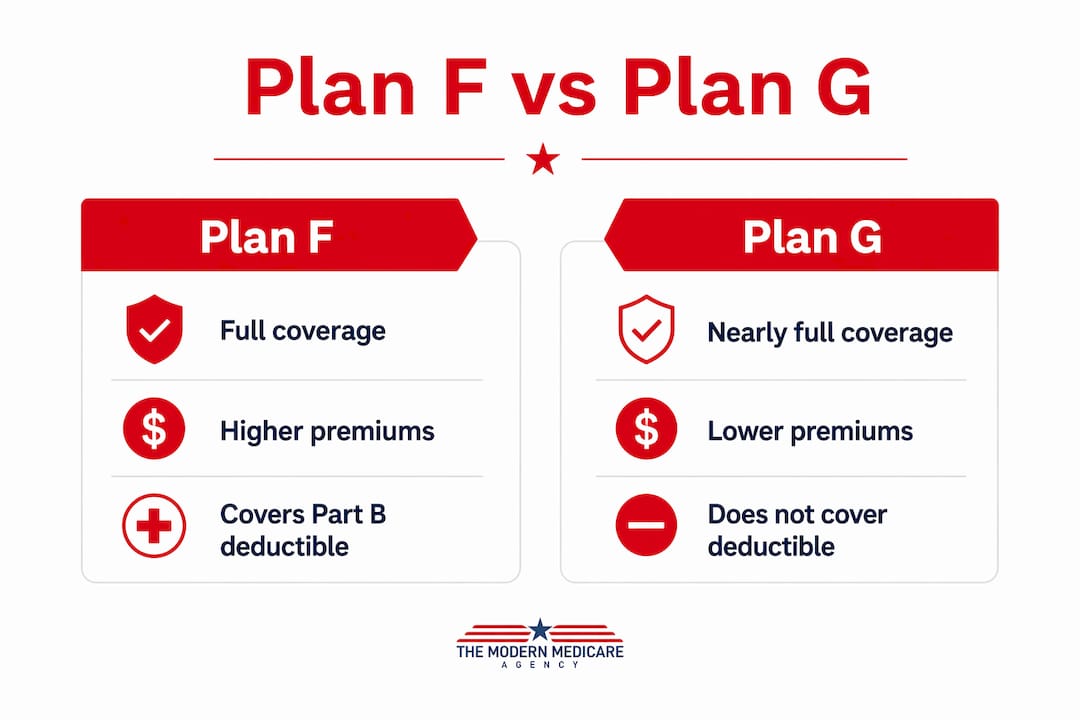
The only coverage difference between Plan F and Plan G is the Part B deductible ($257 in 2026). If Plan F costs $30 more per month than Plan G from the same insurer, that is $360 per year in extra premiums to cover a $257 deductible. You are paying $103 more annually for the privilege of not writing a $257 check. That math favors Plan G for most new buyers.
The break-even only tips toward Plan F if the premium difference is less than $257 annually, which is uncommon in most markets.
Pro Tip: Always ask the insurer which pricing method they use before you apply. An attained-age policy from a carrier with a shrinking Plan F block can produce above-average annual increases because no new, younger enrollees are entering that pool.
Plan F vs. Plan G and other Medigap options
Because Plan F benefits are standardized by CMS, the comparison between plans comes down to which cost-sharing gaps each one fills and what you pay for that coverage.
| Feature | Plan F | Plan G | Plan N |
|---|---|---|---|
| Part B deductible covered | Yes | No | No |
| Part B excess charges covered | Yes | Yes | No |
| Part A deductible covered | Yes | Yes | Yes |
| Skilled nursing coinsurance | Yes | Yes | Yes |
| Foreign travel emergency | Yes | Yes | Yes |
| Typical monthly premium | — | Lower than F | Lower than G |
| Who can enroll | First eligible before Jan 1, 2020 | Anyone eligible for Medigap | Anyone eligible for Medigap |
| Best for | Current holders with low premium increases | New enrollees wanting near-complete coverage | Cost-conscious buyers who accept small copays |
Plan G has become the preferred choice for post-2020 enrollees. It covers everything Plan F does except the Part B deductible, and its premiums are typically lower. For a deeper look at Plan G, the math almost always favors it over Plan F for new buyers.
Plan N sits a step below both. It does not cover Part B excess charges and requires small copays ($20 for office visits, $50 for emergency room visits). For people who rarely see specialists and whose doctors accept Medicare assignment, Plan N can cut premiums meaningfully. The Plan N vs. Plan G comparison is worth reviewing if you are price-sensitive.
Plans K and M offer partial cost-sharing coverage with lower premiums. Plan K, for example, covers 50% of several benefits and has a 2026 out-of-pocket limit of $8,000 per CMS. Plan M covers 50% of the Part A deductible. These are niche options and rarely the right fit for someone who qualifies for Plan F or G.
How to shop for Plan F: a step-by-step process
Shopping for Plan F is not complicated, but skipping steps costs money.
- Confirm your eligibility. Pull out your Medicare card and verify your Part B effective date. If it is before January 1, 2020, you are eligible for Plan F.
- Gather your information. You will need your Medicare effective date, ZIP code, date of birth, and any current Medigap policy details.
- Request at least three quotes. Premiums for identical Plan F coverage can differ by $100 or more per month between carriers in the same ZIP code. Use Medicare.gov’s comparison tool and an independent broker.
- Note the pricing method for each quote. Ask every carrier whether the policy is attained-age, issue-age, or community-rated. This single factor shapes your long-term costs more than the starting premium.
- Check underwriting rules. If you are outside a guaranteed-issue window, insurers can ask health questions. Know your health status and ask whether the carrier has a history of approving applicants with your conditions.
- Enroll within your allowed window. Missing your Open Enrollment Period means underwriting applies, which can mean higher premiums or denial.
What to verify in every quote
- Pricing method (attained-age, issue-age, or community-rated)
- Whether the carrier offers a High-Deductible Plan F option
- The carrier’s rate-increase history for Plan F blocks in your state
- Renewal guarantees (all Medigap plans are guaranteed renewable, but confirm)
For state-specific help, contact your SHIP counselor. SHIP provides free, unbiased guidance and can flag state-specific protections like birthday rules (California, Oregon, and a handful of other states allow annual plan switches without underwriting on your birthday).
Is Plan F right for you? A practical decision guide
The answer depends almost entirely on when you became eligible and what your current premiums look like.
Keep Plan F if:
- You already have it and your premiums are competitive with Plan G in your area.
- Your health history would make passing medical underwriting difficult or impossible.
- You value absolute predictability: $0 out of pocket for any Medicare-approved service.
- Your state has a birthday rule that lets you switch later without underwriting if rates climb.
Consider switching to Plan G if:
- You are newly eligible (post-2020) and cannot buy Plan F anyway.
- The premium difference between Plan F and Plan G at your insurer exceeds $257 annually.
- You have a guaranteed-issue right that lets you switch without underwriting.
Consider High-Deductible Plan F or Plan N if:
- You are generally healthy and use Medicare services infrequently.
- You want lower monthly premiums and can absorb the $2,950 deductible in a bad year.
- Your doctors all accept Medicare assignment (which eliminates excess charge risk for Plan N).
The main risks of staying on Plan F long-term:
- A shrinking enrollee pool means no new, younger members enter the block. As the average age of Plan F holders rises, claims increase, and premiums follow. This “block aging” effect tends to produce above-average annual increases compared to open plans like Plan G.
- Switching away later can require medical underwriting unless you have a guaranteed-issue right, which makes the decision to leave Plan F a one-way door for many people.
Decision checklist:
- Am I first eligible for Medicare before January 1, 2020?
- What is the annual premium difference between Plan F and Plan G at my insurer?
- Is that difference greater than $257 (the 2026 Part B deductible)?
- Do I have a guaranteed-issue right that would let me switch without underwriting?
- Does my state have a birthday rule or other annual switching protection?
- How is my current policy priced (attained-age, issue-age, community-rated)?
For a broader look at lowering your Medicare costs, the strategies go well beyond plan selection.
Why work with an independent Medicare agent?
Because Plan F benefits are identical across every insurer, the only variable is price and service. That is exactly where an independent broker earns their value.
Paul Barrett has been advising Medicare consumers since 2007. Paulbinsurance operates on an education-first model: the goal is to make sure you understand your options before you make any decision, not to push you toward a particular carrier.
Here is what working with an independent broker like Paulbinsurance actually gets you:
- Cross-carrier quotes: A captive agent represents one insurer. An independent broker pulls quotes from multiple carriers and can show you the pricing-method differences side by side.
- State underwriting expertise: Guaranteed-issue rules, birthday rules, and state-specific protections vary. An experienced broker knows which carriers are lenient in your state and which are not.
- Rate-increase history: Brokers who work with a plan regularly know which carriers have a track record of aggressive increases on legacy Plan F blocks.
- Enrollment timing: Missing a guaranteed-issue window is a costly mistake. A broker tracks these dates and flags them before they close.
This article is for general informational purposes only and does not constitute professional insurance or financial advice. Confirm current rules and your specific eligibility with Medicare.gov, your state insurance department, or a licensed Medicare advisor.
Key Takeaways
Medicare Plan F remains the most complete Medigap coverage available, but its closed enrollment pool and premium trajectory make it the right choice only for a specific group of beneficiaries.
| Point | Details |
|---|---|
| Eligibility cutoff | Only beneficiaries first eligible for Medicare before January 1, 2020 can buy Plan F. |
| Full cost-sharing coverage | Plan F covers all nine Medigap benefits, including the Part B deductible and excess charges. |
| Premium range in 2026 | Standard Plan F runs $241–$401/month; High-Deductible Plan F runs $62–$100/month. |
| Plan G is usually better for new buyers | The Plan F vs. Plan G premium gap typically exceeds the $257 Part B deductible Plan F uniquely covers. |
| Paulbinsurance | Independent broker offering cross-carrier Plan F and Plan G quotes, pricing-method analysis, and enrollment support since 2007. |
The real risk most Plan F articles skip
Plan F is not a bad plan. For the right person, it is still the cleanest, most predictable coverage Medicare offers. But the conventional wisdom that “Plan F is the gold standard” misses a structural problem that compounds over time.
Because no new enrollees can join Plan F, the pool ages every year. Older pools file more claims. More claims mean higher premiums. Higher premiums push out healthier members who can still pass underwriting, leaving an even older, sicker group behind. That cycle accelerates. It is not speculation; it is how insurance pools work, and it is already visible in Plan F rate trends in many states.
The people most at risk are those who bought Plan F years ago, have developed health conditions since, and now cannot pass underwriting to switch to Plan G. They are effectively locked in, watching premiums climb with no exit. That is not a reason to panic if you have Plan F today, but it is a reason to review your rates every year and understand your state’s switching protections before you need them.
The education-first approach Paulbinsurance takes is not just a slogan. It is the difference between a client who reviews options annually and one who discovers their Plan F premium jumped 18% and has no good options left.
Get a free Plan F comparison from Paulbinsurance
Sorting through carrier quotes, pricing methods, and underwriting rules on your own takes hours and still leaves gaps. Paulbinsurance does this work for you at no cost.

When you reach out, you get quotes from multiple carriers, a plain-English explanation of how each policy is priced, and honest guidance on whether Plan F, Plan G, or a high-deductible option fits your situation. Bring your Medicare effective date, ZIP code, and your current policy details if you have one.
The service is free because carriers pay a commission when you enroll. You pay nothing extra. To get started, visit the Medicare supplement comparison page or explore Medicare supplement costs to see what drives premiums in your area.
Useful sources and recommended reading
These are the primary sources used in this article. Each one is worth bookmarking for ongoing reference.
- Medicare.gov: Compare Medigap Plan Benefits — The official CMS benefits matrix showing exactly which Medigap plan covers which cost-sharing gaps.
- CMS: High-Deductible Plan F, G & J Deductible Announcements — Where CMS publishes the annual deductible for high-deductible Medigap options; check here each fall for the following year’s figure.
- Medicare.gov: Medigap Costs — Explains how Medigap premiums are set and why prices vary across insurers for identical coverage.
- CMS: Plan K & L Out-of-Pocket Limits — Annual OOP limit announcements for Plans K and L; useful for comparing partial-coverage alternatives.
- MoneyGeek: Medicare Supplement Plan F — Detailed cost analysis and 2026 premium ranges for standard and high-deductible Plan F.
- Investopedia: Medicare Supplement Plan F — Clear explanation of the MACRA eligibility cutoff and the Plan F vs. Plan G value comparison.
- Medicare.gov: Medigap Basics — The starting point for anyone new to Medigap; covers enrollment windows, plan letters, and state resources.
- SHIP (State Health Insurance Assistance Program) — Free, unbiased Medicare counseling available in every state. Find your local SHIP through Medicare.gov or by calling 1-800-MEDICARE.