
What if the lowest monthly premium isn’t the choice that gives you the most peace of mind? In 2026, making the right medicare choice for peace of mind means looking beyond one number and matching coverage to the care you use, the prescriptions you take, and the way you want to access doctors. It’s understandable if the unfamiliar terms and growing list of plans feel like a lot to sort through. You don’t have to compare everything at once.
This guide offers a calm, practical way to narrow your options. You’ll learn the basic trade-offs between Original Medicare with a Part D plan and Medicare Supplement coverage, and Medicare Advantage. You’ll also see what to check before comparing plans, including whether your doctors and hospitals are included, how your prescriptions are covered, what costs you may face, and whether plan rules feel comfortable to you.
There’s no single plan that suits everyone, and a lower premium alone doesn’t tell the whole story. Start with your own priorities, then review the 2026 options available to you. That simple first step can make the decision feel clearer and more personal.
Key Takeaways
- Define what peace of mind means for you by weighing your care needs, prescriptions, budget, and preferred flexibility.
- Make a short list of doctors, hospitals, pharmacies, and medicines to check against 2026 plan details.
- Compare Medicare Advantage and Original Medicare with supplemental coverage by looking at access, drug coverage, plan rules, and costs, not just the plan labels.
- Use the article’s step-by-step checklist to review options consistently and verify important details before deciding.
- Making the right medicare choice for peace of mind starts with your priorities; independent guidance can help you compare options without promising a particular outcome.
What does the right Medicare choice for peace of mind look like in 2026?
Medicare choices can feel consequential because they affect how you get care, cover prescriptions, and manage household expenses. The terms may be unfamiliar, and the details are personal. A good choice isn’t necessarily the plan with the lowest premium or the most features. It’s coverage that fits the care you expect, the medicines you take, your finances, and how much flexibility you want.
That’s the starting point for making the right medicare choice for peace of mind in 2026. There isn’t one plan that works best for everyone. This section is a decision aid to help you identify what matters and compare options. Before enrolling, review the current official plan documents for specific coverage, costs, rules, and availability.
Which parts of Medicare might shape your decision?
Medicare has several parts, and knowing their basic roles can make the choices easier to sort through. Original Medicare includes Part A, which helps cover hospital care, and Part B, which helps cover medical care. Medicare Advantage, also called Part C, is an alternative way to receive Medicare-covered benefits through a private plan. Medigap, or Medicare Supplement insurance, can supplement eligible Original Medicare coverage. Part D helps cover prescription drugs.
The terms can take a little time to learn. For a plain-language introduction to the basics, see “What Is Medicare? A Simple Guide for Beginners.”
What does peace of mind mean for your household?
Start with what would make coverage feel manageable for you. Is keeping access to particular doctors or hospitals most important? Do you want to make sure your medicines are covered? Are predictable expenses, fewer plan rules, or flexibility in choosing care higher priorities? Your answers help turn a long list of options into a more focused comparison.
Comfort with networks, referrals, and other plan rules varies by person and by plan. One person may be comfortable checking whether providers are in a plan’s network. Another may prefer a different approach to accessing care. Neither preference is automatically right or wrong. The important thing is to understand the rules and decide whether they suit your needs.
Plan fit means coverage that aligns with your care, medicines, finances, and comfort with its rules, after you’ve checked the details. Keep that definition in mind as you compare 2026 options. It gives you a practical way to weigh trade-offs without assuming that one label, benefit, or monthly premium tells the whole story.
Start with your doctors, prescriptions, budget, and everyday care
Before comparing 2026 plans, take a few minutes to write down what your household needs from coverage. This simple inventory gives you a consistent way to check each option and can keep a low monthly premium from becoming the only factor in your decision.
- Care team: List preferred doctors, specialists, hospitals, and clinics.
- Prescriptions: Gather each medicine’s name and dosage, along with the pharmacies you prefer.
- Expected care: Note regular appointments, ongoing treatments, or care you may need this year.
- Household priorities: Record your budget concerns and how much flexibility you want when choosing providers or getting care.
Medicare has several parts, and their roles can affect what you need to compare. The official Medicare website explains the basics. Use current plan information and official 2026 documents to verify benefits, provider participation, drug coverage, and costs for each option. Details can differ from plan to plan, even in the same area.
How can you check doctors and care access?
Check every provider who matters to you against each plan’s current information. Don’t assume a doctor or hospital participates just because it did before or accepts another plan. Networks and access rules can vary by plan and location. Consider whether you’re comfortable using a network, following referral steps, or checking plan rules before receiving care. Your comfort with those requirements is part of plan fit.
How should prescriptions and spending priorities factor in?
Use your medicine list to check each plan’s drug coverage, and review the plan’s current 2026 documents for applicable costs and rules. Also note whether your preferred pharmacy is included. A plan’s general description may not answer whether your specific medicines and pharmacy fit. For a plain-language overview, read this Medicare Part D guide.
As you compare, think beyond the monthly premium. Consider how the plan’s costs and rules fit your budget and likely care needs. Making the right medicare choice for peace of mind starts with your own list, not a guess about what matters most. If you’d like help reviewing your priorities, you can discuss them with an independent Medicare guide before deciding. A conversation can help clarify questions, but you’ll still want to verify plan details in the official documents.
Medicare Advantage or Original Medicare: compare trade-offs, not labels
These coverage paths work differently, so compare how each fits your priorities rather than assuming one is automatically safer, cheaper, or more complete. Medicare Advantage is a private-plan alternative to Original Medicare. With Original Medicare, some people also consider a Medigap policy to supplement eligible coverage and review Part D separately for prescription drugs. The right comparison depends on the specific plans available where you live and the care you expect to use.
| What to compare | Medicare Advantage | Original Medicare with supplemental coverage |
|---|---|---|
| Provider access | Check the plan’s provider network and access rules. | Review how Original Medicare and any supplemental coverage apply to your providers. |
| Drug coverage | Confirm whether the specific plan includes drug coverage and check your medicines. | Review Part D separately and verify coverage for your prescriptions. |
| Plan rules | Look for requirements such as referrals and other plan-specific steps. | Understand the rules for Original Medicare and any supplemental policy you’re considering. |
| Costs | Compare the plan’s current costs and coverage details. | Consider costs across Original Medicare, supplemental coverage, and Part D. |
What should you understand about Medicare Advantage?
Medicare Advantage plans are offered by private companies approved by Medicare and provide another way to receive Medicare coverage. Plan networks, referral requirements, drug coverage, and costs can vary. Check the exact 2026 plan documents and local availability rather than relying on general descriptions. For more detail, read this Medicare Advantage guide.
What should you understand about Original Medicare and Medigap?
Some people compare Original Medicare with a Medigap policy, which supplements eligible Original Medicare coverage, and evaluate Part D drug coverage separately. Medigap terms, eligibility, and availability depend on individual circumstances and location, so verify what applies to you. You can learn more in a Medicare Supplement Insurance guide.
For a current starting point, use the official Medicare Plan Finder to review options available in your area. Confirm benefits, providers, drug coverage, rules, and costs in each plan’s current 2026 materials before drawing conclusions. Making the right medicare choice for peace of mind means weighing these trade-offs against your own priorities, not choosing by label alone.
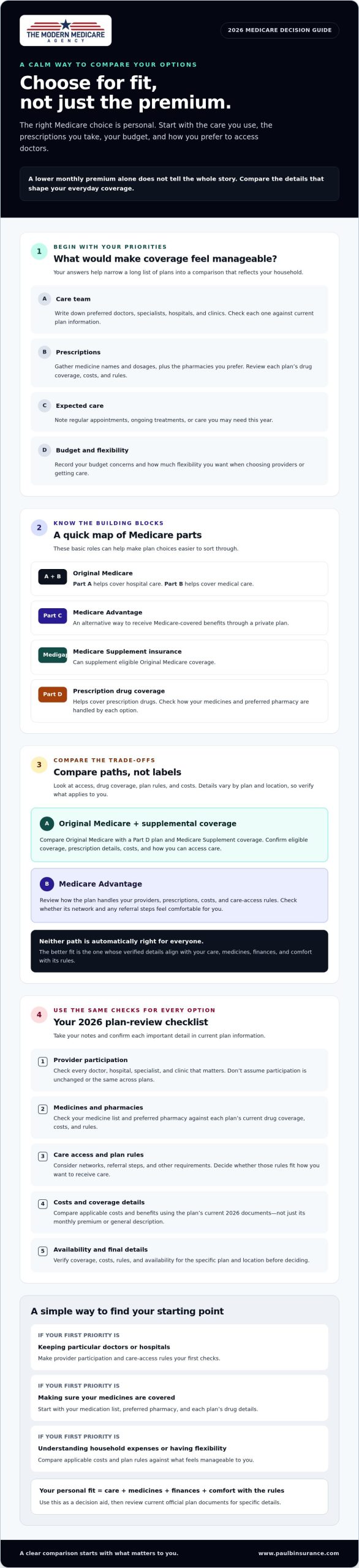
Use this 2026 checklist to compare plans with confidence
A consistent process can make plan details easier to sort through. Use the same priorities for every option, and keep notes in one place. That way, you can compare what matters to you instead of relying on memory or a plan’s headline benefits.
1. Confirm your needs. Review your doctors, hospitals, prescriptions, preferred pharmacies, expected care, budget, and comfort with plan rules.
2. Shortlist plans available to you. Focus on options offered in your location and appropriate to your current enrollment situation. Availability can vary by location and plan.
3. Check each plan’s details. Use current 2026 documents to look up your providers, medicines, pharmacies, coverage rules, and how costs are shared.
4. Compare using the same questions. Record the answers for each plan, including anything you can’t confirm. Use the same categories so you’re comparing like with like.
5. Verify before you decide. Recheck important details with official sources or a qualified professional, especially if something is unclear or your needs have changed.
Which details should you verify before deciding?
Before enrollment, verify 2026 plan availability for your location and enrollment situation, participating doctors and hospitals, prescription and pharmacy coverage, plan rules, benefits, and cost-sharing in current plan materials.
Drug lists, provider participation, benefits, costs, and availability can differ by plan. Don’t assume that information from a prior year still applies. If the documents don’t answer a question clearly, write it down and seek confirmation before relying on an assumption.
What questions can help you compare two plans?
- Are my preferred doctors and hospitals included under the current plan terms?
- Are my medicines covered, and does the plan work with my preferred pharmacy?
- What rules could affect how I access care, such as network or referral requirements?
- How are the plan’s costs structured, and which expenses should I review in the documents?
- Which details are still unclear, and where can I verify them?
Keep the answers side by side, along with the source and date you checked them. This gives you a useful record if you need to revisit a detail or ask a follow-up question. Making the right medicare choice for peace of mind doesn’t mean knowing every term by heart. It means checking the details that matter to your household and taking time to resolve uncertainties.
If you’ve gathered your priorities and would like help reviewing options, you can request personalized Medicare guidance. A conversation is an optional next step, not a commitment to choose a particular plan.
Get personal Medicare guidance and take your next step calmly
You’ve now identified what matters to your household and what to verify. Your next move can stay simple: use those priorities to compare available 2026 options, check current plan documents, and ask for clarification wherever something is unclear. You don’t have to make a decision based on a headline benefit or an unfamiliar term.
How can an independent broker support your decision?
An independent broker can help you compare Medicare Advantage, Medigap, and Part D offerings from multiple carriers against the needs you’ve identified. The Modern Medicare Agency is an independent brokerage, not a government Medicare plan provider or an insurance company. Its role is to help you review available options, not to promise a particular plan outcome or replace the plan’s official documents.
Independent guidance can be useful if you want help organizing questions about doctors, medicines, costs, or plan rules. You can ask how options are being compared and whether the guidance considers your stated priorities. Keep verifying important details in current plan materials so you understand what a specific plan covers and what requirements apply.
What should you have ready for a conversation?
You don’t need to have every answer before asking for help. A few notes can make the conversation more focused:
- Your location and current Medicare coverage
- Preferred doctors, hospitals, and pharmacies
- Medicine names and dosages
- Your expected care and household budget priorities
- Questions about provider access, drug coverage, costs, or plan rules that remain unanswered
Ask how the available options are compared with your priorities, what details still need checking, and where to confirm them. The right conversation should help you understand the trade-offs, not pressure you to choose before you feel ready.
Making the right medicare choice for peace of mind means taking the next step with your own needs in view. If you’d like personalized help comparing 2026 Medicare Advantage, Medigap, or Part D options, speak with The Modern Medicare Agency. Bring your notes, ask your questions, and review the details at a pace that feels comfortable.
Move forward with a clear plan for 2026
Medicare decisions feel more manageable when you focus on what matters in your household. Start with your care, prescriptions, budget, and preferred flexibility. Then compare coverage paths and verify the details that affect your providers, medicines, costs, and access to care in 2026.
There’s no single choice that fits everyone. Making the right medicare choice for peace of mind means understanding the trade-offs and choosing based on your own priorities, not assuming a low premium or a familiar plan name tells the whole story.
The Modern Medicare Agency is an independent brokerage that helps people compare Medicare Advantage, Medigap, and Part D options from more than 40 carriers. It provides personalized guidance and year-round support across more than 34 states. Confirm current carrier and state availability when discussing your options, and review official plan documents before making a decision.
If you’re ready to talk through your priorities, talk with an independent Medicare guide about your 2026 options. You can ask questions, take your time, and move forward one clear step at a time.
Frequently Asked Questions
How do I choose the right Medicare plan for peace of mind?
Choose by matching coverage to your needs, not by relying on a plan label or monthly premium alone. List your preferred providers, medicines, expected care, budget priorities, and comfort with plan rules. Then compare available 2026 options using current plan documents, checking details such as provider participation, prescription coverage, and costs. Making the right medicare choice for peace of mind means understanding the trade-offs and confirming the details that matter to you.
Is Medicare Advantage or Original Medicare better for peace of mind?
Neither is automatically better for everyone. Medicare Advantage is a private-plan alternative to Original Medicare, and its networks, rules, drug coverage, and costs vary by plan. With Original Medicare, you may consider supplemental coverage, such as Medigap, and review Part D drug coverage separately. Think about which approach fits your provider preferences, prescriptions, budget, and desired flexibility. Verify the terms and local availability of specific 2026 options before deciding.
Can I keep my doctor if I choose a Medicare Advantage plan?
Possibly, but you’ll need to check whether your doctor participates in the specific Medicare Advantage plan you’re considering. Provider participation can vary by plan and location, and it may change. Look up each important doctor in current plan information, then confirm directly with the plan and provider before enrolling. Check hospitals and specialists too. If keeping a particular provider is a priority, make that an early comparison step rather than an assumption.
What should I compare when choosing a Medicare plan?
Compare provider access, prescription coverage, pharmacies, plan rules, benefits, and costs using current 2026 materials. Check that preferred doctors and hospitals participate, and review how your medicines are covered at pharmacies you use. Consider whether you’re comfortable with networks or referral requirements. Record the same details for each option so the comparison stays consistent. If a document doesn’t answer a question, note it and verify the information with an official source or qualified professional.
Do I need Medigap and a Part D plan with Original Medicare?
Not everyone chooses both, and your needs will help determine what to review. Medigap is supplemental coverage that can help with eligible Original Medicare costs, while Part D is prescription drug coverage. They serve different purposes, so one doesn’t replace the other. Consider your health needs, medicines, budget, and available options. Before making a decision, check current terms, eligibility, and availability for your situation and location.
When should I review my Medicare choice for 2026?
Review plan details before choosing coverage and check them again when preparing for a new coverage year. The annual Open Enrollment period for 2026 coverage ran from October 15 to December 7, 2025, and the Medicare Advantage Open Enrollment period ran from January 1 to March 31, 2026. If you’re reviewing options now, in 2026, confirm current enrollment dates and any options that apply to your circumstances through official Medicare resources.
Can an independent Medicare broker help me compare plans?
Yes. An independent broker can help you compare offerings from multiple carriers against your stated needs, while you review plan documents and verify details before deciding. The Modern Medicare Agency is an independent brokerage that helps people compare Medicare Advantage, Medigap, and Part D options from more than 40 carriers. You can bring your provider and prescription lists, ask how options are compared, and clarify which details still need confirmation.

Article by
Paul Barrett
Paul Barrett, CMIP is the founder of The Modern Medicare Agency, an independent Medicare-only brokerage based in Melville, NY. With 18 years of Medicare-exclusive experience, a CMIP designation, and more than 5,000 clients served across 37 states, Paul is one of the most credentialed independent Medicare specialists on Long Island — and one of the most direct.
He represents 40+ carriers with no quotas and no allegiances, which means his recommendations are based entirely on what fits each client's specific situation. He is the author of Medicare Mastery Unlocked and host of the Wise Guys Retirement Talk podcast. His content is grounded in primary sources, real carrier intelligence, and 18 years of watching what happens when people get Medicare right — and when they don't.
📞 631-358-5793 | paulbinsurance.com