




If you’re Medicare-eligible and still covered by an employer group health plan, who pays first depends on two things: whether your coverage is based on current employment and how many employees your employer has. That single determination drives every enrollment decision you’ll face.
Here’s the short version before we go deeper:
- Check with HR first. Ask whether your group plan is based on current employment and whether it pays primary or secondary to Medicare.
- Request a creditable coverage letter for Part D. Your employer must provide one. Keep it. You’ll need it to avoid a late-enrollment penalty later.
- Confirm your enrollment window. If your employer has 20 or more employees and you’re still working, you may be able to delay Part B using a Special Enrollment Period (SEP). If your employer has fewer than 20 employees, Medicare is likely primary now, and delaying Part B could cost you.
Medicare.gov and the Social Security Administration (SSA) both publish the coordination rules. Your employer’s benefits administrator is the person who can tell you how those rules apply to your specific plan.
Table of Contents
- How does Medicare and group health insurance determine who pays first?
- Should you enroll in Part B now or wait while still working?
- When do enrollment windows open, and how do you avoid Part B and Part D penalties?
- What is creditable coverage for Part D, and how do you get the letter?
- How do retiree plans and COBRA coordinate with Medicare?
- What questions should you ask HR, and what documents do you need?
- What should you do if a claim is denied or you get an unexpected bill?
- Key Takeaways
- The rule most people learn too late
- How Paulbinsurance helps you get this right
- Authoritative sources and where to read more
How does Medicare and group health insurance determine who pays first?
The answer hinges on a concept called coordination of benefits, and the rules are more specific than most people realize.

A Group Health Plan (GHP) is coverage offered by an employer, union, or association while members are actively working. That phrase “actively working” matters enormously. Retiree coverage, COBRA, and severance-based coverage are not GHPs based on current employment. They follow different rules entirely, which we’ll cover in a later section.
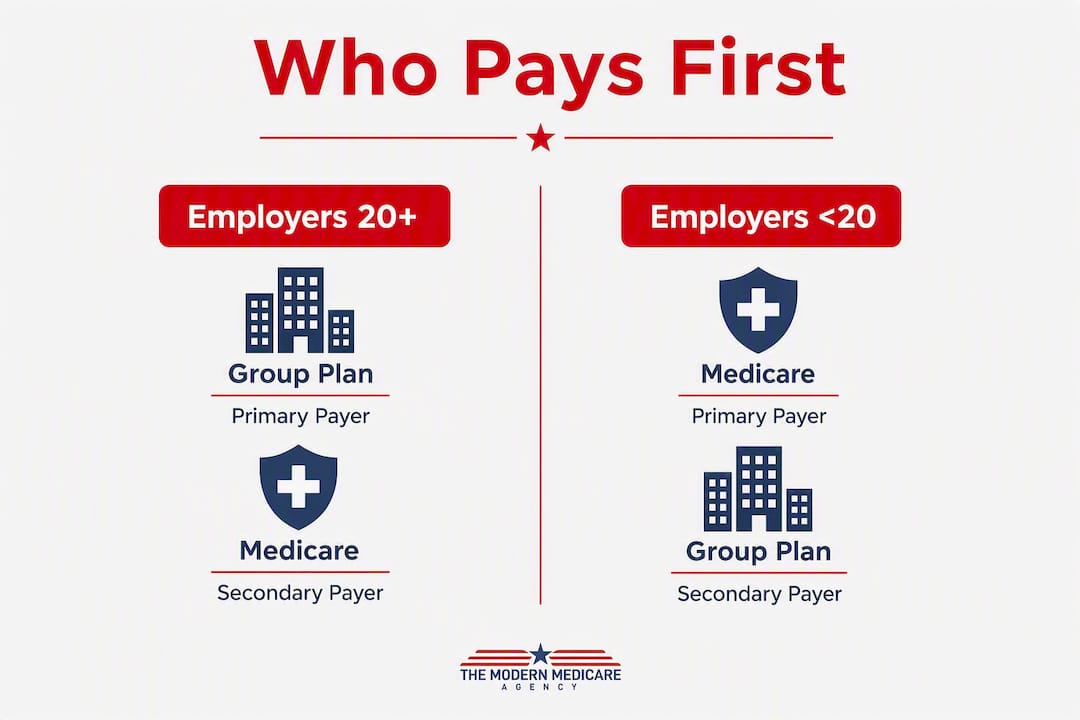
For people still working and covered by an employer plan, the primary/secondary determination comes down to employer size.
The employer-size tests
| Employer size | Who pays first | Who pays second |
|---|---|---|
| 20 or more employees | Group health plan | Medicare |
| Fewer than 20 employees | Medicare | Group health plan |
| Multi-employer or union plan | Varies by plan rules | Confirm with plan admin |
| Tribal employer plans | Special rules apply | Contact Medicare directly |
For employers with 20 or more employees, the group plan is primary and Medicare is secondary. For employers with fewer than 20 employees, Medicare pays first, and the employer plan wraps around it. If you work for a small employer and haven’t enrolled in Medicare Part B, you may be paying for coverage that won’t actually pay your claims, because the employer plan is waiting for Medicare to go first.
Union plans and multi-employer plans have their own coordination rules that don’t always follow the standard 20-employee test. Always confirm in writing with the plan administrator.
Pro Tip: Ask your employer’s benefits administrator for written confirmation of whether your plan is primary or secondary to Medicare. Providers can submit conditional Medicare claims if the primary payer doesn’t respond within approximately 120 days, per Medicare’s coordination rules, but that process is slower and messier than getting it right from the start.
Should you enroll in Part B now or wait while still working?
This is where people make the most expensive mistakes. The answer depends on your employer’s size and your specific situation.
If you work for a company with 20 or more employees and your coverage is based on current employment, you can safely delay Part B enrollment without penalty. Medicare allows you to use a Special Enrollment Period (SEP) when you eventually leave employment or lose that group coverage. That SEP gives you 8 months to enroll in Part B after employment or GHP coverage ends, whichever comes first.
If your employer has fewer than 20 employees, Medicare is primary. Delaying Part B in that situation means your employer plan may pay little or nothing on your claims, because it’s designed to supplement Medicare, not replace it.
Three common scenarios
Scenario 1: You work for a company with 150 employees.
Your group plan is primary. You can delay Part B without penalty as long as you’re actively employed and covered. When you retire, you have a limited period to enroll in Part B under the SEP. Enroll in Part A now (it’s usually free) so you have hospital coverage as a secondary benefit.
Scenario 2: You and your spouse both work, and you’re covered under your spouse’s employer plan.
The same employer-size test applies to your spouse’s employer. If their employer has 20 or more employees, you’re covered under a GHP based on current employment, and you can delay Part B. If their employer has fewer than 20 employees, Medicare should be primary for you.
Scenario 3: You work for a small firm with 12 employees.
Medicare is primary for you. Enroll in Part B during your Initial Enrollment Period (IEP) to avoid a late-enrollment penalty. Your employer plan will act as secondary coverage.
A simple decision flow
- Is your group coverage based on current employment (yours or your spouse’s)? If no, Medicare is primary. Enroll in Part B.
- Does the employer have 20 or more employees? If yes, the group plan is primary. You may delay Part B.
- Are you still actively employed? If you’ve retired or left, the SEP clock starts. You have 8 months.
- Have you compared total annual costs between your group plan and Medicare options? Compare premiums, deductibles, and out-of-pocket exposure before deciding to drop employer coverage.
For a deeper look at how employer and Medicare coverage interact, this coordination guide walks through the key differences side by side.
When do enrollment windows open, and how do you avoid Part B and Part D penalties?
Missing an enrollment window is one of the most common and most preventable Medicare mistakes. The penalties are permanent, and they compound over time.
Enrollment timeline
| Event | Enrollment window | Deadline to avoid penalty |
|---|---|---|
| Turning 65 (Initial Enrollment Period) | 7-month window: 3 months before, month of, 3 months after birthday | Enroll by end of IEP or qualify for SEP |
| Still covered by employer GHP (20+ employees) | Delay Part B without penalty while actively employed | Enroll within 8 months of losing coverage or employment |
| Employment ends or GHP coverage ends | 8-month SEP begins | 8 months from the later of employment end or coverage end |
| Part D (prescription drug coverage) | Enroll when first eligible or when employer drug coverage ends | Enroll within 63 days of losing creditable drug coverage |
The Part B late-enrollment penalty adds 10% to your monthly premium for every 12-month period you were eligible but didn’t enroll, and you pay that increase for as long as you have Part B. Someone who delays 3 years pays a 30% premium surcharge, permanently.
The Part D penalty works differently. It’s calculated as 1% of the national base beneficiary premium multiplied by the number of months you went without creditable drug coverage. That amount is added to your Part D premium every month, for life. The only way to avoid it is to have creditable employer drug coverage continuously and to document it properly.
The 8-month SEP rule is tied to when employment or GHP coverage ends, not when you turn 65. If you retire in March and your coverage ends in April, the 8-month clock starts in April. Missing that window means waiting for the General Enrollment Period (January 1 through March 31), with a penalty attached.
What is creditable coverage for Part D, and how do you get the letter?
“Creditable coverage” means your employer’s prescription drug plan is at least as good as the standard Medicare Part D benefit. If it is, you can delay enrolling in a standalone Part D plan without penalty. If it isn’t, you need to enroll in Part D during your IEP or face a late-enrollment penalty when you eventually do sign up.
Employers are required to notify you each year whether their drug coverage is creditable. They typically send this notice before October 15, the start of Medicare’s Annual Enrollment Period. But you shouldn’t wait for the annual mailing. Ask for it proactively, especially if you’re approaching 65 or leaving employment.
What to do with the creditable coverage notice
- Keep every notice you receive, even after you leave the employer. You may need to show it to Medicare or a Part D plan when you enroll.
- Store a digital copy (email or scanned PDF) and a physical copy in a dedicated Medicare folder.
- If your employer tells you verbally that coverage is creditable, ask for written confirmation. Verbal assurances don’t protect you from a penalty.
- If coverage is not creditable, enroll in a standalone Part D plan during your IEP to avoid the penalty clock starting.
Pro Tip: Request the creditable coverage notice in writing as soon as you turn 64, not 65. Some employers send it automatically; others don’t. Getting it early gives you time to act before your IEP opens.
Here’s a short email you can send to your HR department or plan administrator:
Subject: Request for Medicare Part D Creditable Coverage Notice
Dear [HR Contact / Benefits Administrator],
I am approaching Medicare eligibility and need to confirm whether our employer’s prescription drug plan qualifies as “creditable coverage” under Medicare Part D. Could you please provide me with a written creditable coverage notice at your earliest convenience? I understand this notice is required annually and also upon request.
Please let me know if you need any additional information from me.
Thank you,
[Your Name]
How do retiree plans and COBRA coordinate with Medicare?
This is where a lot of people get into trouble, because retiree coverage and COBRA feel like they should work the same way as active employer coverage. They don’t.
Neither retiree coverage nor COBRA qualifies as a Group Health Plan based on current employment. That distinction matters because it removes the protection that lets you delay Part B. Once you’re Medicare-eligible and enrolled, Medicare is generally primary, and your retiree plan or COBRA coverage wraps around it as secondary.
Many retiree plans are specifically designed to coordinate with Medicare. Some will reduce their payment if Medicare is available and you haven’t enrolled, leaving you with a larger out-of-pocket bill than you expected. A few plans will terminate your retiree coverage entirely if you don’t enroll in Medicare when you become eligible. Always read your retiree plan’s Summary Plan Description before making any decisions.
COBRA is a temporary bridge, not a long-term strategy. Group health insurance tied to employment ends when employment ends, and COBRA simply extends that coverage for a limited period at full cost. It does not count as current employment coverage for Medicare coordination purposes.
A common and costly mistake: Someone retires at 65, keeps their retiree health plan, and assumes it counts as current employer coverage. They delay Part B enrollment. When they eventually try to enroll, they discover they don’t qualify for the SEP because retiree coverage isn’t a GHP based on current employment. They’re now subject to the late-enrollment penalty and must wait for the General Enrollment Period. That’s a real scenario, and it happens more often than it should.
What questions should you ask HR, and what documents do you need?
Getting the right documents from your employer is the single most important thing you can do before making any Medicare enrollment decision. Here’s a step-by-step checklist.
- Contact the SSA or Medicare.gov. Once you have your plan documents, call SSA at 1-800-772-1213 or visit Medicare.gov to confirm your enrollment options and SEP eligibility.
- Compare your options before dropping employer coverage. Review total annual costs, including premiums, deductibles, and copays, across your employer plan and Medicare alternatives. A Medicare vs employer coverage comparison can help you see the full picture.
Exact questions to ask HR
Pro Tip: Save every email and dated letter related to your Medicare coordination questions. The absence of documentation is the most common reason people lose disputes over late-enrollment penalties. Keep both a digital and a physical copy, and note the date of every phone call with the name of the person you spoke to.
What should you do if a claim is denied or you get an unexpected bill?
Coverage disputes happen, especially during transitions between employer coverage and Medicare. Here’s how to handle them.
- Tell your provider about all your coverage — Make sure every provider has both your Medicare information and your group plan information on file. Providers sometimes submit to only one payer, which causes delays and denials.
Pro Tip: If your provider hasn’t received a response from the primary payer after about 120 days, ask them to bill Medicare as a conditional payer while you continue pursuing the primary payer. This keeps your claim moving and protects you from provider collections.
Key Takeaways
Whether Medicare or your group plan pays first depends on employer size and whether coverage is based on current employment — getting that answer from HR in writing is the single most important step you can take.
| Point | Details |
|---|---|
| Employer size determines who pays first | Plans from employers with 20+ employees pay primary; Medicare pays primary for employers under 20. |
| Retiree and COBRA coverage are not current employment GHPs | Neither qualifies for the SEP delay; Medicare is generally primary once you’re eligible and enrolled. |
| The Part B SEP window is 8 months | You have 8 months after employment or GHP coverage ends to enroll in Part B without a penalty. |
| Keep your creditable coverage letter | Your employer’s written notice protects you from a Part D late-enrollment penalty when you later enroll. |
| Paulbinsurance offers free plan comparisons | Paulbinsurance’s independent agents help you compare Medicare Supplement, Advantage, and Part D options alongside your employer coverage. |
The rule most people learn too late
The coordination rules for Medicare and employer group coverage aren’t complicated once you know the framework. But the mistakes people make are almost always the same: they assume retiree coverage works like active employment coverage, they don’t request the creditable coverage letter until they need it, or they miss the 8-month SEP window because no one told them the clock had started.
What’s worth saying plainly is that HR departments are not Medicare experts. They know their plan, but they may not know how it interacts with Medicare’s secondary payer rules, especially for edge cases like multi-employer plans or spouses covered under a different employer. The written documentation you request from HR is only as useful as your ability to interpret it correctly.
The conventional wisdom is to “just call Medicare.” That’s fine for basic questions, but Medicare’s phone representatives can tell you the rules; they can’t tell you whether your specific employer plan qualifies as a GHP based on current employment, or whether your drug coverage is actually creditable. That determination lives in your plan documents. Getting a second set of eyes on those documents, from someone who reads them regularly, is where most people avoid the expensive mistakes.
How Paulbinsurance helps you get this right
Sorting out Medicare and group health insurance coordination is genuinely one of the more complex decisions Medicare-eligible people face. The rules are specific, the penalties are permanent, and the documentation requirements are easy to overlook until it’s too late.
Paulbinsurance is a team of independent Medicare agents who specialize in exactly this kind of situation. Whether you’re still working and trying to decide whether to delay Part B, comparing a Medicare Supplement plan against your employer’s retiree coverage, or trying to figure out whether your drug plan is creditable, the team can walk you through it without selling you something you don’t need.

Services include enrollment guidance, Part D plan comparisons, Medicare Supplement and Medigap cost analysis, and retiree-plan coordination review. Paul Barrett has been helping Medicare consumers since 2007, and the agency’s approach starts with education: you understand your options before you make any decision.
If you’re approaching 65 or leaving employer coverage soon, request a free plan comparison to see how your current coverage stacks up against Medicare Advantage and Medigap options. There’s no obligation, and it takes less time than a call to your HR department.
Authoritative sources and where to read more
- Who pays first? | Medicare.gov: The official CMS page on coordination of benefits, employer-size rules, and primary/secondary payer determinations.
- How Medicare works with other insurance | Medicare.gov: Explains conditional payments, how to submit claims when you have multiple payers, and what to do when a primary payer is slow to respond.
- Working past 65 | Medicare.gov: Covers enrollment decisions for people still employed, including when to contact your employer’s benefits administrator.
- Group Health Plan definition | SSA.gov: The SSA’s definition of a GHP based on current employment, including the Special Enrollment Period rules and the 8-month window.
- Your coverage options | Medicare.gov: Compares Original Medicare and Medicare Advantage side by side, useful when evaluating what to do after employer coverage ends.
- Health Plans and Benefits | U.S. Department of Labor: Covers ERISA protections for employer health plan participants, including rights to plan documents and appeals.
- Group health insurance overview | Investopedia: A plain-language explanation of how group health insurance works, including the risks of coverage tied to employment status.