
If you’re searching for powersinsurance.net alternatives with a real Medicare focus, the short answer is this: Paulbinsurance is the strongest independent, education-first option, followed by Boomer Benefits, eHealth, SelectQuote, and local independent agents—depending on how you prefer to shop and which level of in-person, online, or consultative support you want. (See the shortlist below for important differences in product focus and ongoing service.)
Powers Insurance & Risk Management is a long-established, family-owned generalist agency built around commercial and personal lines, including alternative risk financing for large commercial clients. If you came to them for Medicare, you were likely getting a generalist’s answer to a specialist’s question.
Here’s the shortlist at a glance:
- Paulbinsurance — independent Medicare brokerage, education-first, annual plan reviews, ongoing advocacy
- Boomer Benefits — Medigap-focused brokerage with strong post-enrollment support
- eHealth — national online marketplace for fast self-serve plan comparisons
- SelectQuote — large quote-comparison service with broad carrier access
- Local independent Medicare agents — hands-on, in-person or phone support with local plan knowledge
For most Medicare shoppers, calling Paulbinsurance first saves time. If you prefer to browse plans yourself before talking to anyone, eHealth or SelectQuote let you start online.
Key Takeaways
For Medicare shoppers leaving a generalist agency, an independent Medicare-focused broker like Paulbinsurance gives you multi-carrier plan comparisons, annual reviews, and ongoing advocacy that a large marketplace or generalist agency typically does not.
| Point | Details |
|---|---|
| Generalist vs. specialist | Powers Insurance focuses on commercial lines; Medicare shoppers need a Medicare-specialist broker. |
| Top independent option | Paulbinsurance offers Medigap, Advantage, Part D, and ongoing annual reviews at no cost to the consumer. |
| Enrollment timing matters | Missing your Initial Enrollment Period can trigger Medigap underwriting; the Annual Enrollment Period runs from October 15 through December 7. |
| Ask two key questions | Confirm any agent offers annual plan reviews and will help with claims disputes before you enroll. |
| Paulbinsurance next step | Book a free consultation at paulbinsurance.com for a side-by-side plan comparison across multiple carriers. |
This article is general information, not a substitute for advice from a qualified financial advisor. Consult a qualified financial professional about your own circumstances before acting on anything here.
Table of Contents
- What are the best powersinsurance.net alternatives for Medicare?
- How we chose these alternatives
- What do Medicare plans actually cost through these agencies?
- When can you enroll or switch Medicare plans?
- How do these agencies handle customer service and complaints?
- What most people miss when switching Medicare agencies
- Paulbinsurance: free Medicare consultation, no pressure
- Sources
What are the best powersinsurance.net alternatives for Medicare?
Paulbinsurance strengths: Independent access to multiple carriers, dedicated Medicare eligibility guidance, annual plan reviews, and a product range that covers Medigap, Advantage, Part D, dental, and long-term care under one roof.
Paulbinsurance watch: Phone and online only; no walk-in office for consumers who want face-to-face.
Boomer Benefits strengths: Deep Medigap expertise, well-regarded post-enrollment claims support.
Boomer Benefits watch: Less emphasis on Medicare Advantage than on supplements.
eHealth strengths: Fast online comparisons, large plan database, no phone call required to browse.
eHealth watch: Operates partly as a lead marketplace; ongoing advocacy after enrollment is limited.
SelectQuote strengths: Broad carrier access, quick rate comparisons across many plans.
SelectQuote watch: Agent depth on Medicare nuances varies; primarily a rate-shopping tool.
Local independent agents strengths: Face-to-face enrollment help, deep local plan knowledge, strong claims advocacy.
Local independent agents watch: Quality and carrier access vary widely by agent and state.
How we chose these alternatives
Disclosure: Paulbinsurance publishes this article and is one of the recommended options. That creates a potential bias, which is why the selection criteria below are stated explicitly so you can weigh them yourself.
Selection was based on:
- Medicare-specific product range — does the agency or platform cover Medicare Advantage, Medigap, and Part D as core products, not add-ons?
- Licensing and availability — is the option accessible to most U.S. Medicare consumers, or limited to select states?
- Enrollment channels — can consumers enroll by phone, online, or in person?
- Ongoing advocacy — does the agency offer annual plan reviews and help with claims or billing disputes after enrollment?
- Fee and commission transparency — is it clear the agent is paid by carriers, not the consumer?
- Customer-service signals — are there verifiable reviews, BBB profiles, or industry recognition?
Primary sources: publisher pages, independent agency industry coverage, and official Medicare references. No paid placements influenced the rankings.
What do Medicare plans actually cost through these agencies?
The agencies and platforms above charge you nothing directly. Every one of them is paid a commission by the insurance carrier when you enroll. Your premium is the same whether you use an agent or enroll directly through Medicare.gov.
What varies is the plan itself:
- Medicare Advantage (Part C): Many plans carry a $0 monthly premium, though you pay cost-sharing when you use care; this is common among such plans. Plans with richer benefits typically carry a modest premium.
- Medigap (Medicare Supplement): Premiums vary by plan letter, age, and state. Plan G, currently the most popular choice for new enrollees, typically costs a moderate monthly premium that varies by location and carrier. Paulbinsurance’s Medigap cost guide walks through the trade-offs in detail.
- Part D (prescription drug plans): Standalone Part D premiums typically range from under $10 to over $100/month depending on your drug list and preferred pharmacy network.
The right plan type depends on your health use, budget, and whether you want predictable costs (Medigap) or lower premiums with cost-sharing (Advantage). A side-by-side breakdown is at Paulbinsurance’s Advantage vs. Medigap guide.
When can you enroll or switch Medicare plans?
Timing matters more than most people realize. Missing a window can lock you into a plan for a full year, or trigger medical underwriting for Medigap.
- Initial Enrollment Period (IEP): Starts three months before your 65th birthday month, includes your birthday month, and ends three months after. This enrollment window is typically the best time to enroll in Medigap without underwriting.
- Annual Enrollment Period (AEP): October 15 through December 7 each year. During this time, consumers can switch Medicare Advantage plans or Part D plans; changes take effect January 1.
- Medicare Advantage Open Enrollment: January 1 through March 31. During this period, those already enrolled in a Medicare Advantage plan may switch to a different Advantage plan or revert to Original Medicare once.
- Special Enrollment Periods (SEPs): Triggered by life events such as losing employer coverage, moving, or a plan leaving your area.
Any of the agencies above can walk you through which window applies to your situation. Paulbinsurance’s eligibility and enrollment guide covers each period with plain-language explanations.
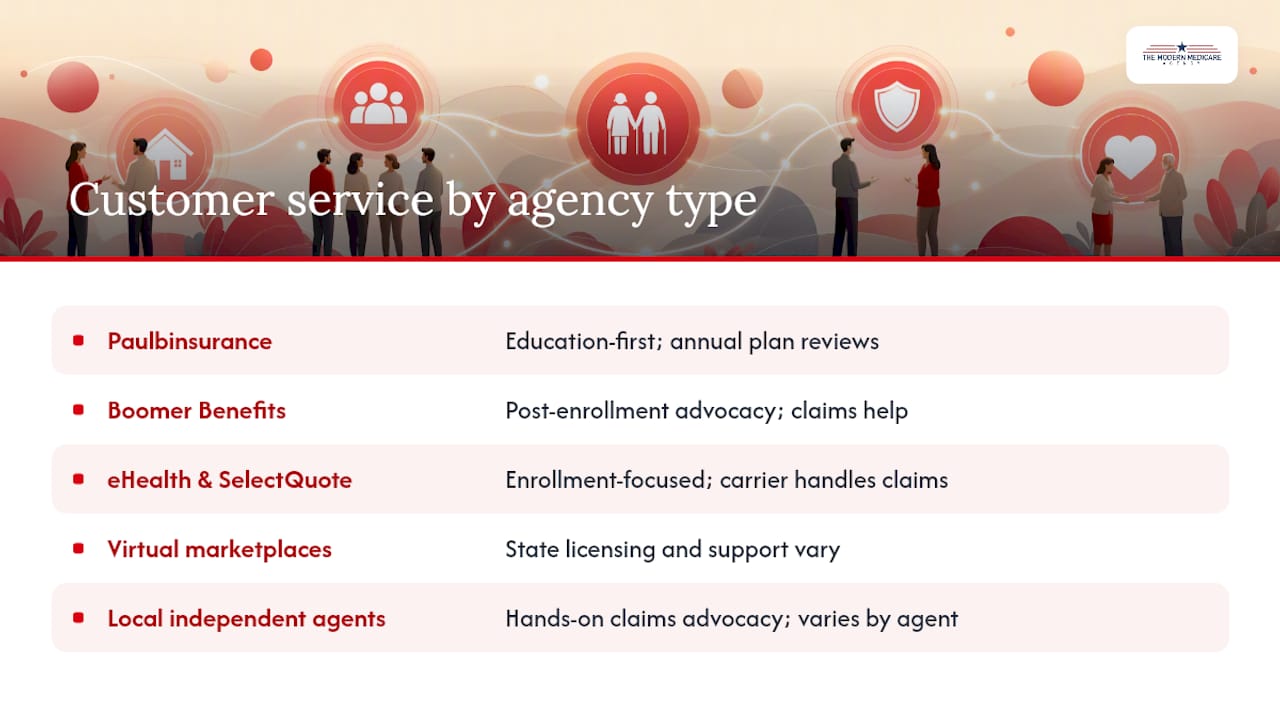
How do these agencies handle customer service and complaints?
This is where independent agents and large marketplaces diverge most sharply.
Paulbinsurance operates on an education-first model: the goal is that you understand your plan before you enroll, which reduces post-enrollment confusion. Annual plan reviews are a standard part of the relationship, not an upsell.
Boomer Benefits has built a reputation specifically around post-enrollment support, including helping clients navigate billing disputes and claims denials with carriers. That focus on after-the-sale advocacy is a genuine differentiator for Medigap buyers.
eHealth and SelectQuote are primarily enrollment platforms. Once you’re enrolled, your primary contact for claims issues is the carrier directly. Some agents within those networks do provide follow-up, but it is not a guaranteed service model. Virtual and comparison marketplaces vary in state licensing and ongoing support, which matters when you need someone to go to bat for you at renewal.
Local independent agents tend to offer the most hands-on claims advocacy, simply because their business depends on local referrals and long-term relationships. The trade-off is that carrier access and Medicare expertise vary by individual agent.
For complaint resolution, every licensed agent is regulated by their state insurance department. You can verify any agent’s license and check for disciplinary history through your state’s insurance commissioner website.
What most people miss when switching Medicare agencies
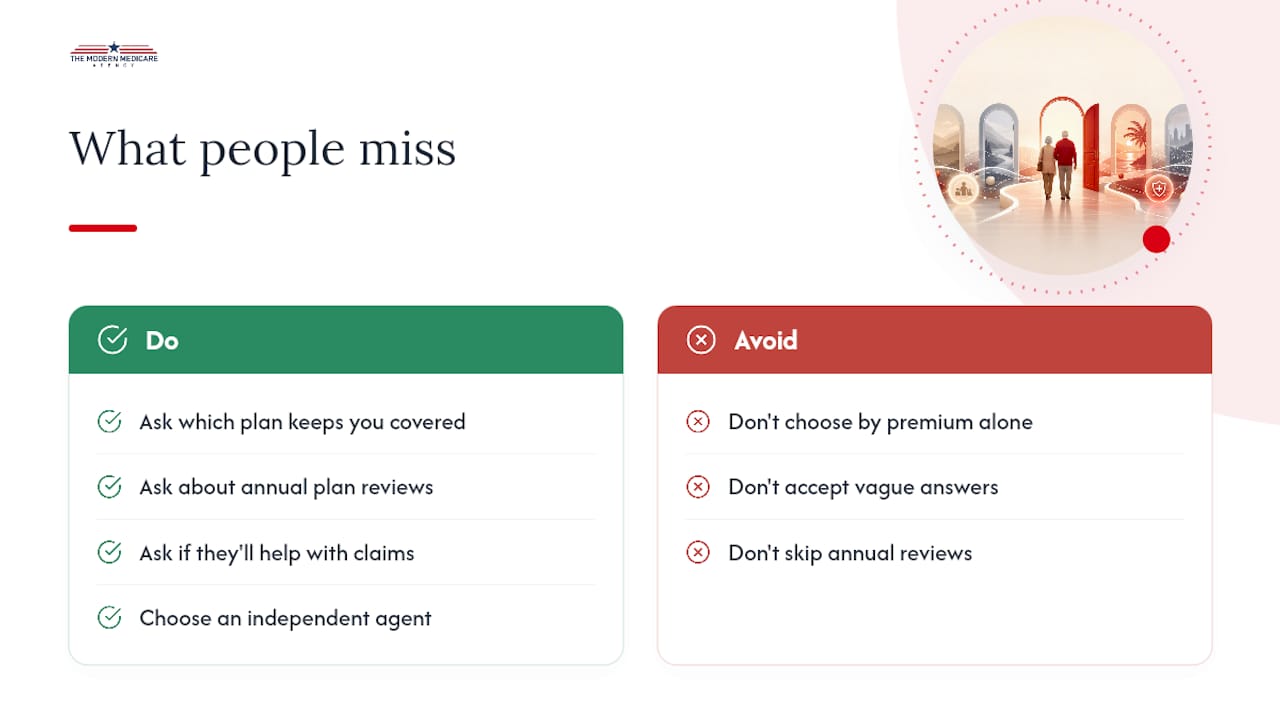
The question I hear most often is: “Which plan is cheapest?” That’s the wrong starting question.
The right question is: “Which plan keeps me covered when I actually need care?” A $0-premium Advantage plan with a narrow network can cost far more than a Medigap plan if you need a specialist outside that network. I’ve seen clients switch to a lower-premium plan during AEP and then face unexpected out-of-pocket costs the following spring because no one walked them through the network restrictions.
The other thing people consistently underestimate is the value of the annual review. Plans change every year. Premiums shift, formularies change, networks shrink. An agent who calls you every October to check whether your plan still fits your situation is worth more than a one-time enrollment transaction. When you’re evaluating any agency, ask two questions upfront: “Do you do annual plan reviews?” and “Will you help me if I have a claims dispute?” If the answer to either is vague, keep looking.
Independent agents, whether at Paulbinsurance or a local agency, tend to win on both counts because their business model depends on keeping clients, not just enrolling them.
Pro Tip: Ask any agent you’re considering whether they are captive (representing one carrier) or independent (representing multiple carriers). An independent Medicare agent can show you plans from multiple insurers side by side; a captive agent can only sell you what their one carrier offers.
Paulbinsurance: free Medicare consultation, no pressure
If you’ve been with a generalist agency and want a broker who works exclusively in Medicare, Paulbinsurance is the direct next step. Paul Barrett has been assisting Medicare consumers since 2007, and the agency covers a full product range including Medicare Advantage, Medigap, Part D, dental, critical illness, hospital indemnity, long-term care, and final expense.

A first appointment covers your eligibility window, a side-by-side plan comparison across multiple carriers, and a plain-language cost estimate. No obligation, no pressure. You can start with the Medicare Advantage overview or go straight to the Medigap cost guide if you already know which product you’re leaning toward. Ready to compare your options? Paulbinsurance.
Sources
- How one independent agency is embracing AI as catalyst, not competitor | Insurance Business
- Insurance Agency | Powers Insurance & Risk Management
- Compare Insurance Quotes: Life, Health, Car, Home & Employee Benefits | Care Insures