
Choosing the most expensive Medicare supplement plan doesn’t always mean you’re getting the best value for your retirement. You’ve likely felt the weight of those thick Medicare handbooks or felt pressured by agents who only show you one option. It’s stressful to worry that a single hospital visit could wipe out your savings because you picked the wrong letter. This medigap plan g vs plan n comparison is designed to replace that anxiety with clarity.
We will clear the confusion between these two popular options so you can choose your 2026 coverage with total peace of mind. You deserve to know how the $257 Part B deductible affects your wallet and whether Plan N’s small copays are a fair trade for lower monthly premiums. We’ll walk through the specific differences in excess charges and out of pocket costs, giving you a structured path from uncertainty to a confident decision for your 2026 healthcare needs. By the end of this guide, you’ll see exactly which plan protects your budget while giving you the freedom to see any doctor who accepts Medicare.
Key Takeaways
- Understand why Plan G has become the primary “safety net” choice for those seeking the most comprehensive coverage available in 2026.
- Learn how a medigap plan g vs plan n comparison helps you weigh the benefit of lower monthly premiums against small, manageable copays.
- Discover the truth about “Excess Charges” and how they impact your choice depending on your location and your doctors.
- Identify the shared costs both plans have in common, such as the $257 Medicare Part B deductible, to build an accurate retirement budget.
- Gain a simple, step-by-step framework to decide whether you value total cost certainty or prefer paying for care only as you use it.
Medigap Plan G vs. Plan N: Why These Are the Top Choices in 2026
Choosing a plan shouldn’t feel like a high-stakes gamble. For years, Plan F was the “easy” choice, but since January 1, 2020, it hasn’t been available to those new to Medicare. This shift has left two clear leaders in the market. Plan G has stepped up as the most comprehensive safety net available today, covering almost everything after you meet your deductible. Meanwhile, Plan N has become the preferred choice for healthy retirees who want to save on monthly premiums without sacrificing essential protection. Both options serve a single, vital purpose: they fill the financial holes left by Original Medicare.
What is a Medicare Supplement Plan?
Original Medicare is great, but it doesn’t pay for everything. Medigap (also called Medicare supplement insurance) is private coverage designed to pay those leftover costs, like the 20% coinsurance you’d otherwise owe for doctor visits or hospital stays. Because these plans are standardized by the government, the benefits for a specific letter are identical regardless of which company you choose. This means you can visit any doctor in the United States who accepts Medicare. There are no networks to worry about and no referrals required. It’s about giving you back control over your own healthcare journey. You can learn more about how these Medigap plans work to protect your retirement savings and provide long-term security.
Why 2026 is the Year to Compare These Two
Healthcare costs are rising, and your fixed retirement budget needs to keep pace. In 2026, the Medicare Part B deductible has reached $257. This is a cost you’ll face regardless of which plan you pick, making a medigap plan g vs plan n comparison more important than ever before. Plan G offers total predictability; you pay your premium and your deductible, and you’re done for the year. Plan N offers lower monthly costs, but you’ll pay small copays for doctor and emergency room visits. With premium savings for Plan N often ranging between $240 and $600 per year, the “right” choice depends on how often you see your doctor. Locking in your rate during your one-time Open Enrollment Period is the best way to ensure you aren’t subject to medical underwriting later. We’re here to help you shop the entire market of 40+ carriers to find the best 2026 rates for your specific needs.
What Plan G and Plan N Have in Common: The Foundation of Your Coverage
While much of the medigap plan g vs plan n comparison focuses on where these plans differ, it’s reassuring to know they share a very strong foundation. Both plans are designed to remove the most frightening financial risks of Original Medicare. Whether you choose G or N, you are securing a safety net that covers the most expensive “gaps” in your healthcare. This shared protection ensures that a sudden health crisis won’t lead to a sudden financial crisis.
The Standardized Benefit Rule
One of the most comforting aspects of Medicare Supplement insurance is that the benefits are standardized by federal law. This means a Plan G offered by one insurance company must provide the exact same medical coverage as a Plan G from any other company. The same rule applies to Plan N. This standardization exists to protect you from hidden coverage gaps or confusing fine print. According to the official U.S. government site for Medicare, the only real differences you’ll find between carriers are the monthly premium prices and the quality of their customer service. Because the benefits are identical, you can focus your energy on finding a stable company with a fair price rather than worrying about the quality of the care itself.
Hospital and Skilled Nursing Coverage
Both Plan G and Plan N provide exceptional protection for inpatient care. In 2026, the Medicare Part A hospital deductible remains a significant expense that you would otherwise have to pay out of your own pocket. Both plans cover 100% of this deductible. They also provide an additional 365 days of hospital coverage after your Medicare benefits are exhausted. If you require time in a skilled nursing facility, both plans cover the coinsurance that Medicare doesn’t pay. This means you can focus entirely on your recovery instead of counting the days and worrying about the mounting daily costs of a long-term stay.
Beyond the hospital walls, both plans offer the same level of freedom. You’ll never have to check if a doctor is “in-network” because these plans don’t use networks. If a physician accepts Medicare, they accept your Plan G or Plan N. This freedom extends even when you leave the country. Both plans include foreign travel emergency care, covering 80% of the cost for medically necessary emergency care outside the U.S., up to plan limits. This shared baseline of security is why so many retirees feel confident choosing between these two options. If you’re feeling overwhelmed by the choices, you can view our Medigap comparison resources to see how these shared benefits fit into your 2026 retirement strategy.
The Key Differences: Copays, Excess Charges, and Your Monthly Budget
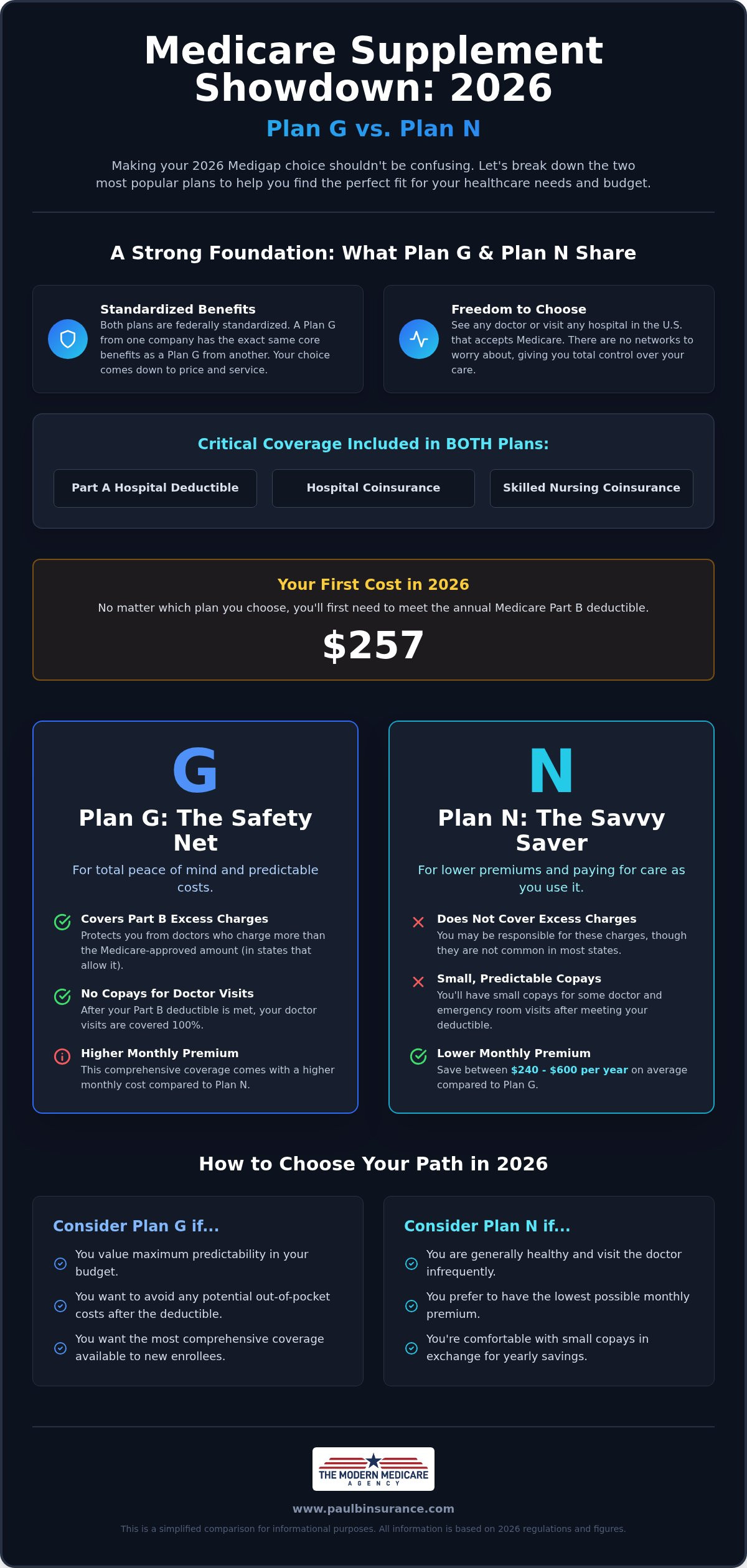
The heart of your medigap plan g vs plan n comparison lies in how you want to manage your monthly budget. Plan G is the “set it and forget it” option. Once you pay your $257 Part B deductible, you won’t see another medical bill for Medicare-covered services all year. Plan N is the “value” option. It offers lower monthly premiums, but you agree to pay small copays for certain visits. These premium savings often range from $240 to $600 per year compared to Plan G. For many people, these savings stay in their bank account rather than going to an insurance company.
Understanding Plan N Copays
Plan N keeps your monthly costs low by asking you to share a small part of the cost when you use medical services. You might pay up to $20 for an office visit, but this doesn’t apply to every medical encounter. For example, lab work and diagnostic tests typically don’t require a copay. Telehealth visits are also a great way to skip the office and the copay entirely. If you need the emergency room, there’s a $50 copay, but it’s waived if you are admitted to the hospital. Plan G has no copays at all. This difference is why Plan G is often called “peace of mind” coverage, while Plan N is seen as a smart budget choice for those who don’t need frequent doctor visits.
The Truth About Part B Excess Charges
An “Excess Charge” is an additional 15% that doctors who don’t accept Medicare assignment can charge. This is one of the biggest fears for new retirees, but the reality is much less stressful. Plan G covers these charges, while Plan N does not. However, more than 96% of doctors nationwide accept Medicare assignment. In states like Florida, that number is even higher. Several states actually prohibit these charges by law. These include Connecticut, Massachusetts, Minnesota, New York, Ohio, Pennsylvania, Rhode Island, and Vermont. Unless you see specialists who specifically opt out of Medicare’s standard pricing, you’ll likely never see an excess charge. We can help you compare these plans against your own doctor list to see if this is a factor you need to worry about.
2026 Cost Comparison: Which Plan Saves You More Money?
Money is often the biggest source of stress when you’re looking at a medigap plan g vs plan n comparison. You want to know if the higher monthly premium for Plan G is worth the total coverage it provides. Or, you might wonder if the lower cost of Plan N will eventually cost you more in doctor visit copays. The answer isn’t the same for everyone, but the math for 2026 is actually quite simple once you look at the numbers. We want to help you move from second-guessing your choice to feeling completely certain about your budget.
The Part B Deductible in 2026
In 2026, every Medigap shopper starts at the same baseline. Federal law prevents any Medigap plan from covering the Medicare Part B deductible for new enrollees. For 2026, this deductible is $257. This is the only out-of-pocket cost for Plan G users for the entire year. Once you pay those first $257 in medical bills, Plan G pays everything else. If you choose Plan N, you also pay this $257 first. The difference is that after the deductible is met, Plan N requires you to continue paying small copays, while Plan G does not. It is a good idea to set this amount aside in January so you’re prepared for your first few visits of the year.
Scenario: The Frequent Visitor vs. The Occasional Patient
Let’s look at the “break-even” point. Plan N premiums are typically $30 to $50 lower per month than Plan G. That adds up to a yearly savings of $360 to $600. If you save $480 a year on premiums by choosing Plan N, you would need to visit the doctor more than 24 times a year (at a $20 copay each) before Plan G becomes the cheaper option. For a healthy retiree who visits a specialist five times a year, Plan N is the clear mathematical winner. Even with a $50 emergency room visit, the “occasional patient” usually keeps more money in their own bank account with Plan N. You can find the best Medicare Supplement plans by looking at your specific health history and expected doctor visits.
The long-term view is also important. Historically, Plan N premiums have seen slightly more stable rate increases than Plan G. This happens because people with more chronic health conditions often choose Plan G for the total certainty. This leaves the “healthier” pool of people in Plan N, which can lead to lower claims for the insurance companies and smaller price hikes for you. If you value a predictable monthly bill above all else, Plan G is your best bet. If you prefer to keep your fixed costs as low as possible and don’t mind paying for care only as you use it, Plan N is likely your 2026 winner. To get a personalized look at the numbers for your specific area, you can find your 2026 rate through our independent agency today.
Choosing Your Path: How to Decide Between Plan G and Plan N
Deciding between these two often comes down to your personal comfort level with risk and your preference for how you pay for care. If you prefer to pay for your healthcare only when you use it, Plan N is likely your best fit. If you would rather pay a slightly higher monthly premium to ensure you never see a surprise bill, Plan G is the way to go. This medigap plan g vs plan n comparison shows that both paths lead to high-quality care. Your choice simply determines the rhythm of your medical expenses.
Before you sign, look at your local market. While we know most doctors accept Medicare assignment, it’s worth checking with your specific specialists. If you live in a state like New York or Ohio where excess charges are prohibited, Plan N becomes an even more attractive value. For those in other states who see doctors outside of major hospital systems, Plan G offers the simplicity of never having to ask about billing status. It’s the “sleep well at night” factor. You pay your premium, and the rest is taken care of.
The Advantage of an Independent Broker
Why settle for one or two options when you can see them all? A restricted agent only shows you the plans their specific company sells. We are independent brokers. This means we compare over 40 carriers across 34 states to find your lowest 2026 rate. Our mission is to protect you, not a corporate bottom line. We provide year-round support, which means we’re here to help if your premiums rise or if you have questions about a claim long after you’ve enrolled. We act as your advocate, removing the stress of high-pressure sales tactics and replacing them with clear, honest guidance.
Your Next Steps for a Stress-Free 2026
Ready to move from confusion to certainty? Start by gathering a list of your current doctors and medications. This ensures we check for any potential excess charges and help you learn about Medicare Part D to round out your coverage. Once you have your list, request a personalized comparison quote for your specific zip code. You don’t have to do this alone. You can contact The Modern Medicare Agency for a simple, expert review of your options today. We’ll walk through the math together so you can start your 2026 retirement journey with total peace of mind. We’re here to guide you through every step of the process.
Take Control of Your 2026 Healthcare Journey
Choosing between these two paths doesn’t have to be a source of stress. This medigap plan g vs plan n comparison has shown that both options provide a secure foundation for your retirement. Plan G offers the total peace of mind that comes with predictable costs, while Plan N provides a way to keep more money in your pocket through lower monthly premiums. Both plans protect you from the high costs of hospital stays and give you the freedom to see any doctor who accepts Medicare.
You don’t have to navigate these complex choices alone. As an independent broker, we compare over 40 insurance carriers across 34 states to find the exact right fit for your budget. We provide unbiased guidance and remain your advocate long after you’ve signed up. It’s time to move from confusion to total certainty about your future.
Get Your Free 2026 Medigap Comparison Quote and let us help you build a plan that fits your life perfectly. You’ve worked hard for your retirement, and we’re here to make sure your healthcare coverage works just as hard for you. You deserve to move forward with confidence and peace of mind.
Frequently Asked Questions
Is Medigap Plan G better than Plan N?
The better plan depends entirely on your health needs and your monthly budget. Plan G is the most comprehensive option because it covers all your costs once you meet the Part B deductible. Plan N is often the better value for those who don’t mind paying small copays in exchange for lower monthly premiums. This medigap plan g vs plan n comparison shows that both plans offer high-quality protection for your retirement.
Do Plan G and Plan N cover prescription drugs?
No, neither Plan G nor Plan N includes coverage for outpatient prescription drugs. Medigap plans are designed to fill the gaps in Medicare Part A and Part B only. To get coverage for your medications, you’ll need to enroll in a separate Medicare Part D plan. We can help you compare 40+ carriers to find a drug plan that covers your specific prescriptions at the lowest possible cost.
Can I switch from Plan N to Plan G later on?
You can apply to switch plans at any time, but you’ll typically need to answer health questions and pass medical underwriting. Unless you live in a state with special rules, the insurance company can deny your application based on your health history. This is why we recommend choosing the plan that fits your long-term needs right from the start. We can help you evaluate your health status to see if switching is a viable option.
What is the 2026 Part B deductible?
The Medicare Part B deductible is $257 in 2026. This is a yearly cost that you must pay before your Medigap plan starts covering your doctor visits and outpatient care. Because federal law prohibits new Medigap plans from covering this deductible, you’ll pay this amount whether you choose Plan G or Plan N. It’s a central part of any medigap plan g vs plan n comparison when calculating your total yearly costs.
Are Plan G and Plan N accepted by all doctors?
Yes, both plans are accepted by every healthcare provider in the United States who accepts Original Medicare. You never have to worry about staying within a specific network or getting referrals to see a specialist. This freedom of choice is one of the biggest benefits of choosing a Medigap plan. If your doctor takes Medicare, they’ll take your Plan G or Plan N coverage regardless of the insurance company you choose.
Do I need a separate dental plan if I choose Plan G or N?
Yes, you’ll likely want to add a separate dental insurance plan because Medigap doesn’t cover routine dental care. Standard supplement plans are focused on medical costs like hospital stays and doctor visits. They don’t provide benefits for cleanings, fillings, or dentures. We can help you find a standalone dental or vision policy that complements your Medigap coverage and fits your 2026 retirement budget without any added stress or confusion.
How much do Medigap premiums increase each year?
Premium increases vary by carrier and location, but they typically rise by a small percentage annually to keep up with healthcare inflation. Historically, Plan N has shown slightly more stable rate increases than Plan G. This is because the copay structure often attracts a healthier group of people, which leads to fewer claims for the insurer. We provide year-round support to help you monitor your premiums and shop for a new carrier if rates rise.
What happens if my doctor charges more than Medicare allows?
If your doctor charges more than the Medicare-approved amount, these are called Part B excess charges. Plan G covers these charges in full, so you won’t owe anything extra. Plan N doesn’t cover them, meaning you would pay the difference out of your own pocket. Fortunately, over 96% of doctors nationwide accept Medicare assignment. This means they agree not to charge these extra fees, making this risk very low in most states.

Article by
Paul Barrett
Paul Barrett, CMIP is the founder of The Modern Medicare Agency, an independent Medicare-only brokerage based in Melville, NY. With 18 years of Medicare-exclusive experience, a CMIP designation, and more than 5,000 clients served across 37 states, Paul is one of the most credentialed independent Medicare specialists on Long Island — and one of the most direct.
He represents 40+ carriers with no quotas and no allegiances, which means his recommendations are based entirely on what fits each client's specific situation. He is the author of Medicare Mastery Unlocked and host of the Wise Guys Retirement Talk podcast. His content is grounded in primary sources, real carrier intelligence, and 18 years of watching what happens when people get Medicare right — and when they don't.
📞 631-358-5793 | paulbinsurance.com