
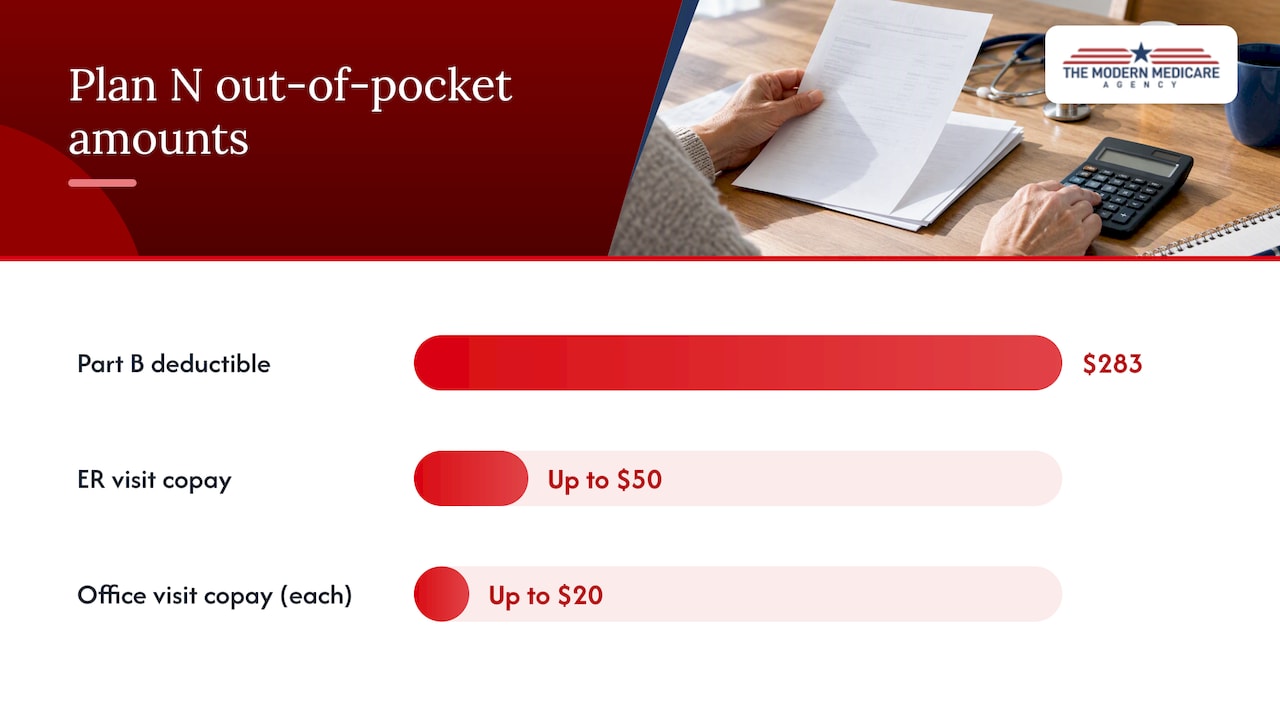
Medigap Plan N can require up to $20 for certain office visits and up to $50 for emergency room visits when you are not admitted, and it does not pay your Part B deductible. These rules explain why Plan N typically carries a lower premium than Plan G: you trade some predictable monthly savings for a handful of smaller bills tied to specific visit types and billing codes.
TL;DR:
- Plan N requires up to $20 for some office visits and $50 for ER visits when not admitted, with copays based on CPT codes and billing details.
- The Part B deductible of $283 in 2026 remains your responsibility before insurance coverage begins, regardless of the plan.
- ER copays are waived if the visit results in inpatient admission, but multiple visits can incur separate copays.
- The plan does not cover Part B excess charges and has no annual out-of-pocket maximum, which could lead to higher costs for frequent visits.
- Comparing total expected annual costs, including visit frequency and potential billing codes, is essential to choose the most cost-effective plan.
Table of Contents
- Plan N copays at a glance
- How copays are calculated: deductibles, coinsurance, and coding
- Emergency room copays, admissions, and examples
- What Plan N doesn’t cover and the tradeoffs to weigh
- How to estimate your expected annual cost with Plan N
- In many cases of confusing bills, the most common issue is not an insurer error but a coding mismatch: a visit gets billed under a code that triggers the $20 copay when the patient expected it to be fully covered. The fix almost always starts with the remittance advice, not a phone call to the insurer.
- Our take on where Plan N actually makes sense
- Get a personalized Plan N comparison from an independent agent
- FAQ
- Sources
Plan N copays at a glance
Before you look at the math behind these numbers, it helps to see them laid out plainly. Plan N follows a standardized set of copay rules that apply the same way no matter which insurer sells you the policy.
- You may owe up to $20 for some Part B office visits, based on the lesser of $20 or your actual Part B patient responsibility.
- You may owe up to $50 for an emergency room visit, but only when that visit does not result in an inpatient admission.
- Copays apply per qualifying visit, so two office visits in one day can mean two separate copays.
- Urgent care visits and services billed under different claim categories are not subject to the $20 or $50 copay rules at all.
Medicare’s own plan comparison chart confirms these exact thresholds: Plan N pays Part B coinsurance, but you pay up to $20 for some office visits and up to $50 for ER visits when you are not admitted. Those two numbers are the entire copay structure. Nothing else in Plan N works this way.
How copays are calculated: deductibles, coinsurance, and coding
The copay amount you actually owe depends on three things stacked on top of each other: the Part B deductible, the coinsurance math, and the billing code your provider uses.
First, the deductible. For 2026, the Medicare Part B deductible is $283, and Plan N does not cover it. You pay that amount out of pocket before Medicare starts sharing costs, regardless of which Medigap plan you hold.
Once the deductible is met, Plan N pays your Part B coinsurance, but the office-visit copay is calculated as the lesser of $20 or your Part B patient responsibility for that visit, not a flat $20 every time. According to CMS guidance on Plan N, the copay is tied to specific CPT and Evaluation and Management codes, commonly 99201 through 99205 and 99211 through 99215, along with select ophthalmology and psychotherapy codes. These codes identify a visit as an “office visit” for Plan N purposes. A service billed under a different code, such as a lab test, imaging, or a procedure done in a specialist’s office, will not trigger this copay at all.
To check what you actually owe on a bill, try this sequence:
- Pull up the remittance advice or Explanation of Benefits from Medicare.
- Look for the CPT or E&M code listed next to the charge in question.
- Confirm whether that code falls under the office-visit categories Plan N copays apply to.
- If you had more than one qualifying visit in a single day, expect a separate copay for each.
Pro Tip: Call your provider’s billing office and ask which CPT code they submitted before you assume a charge is wrong; most billing confusion traces back to a coding question, not an insurer error.
Emergency room copays, admissions, and examples
The ER copay works on a similar lesser-of-the-two basis, but with one major exception: it disappears entirely if you are admitted.
- Plan N applies one ER copay, up to $50, based on your total Part B patient responsibility when you are treated and released without inpatient admission.
- If your ER visit leads to a Part A inpatient admission, the ER copay is waived because the charges shift from Part B’s outpatient category to Part A’s hospital category.
- Say you go to the ER for chest pain, get evaluated, and are discharged the same day: you may owe up to $50 toward that visit.
- Say the same visit results in an overnight hospital admission for observation that becomes inpatient status: the $50 ER copay does not apply, since Part A now governs the claim.
- Multiple ER visits on different days, or even the same day for separate incidents, can each carry their own copay.
The distinction between “treated and released” and “admitted” is the single biggest factor in whether an ER bill includes that extra charge, so it is worth asking hospital staff about your admission status before you leave.
What Plan N doesn’t cover and the tradeoffs to weigh
Plan N’s lower premium comes with gaps that matter more to some beneficiaries than others.
- The Part B deductible, $283 in 2026, is entirely your responsibility under Plan N.
- Medicare’s Plan N coverage details confirm the plan does not cover Part B excess charges, the extra amount some providers can legally bill above the Medicare-approved rate.
- Plan N’s standardized benefits include no annual out-of-pocket maximum, so a year with frequent office visits or an ER trip adds up without a ceiling.
- The plan’s foreign-travel emergency benefit is limited to plan-specified maximums and is not a substitute for dedicated travel medical insurance when you travel outside the United States.
None of these gaps are dealbreakers on their own. The point is to weigh them against the premium savings rather than looking at the monthly price in isolation. Our guide to Medicare coverage for international travel and our breakdown of the foreign-travel emergency cap go into more detail if you travel often.
How to estimate your expected annual cost with Plan N
Comparing Plan N to other Medigap letters by monthly premium alone misses the real picture. Medicare recommends comparing total expected annual cost, not just the sticker price, since premiums vary by company and location.
- Multiply your insurer’s monthly premium quote for your ZIP code by twelve to get your annual premium baseline.
- Add the 2026 Part B deductible of $283, since Plan N never covers it.
- Estimate your expected number of office visits for the year and multiply by an amount up to $20, understanding that some visits may cost less depending on coding.
- Add a conservative allowance for one possible non-admitted ER visit, with a copay up to $50, plus a small buffer for potential excess charges.
- Compare that total against the same math run for Plan G or another Medigap letter before deciding.
Pro Tip: Run this calculation with your actual visit history from the past two years; most people overestimate how often they will land in the ER and underestimate routine office visits.
Our comparison of Plan G versus Plan N walks through this exact math side by side if you want a direct reference point.
In many cases of confusing bills, the most common issue is not an insurer error but a coding mismatch: a visit gets billed under a code that triggers the $20 copay when the patient expected it to be fully covered. The fix almost always starts with the remittance advice, not a phone call to the insurer.
A short script that works well with provider billing offices: ask what CPT code was submitted, ask whether that code falls under an office visit or a separate category, and request a corrected claim if the code looks mismatched to the service received. Comparing Plan N quotes across different carriers often reveals meaningful savings for the same standardized copay structure.
Our take on where Plan N actually makes sense
The conventional pitch for Plan N treats the $20 and $50 copays as a minor asterisk next to a lower premium. That undersells the real variable: how often you see specialists. A beneficiary with four or five office visits a year barely notices the copay difference against Plan G’s higher premium. Someone managing a chronic condition with monthly specialist visits can see those copays stack up fast enough to erase the premium savings within a year.
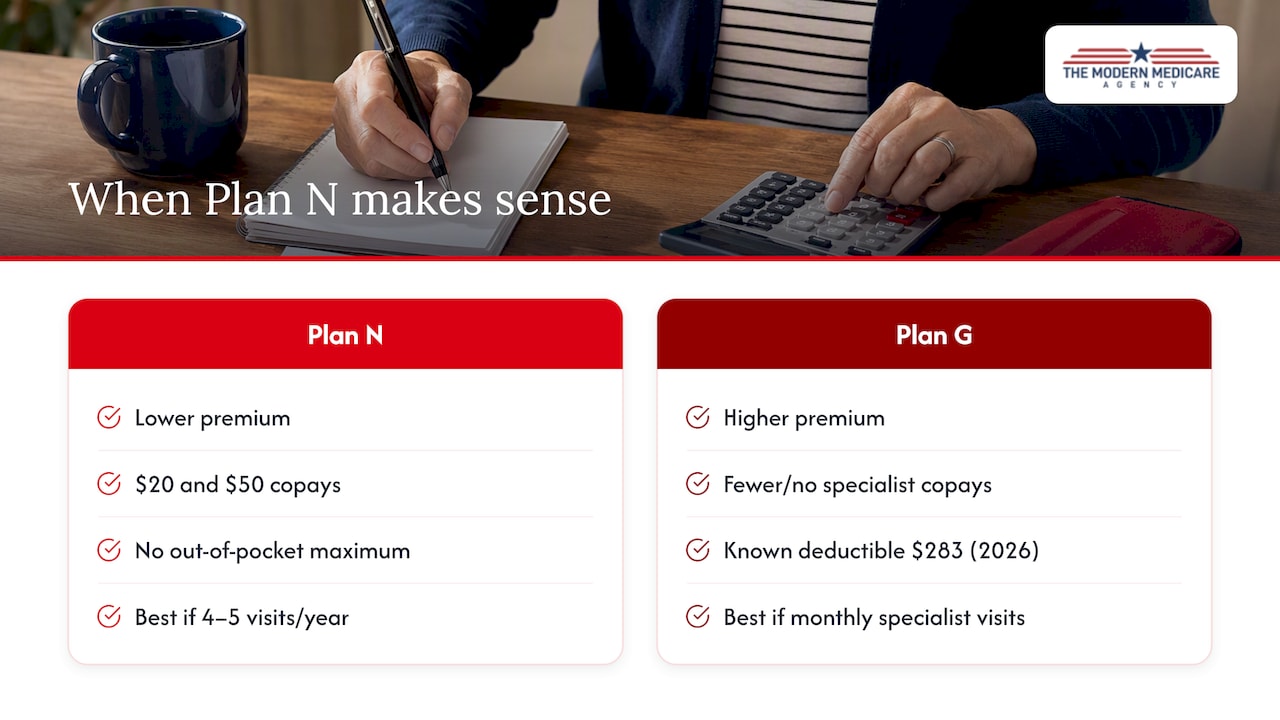
The bigger blind spot is the missing out-of-pocket maximum. Shoppers fixate on the deductible gap because it is a known, fixed number, $283 in 2026. The copays and potential excess charges are the open-ended part, and they deserve more attention than they usually get in plan comparisons.
Our advice: run your own visit history through the math before you compare premiums. The plan that looks cheaper on a rate sheet is not always cheaper by December.
— Paul
Get a personalized Plan N comparison from an independent agent
We compare Plan N quotes across carriers for your ZIP code and run the total-cost math, premium, deductible, expected copays, and realistic ER scenarios, so you see the real annual number before you enroll, not just the monthly rate.

- We request a free plan review and quote tailored to your expected visit patterns.
- We provide year-round support if a billing question or coding mismatch comes up after enrollment.
- We help you weigh Plan N against Plan G or other Medigap letters using total expected annual cost, not sticker price.
If you are ready to see how Plan N compares for your situation, visit our Medicare Supplement plans page to request a free comparison and quote.
FAQ
Does Medigap Plan N have a copay?
Yes. Plan N can require up to $20 for certain office visits and up to $50 for emergency room visits when you are not admitted, based on Medicare’s standardized benefit rules. Both amounts are capped at the lesser of the stated dollar figure or your actual Part B patient responsibility.
Who has the cheapest Medigap Plan N?
Premiums for Plan N vary by insurance company and by location, since Medicare confirms pricing depends on insurer and ZIP code rather than a single national rate. The only way to find the lowest cost for your area is to compare quotes from multiple carriers offering the same standardized Plan N benefits.
What are the disadvantages of Medigap Plan N?
Plan N does not cover the Part B deductible or Part B excess charges, and its standardized benefits include no annual out-of-pocket maximum. It also carries the office visit and ER copays that Plan G avoids, which can add up for beneficiaries with frequent specialist visits.
Which states have the most expensive Medigap plans?
Medigap premiums vary by state and insurer, and Medicare’s own guidance points to location as a key pricing factor rather than publishing a single ranked list of most expensive states. The most reliable way to know your cost is to request quotes specific to your ZIP code rather than relying on national averages.
Sources
- 2026 Medicare Parts B premiums and deductibles (CMS newsroom)
- Compare Medigap plan benefits | Medicare