




Could a Medicare-covered visit still leave you with a bill you didn’t expect? In 2026, you might be asking, medigap excess charges what are they, and when could they affect me? The answer depends on how your doctor bills and which Medigap plan you have. If a doctor doesn’t accept Medicare assignment, they may charge up to 15% above Medicare’s approved amount for certain Part B services.
That can feel unsettling, especially when “Medicare-covered” sounds like the amount is settled. It’s understandable to want a clear answer before an appointment. These charges follow specific rules, and some Medigap plans can cover eligible excess charges.
This guide explains when a Part B excess charge may apply, how Plans F and G handle it in 2026, and why Plan F isn’t available to everyone who is new to Medicare. You’ll also learn how to review provider assignment information and check your coverage. Knowing what to look for can help you make informed choices and reduce billing surprises.
Key Takeaways
- Understand what Medigap excess charges are and when one might appear on a Part B bill.
- Review whether your doctor accepts Medicare assignment and check your plan benefits to understand your potential costs.
- Compare Plans F, G, and N for excess-charge coverage, and keep Plan F eligibility rules in mind.
- Use Medicare.gov’s Care Compare tool and your Medicare claim information to review provider details and bills.
- Consider excess-charge protection alongside your eligibility, state availability, and the other benefits that matter to you.
What Are Medigap Excess Charges Under Medicare Part B?
An unfamiliar charge on a Medicare bill can be hard to interpret. The term “excess charge” has a specific meaning. It doesn’t describe every Medicare bill or every out-of-pocket cost.
Featured-snippet definition: A Medicare Part B excess charge is an amount a non-participating provider may bill above Medicare’s approved amount for certain covered services, up to the applicable limiting charge. In 2026, this federal limit can be up to 15% above the Medicare-approved amount. Whether it applies depends on the provider, service, and any relevant state rules.
This guide focuses on Original Medicare Part B services, such as covered doctor visits and other outpatient care. An excess charge is separate from other costs you may owe under Medicare. For a broader overview of Medicare Supplement Insurance (Medigap), including how standardized plan letters fit into coverage, see the linked reference. You can also review the Medigap plan overview for more about supplement coverage.
What does “Medicare-approved amount” mean?
The Medicare-approved amount is the amount Medicare recognizes for a covered service. It may be less than the provider’s full billed charge. Assignment and limiting-charge rules affect what the provider can collect from you. Providers may handle billing and claims differently, so the details of the service matter.
When can a Part B excess charge come up?
An excess charge may arise when a non-participating provider doesn’t accept assignment for a covered Part B service. Assignment means the provider agrees to accept Medicare’s approved amount as full payment for that service, apart from applicable cost-sharing. A non-participating provider can decide whether to accept assignment for a particular service, so the provider’s general status doesn’t tell you exactly how every claim will be handled.
Here’s a simple hypothetical sequence:
- You receive a covered Part B service from a non-participating provider.
- The provider doesn’t accept assignment and submits the claim to Medicare.
- Medicare determines the approved amount. If the service and billing meet the rules for a limiting charge, the provider may bill you up to the permitted amount above it.
That’s the basic idea behind medigap excess charges what are they: a possible, limited amount above Medicare’s approved figure, not an automatic extra fee on every bill. Your plan’s benefits and the details of the claim help determine what you may owe.
How Medicare Assignment and the Limiting Charge Affect Your Bill
Assignment helps determine how a provider bills Medicare for a covered Part B service. A provider who accepts assignment agrees to accept Medicare’s approved amount as full payment for that service, although you may still owe applicable costs such as your deductible or coinsurance.
What changes when a provider accepts assignment?
Providers that participate in Medicare generally accept assignment for all Medicare-covered services. Non-participating providers may accept assignment for some services but not others. A provider’s general status is useful to know, but it doesn’t guarantee how every claim will be handled. For a specific visit, both the service and the provider’s decision to accept assignment matter.
When assignment is accepted, the provider generally can’t bill a separate Part B excess charge for that service. That doesn’t mean the service is automatically covered or that you owe nothing. Coverage, claim details, other Medicare cost-sharing, and 2026 rules still affect the final bill.
What does the 15% limiting charge mean?
For applicable Part B services, the federal limiting charge caps what a non-participating provider who hasn’t accepted assignment can bill at up to 15% above Medicare’s approved amount. It’s a ceiling, not an automatic surcharge. The limit doesn’t apply to every Medicare bill or every service, and certain services may be subject to different rules.
Here’s how the billing steps can unfold:
- You receive a service. A non-participating provider furnishes a Part B service and doesn’t accept assignment for it.
- A claim is processed. Medicare reviews the claim and determines the approved amount under its rules.
- Payment and cost-sharing are applied. Medicare pays its share according to the claim, and you may owe your share of the covered cost.
- A possible excess charge is considered. If the service is subject to the limiting charge, the provider may bill no more than the permitted amount above Medicare’s approved amount.
This sequence can make a confusing bill easier to follow. Assignment is a key part of the answer to medigap excess charges what are they, but the provider’s status alone doesn’t tell the whole story. The specific service, claim, and applicable rules matter. Understanding how these details fit with your policy can also help you compare Medigap coverage options with greater confidence.
Which Medigap Plans Cover Part B Excess Charges?
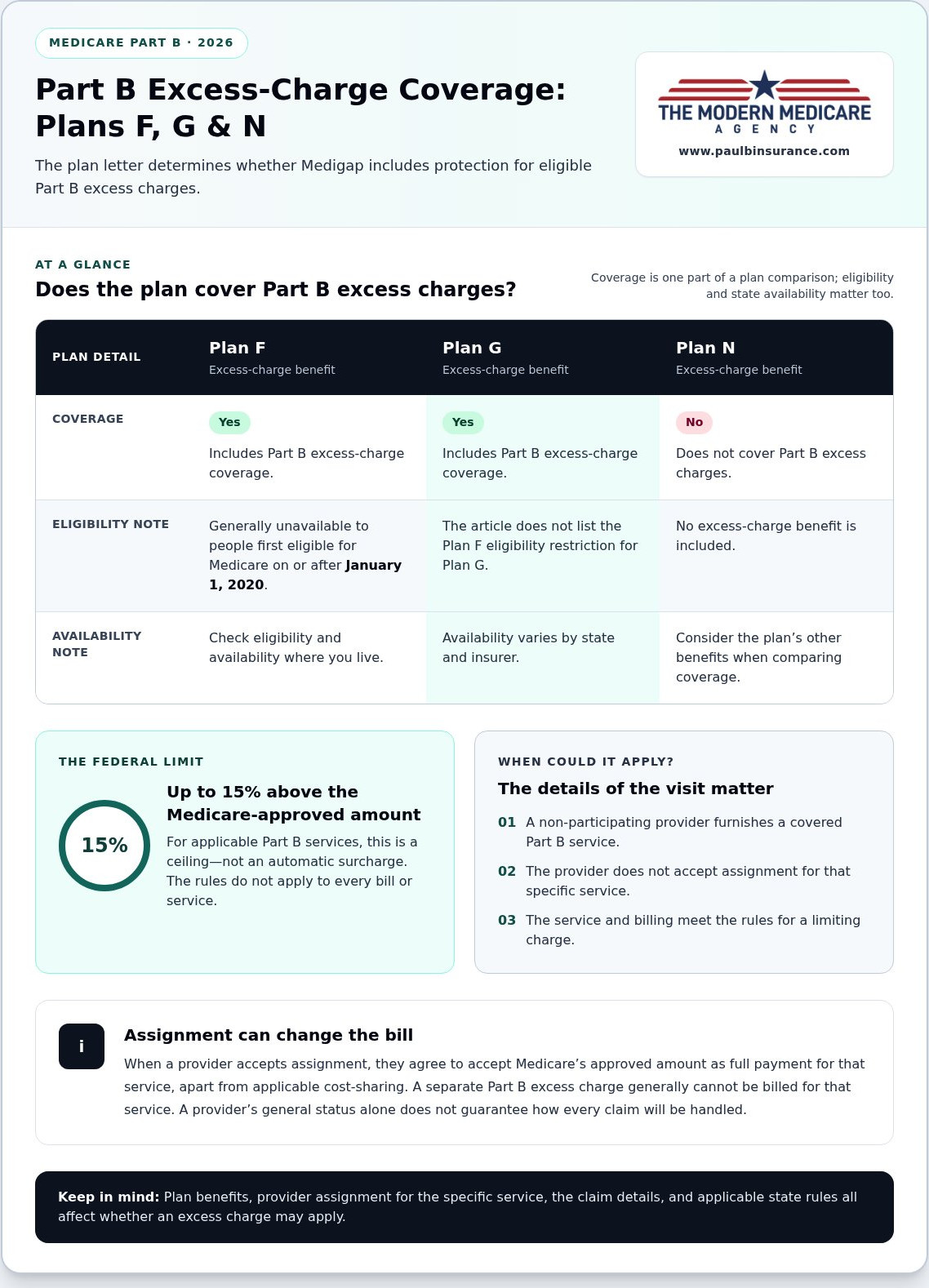
The plan letter matters when you’re checking whether Medigap may help with a Part B excess charge. In 2026, Plans F and G include this benefit under standardized Medigap coverage. Plan N does not. That’s an important difference, but it’s only one part of comparing coverage. Eligibility, state availability, and other benefits matter too.
| Medigap plan | Covers Part B excess charges? | Key point |
|---|---|---|
| Plan F | Yes | Generally unavailable to people first eligible for Medicare on or after January 1, 2020. |
| Plan G | Yes | Includes excess-charge coverage; availability varies by state and insurer. |
| Plan N | No | Doesn’t cover Part B excess charges. |
How Plans F and G treat excess charges
With Plans F and G, the standardized benefit includes coverage for eligible Part B excess charges. That can help protect you from paying the permitted amount above Medicare’s approved amount when a provider bills one. Plan F and Plan G aren’t interchangeable for everyone: Plan F is generally unavailable if you first became eligible for Medicare on or after January 1, 2020. Plan G may be an option, depending on state availability and eligibility.
Medigap benefits are standardized by plan letter, but the plans offered and their prices can vary by state and insurer. Before relying on a benefit, review the policy details available where you live in 2026. You can explore Medigap plan options and compare benefits alongside other factors that affect your coverage.
Does Medigap Plan N cover excess charges?
No. Plan N doesn’t cover Part B excess charges. That’s a clear difference from Plan G, but it doesn’t automatically make one plan right for everyone. Plan N also has separate cost-sharing rules, including certain copayments. Those costs are distinct from excess charges, so consider the full set of benefits and potential out-of-pocket expenses when comparing plans.
If you’re asking what medigap excess charges are and which plans address them, the short answer is that Plans F and G cover them, while Plan N doesn’t. Use that as one comparison point, then weigh eligibility, state availability, and the other coverage features that matter to you.
How to Check Your Exposure Before a Medicare Part B Visit
A little preparation can make a Medicare bill easier to understand, though it can’t prevent every out-of-pocket cost or claim question. Before a 2026 visit, review your coverage, the provider’s assignment information, and the benefits in your Medigap policy.
What should you check before receiving care?
- Confirm your coverage. Check whether the planned service is covered under Original Medicare Part B. Medicare.gov can help you review coverage information.
- Review provider assignment information. Use Medicare.gov’s Care Compare tool to review provider information. A provider’s general participation status may not tell you how every service will be billed.
- Review your Medigap benefits. Look at your plan letter and policy documents for the Part B excess-charge benefit. In 2026, Plans F and G generally include this coverage, while Plan N does not. Availability and eligibility can vary.
These checks can help you understand the likely billing path, but the specific service and claim still matter. For help comparing benefits and trade-offs, explore the available Medigap coverage options.
What if a bill appears to include an excess charge?
Don’t assume the first bill shows your final responsibility. For Original Medicare, compare the provider’s bill with your Medicare Summary Notice (MSN), which explains how Medicare processed the claim. Check the service, Medicare-approved amount, payment information, and any amount listed as your responsibility. Then review how your Medigap plan processed its share.
If something doesn’t line up, gather the bill, MSN, Medigap claim notice, and policy documents. Contact Medicare about how it processed the Original Medicare claim. For questions about your supplement benefit or its payment, contact your Medigap insurer. Keep copies of notices and bills, along with the dates you received them and any follow-up notes. A clear record can help you work through the question.
In practical terms, to understand medigap excess charges what are they, compare the provider bill with Medicare’s claim decision and your policy’s benefits. This won’t eliminate every billing surprise, but it can help you spot what needs clarification and decide what to do next.
Choose Medigap Coverage With a Clear View of Excess Charges
Excess-charge protection can matter, but it’s only one part of choosing Medigap coverage in 2026. Your decision also depends on the providers you use, the benefits you want, your eligibility, and which plans are available in your state. Looking at these factors together gives you a clearer picture than focusing on a single plan feature.
How to weigh excess-charge protection against other plan needs
Start with your own situation. Do your providers accept Medicare assignment? Which plan-letter benefits matter most to you? What level of out-of-pocket cost fits your budget? A plan that covers Part B excess charges may offer useful protection, but other benefits and costs may matter more for your needs.
Availability and pricing can vary by state and insurer, and eligibility rules affect which plans you can enroll in. The balance you prefer may differ from someone else’s. There isn’t one Medigap plan that’s right for everyone, and excess-charge coverage alone can’t guarantee savings.
Medigap and Medicare Advantage also work differently. Medigap supplements Original Medicare, while Medicare Advantage provides coverage through a Medicare-approved plan with its own rules and costs. They aren’t interchangeable ways of handling the same benefits. If you’re weighing those coverage structures, the Medicare Advantage guide can help clarify the distinction.
Where personalized Medigap guidance can help
Comparing options can feel like a lot, especially when plan letters, eligibility, and state availability all come into play. An independent brokerage can help you review available Medigap plans side by side and understand the benefits and trade-offs in light of your needs. The Modern Medicare Agency compares plans from more than 40 carriers and offers personalized guidance and year-round support.
If you’re still asking, “medigap excess charges what are they?” connect the answer to your provider habits and the plan benefits available to you. Excess-charge protection is one useful consideration, not a stand-alone recommendation. Explore Medigap options and compare the coverage details that matter to you, at a pace that feels comfortable.
Make Your Medigap Choice With More Confidence
Medigap excess charges apply only in certain Part B billing situations, and your provider’s assignment status can affect whether one arises. Your plan letter matters too: Plans F and G generally cover eligible excess charges, while Plan N doesn’t. To understand what medigap excess charges are, consider the provider, the service, and your plan together.
As you compare Medigap options in 2026, look beyond this one benefit. Consider your eligibility, the plans available in your state, the coverage you value, and the costs that fit your budget. The right balance is personal, and understanding the trade-offs can make the decision feel more manageable.
The Modern Medicare Agency is an independent brokerage that compares plans from more than 40 carriers and offers personalized guidance and year-round support across more than 34 states. If you’d like help reviewing your options, compare Medigap options with a knowledgeable guide. Take the next step with a clearer view of what matters to you.
Frequently Asked Questions
What are Medigap excess charges?
Medigap excess charges are amounts a non-participating provider may charge above Medicare’s approved amount for certain covered Part B services, up to the applicable limit. They don’t apply to every Medicare bill. Whether one could appear depends on the service, whether the provider accepts assignment for it, and applicable rules. Some Medigap plans cover eligible excess charges, but the benefit depends on your plan letter.
How much can a Medicare Part B excess charge be in 2026?
For applicable services in 2026, a non-participating provider who doesn’t accept assignment may charge up to 15% above Medicare’s approved amount. This is a cap, not an automatic surcharge on every Part B bill. The limiting charge doesn’t apply to every service, and state rules may affect whether excess charges are permitted. Review your claim and plan documents to understand how a specific bill was handled.
Can every doctor charge Medicare excess charges?
No. A provider who accepts assignment agrees to accept Medicare’s approved amount as full payment for a covered service, apart from applicable cost-sharing. Participating providers generally accept assignment for covered services. Non-participating providers may accept assignment for some services and not others. Even when assignment isn’t accepted, an excess charge can apply only when the service and billing meet the applicable rules and limits.
Does Medigap Plan G cover Part B excess charges?
Yes. In 2026, standardized Medigap Plan G benefits include coverage for eligible Part B excess charges. That benefit may help pay an allowed charge above Medicare’s approved amount when the provider and service qualify. Plan availability and pricing can vary by state and insurer, so review the policy offered where you live. Also consider Plan G’s other benefits and costs rather than choosing based on excess-charge coverage alone.
Is Medigap Plan F still available to new Medicare beneficiaries?
Plan F is generally unavailable to people who first became eligible for Medicare on or after January 1, 2020. People who were eligible before that date may be able to buy it, depending on availability and applicable enrollment rules. Plan F covers eligible Part B excess charges, as does Plan G. If you’re comparing plans in 2026, consider your eligibility and the options available in your state.
Do Medicare Advantage plans have Medigap excess charges?
No. Medigap excess charges are associated with Original Medicare Part B billing, not Medicare Advantage plan billing. Medicare Advantage plans have their own coverage terms and cost-sharing rules. Medigap is designed to supplement Original Medicare, and you generally can’t use Medigap to pay Medicare Advantage plan costs. If you have Medicare Advantage, review your plan’s documents to understand provider and out-of-pocket rules.
How can I avoid unexpected Medicare excess charges?
Before a Part B visit, check whether the service is covered and review information about whether the provider accepts Medicare assignment for that service. Medicare.gov’s Care Compare tool can help you review provider information. Check your Medigap policy’s excess-charge benefit too. After care, compare the provider bill with your Medicare Summary Notice and your Medigap claim information. Keep the notices and bills together, and follow up if the amounts don’t match.

Article by
Paul Barrett
Paul Barrett, CMIP is the founder of The Modern Medicare Agency, an independent Medicare-only brokerage based in Melville, NY. With 18 years of Medicare-exclusive experience, a CMIP designation, and more than 5,000 clients served across 37 states, Paul is one of the most credentialed independent Medicare specialists on Long Island — and one of the most direct.
He represents 40+ carriers with no quotas and no allegiances, which means his recommendations are based entirely on what fits each client's specific situation. He is the author of Medicare Mastery Unlocked and host of the Wise Guys Retirement Talk podcast. His content is grounded in primary sources, real carrier intelligence, and 18 years of watching what happens when people get Medicare right — and when they don't.
📞 631-358-5793 | paulbinsurance.com