




Outside your Medigap Open Enrollment Period or a qualifying guaranteed-issue event, insurers can use medical underwriting and the application can end three ways: approval at standard rates, approval with a higher premium, or denial, and some states add a pre-existing condition waiting period. Before you apply, confirm whether you currently qualify for guaranteed issue, and start pulling together your medical records and proof of prior coverage now.
TL;DR:
- Insurers outside protected periods may approve at standard rates, higher premiums, or deny based on specific diagnoses, medications, or recent hospitalizations.
- A diagnosis of cancer, organ transplant, or advanced heart failure within the look-back period significantly increases the risk of denial or higher rates.
- Guarantee-issue rights apply if you lose employer coverage or disenroll from a Medicare Advantage plan within certain timeframes, but proof is essential.
- Preparing an organized medical timeline, maintaining continuous coverage, and working with an independent broker can improve approval chances outside open enrollment.
- Submitting applications to multiple carriers simultaneously and obtaining physician notes helps find more favorable underwriting outcomes.
Table of Contents
- What underwriting questions insurers typically ask
- How Medigap underwriting works: process, timing, and who decides
- What triggers denial, higher rates, or waiting periods
- Guaranteed-issue rights and Medigap open enrollment
- How to prepare and improve your chances outside protected windows
- What an experienced Medigap agent sees in practice
- My take on timing and documentation
- How Paul B Insurance helps with Medigap underwriting
- FAQ
- Sources
What underwriting questions insurers typically ask
Medigap applications outside protected periods generally follow a similar pattern, though the exact wording and the conditions that trigger concern vary by carrier. According to KFF’s review of Medigap underwriting, application question sets are carrier-specific, and some insurers instruct applicants not to submit at all if certain conditions apply.
Expect questions in these categories:
- Yes or no diagnosis questions covering a defined look-back period, often the past two to five years depending on the carrier.
- A full list of current prescriptions, since certain medications or dosage levels can signal an underlying condition the carrier screens for.
- Recent hospital stays, skilled nursing or home health use, and any procedures that are scheduled but not yet completed.
- Treatments a doctor has recommended but you have not started, which carriers treat as pending risk rather than resolved history.
- Tobacco, alcohol, or drug use, height and weight, and any functional limitations affecting mobility or daily activities.
Some carriers also ask for permission to contact your physician directly for clarification. Answer every question accurately. An inaccurate answer discovered later can jeopardize the policy itself, not just delay approval.
How Medigap underwriting works: process, timing, and who decides
Medicare sets the eligibility rules, but individual insurance carriers make the underwriting decision, not Medicare itself. The process typically runs in three stages:
- You complete the health questionnaire and medication list on the application.
- The carrier reviews your answers and may request medical records or call you or your physician for clarification on an ambiguous response.
- An underwriter issues a decision: approve at standard rates, approve with a rated premium, apply a waiting period, or decline.
There is no uniform federal processing time, and carriers differ widely in how long this takes and how often they request outside records. A “yes” answer to a health question does not automatically mean denial. It often just triggers a follow-up question or a records request before the underwriter decides.
What triggers denial, higher rates, or waiting periods
Certain diagnoses, medications, and care patterns show up repeatedly on carrier underwriting lists. KFF’s analysis found that many common chronic conditions and commonly prescribed medications appear on carrier applications as potential triggers for denial or a higher premium, which is a major reason outcomes differ so much from one insurer to the next.
Common red flags include:
- Recent cancer treatment, particularly within the past two to five years depending on the carrier’s look-back window.
- Organ transplant history, active congestive heart failure, or end-stage renal disease.
- Medications at or above certain dosage thresholds that a carrier’s list flags as indicators of a disqualifying condition.
- Frequent hospitalizations, ongoing home health services, or current nursing facility confinement.
A sourced reality check: Milliman’s underwriting brief describes Medigap underwriting as typically relying on “knockout” medical-history questions, a design meant to screen out higher-risk applicants quickly rather than evaluate each case individually. That is why a condition that disqualifies you with one carrier may not even appear on another’s question list.
Carriers also treat a recommended-but-not-completed treatment as unresolved risk, even if you feel fine and have no symptoms yet.
Guaranteed-issue rights and Medigap open enrollment
Your strongest position is applying during a period when underwriting does not apply at all. The federal baseline, explained in Medicare’s consumer guide to Medigap, includes a six-month Medigap Open Enrollment Period that starts the month you are both 65 and enrolled in Part B. During this window, carriers cannot deny you or charge more based on health.
Outside that window, guaranteed-issue rights can still apply if you experience specific events:
- Losing employer group coverage or a Medicare Advantage plan that is leaving your area.
- Your Medicare Advantage plan’s trial period ending within the allowed deadline.
- Certain state-specific protections that go beyond the federal minimum, which is why checking your state SHIP program matters.
Collect proof before you apply: termination letters, employer notices, or Medicare Advantage disenrollment confirmations. Our guide to guaranteed-issue rights for Medigap walks through deadlines and documentation in more detail.
How to prepare and improve your chances outside protected windows
If you are applying outside open enrollment or guaranteed issue, preparation changes the outcome more than almost anything else.
- Gather medical records, recent provider notes, and proof of continuous prior creditable coverage, since Medicare’s guidance notes that continuous coverage can shorten or eliminate a waiting period.
- Before submitting, ask the insurer directly: do you medically underwrite this application, is there a waiting period, and does this specific medication or condition cause an automatic decline?
- Keep your current coverage active until the new policy is officially effective. Never cancel early.
- Work with an independent broker who can submit your information to multiple carriers at once and include a brief physician note when it helps explain a stable or resolved condition.
Pro Tip: A one-page chronological medical timeline, listing diagnosis dates, major treatments, and current medications, often helps an underwriter interpret an ambiguous “yes” answer more favorably.
What an experienced Medigap agent sees in practice
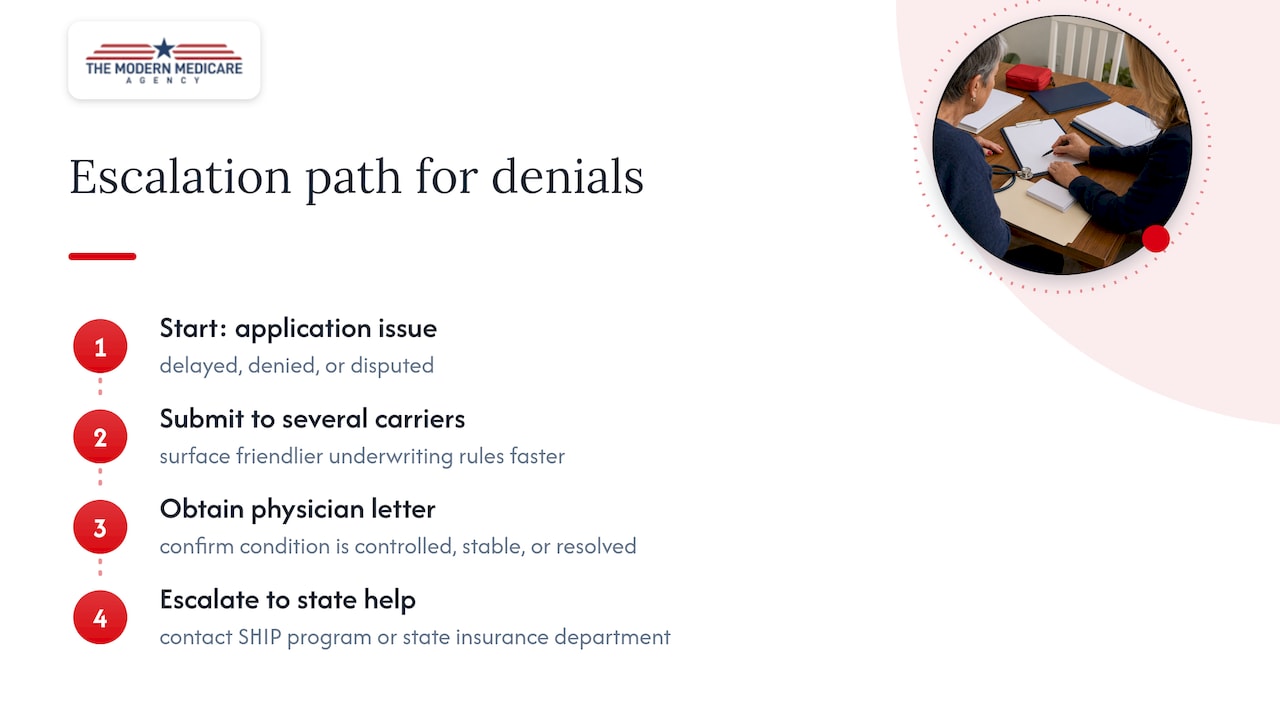
Paul Barrett has worked with Medicare consumers on supplement applications since 2007, and that history across many carriers’ underwriting rules shapes a few consistent tactics. Submitting to several carriers at once, rather than one at a time, often surfaces a friendlier rule set faster, since the same medication or diagnosis can be a non-issue for one insurer and an automatic decline for another.
A short physician letter confirming that a condition is controlled, stable, or fully resolved frequently shortens or avoids a waiting period entirely. When an application is delayed, denied, or a guaranteed-issue right is disputed, contacting your state SHIP program or state insurance department is the right next step, since they handle complaints and verify rights the carrier itself may be getting wrong.
My take on timing and documentation
If you can buy during Medigap Open Enrollment, do it. Underwriting risk disappears entirely in that window. Outside it, document every qualifying event the day it happens, never let existing coverage lapse before a new policy starts, and work with an independent broker who can shop several carriers rather than betting everything on one application.
— Paul
How Paul B Insurance helps with Medigap underwriting

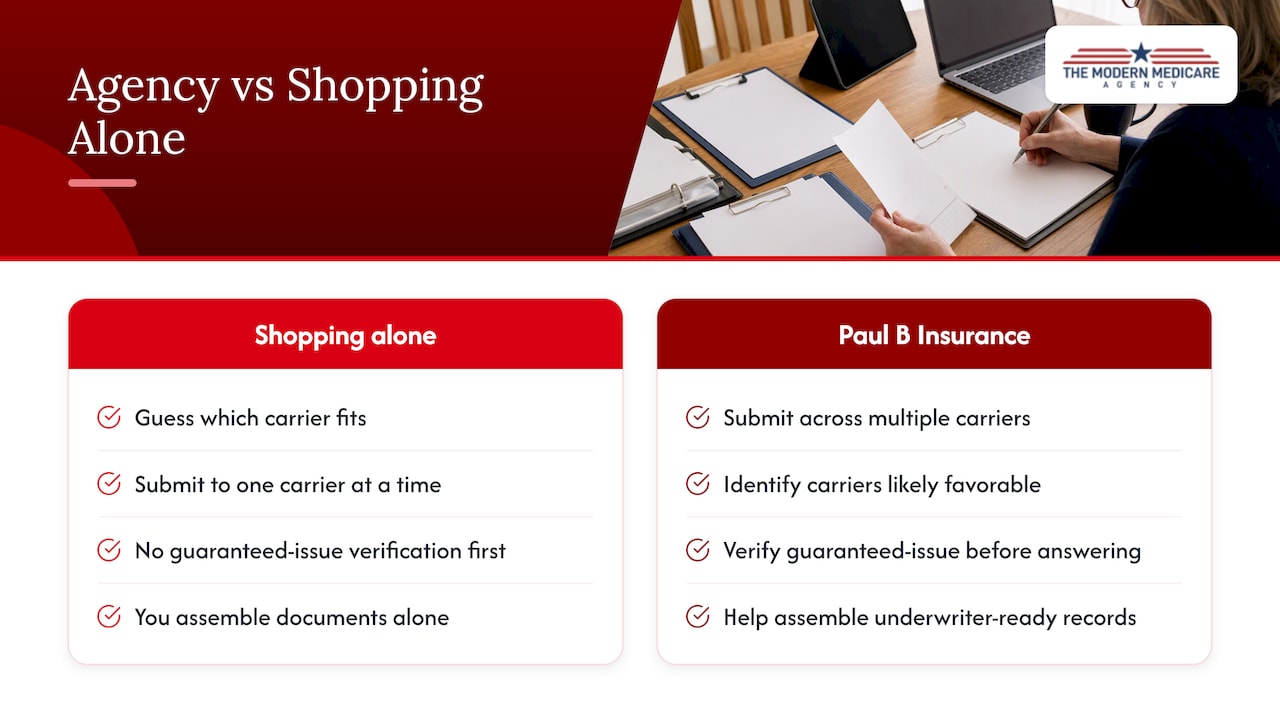
Shopping Medigap underwriting alone means guessing which carrier’s question list your health history will clear. An independent agency with access to multiple carriers can submit your information across insurers at once, identify which carriers may view your medications or history favorably, and verify your eligibility for guaranteed issue before answering health questions. That verification step alone can save you from an unnecessary denial on your record.
Some teams assist in assembling documentation that can strengthen an application: proof of prior creditable coverage, physician notes, and records organized as underwriters expect. Ongoing support can include annual coverage reviews to ensure the plan still fits.
If you are approaching an application outside a protected window, visit our Medicare Supplement plans page to request a free review of your guaranteed-issue status before you submit anything.
This article is general information, not a substitute for advice from a qualified financial advisor. Consult a qualified financial professional about your own circumstances before acting on anything here.
FAQ
What questions are asked for Medigap underwriting?
Carriers typically ask yes or no questions about specific diagnoses within a look-back period, a full medication list, recent hospital or nursing facility stays, and any pending or recommended treatments. Some also ask about tobacco use, height and weight, and request permission to contact your physician for clarification.
What are common complaints about Medigap insurers?
Beneficiaries most often report confusion over inconsistent underwriting rules between carriers and frustration when a guaranteed-issue right is disputed or overlooked during the application. Contacting your state SHIP program or insurance department is the recommended path for resolving a disputed guaranteed-issue claim.
Is there underwriting for Medigap plans?
Yes, outside your Medigap Open Enrollment Period or a guaranteed-issue event, insurers can medically underwrite your application and may approve at a higher premium, apply a waiting period, or deny coverage. During open enrollment or a qualifying guaranteed-issue event, carriers cannot use your health history to deny you or raise your rate.
Which states do not require underwriting for Medicare plans?
Federal rules set the baseline guaranteed-issue and open enrollment protections nationwide, but some states add broader protections, such as extra annual windows without underwriting. Check your specific state’s rules through your state SHIP program since protections beyond the federal minimum vary by state.
Can a Medigap application be denied after a “yes” health answer?
Not automatically. A “yes” answer often triggers a request for medical records or a clarifying call before the underwriter makes a final decision, rather than an immediate decline.
Sources
- Medicare
- KFF — Medigap may be elusive for Medicare beneficiaries with pre-existing conditions
- Milliman — Medicare Supplement Underwriting issue brief