
A Medicare 101 seminar is a free, beginner-focused educational session that walks you through Parts A, B, C, and D, enrollment windows, and how to choose a plan before your coverage starts. You can find upcoming sessions through Medicare, your state’s SHIP (State Health Insurance Assistance Program), local community centers, or Paulbinsurance’s free online Medicare 101 seminar hosted by licensed agent Paul Barrett.
Key Takeaways
Attending a free Medicare 101 seminar before your Initial Enrollment Period opens is the single most effective way to avoid costly coverage gaps and late-enrollment penalties.
| Point | Details |
|---|---|
| Seminars are free | Most Medicare 101 sessions cost nothing; state SHIPs, public agencies, and independent agents like Paulbinsurance offer them at no charge. |
| Enrollment windows are strict | Your Initial Enrollment Period is a 7-month window around your 65th birthday; missing it can trigger permanent late penalties. |
| Medicare is not free | Part B carries a monthly premium and cost-sharing applies; a seminar explains what supplemental coverage can reduce those costs. |
| Bring your prescription list | Your drug list is the most important document for evaluating Part D plans and Medicare Advantage formularies. |
| Paulbinsurance offers free sessions | Paul Barrett’s live webinars and on-demand recordings cover all plan types with a real-time Q&A and no enrollment pressure. |
Table of Contents
- What a Medicare 101 seminar covers
- Who should attend and what you’ll learn
- When and how to attend: formats and registration steps
- What to bring or prepare before the seminar
- Common questions a Medicare 101 seminar will answer
- How to spot a trustworthy seminar presenter
- About Paulbinsurance: Paul Barrett’s Medicare 101 seminar
- Why I run these seminars every month
- Ready to register for a free Medicare 101 seminar?
- Sources
What a Medicare 101 seminar covers
Every solid Medicare education workshop starts with the same foundation: the four parts of Medicare and what each one actually does for you.
- Part A covers hospital stays, skilled nursing facility care, and some home health services. Most people pay no monthly premium for Part A if they or a spouse worked and paid Medicare taxes for at least 10 years.
- Part B covers outpatient care, doctor visits, preventive services, and durable medical equipment. It carries a monthly premium.
- Part C (Medicare Advantage) is a private-plan alternative to Original Medicare that bundles Parts A and B and usually includes Part D drug coverage, often with extra benefits like dental and vision.
- Part D covers prescription drugs. You can get Part D coverage by joining a standalone drug plan or choosing a Medicare Advantage plan that includes it.
- Medigap (Medicare Supplement) fills the cost gaps in Original Medicare, covering deductibles and coinsurance that Part A and B leave behind.
The Medicare & You handbook covers all of these topics in detail and is worth downloading before or after any seminar.
Original Medicare vs. Medicare Advantage at a glance
| Feature | Original Medicare | Medicare Advantage |
|---|---|---|
| Provider network | Any provider who accepts Medicare | Usually network-restricted (HMO/PPO) |
| Prior authorization | Rarely required | Often required for specialists and procedures |
| Drug coverage (Part D) | Must add a separate plan | Usually included |
| Extra benefits (dental, vision, hearing) | Not included | Often included |
| Out-of-pocket cap | No annual cap | Annual cap required by law |
Medicare.gov’s side-by-side comparison goes deeper on each of these differences if you want to study them before attending.
Typical seminar modules also include enrollment windows (Initial Enrollment Period, General Enrollment, Special Enrollment, Annual Open Enrollment), how to apply through Social Security, cost-sharing basics, and a live Q&A.
Who should attend and what you’ll learn
The ideal attendee is anyone within a year of turning 65, someone losing employer or group health coverage, or a person under 65 who qualifies through disability. Caregivers who help a parent or spouse navigate Medicare also get real value from these sessions.
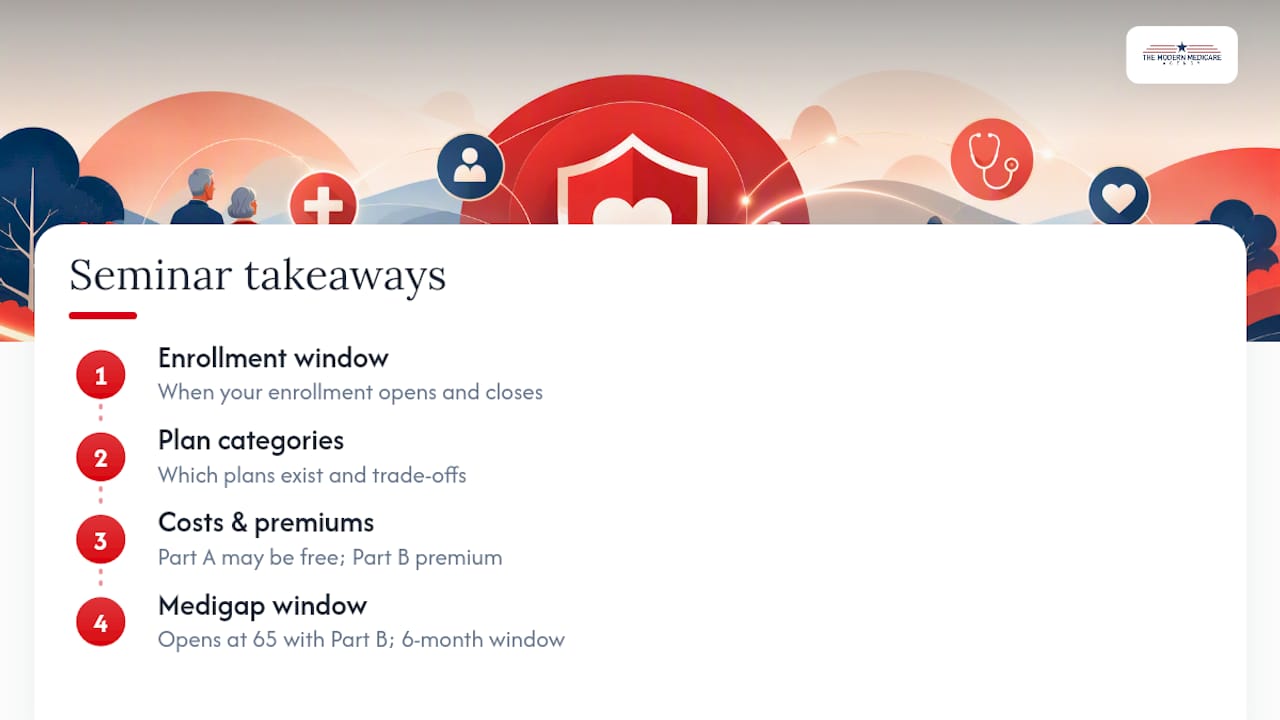
After a well-run seminar, you should leave knowing three things: when your enrollment window opens and closes, which plan categories exist and what trade-offs each carries, and roughly what Medicare will and will not cost you. That last point surprises many people. As the NCOA points out, new enrollees often expect Medicare to be free. Part A may carry no premium for most people, but Part B has a monthly premium, and cost-sharing continues unless you add supplemental coverage. A seminar is where that reality gets explained clearly, without the shock of discovering it after you’ve already enrolled.
One more thing worth knowing before you walk in: the Medigap open enrollment window. It opens the month you turn 65 and have Part B, and it lasts six months. Miss it, and insurers can use medical underwriting to price or deny your Medigap application. No seminar worth attending skips this point.
When and how to attend: formats and registration steps
Seminars come in four main formats, and the right one depends on your schedule and how you learn best.
- Live webinar: Hosted on Zoom or a similar platform, usually 60–90 minutes, with a real-time Q&A at the end. Best option if you have specific questions.
- On-demand recording: Watch at your own pace. State agencies like Washington’s DSHS offer free on-demand Medicare 101 training covering eligibility, parts, and enrollment periods.
- In-person community seminar: Libraries, senior centers, and hospital systems host these regularly. Check your local SHIP or community calendar.
- One-on-one review: Not a group seminar, but some agents offer individual sessions for people with complex situations (disability, employer coverage, late enrollment).
Registration checklist:
- Find an event through Medicare.gov, your state SHIP, or Paulbinsurance.com.
- Confirm the date, time, and format (live vs. recorded).
- Register online or call the contact number listed on the event page.
- Add it to your calendar with the login link or address.
- Write down two or three questions you want answered before you log in.
Pro Tip: Choose a live session over a recording whenever possible. The Q&A at the end is where the most useful, situation-specific answers come out. Recordings can’t answer your question about your specific doctor network or drug formulary.
What to bring or prepare before the seminar
You don’t need much, but the right preparation makes the session far more useful.
- List of current prescriptions: drug name, dosage, and how often you take it. You’ll need this to evaluate Part D plans.
- Current insurance cards: employer plan, retiree coverage, or VA card if applicable.
- Your Medicare eligibility date: check it at Ssa or your Social Security statement.
- List of preferred doctors and specialists: you’ll want to know whether they accept Original Medicare or are in a specific Advantage network.
- Basic income information: useful if you want to ask about Extra Help (Low Income Subsidy) for Part D or Medicare Savings Programs.
Write your questions down before the session starts. It sounds obvious, but in a live webinar the Q&A moves fast and a written list keeps you from forgetting what you came to ask.
Privacy note: Never share your Social Security number in a public webinar chat. Bring it only to a verified, private one-on-one session with a licensed agent you’ve confirmed is legitimate.
Common questions a Medicare 101 seminar will answer
- When does my enrollment window open? Your Initial Enrollment Period is a 7-month window centered on your 65th birthday month: three months before, the month of, and three months after. The SSA Medicare parts page has the full breakdown.
- How is Original Medicare different from Medicare Advantage? Original Medicare lets you see any provider who accepts Medicare nationwide. Medicare Advantage uses networks, often requires prior authorization, but usually bundles drug coverage and extra benefits.
- Does Medicare cover my prescriptions? Not automatically. You need to either join a standalone Part D plan or choose a Medicare Advantage plan that includes drug coverage.
- Will the seminar try to sell me a plan? A legitimate educational seminar will not pressure you to enroll. If it does, that’s a red flag covered in the next section.
How to spot a trustworthy seminar presenter
Not every Medicare seminar is created equal. Some are genuinely educational; others are thinly veiled sales events. Here’s how to tell the difference before you register.
Trust signals to look for:
- Sponsored by a state SHIP, Medicare.gov, or a recognized public agency
- Presenter is a licensed Medicare agent with verifiable credentials and years in the field
- Slide deck or handout is posted publicly before or after the event
- Clear contact information: phone number, email, and organization name
- No enrollment forms distributed during the session itself
Red flags:
- Aggressive language about “limited spots” or “act before open enrollment ends”
- Pressure to enroll in a specific plan during or immediately after the session
- No sponsor name or contact information listed on the event page
- Requests for your Social Security number in a group setting
Three questions to ask before you register:
- Who sponsors this event, and are they affiliated with a specific insurance carrier?
- Is this session educational only, or will plan enrollment be offered?
- Who will have access to my contact information after I register?
Presenters who publish their slides and hold SHIP or state-agency sponsorship are far more likely to be running education-first sessions rather than sales-driven ones.
About Paulbinsurance: Paul Barrett’s Medicare 101 seminar
Paul Barrett has been helping Medicare consumers since 2007. As a licensed independent Medicare agent, he works with multiple carriers rather than representing a single plan, which means the seminar covers your options across the board rather than steering you toward one product.
What the Paulbinsurance Medicare 101 seminar includes:
- Live webinar format with an on-demand recording available afterward
- Coverage of Parts A, B, C, and D; Original Medicare vs. Medicare Advantage; Medigap basics; Part D drug plans; and enrollment windows
- Real-time Q&A with Paul directly
- Free downloadable guide and event slides shared with registrants
How to register or get in touch:
- Visit Paulbinsurance to see upcoming seminar dates and register online
- Prefer to talk first? Call or email through the contact page to schedule a one-on-one review
Pro Tip: If your situation involves disability-based Medicare eligibility, employer coverage coordination, or a late enrollment penalty question, book the one-on-one session instead of the group webinar. Those scenarios need individual attention.
Disclosure: Paulbinsurance is compensated by insurance carriers when a beneficiary enrolls in a plan through the agency. The seminar itself is free and carries no obligation to enroll.
Why I run these seminars every month
People come to me after making Medicare decisions they didn’t fully understand, and most of those mistakes were avoidable. A missed enrollment window, a plan that doesn’t cover their doctors, a Medigap application filed six months too late. None of that has to happen. Running a free Medicare 101 seminar every month is my way of making sure you have the information before the deadline, not after. Come with your questions. There’s no pressure, no sales pitch during the session, and if you want help comparing plans afterward, I’m here for that too.
Ready to register for a free Medicare 101 seminar?
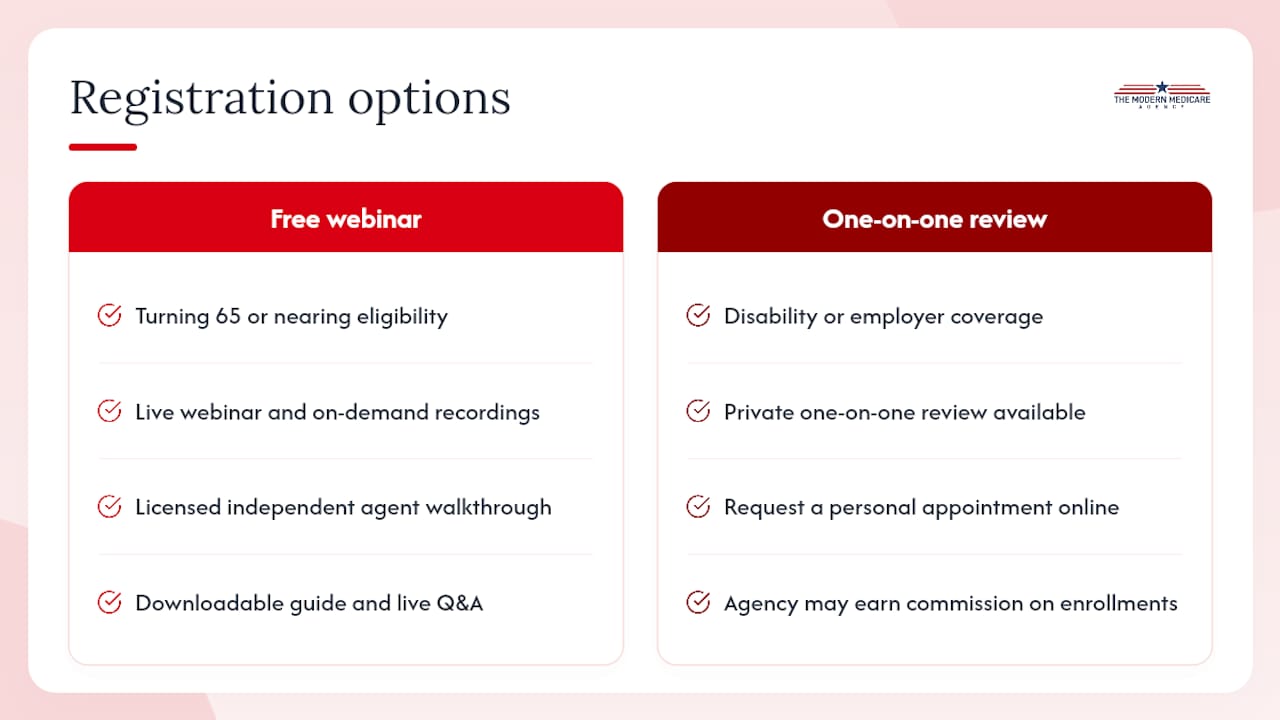
Paulbinsurance offers free live webinars and on-demand recordings designed specifically for people turning 65 or approaching Medicare eligibility. You get a licensed independent agent walking you through every coverage option, a downloadable guide, and a live Q&A, all at no cost and no obligation.

For people with more complex situations, including disability-based eligibility or coordination with employer coverage, a private one-on-one review is available. Visit Paulbinsurance to register for the next session or request a personal appointment. You can also explore Medicare supplement costs and how to choose between Advantage and supplements to get a head start before the seminar.
Paulbinsurance earns a commission from insurance carriers when a beneficiary enrolls in a plan through the agency. Attending the seminar is free and creates no enrollment obligation.
Sources
After any seminar, these resources let you verify what you heard and go deeper on specific rules.
- Your coverage options | Medicare
- New to Medicare? 5 Steps to Enroll on Time and Avoid Penalties
- On demand Medicare 101 Training | DSHS
- Parts of Medicare | SSA
- How does Medicare work? | Medicare
This article is general information, not a substitute for advice from a qualified financial advisor. Consult a qualified financial professional about your own circumstances before acting on anything here.