




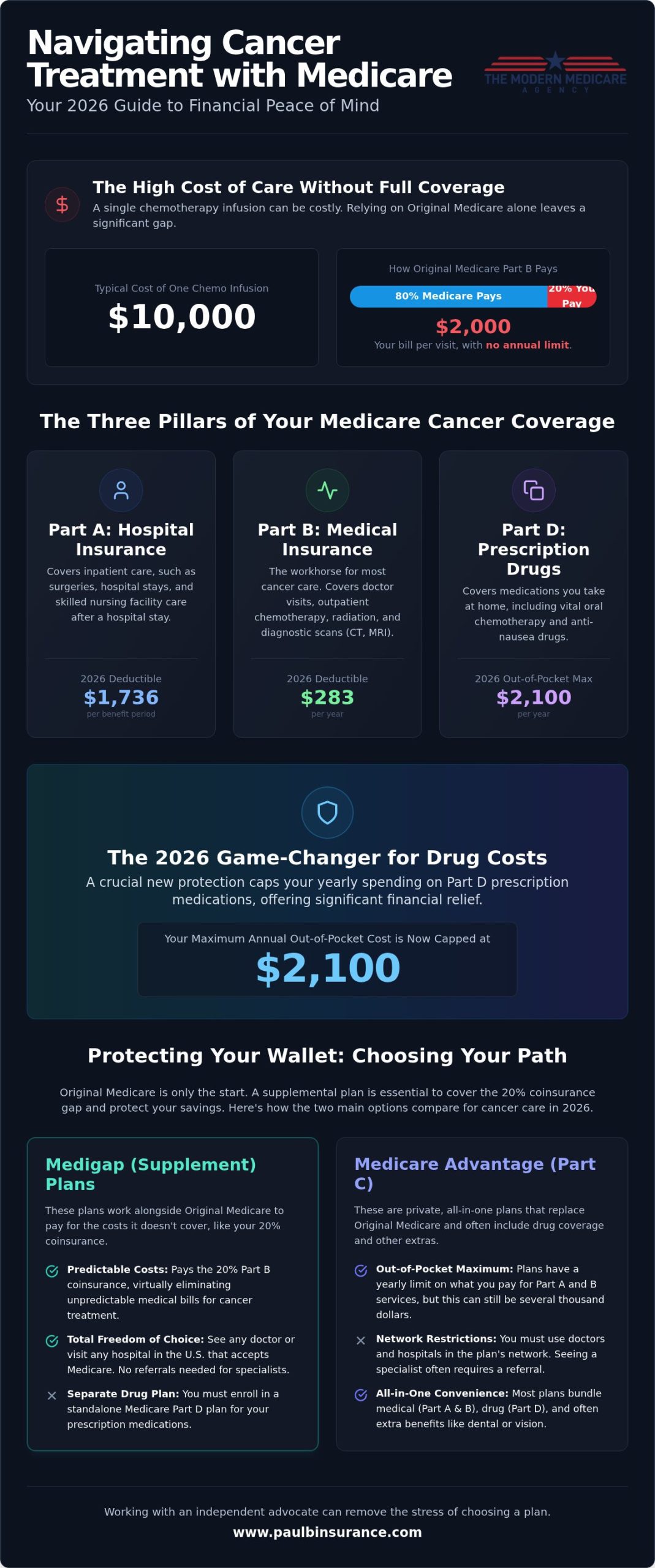
A single infusion of chemotherapy can cost $10,000, which often leaves patients with a $2,000 bill for every visit if they rely on Original Medicare alone. When you are facing a health crisis, the last thing you should have to worry about is whether you can afford to stay alive. You are likely asking, does medicare cover cancer treatment? The answer is yes, but the way that coverage is structured can be the difference between financial security and overwhelming debt. We understand that the fear of high out-of-pocket costs and the confusion over drug plans can feel like an added weight on an already difficult journey.
It’s okay to feel stressed by the complex rules of the healthcare system. You deserve a patient advocate who simplifies the process so you can focus on your recovery. This 2026 guide will show you exactly how Medicare Parts A, B, and D cover your care and how to minimize your expenses. We’ll explain the crucial new $2,100 out-of-pocket cap for medications and help you understand the difference between Part B and Part D drugs. By the end of this article, you’ll have a clear path to choosing the right supplemental plan and the peace of mind that comes with knowing your doctor and your wallet are both protected.
Key Takeaways
- Learn how Medicare Parts A and B work together to cover essential services like inpatient surgeries and outpatient chemotherapy.
- Understand the significant 2026 update that caps your yearly out-of-pocket costs for prescription drugs at $2,000.
- Compare the benefits of Medigap and Medicare Advantage to find the best fit for your budget and your choice of specialists.
- Get a straightforward answer to “does medicare cover cancer treatment” and discover how to protect yourself from high coinsurance costs.
- See how working with an independent advocate can remove the stress of choosing a plan during a difficult diagnosis.
Medicare and Cancer Care: What You Need to Know First
Facing a cancer diagnosis is one of the most challenging experiences a family can go through. It is natural to feel overwhelmed by medical jargon and the logistics of your care. One question we hear constantly is, does medicare cover cancer treatment? You can breathe a little easier knowing that the answer is a definitive yes. Medicare provides comprehensive coverage for the essential tools used to fight cancer, including complex surgeries, chemotherapy, and radiation therapy. However, the way Medicare pays for these services depends entirely on where you receive the care and which “Part” of the program is billed.
The 2026 landscape brings new, vital protections that make this care more affordable than in previous years. While the system can feel like a maze, it is designed to ensure you have access to life-saving treatments. Our goal is to act as your patient advocate, helping you understand how these different pieces fit together so you can focus on what matters most: your recovery.
The Three Pillars of Cancer Coverage
Medicare is not a single plan. It is a system of different parts that work together to cover your journey from diagnosis through remission. Understanding these three pillars is the first step toward peace of mind.
- Part A (Hospital Insurance): This covers your care if you are admitted to the hospital as an inpatient. It handles the costs of your room, meals, nursing care, and any surgeries performed during your stay.
- Part B (Medical Insurance): This is the workhorse for most cancer patients. It covers outpatient services, including doctor visits, radiation, and chemotherapy administered in a clinic or office.
- Part D (Prescription Drug Coverage): This covers the medications you take at home. This includes oral chemotherapy treatments and anti-nausea medications that are crucial for managing side effects.
Why ‘Original Medicare’ Isn’t Enough
While the coverage is broad, relying solely on Original Medicare (Parts A and B) can be a significant financial risk. The biggest hurdle is the 20% coinsurance. Under Part B, Medicare pays 80% of the approved cost for treatments like chemotherapy, but you are responsible for the remaining 20%. Because Original Medicare has no annual out-of-pocket maximum, those 20% bills can add up to tens of thousands of dollars very quickly.
This “gap” is why many of our clients find that a Medicare Supplement plan becomes an urgent priority. These plans are specifically designed to step in and pay that 20% for you. Without this extra layer of protection, a single round of treatment could become a heavy financial burden. We want to help you avoid that stress by finding a plan that acts as a shield for your savings. When you have the right supplemental coverage, you gain the certainty that your medical bills are handled, regardless of how complex your treatment becomes.
Understanding Hospital and Medical Coverage for Cancer
Knowing exactly where your care takes place is the key to understanding your bills. When people ask, does medicare cover cancer treatment, they are often thinking about the doctors and the medicine. Medicare looks at the building. If you are admitted to a hospital as an inpatient, your care falls under Part A. If you are visiting a clinic, a doctor’s office, or a freestanding center, it falls under Part B. This distinction is important because the costs you pay out-of-pocket change depending on the setting.
Inpatient Care Under Part A
Outpatient Services Under Part B
Outpatient care is where you will likely spend most of your time. Part B covers your visits to the oncologist and any second opinions you may need to feel certain about your path forward. It also covers Durable Medical Equipment (DME), such as the external infusion pumps used for certain types of chemotherapy. We know that a diagnosis affects more than just your physical health. That’s why Part B also covers mental health services. Professional counseling can provide the emotional strength needed to face the challenges of treatment. If you are feeling overwhelmed by these choices, speaking with an independent broker can provide the clarity you need to move forward with confidence.
How Medicare Part D Covers Your Cancer Medications
While Medicare Part B covers the treatments you receive in a clinical setting, many modern cancer therapies are now taken as pills in the comfort of your own home. You might wonder, does medicare cover cancer treatment that you manage yourself? The answer is found in Medicare Part D. This part of the program is specifically designed to handle the costs of oral chemotherapy and the vital anti-nausea medications that help you maintain your quality of life during treatment. It provides a necessary layer of protection for medications that would otherwise be prohibitively expensive.
We know that “financial toxicity” is a real concern for families facing a diagnosis. The cost of specialty oncology drugs can be staggering, sometimes reaching thousands of dollars for a single month’s supply. In the past, this led to a high level of anxiety for patients who feared they would exhaust their savings just to stay on their prescribed regimen. Fortunately, the landscape for 2026 has changed significantly to offer you better security and predictable costs.
The 2026 $2,100 Out-of-Pocket Cap
The most significant update for 2026 is the introduction of a hard cap on your prescription drug costs. For the first time, your total out-of-pocket spending for covered medications is limited to $2,100 for the year. In 2026, the catastrophic phase has been eliminated in favor of this hard spending limit, ensuring you pay $0 for your covered medications once you hit that cap. This change makes Medicare Part D more valuable than it has ever been. It acts as a financial shield, ensuring that no matter how expensive your oral chemotherapy is, your liability has a clear and manageable end point.
Formularies and Tiered Pricing
Every Part D plan uses a “formulary,” which is simply a list of the drugs they cover. Oncology medications are often placed on higher “specialty tiers,” which usually come with higher co-pays until you reach your deductible, which is $615 in 2026. It’s vital to check that your specific oncology drugs are included on your plan’s list for the coming year. If a necessary drug isn’t covered, there is a formal process to request an “exception” based on medical necessity. Because formularies can change every year, we help our clients compare drug lists across more than 40 different carriers. This step-by-step comparison ensures you don’t face any surprises at the pharmacy counter. Having an independent expert in your corner means you can focus on your health while we handle the fine print of the insurance tiers.
Medicare Advantage vs. Medigap: Which Protects You Better?
While Original Medicare provides the foundation for your care, your choice of supplemental coverage determines your daily experience with cancer care. You already know that the answer to “does medicare cover cancer treatment” is yes, but the way you access that treatment varies wildly between Medicare Advantage and Medigap. One path offers total freedom at a higher monthly cost. The other path offers lower monthly costs but comes with more rules and restrictions.
Choosing between these two options is often the most critical decision a cancer patient can make. We understand that this choice feels heavy, especially when you are already dealing with the stress of a diagnosis. Our role is to simplify these options so you can choose with confidence and move from a state of uncertainty to a state of security.
The Medigap Advantage for Cancer Patients
Medigap plans, also known as Medicare Supplement plans, are often the preferred choice for those who want the most control over their care. The primary benefit is freedom. You can visit any specialist or cancer center in the United States that accepts Medicare. This includes world-renowned facilities like the Mayo Clinic or MD Anderson without needing a referral or permission from an insurance company.
- No Network Restrictions: You aren’t limited to a local list of doctors or specific hospital groups.
- No Prior Authorization: Your oncology team can start life-saving treatments immediately. You won’t have to wait days or weeks for an insurance company to “approve” a vital scan or a round of chemotherapy.
- Predictable Costs: While monthly premiums are higher, your out-of-pocket costs for medical services are often near zero. This removes the anxiety of receiving a new bill after every appointment.
Learn more about Medigap options to see how these plans can act as a financial shield for your savings.
Medicare Advantage Considerations
Medicare Advantage plans (Part C) are an alternative that many people choose for their lower monthly premiums and bundled drug coverage. These plans are managed by private insurance companies and operate on a network-based system. If you choose this path, it is vital to ensure your oncologist and preferred hospital are “in-network” to avoid unexpected costs.
- Copays and Costs: You will likely pay a copay for every radiation session or doctor visit. These costs stop once you hit the plan’s annual out-of-pocket maximum, which acts as your safety net.
- Prior Authorization: These plans often require the insurance company to review and approve treatment plans before they begin. This can sometimes cause stressful delays during a time when every day counts.
Our Simple Guide to Medicare Advantage helps you weigh these factors carefully. We believe you should never feel rushed or pressured into a decision. Connect with an independent advocate to compare plans from 40+ carriers and find the coverage that truly protects your health and your future.
Finding Your Way Forward with Expert Support
A cancer diagnosis changes everything in an instant. While we have answered the primary question, does medicare cover cancer treatment, knowing the rules is only the first step. You shouldn’t have to spend your energy deciphering insurance fine print or worrying about network changes while you are fighting for your health. The Modern Medicare Agency is here to carry that burden for you. We provide a calm, methodical path that leads you from a state of distress to one of absolute certainty.
We believe that every patient deserves a dedicated advocate. Our mission is to serve as your guide, removing the anxiety from a complex system so you can focus on your recovery. We don’t work for the insurance companies; we work for you. By comparing options from over 40 different carriers, we ensure that your specific doctors and medications are prioritized. This impartial support is the foundation of the trust we build with every client.
The Value of an Independent Broker
There is a significant difference between a restricted representative and an independent broker. A representative from a single insurance company can only offer you a limited selection of plans, even if they aren’t the best fit for your oncology team. As independent experts, we have the autonomy to look at the entire market across 34+ states. This allows us to be the unambiguous champion of your needs.
Our support doesn’t end when you select a plan. We provide year-round assistance, which is vital if your treatment plan or medications change mid-year. We are committed to protecting your health and your savings with equal care. This journey from uncertainty to peace of mind is one we take together, ensuring you never feel alone in the process.
Your Next Steps for 2026
The changes coming in 2026, especially the new $2,100 out-of-pocket cap for prescriptions, make this the right time for a thorough coverage review. We recommend a simple, structured approach to prepare for your personalized consultation:
- List your providers: Include every specialist, oncology center, and hospital you currently visit.
- Catalog your medications: Write down the exact names and dosages of your current prescriptions.
- Review your current costs: Note your monthly premiums and any recent out-of-pocket expenses for treatment.
We will take this information and perform a detailed review to see how the 2026 updates affect your specific situation. This service is provided at no cost to you, offering expert guidance when you need it most. You can book a simple, stress-free consultation with Paul Barrett today to begin your journey toward total security.
Your Path to Certainty and Care
Facing a diagnosis is a heavy burden, but you don’t have to carry the weight of insurance confusion alone. You now have a clearer understanding of the answer to your most pressing question: does medicare cover cancer treatment? We’ve explored how Part B serves as the workhorse for your outpatient care and how the significant 2026 update provides a $2,100 safety net for your prescription medications. Whether you choose the freedom of a Medigap plan or the bundled convenience of Medicare Advantage, the right choice is the one that brings you peace of mind and protects your financial future.
Our team is here to act as your patient advocate. We provide independent guidance by comparing options from over 40 carriers across 34+ states. This service is provided at no cost to you, ensuring you receive unbiased advice tailored to your specific doctors and medications. You deserve to focus entirely on your health while we handle the logistics of your coverage. Please reach out to Get a Free, Empathetic Review of Your Cancer Coverage Options today. You are strong, you are supported, and there is a clear way forward.
Frequently Asked Questions
Does Medicare Part B cover chemotherapy?
Yes, Medicare Part B covers chemotherapy infusions administered in an outpatient setting or a doctor’s office. Once you meet your annual Part B deductible of $283, Medicare pays 80% of the approved cost. You are responsible for the remaining 20% coinsurance. Because chemotherapy can be expensive, many patients use a supplemental plan to cover this gap. It’s one of the ways the system ensures you have access to life-saving medical care.
What is the $2,100 Medicare cap for 2026?
The $2,100 cap is a new financial protection for 2026 that limits your total yearly out-of-pocket spending for prescription drugs. This rule applies to everyone with a Medicare Part D plan. Once you spend $2,100 on covered medications, you pay nothing for the rest of the year. This change is vital for cancer patients using high-cost oral therapies. It provides the predictability you need to manage your budget while focusing on your recovery.
Is immunotherapy covered by Medicare?
Yes, Medicare covers immunotherapy when your doctor determines it is medically necessary to treat your specific type of cancer. Most immunotherapy treatments are administered in a clinic, which means they fall under Part B. If the treatment happens during a hospital stay, Part A handles the cost. We can help you check if your specific treatment is covered by your current plan to ensure you have no surprises during your treatment journey.
Will Medicare pay for a second opinion on my cancer diagnosis?
Yes, Medicare Part B covers second opinions for non-emergency surgeries or treatments, including cancer. If the first and second opinions differ, Medicare will even cover a third opinion. This benefit is designed to give you peace of mind and total confidence in your treatment path. You’ll typically pay 20% of the Medicare-approved amount after meeting your deductible. We believe you should always feel certain about your medical decisions.
Does Medicare cover clinical trials for cancer?
Yes, Medicare covers the routine costs of participating in a qualifying clinical trial for cancer. These routine costs include doctor visits, diagnostic tests, and hospital stays that you would need even if you weren’t in the trial. This coverage allows you to access cutting-edge treatments while Medicare handles the standard medical expenses. It’s a supportive way for the system to help you explore every available option for your health and your future.
Are breast prostheses covered by Medicare after a mastectomy?
Yes, Medicare Part B covers external breast prostheses, including a post-surgical bra, following a mastectomy. These are classified as prosthetic devices and are covered as long as they are provided by a Medicare-enrolled supplier. You generally pay 20% of the approved amount. This coverage is part of Medicare’s commitment to supporting your full recovery and well-being. We can help you find suppliers that accept Medicare to minimize your out-of-pocket costs.
What happens if my cancer drug isn’t on my Part D formulary?
If your medication isn’t on the list, your doctor can request a “formulary exception” from your Part D plan. Your medical team must provide a statement explaining that the drug is necessary for your treatment. If the request is denied, you have the right to appeal the decision. We help our clients navigate this process to ensure they get the medicine they need. It’s another reason why having an advocate is so important.
Can I switch to a Medigap plan after being diagnosed with cancer?
Switching to a Medigap plan after a diagnosis can be difficult because of medical underwriting. In most states, insurance companies can review your health history and may deny coverage or charge higher rates. However, you may have “guaranteed issue rights” in specific situations, such as losing other coverage. We can review your state’s rules to see if you have a path to switching. Our goal is to protect your health and your savings.

Article by
Paul Barrett
Paul Barrett, CMIP is the founder of The Modern Medicare Agency, an independent Medicare-only brokerage based in Melville, NY. With 18 years of Medicare-exclusive experience, a CMIP designation, and more than 5,000 clients served across 37 states, Paul is one of the most credentialed independent Medicare specialists on Long Island — and one of the most direct.
He represents 40+ carriers with no quotas and no allegiances, which means his recommendations are based entirely on what fits each client's specific situation. He is the author of Medicare Mastery Unlocked and host of the Wise Guys Retirement Talk podcast. His content is grounded in primary sources, real carrier intelligence, and 18 years of watching what happens when people get Medicare right — and when they don't.
📞 631-358-5793 | paulbinsurance.com