
What if your upcoming move was actually a hidden opportunity to upgrade your healthcare instead of a bureaucratic nightmare? It’s natural to feel a sense of dread when you think about moving to another state with medicare. You might worry about losing your favorite doctor, facing a gap in your coverage, or getting tangled in a web of state-specific rules. We understand that these fears are real and can take the joy out of starting your new chapter in 2026.
You deserve to feel secure in your health coverage, no matter where you call home. This guide is here to replace that anxiety with a clear, step-by-step path to peace of mind. We’ll show you exactly how to use the 2026 Special Enrollment Period to your advantage so you can find the best local options without any stress. You’ll learn who you need to notify, how to protect your prescription access, and how to ensure your transition is completely seamless. By the time you finish reading, you’ll have the confidence to focus on your new home while we handle the complexities of your coverage.
Key Takeaways
- Original Medicare remains consistent across the country, but private plans like Medicare Advantage are local and will likely require a change when you relocate.
- Moving to another state with medicare in 2026 triggers a Special Enrollment Period, giving you a two-month window to secure a new plan without a gap in coverage.
- Notifying the Social Security Administration of your new address is a critical first step to ensure your records and benefits remain accurate during the transition.
- Working with an independent broker allows you to compare options from dozens of carriers to find the most cost-effective and comprehensive local coverage.
Does Medicare Move With You? Understanding Federal vs. Local Rules
Moving to another state with medicare doesn’t mean you’re starting from scratch. It’s a common fear that crossing a state line will cancel your benefits overnight. I want to reassure you right now: your Medicare rights are protected by federal law. The real question isn’t whether Medicare moves with you, but how your specific plan structure reacts to your new zip code. You won’t lose your entitlement to healthcare, but you will likely need to update your “address” with the system to keep things running smoothly.
Original Medicare: The Portable Foundation
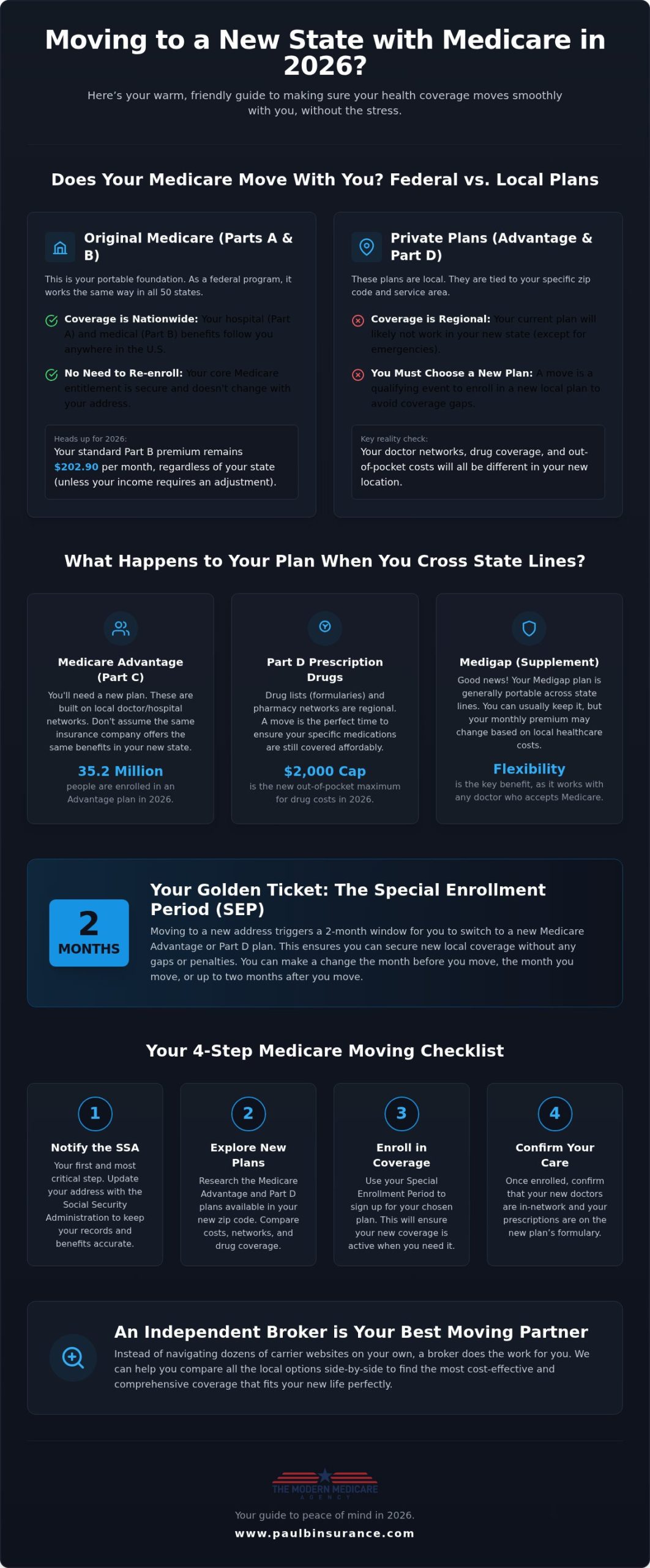
Original Medicare, which includes Part A and Part B, is a national Medicare program managed by the federal government. This means its core rules are the same in Maine as they are in California. In 2026, your standard Part B premium of $202.90 stays the same regardless of your location, unless your income level triggers a specific adjustment. You don’t need to re-enroll in the federal side of the program just because you’ve crossed a border. However, you should always verify that your new doctors and local hospitals accept Medicare before you schedule your first appointment.
Original Medicare is a federal benefit that follows you across all fifty states, ensuring your core hospital and medical coverage remains active the moment you arrive at your new home.
Private Medicare Plans: The Regional Reality
While the federal foundation is stable, private options like Medicare Advantage and Medicare Part D work differently. These plans are built on local contracts with specific doctors, hospitals, and pharmacies. If you move outside your plan’s service area, your current insurance card might stop working for anything other than emergency care. Your zip code is the most important factor in this transition.
In 2026, over 99% of beneficiaries have access to at least one Advantage plan, but the specific benefits and out-of-pocket costs change from county to county. A plan that was affordable in your old state might have a higher premium or a more restrictive network in your new one. Prescription drug coverage also varies, as Medicare Part D plans use regional pharmacy networks. This is why a move is the perfect time to review your options and ensure your specific medications are still covered at a price that fits your budget.
What Happens to Your Specific Plan When You Cross State Lines?
Crossing a state line feels like a significant life shift, but for your insurance, the biggest change is often just your new mailing address. While Original Medicare stays steady, your private coverage is much more sensitive to your physical location. Understanding What Is Medicare? at its core helps you see why some parts of your coverage are “locked in” while others are “on the move.” Your experience moving to another state with medicare will depend entirely on which “parts” of the program you currently use to receive your benefits.
Medicare Advantage (Part C) and Part D Transitions
If you’re one of the 35.2 million people enrolled in a Medicare Advantage plan in 2026, your move will likely require a plan switch. These plans are regional. They rely on contracts with local doctors and hospitals in a specific service area. If you move outside that area, your plan usually ends. Even if your current insurance company offers a plan in your new state, the benefits, provider networks, and costs might look completely different. It’s a common trap to assume “same company” means “same plan.”
Prescription drug coverage also requires a close look. 2026 is a landmark year for Part D because of the $2,000 out-of-pocket cap on drug costs. Because of this change, many carriers have adjusted their drug lists, also known as formularies. A move is the perfect time to check if your specific prescriptions are still on the “preferred” list in your new zip code. You can explore our Medicare Advantage Guide to see how these networks function across different regions and how to avoid coverage gaps.
Medicare Supplement (Medigap) Portability
Medigap plans offer a much higher level of flexibility. Since these plans work alongside Original Medicare, they’re generally portable. You can usually keep your same policy even when relocating across the country. However, your monthly premium might change. Insurance companies often adjust prices based on the local cost of healthcare in your new state. If you move from a rural area to a major city, you might see a slight increase in what you pay each month.
There are important exceptions to this rule. If you’re moving to or from states like New York, Connecticut, or California, the rules for switching or keeping plans are unique. These states often use community-rating systems that affect how much you pay regardless of your age. If you’re unsure how your current supplement will behave in a new environment, it’s worth reviewing our guide on Medicare Supplement Insurance to understand your rights. If you feel overwhelmed by these regional differences, you can always talk to a dedicated expert who can compare your current plan against the new local options for you.
The Medicare Moving Timeline: Special Enrollment Periods Explained
Timing is everything when you’re packing up your life. You might feel like you’re racing against a clock you don’t fully understand. I’m here to tell you that the system actually has a built-in safety net for this exact situation. It’s called a Special Enrollment Period (SEP). Think of it as your “get out of jail free” card. This window allows you to change your Medicare Advantage or Part D plan without waiting for the usual fall enrollment season. It’s the perfect time to audit your 2026 healthcare needs and ensure your coverage matches your new lifestyle.
When Does Your Special Enrollment Period Start?
The secret to a stress-free transition is when you choose to tell your current insurance company about the move. If you notify them before you leave, your window of opportunity is wider. This gives you more control over the effective date of your new plan. If you wait until after you’ve already unpacked, your SEP starts the month you notify the carrier. Understanding your Medicare Eligibility during this time is vital to avoid a break in service. We usually recommend starting this process at least 30 days before your moving truck arrives. This proactive approach ensures your new coverage starts the very first day you’re in your new home.
Avoiding Penalties and Gaps
Missing your window isn’t just an inconvenience. It can be expensive. If you go too long without a Part D prescription plan, you could face a lifetime late-enrollment penalty. In 2026, with the new $2,000 out-of-pocket limit on drug costs, having the right Part D plan is more important than ever. You also want to protect your “Guaranteed Issue” rights for Medigap. This right ensures you can buy a supplement plan in your new state without being turned away for health reasons. In 2026, the Special Enrollment Period for moving gives you a three-month window that typically begins the month before your move and extends for two full months after you arrive at your new home. Taking action early removes the anxiety of “what if” and replaces it with the certainty that you’re protected.
5 Practical Steps to Transfer Your Medicare Coverage Successfully
I know your to-do list is miles long right now. Between packing boxes and signing papers, your healthcare can feel like just another chore. But moving to another state with medicare doesn’t have to be a source of stress. If you follow a logical, step-by-step process, you can move with the certainty that your coverage is waiting for you at your new front door. Let’s break this down into five simple actions to protect your health and your wallet in 2026.
Updating the Government Records
The very first step is notifying the Social Security Administration (SSA) of your move. This is the foundation of the entire process. When you update your address with the SSA, it triggers a “change of address” across the federal Medicare system. The fastest way to do this is through your “my Social Security” online account. It only takes a few minutes and provides an immediate record of the change. If you prefer a more personal touch, you can call their national toll-free number or visit a local SSA office in person. Regardless of how you do it, this step ensures your mail, including your new Medicare cards and important benefit notices, reaches your new home without delay.
Comparing Your New Local Options
Once the government knows where you’re going, it’s time to look at the local 2026 plan landscape. Healthcare is regional. A plan that offered fantastic benefits in Florida might not even exist in New York; or it might have much higher costs. You should research the specific Medicare Advantage and Medicare Part D options available in your new zip code. While the government’s Plan Finder tool is a good starting point, it can sometimes feel cold and overwhelming. Many people find that working with an independent broker provides a much clearer picture. We can compare over 40 different carriers to see which one actually fits your new life. After you’ve narrowed down the plans, follow these final steps:
- Contact your current carrier: Ask them specifically if your new zip code is in their 2026 service area.
- Verify your doctors: Call your new local specialists and primary care doctors to confirm they are in-network for the specific plan you’re considering.
- Check your pharmacy: Ensure your preferred pharmacy is a “preferred” location for your new drug plan to keep your copays as low as possible.
- Enroll early: Submit your enrollment application at least three weeks before your move date to ensure a seamless transition on day one.
Taking these steps early removes the “what-ifs” from your move. If you want to make sure you haven’t missed a single detail in your new state, you can request a personalized move consultation with our team today.
Why an Independent Broker is Your Best Moving Partner in 2026
Moving to another state with medicare is a massive logistical puzzle. You’re already juggling utility transfers, address changes, and the physical exhaustion of packing boxes. Beyond these tasks, you might also need to explore Lock changes. Why add the stress of deciphering complex insurance networks to your plate? An independent broker acts as your personal navigator. We take the heavy lifting off your shoulders so you can focus on settling into your new neighborhood and enjoying your new home.
The biggest advantage of working with an independent broker like Paul Barrett is the breadth of choice. A captive agent works for a single insurance company and can only offer you their specific products. If that company isn’t the best fit for your new zip code, they simply can’t help you. As independent experts, we represent you, not the insurance companies. We compare plans from over 40 carriers across 34+ states to find your perfect match. In 2026, we’ve seen significant shifts in provider networks and plan availability. We meticulously analyze these 2026 networks to ensure your favorite specialists and local hospitals are still covered in your new location. You can find more details on choosing the right partner in our Medicare Broker guide.
Your Advocate in a Complex System
The government’s rules can feel rigid, and the fear of missing a deadline is real. We remove that anxiety by handling the logistics and explaining everything in plain English. We believe that clarity is the best cure for stress. Our commitment to simple, jargon-free education means you’ll always know exactly what you’re signing and why it benefits you. We don’t use high-pressure tactics because our goal is to serve and protect your interests, not to meet a sales quota.
We also provide year-round support that doesn’t end when the moving truck leaves. If your healthcare needs change later in 2026, or if a local pharmacy leaves your network, we’re just a phone call away. You are not alone in this journey. Whether you’re moving to be closer to family or to enjoy a different climate, we’re here to ensure your transition is a journey from distress to absolute certainty. We pride ourselves on being the unambiguous champion of the consumer, making sure you always have a reliable guide by your side.
Secure Your Peace of Mind for the Big Move
You’ve worked hard to plan every detail of your relocation. Now, it’s time to ensure your healthcare is ready to welcome you to your new home. Remember that while Original Medicare remains steady, your private plans are regional and require a quick check against your new zip code. By using your 2026 Special Enrollment Period early, you can avoid coverage gaps and late penalties. Moving to another state with medicare is a significant transition, but you don’t have to navigate the paperwork alone.
Paul Barrett and our empathetic team are dedicated to acting as your personal advocate. We provide unbiased comparisons from over 40 carriers across 34+ states to find the specific “perfect fit” for your new life. We focus on simplicity and clarity so you can focus on unpacking and meeting your new neighbors. Let us take the stress out of your move; schedule a free 2026 Medicare review today. Your new chapter deserves a healthy start, and we’re honored to help you move with absolute certainty.
Frequently Asked Questions
Do I need to get a new Medicare card when I move to another state?
No, you do not need a new physical Medicare card when you relocate. Your unique Medicare number stays the same for life. You simply need to update your home address with the Social Security Administration. Once they have your new information, they will ensure all official correspondence and 2026 benefit updates reach you at your new residence without any interruption.
Can I keep my current Medicare Advantage plan if I move out of state?
Usually, you cannot keep your current Medicare Advantage plan if you move outside its specific service area. These plans are regional and rely on local networks of doctors and hospitals. When moving to another state with medicare, you will almost certainly need to select a new plan available in your new zip code. This ensures you have access to local providers who are in-network for your care.
How long do I have to change my Medicare plan after I move?
You typically have a three-month window to update your coverage. This Special Enrollment Period begins the month before your move and continues for two full months after you relocate. If you notify your plan before you leave, your new coverage can begin the first day of the month you move. This timeline is designed to prevent any gaps. Acting early ensures your prescriptions and doctor visits are covered from day one.
What happens to my Medigap policy if I move to a state with different rules?
Your Medigap policy is generally portable, meaning you can keep your current coverage as long as you stay enrolled in Original Medicare. However, your monthly premium might change based on the local cost of healthcare in your new area. Some states like New York or Connecticut have unique rules for how plans are priced. It is always a good idea to compare your current rate against new local 2026 options.
Will my prescription drug costs change when I move to a new state in 2026?
Yes, your prescription costs will likely change because Part D plans are regional. While the core rules are federal, private insurance companies set their own premiums and drug lists for different states. A medication that is affordable in your current home might be in a more expensive category in your new state. It is essential to review your specific medications against the 2026 plan options in your new zip code to keep costs manageable.
What if I move into a nursing home or long-term care facility in another state?
Moving into a long-term care facility gives you a Special Enrollment Period to change your coverage. This allows you to switch to a plan that better fits your new living situation, such as a Special Needs Plan. These plans are designed to coordinate care within the facility to manage chronic conditions effectively. Our team can help you compare these specialized 2026 options so you can focus on your health and comfort.
Do I have to notify Medicare if my move is only temporary?
You generally don’t need to notify Medicare if your move is truly temporary, such as a short vacation. However, if you spend several months a year in a second home, you should check your plan’s travel benefits. Some Medicare Advantage plans offer coverage in multiple regions, while others only cover emergencies outside your home area. If you are a snowbird, we can help you find a plan that works in both locations.
How do I find a doctor who accepts Medicare in my new state?
You can find local providers by using the Medicare Care Compare tool or by contacting your new insurance plan directly. If you are moving to another state with medicare, finding a new primary care physician is a top priority. Always confirm that the doctor is currently accepting new Medicare patients in 2026. If you have a Medicare Advantage plan, you must use their specific directory to ensure the doctor is in-network.

Article by
Paul Barrett
Paul Barrett, CMIP is the founder of The Modern Medicare Agency, an independent Medicare-only brokerage based in Melville, NY. With 18 years of Medicare-exclusive experience, a CMIP designation, and more than 5,000 clients served across 37 states, Paul is one of the most credentialed independent Medicare specialists on Long Island — and one of the most direct.
He represents 40+ carriers with no quotas and no allegiances, which means his recommendations are based entirely on what fits each client's specific situation. He is the author of Medicare Mastery Unlocked and host of the Wise Guys Retirement Talk podcast. His content is grounded in primary sources, real carrier intelligence, and 18 years of watching what happens when people get Medicare right — and when they don't.
📞 631-358-5793 | paulbinsurance.com