


The Short Answer
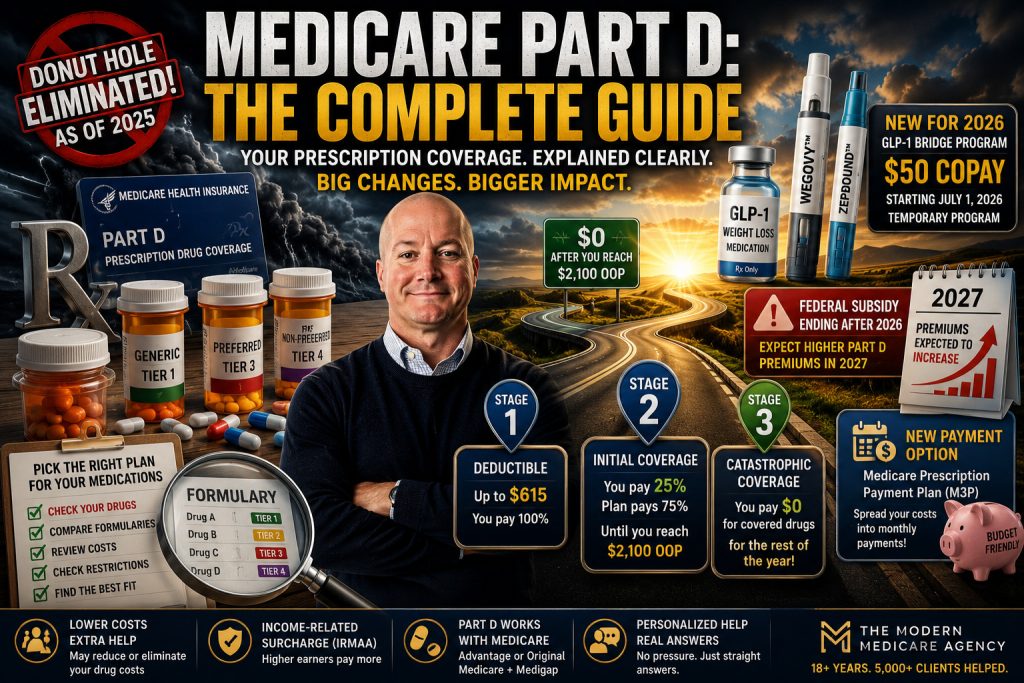
Medicare Part D is prescription drug coverage, offered through private insurance companies, either as a standalone plan alongside Original Medicare or bundled into most Medicare Advantage plans. In 2026, every Part D plan works the same basic way: you pay a deductible (up to $615), then 25% of your drug costs, until your total out-of-pocket spending hits $2,100 for the year — at which point your covered drugs cost you $0 for the rest of the year. The confusing “donut hole” that used to exist in the middle of the year is gone, eliminated as of 2025. What still varies enormously from plan to plan is which specific drugs are covered, and at what cost — which is why picking a Part D plan is really about your medications, not the plan’s name or its premium alone.
Key Takeaways
- The “donut hole” is gone. As of 2025, Part D has a hard annual out-of-pocket cap — $2,100 in 2026 — after which your covered drugs cost $0 for the rest of the year.
- Every Part D plan has its own formulary — the specific list of drugs it covers and what tier each one falls into. This is the single most important thing to check before enrolling, more important than the premium.
- Even covered drugs can carry restrictions — step therapy, prior authorization, or quantity limits — that affect how easily you can actually fill a prescription.
- Medicare Advantage plans usually include Part D coverage built in. Original Medicare and Medigap do not — you’d add a standalone Part D plan separately.
- Standalone Part D plans are sold statewide or regionally, unlike Medicare Advantage, which is generally built around local, county-level networks.
- A new, temporary program — the Medicare GLP-1 Bridge — offers eligible beneficiaries GLP-1 weight-management drugs for a flat $50 copay starting July 1, 2026.
- A federal subsidy that’s helped keep standalone Part D premiums lower is ending after 2026 — expect real premium movement for 2027.
- A new option called the Medicare Prescription Payment Plan (M3P) lets you spread your out-of-pocket drug costs into monthly bills instead of paying it all upfront at the pharmacy.
- If your income is limited, the Extra Help program can dramatically lower or eliminate your Part D costs — and it’s more available than most people realize.
- Higher earners pay an income-related surcharge on Part D, just like they do on Part B — it’s called IRMAA, and it applies here too.
What Part D Actually Covers
Part D is Medicare’s outpatient prescription drug benefit — the medications you pick up at a pharmacy, as opposed to drugs administered to you in a doctor’s office or during a hospital stay, which usually fall under Part B or Part A instead. You get Part D coverage one of two ways:
- A standalone Prescription Drug Plan (PDP) — a separate policy you pair with Original Medicare, whether or not you also have a Medigap policy
- Built into a Medicare Advantage plan (MAPD) — most Medicare Advantage plans include Part D coverage as part of the same plan
Paul’s Honest Take: This is one of the most common gaps I catch when reviewing someone’s coverage: they’ve got a great Medigap plan, but nobody ever signed them up for a standalone Part D plan, because Medigap doesn’t include one automatically. If you’re on Original Medicare and Medigap, drug coverage is a separate decision you have to actively make — it won’t happen on its own.
How Part D Actually Works in 2026: The Three Stages
The biggest change to Part D in recent memory took effect in 2025, and it’s worth understanding clearly, because a lot of outdated information about the “donut hole” is still floating around. Here’s how it actually works now.
Stage 1 — Deductible. You pay 100% of your drug costs until you hit your plan’s deductible. Plans can set their deductible anywhere up to $615 in 2026 — some charge less, and some charge $0.
Stage 2 — Initial Coverage. After the deductible, you generally pay 25% of your drug costs, and your plan covers the rest, until your total out-of-pocket spending for the year reaches $2,100.
Stage 3 — Catastrophic Coverage. Once your out-of-pocket spending hits $2,100 for the year, you’re done. Your covered drugs cost you $0 for the rest of the calendar year.<cite index=”44-1″>For 2026, under the standard benefit, Part D enrollees will pay a deductible of $615, and will then pay 25% of their drug costs in the initial coverage phase until their out-of-pocket spending totals $2,100. At that point, they qualify for catastrophic coverage and pay no additional out-of-pocket costs</cite>
Paul’s Honest Take: If you remember the old system — where costs would spike suddenly in the middle of the year in what everyone called the “donut hole” — you can stop worrying about that. It’s gone. The whole thing is simpler now: pay the deductible, pay 25% for a while, then hit $2,100 and you’re covered for the rest of the year. That $2,100 is genuinely one of the most consumer-friendly changes Medicare has made to Part D in years.
A Subsidy That Helped Keep Premiums Down Is Going Away for 2027
Here’s something worth knowing now, even though it affects next year’s pricing, not this year’s: the federal government has been running a program called the Part D Premium Stabilization Demonstration since 2025, which paid insurers behind the scenes to help keep standalone Part D premiums lower while the industry adjusted to the new $2,100 cap. CMS has confirmed that subsidy will not continue into 2027 — it shaved roughly $16 a month off the average standalone premium in 2026, and without it, most people in standalone Part D plans should expect a real premium increase for 2027, even though CMS projects it to be modest for most beneficiaries.
Paul’s Honest Take: This mainly affects people in standalone Part D plans on Original Medicare — Medicare Advantage enrollees are largely shielded from this particular change, since MAPD pricing works differently. If you’re on a standalone PDP, don’t be surprised if your premium moves more than usual this AEP. It’s not your plan doing something wrong — it’s a federal subsidy ending, and it’s worth reviewing your options carefully rather than assuming last year’s plan is still your best deal.
There Are Fewer Standalone Part D Plans Than There Used to Be
It’s also worth knowing that the standalone Part D marketplace itself has been shrinking. The number of standalone Prescription Drug Plans available nationally dropped significantly for 2026 — down about 22% from the year before, as several carriers consolidated or exited the standalone market entirely.<cite index=”44-2″>In 2026, a total of 360 PDPs will be offered by 17 different parent organizations across the 34 PDP regions nationwide, a 22% decrease in PDPs</cite>
Paul’s Honest Take: Fewer plans doesn’t necessarily mean worse coverage — it often means the weaker or redundant plans got consolidated. But it does mean less room for error when you’re comparing what’s left. With fewer standalone options on the table, making sure the one you pick actually fits your specific medications matters even more than it used to.
One Advantage Standalone Part D Plans Have: They’re Available Statewide
Here’s a structural difference worth knowing, especially if you’re comparing Medicare Advantage against Original Medicare + a standalone Part D plan: standalone Part D plans (PDPs) are sold by region — generally statewide or across a multi-state region — while Medicare Advantage plans are typically local, built around specific counties. If a Medicare Advantage plan works beautifully in one part of your state, there’s no guarantee that exact plan, or an equivalent one, is available if you move across the state, or even to a neighboring county. A standalone Part D plan doesn’t have that problem — if it’s available in your state, it generally stays available anywhere else you go within it.
Paul’s Honest Take: This comes up more than people expect, especially with clients who split time between two homes in the same state, or who are thinking about relocating within New York down the road. It’s one more reason the “Original Medicare + Medigap + standalone Part D” combination tends to travel better than Medicare Advantage.
Medicare’s New GLP-1 Bridge Program
There’s a genuinely new development worth knowing about if you or someone you’re helping takes, or is considering, a GLP-1 medication for weight management: Medicare has historically been legally prohibited from covering drugs prescribed specifically for weight loss. That’s changing, temporarily, through a new program called the Medicare GLP-1 Bridge.
Starting July 1, 2026 and running through December 31, 2027, eligible Medicare beneficiaries enrolled in Part D can access certain GLP-1 medications — currently Wegovy, Zepbound (KwikPen only), and Foundayo — for weight management, for a flat $50 copay per 30-day supply. This runs outside your normal Part D benefit — it doesn’t count toward your deductible or your $2,100 out-of-pocket cap, and it’s processed through a separate CMS system rather than your regular Part D plan.
Eligibility isn’t automatic — it’s generally based on having a BMI of 35 or higher, or 27 or higher along with certain related health conditions like uncontrolled hypertension.
Paul’s Honest Take: This is a genuinely new door opening for a lot of people who’ve wanted access to these medications but couldn’t get Medicare to cover them for weight loss specifically. The word “temporary” matters here, though — this program is only confirmed through the end of 2027, and there’s real uncertainty about what happens after that. If this applies to you, it’s worth asking your doctor about it directly rather than waiting, since eligibility criteria and covered medications can be updated.
The Formulary: Why It Matters More Than the Premium
Here’s the single most important thing to understand about choosing a Part D plan: the premium tells you almost nothing about whether the plan is actually good for you. What matters is the plan’s formulary — its specific list of covered drugs, and which “tier” each drug falls into.
Most formularies use a tiered structure, generally something like:
- Tier 1 — Preferred generic: Lowest copay
- Tier 2 — Generic: Low copay
- Tier 3 — Preferred brand: Moderate copay or coinsurance
- Tier 4 — Non-preferred drug: Higher cost
- Tier 5 — Specialty: Highest cost, often a percentage of the drug’s price rather than a flat copay
Two plans with nearly identical premiums can price the exact same medication completely differently, depending on which tier they place it in — or whether they cover it at all.
Paul’s Honest Take: I’ve seen clients pick the plan with the lowest premium and end up paying more overall than if they’d picked a plan with a slightly higher premium but better placement for their actual medications. This is exactly why I ask every client for their medication list before I recommend anything — the “best” Part D plan is different for almost every person I talk to, because it depends entirely on what you take.
Every Plan Has to Cover at Least 2 Drugs in Every Category
Here’s a consumer protection worth knowing: Medicare requires every Part D formulary to cover at least two drugs in every therapeutic category and class — the plan can’t simply refuse to cover an entire category of medication. For a handful of “protected classes” (like certain antidepressants, antipsychotics, and anti-cancer drugs), the rule is even stricter — plans generally have to cover all or substantially all drugs in that category.
Paul’s Honest Take: This doesn’t mean every plan covers your exact drug — it just means a plan can’t leave you with zero options in a category you need. It’s a floor, not a guarantee. That’s exactly why comparing your actual medication list against a plan’s formulary matters more than trusting that “coverage in that category” automatically means your specific prescription is included.
Step Therapy, Prior Authorization, and Quantity Limits
Even when a drug is on a plan’s formulary, it doesn’t always mean you can fill it right away, exactly as prescribed. Most plans use one or more of these tools to manage costs:
- Prior authorization: Your doctor has to get approval from the plan before it will cover the drug — usually by documenting why it’s medically necessary.
- Step therapy: The plan requires you to try a lower-cost drug first, and only covers the more expensive medication if the cheaper one doesn’t work for you.
- Quantity limits: The plan caps how much of a drug it will cover in a given time period — for example, a 30-day supply instead of the 90-day supply your doctor prescribed.
Paul’s Honest Take: These three restrictions are exactly why I tell clients not to assume a drug being “on the formulary” is the end of the story. I’ve had clients switch plans specifically because their current one required step therapy on a medication their doctor had already determined, through trial and error, wasn’t going to work for them. Checking for these restrictions on your specific medications, not just whether they’re covered, is a step almost nobody thinks to take until it costs them a delay at the pharmacy counter.
Preferred Pharmacies and Mail Order
One more detail that catches people off guard: most Part D plans and Medicare Advantage plans with drug coverage have a network of preferred pharmacies where your copay is lower, alongside other in-network pharmacies where the same drug costs more. Using a pharmacy outside the plan’s network entirely may not be covered at all.
Carriers also frequently steer members toward mail-order pharmacy for maintenance medications — the ones you take regularly, like blood pressure or cholesterol drugs — often at a further discount for a 90-day supply compared to picking it up in person each month.
Paul’s Honest Take: This is one of the most common “surprise cost” calls I get. Someone fills a prescription at their usual neighborhood pharmacy, only to discover it’s not the plan’s preferred pharmacy and they paid more than they expected. Before you enroll, it’s worth confirming that your actual pharmacy — the one you’ll really use — is a preferred pharmacy for that specific plan, not just “in network” in a general sense. And if you’re comfortable with mail order for your regular medications, it’s often a genuinely easy way to lower your costs.
The Medicare Prescription Payment Plan (M3P): Spread the Cost, Not Lower It
A newer option worth knowing about: the Medicare Prescription Payment Plan, or M3P. It doesn’t reduce what you pay for your medications — it changes when you pay it.
Here’s how it works: instead of paying your full drug cost at the pharmacy counter, you pay $0 there, and your Part D plan bills you monthly instead, spreading your remaining out-of-pocket costs for the year across the months that remain. Every Part D plan is required to offer it, participation is free, and it’s entirely optional — you opt in through your plan.
Paul’s Honest Take: M3P is genuinely useful for a specific kind of person: someone who fills an expensive prescription early in the year and would otherwise face a big bill in January or February. It’s not for everyone — if your drug costs are spread evenly across the year already, or you’d rather just pay as you go, there’s no real benefit. But for the client who tells me “I dread January because that’s when my specialty drug bill hits,” this is exactly the tool I bring up.
Extra Help: Financial Assistance Most People Don’t Realize They Qualify For
If your income and resources are limited, the Extra Help program (also called the Low-Income Subsidy, or LIS) can substantially reduce or even eliminate your Part D premium, deductible, and copays. People with full Medicaid benefits are automatically enrolled. But you don’t have to be on Medicaid to qualify — Extra Help has its own income and asset limits, and a meaningful number of people who’d qualify never apply, simply because they don’t know it exists.
Paul’s Honest Take: This is one of the most underused benefits in all of Medicare. I always ask clients whose income is on the tighter side whether anyone’s ever screened them for Extra Help — more often than you’d think, the answer is no. It costs nothing to check, and it can make a real difference in what someone pays for their medications every month.
IRMAA and Part D: The Surcharge People Forget Applies Here Too
Most people know that high earners pay more for Part B. Fewer people realize the same rule — called IRMAA, the Income-Related Monthly Adjustment Amount — applies to Part D as well. If your income is above certain thresholds ($109,000 for an individual, $218,000 for a married couple filing jointly, based on your tax return from two years prior), you’ll pay an extra amount on top of your plan’s regular premium, billed separately, regardless of which Part D plan you choose.
Paul’s Honest Take: This one catches people off guard because the surcharge doesn’t show up on your Part D plan’s bill — it comes through Social Security, separately, and it’s easy to not connect the dots. If your income has recently dropped — retirement, the loss of a spouse, and a few other qualifying events — you can actually appeal your IRMAA determination using Form SSA-44, and I’ve helped clients successfully lower it this way.
Choosing Between a Standalone Plan (PDP) and Medicare Advantage Drug Coverage (MAPD)
If you’re on Original Medicare, you’ll pick a standalone PDP. If you’re on Medicare Advantage, your drug coverage is usually already built into the plan. This isn’t a decision you make entirely on its own — it’s really a byproduct of whether you chose Medicare Advantage or Original Medicare + Medigap in the first place. But it’s worth knowing the tradeoff:
- Standalone PDPs let you choose the drug plan that best matches your specific medications, completely independent of your medical coverage.
- MAPD plans bundle it together for simplicity, but you’re stuck with whatever formulary your Medicare Advantage plan uses — you can’t mix a different drug plan into a Medicare Advantage plan.
For more on how these two paths compare overall, see our guides on [Medicare Advantage] and [Medigap].
Frequently Asked Questions
The Bottom Line
Part D coverage is one of the least glamorous parts of Medicare and one of the most important to get right — because unlike a lot of Medicare decisions, this one touches your wallet every single time you fill a prescription. The premium is the least important number to compare. What matters is whether your specific medications are covered, at what tier, and what that actually costs you across a full year.
If you want help comparing Part D options against your actual medication list — not just guessing based on premium — that’s exactly the kind of review I do with clients every day, at no cost to you.
Call 631-358-5793 or visit paulbinsurance.com to set up a time to talk it through.
Paul Barrett, CMIP, is the founder of The Modern Medicare Agency and has spent 18+ years exclusively helping people navigate Medicare — never life insurance, never annuities, just Medicare. He’s licensed in 37 states, represents more than 40 carriers, and has personally helped over 5,000 clients choose coverage that actually fits their lives.
Figures current as of 2026 and sourced from CMS and KFF. Part D formularies, tiers, and specific drug costs vary by plan — always verify your specific medications against a plan’s current formulary before enrolling.