
Imagine sitting in your doctor’s waiting room in early 2026, only to be told your insurance is no longer accepted there. It’s a frustrating moment that brings up instant anxiety about surprise bills and the daunting task of finding a new provider. Having medicare advantage plan network restrictions explained clearly is the first step toward avoiding that stress. You deserve to know exactly how your plan works before you ever need to use it.
It’s completely normal to feel overwhelmed by the differences between HMO and PPO rules or to worry about your doctor leaving a network mid-year. At The Modern Medicare Agency, we’ve seen how these complexities can weigh on you, and we’re here to help. This 2026 guide will show you how to navigate network limits while keeping your favorite doctors accessible. We’ll break down the new $9,250 out-of-pocket maximums and the updated rules that speed up care approvals. By the end, you’ll have a clear, simple path to choosing a plan that offers both financial security and true peace of mind.
Key Takeaways
- Learn how network restrictions are designed to lower your monthly premiums while still providing the extra benefits you value most.
- Compare the differences between HMO and PPO plans to decide if you prefer the lowest costs or the freedom to see any doctor.
- Have your medicare advantage plan network restrictions explained alongside the new 2026 $9,250 in-network out-of-pocket limit.
- Find out exactly what happens if your doctor leaves your plan mid-year and how to ensure your care continues without interruption.
- Discover how an independent broker can compare 40+ carriers to find the specific plan that keeps your favorite doctors accessible.
What Exactly Are Medicare Advantage Network Restrictions?
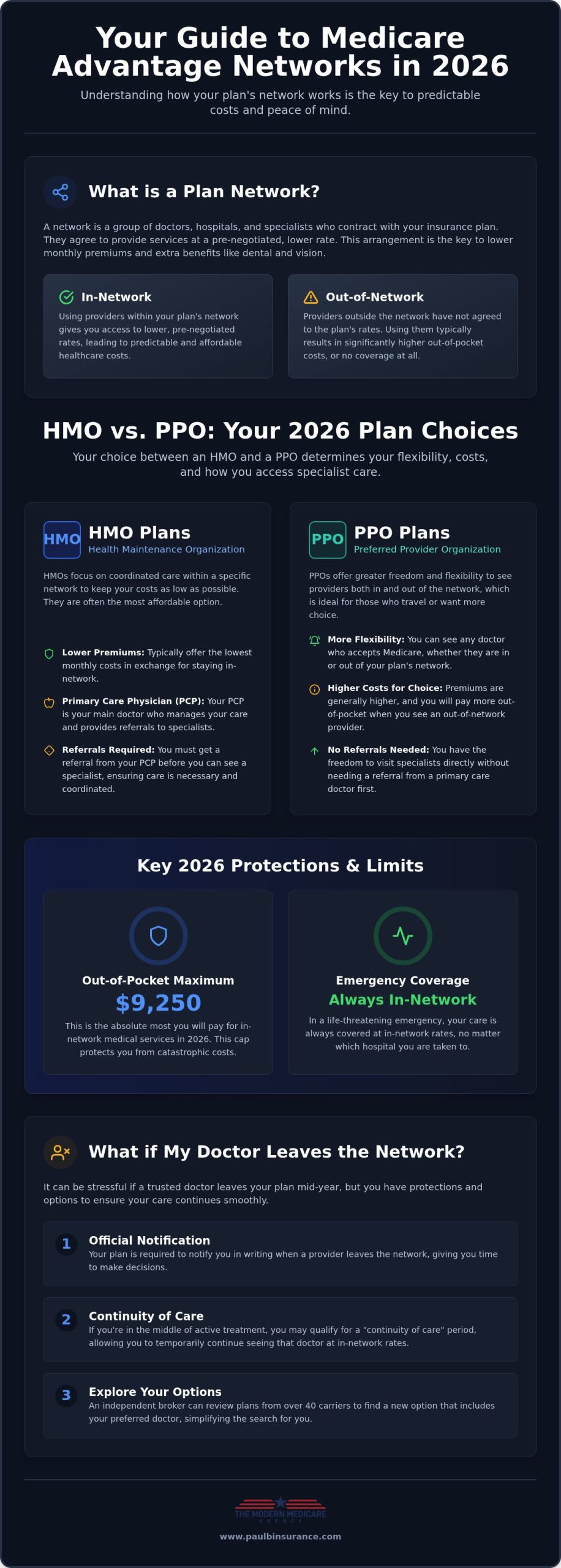
When you first look at a new plan, the word “restricted” can feel a bit scary. It sounds like you’re being told “no” before you even start your healthcare journey. But when we have medicare advantage plan network restrictions explained simply, you’ll see they’re actually the engine that makes your plan affordable. A network is just a group of doctors, hospitals, and specialists who have signed a contract with the insurance company. They agree to accept a set, lower price for their services in exchange for being part of the plan’s list. Having medicare advantage plan network restrictions explained correctly means you can focus on your health instead of your bills.
Think of it as a pre-negotiated discount for you. When you stay “in-network,” you’re seeing providers who have already agreed to those lower rates. If you go “out-of-network,” you’re seeing someone who hasn’t made that deal. This usually means you’ll pay a lot more, or in some cases, the plan won’t cover the visit at all. However, you should never worry in an emergency. If you’re facing a life-threatening situation, your plan will cover you at in-network rates no matter which hospital you’re rushed to. You’re protected when it matters most.
Why Private Plans Use Restricted Networks
Insurance companies use these groups to coordinate your care and ensure a high standard of quality. Because Medicare Advantage plans are managed by private companies, they have the flexibility to trade a smaller list of doctors for much lower monthly premiums. This trade-off is also why many plans can include “extras” like dental, vision, or even gym memberships. It’s helpful to remember that a “restricted” network doesn’t mean you’re getting lower-quality care. It simply means your care is pre-arranged to keep your costs predictable and your benefits high.
Network Adequacy: The 2026 Safety Net
You might worry that a plan won’t have enough specialists in your area. To protect you, the government has strict “network adequacy” rules for 2026. These rules force plans to prove they have enough doctors within a specific travel time and distance from your home. If a plan doesn’t have a specific type of specialist near you, they’re often required to grant a “gap exception.” This allows you to see an out-of-network specialist while paying the lower in-network price. If you want to see how these networks fit into the bigger picture, our Medicare Advantage Guide offers a deeper look at plan structures.
HMO vs. PPO: How Plan Types Dictate Your Doctor Choice
Choosing between plan types is really about how much control you want over your doctor list. Having medicare advantage plan network restrictions explained helps you see that HMOs and PPOs aren’t just acronyms. They’re different ways of managing your care and your costs in 2026. Your choice impacts how much you pay when you step “out of bounds” and how much freedom you have to choose your own specialists.
HMOs are popular because they usually offer the lowest monthly costs. In exchange, you agree to stay within their specific group of providers. If you go outside that group in an HMO, you’ll likely pay the entire bill yourself unless it’s an emergency. On the other hand, PPOs give you the freedom to see any doctor who accepts Medicare. You’ll just pay a higher copay when you go out-of-network. There’s also a rarer option called PFFS. These plans don’t use a traditional network, but you have to check if the doctor will accept the plan’s payment terms before every single appointment.
The HMO ‘Gatekeeper’ System
In an HMO, your Primary Care Physician (PCP) acts as a helpful guide for your health. This “gatekeeper” handles your routine care and decides when you need to see a specialist. To see a cardiologist or a dermatologist, you’ll need a referral. A referral is simply a formal recommendation from your main doctor that tells the insurance company the specialist visit is necessary. This system helps keep costs down by avoiding unnecessary tests. If your plan experiences a significant change in provider network, having a strong relationship with your PCP can make the transition much smoother.
The PPO Flexibility Factor
PPOs are built for people who want more options or travel frequently. You don’t need a referral to see a specialist, which saves you a trip to your main doctor first. In 2026, the cost-sharing gap between in-network and out-of-network care is a big factor to watch. While you have the freedom to wander, doing so will always cost more. If you find these networks too limiting, you might want to consider Medigap as a “no-network” alternative. These plans let you see any doctor in the country who accepts Medicare without worrying about network lists. If you’re feeling stuck, we can help you find a plan that fits your life and your budget.
The Rules You Need to Know: 2026 Out-of-Pocket Limits and Prior Authorization
Having medicare advantage plan network restrictions explained also means looking at the financial protections that keep your bank account safe. While networks tell you which doctors to see, cost-sharing rules tell you the most you’ll ever have to pay in a single year. These rules are designed to give you peace of mind, ensuring that even a major health event won’t lead to financial ruin. In 2026, these protections are stronger than ever, but you need to know how they work with your specific network to get the most value.
The most important number to watch is your Maximum Out-of-Pocket (MOOP) limit. This is the absolute limit on what you’ll spend for covered medical services in 2026. Once you hit this amount, the insurance company pays 100% of your covered costs for the rest of the year. For 2026, the government has set the in-network MOOP limit at $9,250. If you choose a PPO plan and use out-of-network doctors, your combined limit can be as high as $13,900. These caps act as a vital safety net for your retirement savings.
Understanding the 2026 MOOP Protection
It’s helpful to think of the MOOP as a ceiling on your stress. Many plans actually set their limits much lower than the legal maximum to stay competitive. For example, the average in-network limit in 2026 is closer to $5,421. It’s important to remember that these limits only apply to medical services like doctor visits or hospital stays. Your prescriptions fall under Medicare Part D, which has its own separate set of rules and cost-sharing caps. To ensure these networks remain fair, the government enforces strict network adequacy standards that require plans to have enough providers available to actually serve you.
Navigating Prior Authorizations
Sometimes, your doctor might say you need a specific test or surgery, but the insurance company wants to give a “thumbs up” first. This is called prior authorization. Plans use this to confirm that a service is medically necessary before they agree to pay for it. In 2026, new rules make this process much faster and more transparent. Plans must now respond to standard requests within 7 calendar days and urgent requests within 72 hours. Prior authorization isn’t just about saving the plan money; it’s a check to ensure you’re getting the right care at the right time. If a request is denied, don’t panic. You have a legal right to appeal the decision, and the plan must now provide a specific reason for any denial so you and your doctor can address it immediately.
What Happens if Your Doctor Leaves the Network Mid-Year?
Getting a letter that says your doctor is no longer part of your plan can feel like the rug is being pulled out from under you. It is one of the most stressful parts of having medicare advantage plan network restrictions explained in real time. You might feel a sudden surge of anxiety about your health and your wallet. Most of the time, these changes happen because of contract negotiations between the insurance company and a large medical group. In other cases, a doctor might simply retire or move their practice to a new state.
In 2026, your plan is legally required to give you at least 30 days’ notice before a provider leaves the network. This window is meant to give you time to breathe and make a plan. Your first step should be calling your doctor’s office directly. Sometimes they have other insurance contracts they still accept that might work for you. After that, call your insurance plan to see which other local doctors are currently taking new patients. Finally, reach out to your broker to see if there are better options available for your specific situation.
Continuity of Care: A 2026 Safety Rule
If you are in the middle of an active, serious treatment, you have special protections. If you’re undergoing chemotherapy or recovering from a major surgery, you can often keep seeing your current doctor at in-network prices for a set time. This “continuity of care” usually lasts up to 90 days to ensure your health remains stable. Many people believe losing a doctor lets them switch plans immediately through a Special Enrollment Period (SEP). However, this is often a myth. An SEP is usually only granted if the government determines the provider’s departure is a “significant” change to the plan’s overall network.
Finding a Suitable Replacement
When you have medicare advantage plan network restrictions explained by a guide, you’ll learn that your plan’s online directory is your best starting point. Don’t just pick the first name on the list. Call the new office and ask if they have experience with your specific health history. If you’re feeling overwhelmed by the search, you can talk to a Medicare broker who can look at 40+ carriers for you. We can help you find a different plan that still includes your favorite doctor during the next available enrollment window.
How an Independent Broker Simplifies Network Navigation
Having medicare advantage plan network restrictions explained might leave you feeling like you need a law degree just to see your doctor. It’s a lot of information to juggle, from out-of-pocket limits to referral rules. This is where an independent broker becomes your most valuable ally. We don’t just hand you a brochure and wish you luck. We take the time to understand your specific health needs and financial goals for 2026.
Our “Modern Medicare” approach is built on choice and clarity. Because we represent over 40 different insurance carriers, we aren’t limited to one set of rules or one network of doctors. We use specialized software to cross-check every single one of your medications and providers against every available plan in your area. This ensures that the plan you choose actually covers the care you need. Our support lasts all year long. If your doctor leaves the network in the middle of July, we’re right here to help you find a solution, not just during the busy fall enrollment season.
Unbiased Comparisons vs. Captive Agents
It helps to understand who is sitting across the table from you. A captive agent is an employee of one specific insurance company. They can only tell you about that one brand’s plans, even if a better option exists elsewhere. As an independent brokerage, we have the autonomy to put your needs first. We are your advocates, not the insurance company’s representatives. Paul Barrett founded The Modern Medicare Agency on a simple promise: to provide the “Peace of Mind” that comes from knowing you’ve seen every option and picked the best one for your life.
Your Path to Certainty
We’ve turned a confusing system into a methodical, step-by-step process. During a consultation, we listen first. We map out your current doctors and prescriptions, then show you a side-by-side comparison of the plans that fit. This removes the stress and confusion that often leads to “analysis paralysis.” You’ll move from a state of uncertainty to a state of total confidence in your coverage. If you’re ready to stop worrying about the fine print, you can schedule a simple, stress-free Medicare review today and let us handle the heavy lifting for you.
Moving Toward a Confident Healthcare Future
You now have the essentials of medicare advantage plan network restrictions explained, from the 2026 $9,250 in-network out-of-pocket cap to the flexibility of PPO plans. You understand that these networks are tools to keep your costs manageable, provided you have a plan that includes your favorite doctors. Whether it’s navigating a mid-year provider change or understanding your 2026 cost protections, you are no longer in the dark. You have the power to make a choice that protects both your health and your savings.
At The Modern Medicare Agency, we believe you deserve a guide who works for you, not the insurance companies. We represent over 40 top-rated carriers and are licensed in more than 34 states. Paul Barrett and his team specialize in turning complex rules into simple, jargon-free choices that give you genuine peace of mind. Why settle for a limited representative when you can have an independent advocate on your side? Take the final step in your journey from uncertainty to total clarity. Get Your Free, No-Obligation Medicare Advantage Comparison today. You have the knowledge; now let’s find the security you’ve been looking for.
Frequently Asked Questions
Can I see any doctor I want with a Medicare Advantage plan?
No, your choice depends on the specific plan type you select. In an HMO, you are generally limited to doctors within the plan’s network, except in emergencies. PPO plans offer more freedom, allowing you to see out-of-network providers for a higher cost. If seeing any doctor who accepts Medicare is your top priority, you might prefer a Medigap plan instead, as it does not use restricted networks.
What happens if I see an out-of-network doctor in an emergency?
You are always protected during a medical emergency. Federal rules ensure that emergency care is covered at in-network rates, regardless of your plan’s network restrictions. If you face a life-threatening situation in 2026, you should go to the nearest hospital immediately. You won’t be penalized for seeking life-saving care at a facility that doesn’t have a contract with your insurance provider. Your safety always comes first.
Do I need a referral to see a specialist on a PPO plan?
Usually, you do not need a referral on a PPO plan. These plans are designed for flexibility, allowing you to book appointments directly with specialists. This removes the “gatekeeper” step required by HMO plans, where your primary doctor must approve the visit first. While this saves you time, it’s still smart to check if the specialist is in-network to keep your out-of-pocket costs as low as possible.
What is the maximum I will pay out of pocket in 2026?
The legal maximum out-of-pocket limit for in-network services in 2026 is $9,250. If you have a PPO and use out-of-network providers, the combined limit is $13,900. It’s helpful to know that many plans set their limits much lower to be more competitive. On average, most people in 2026 are enrolled in plans with an in-network limit of approximately $5,421, providing a strong financial safety net for your retirement.
Can I switch plans mid-year if my doctor leaves the network?
Generally, you cannot switch plans mid-year just because a doctor leaves. You usually have to wait until the next Annual Enrollment Period to make a change. However, there is an exception if the government decides the doctor’s departure creates a significant gap in the plan’s coverage. Having medicare advantage plan network restrictions explained by a broker can help you identify if you qualify for a Special Enrollment Period in these rare cases.
Does ‘network restriction’ apply to my prescription drugs too?
Yes, pharmacy networks are a major part of your coverage. Just like doctors, pharmacies contract with insurance plans to provide specific pricing. To get the best deal on your medications in 2026, you should use “preferred” pharmacies. If you use a pharmacy that is out-of-network, you might have to pay the full retail price for your prescriptions. We can help you cross-check your medications against every local pharmacy network.
What is prior authorization and why is it required?
Prior authorization is a safety check where the insurance company confirms a treatment is medically necessary before they agree to pay. It’s often required for expensive services like surgeries or specialized scans. In 2026, new rules require plans to respond to these requests within 7 days for standard care and 72 hours for urgent needs. This process ensures you’re getting the right treatment while helping the plan manage high healthcare costs.
How often do Medicare Advantage networks change?
Networks can technically change at any time throughout the year. While most provider contracts are stable, doctors can retire or stop accepting certain plans mid-year. This is why The Modern Medicare Agency provides year-round support to our clients. We don’t just help you sign up; we stay by your side to help you find new providers or navigate plan changes whenever they happen, ensuring you never lose access to care.

Article by
Paul Barrett
Paul Barrett, CMIP is the founder of The Modern Medicare Agency, an independent Medicare-only brokerage based in Melville, NY. With 18 years of Medicare-exclusive experience, a CMIP designation, and more than 5,000 clients served across 37 states, Paul is one of the most credentialed independent Medicare specialists on Long Island — and one of the most direct.
He represents 40+ carriers with no quotas and no allegiances, which means his recommendations are based entirely on what fits each client's specific situation. He is the author of Medicare Mastery Unlocked and host of the Wise Guys Retirement Talk podcast. His content is grounded in primary sources, real carrier intelligence, and 18 years of watching what happens when people get Medicare right — and when they don't.
📞 631-358-5793 | paulbinsurance.com