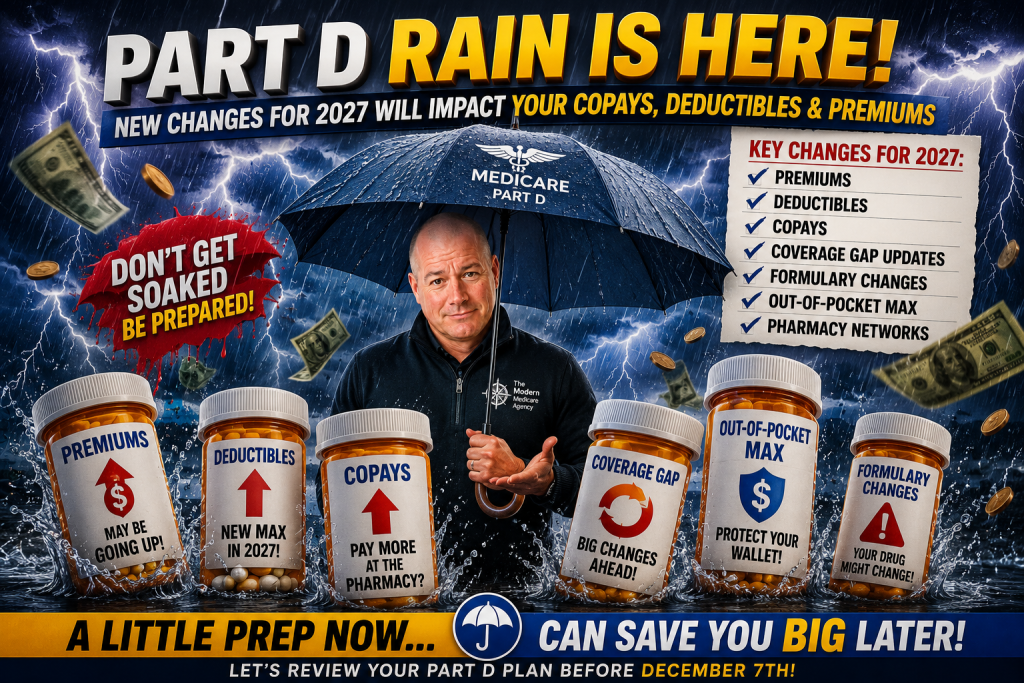
Medicare Part D Explained: How It Works, and What's Changing for 2027
Prescription drug coverage is one of the most confusing parts of Medicare — deductibles, tiers, coverage phases, and now a new payment option. Here's the whole thing explained plainly, plus exactly what's different for 2027.
In This Guide
- What Part D Actually Is
- How Your Costs Work: The Three Coverage Phases
- Formulary Tiers, Explained
- Special Protections: Insulin and Vaccines
- The Medicare Prescription Payment Plan
- Why Standalone Part D Is Hard to Navigate Alone
- Avoiding the Late Enrollment Penalty
- What's Different for 2027
- Standalone Plan Premiums Losing Their Cushion
- 15 More Drugs Get Negotiated Prices
- Quick Answers
Of all the pieces of Medicare, Part D might be the one that generates the most confused phone calls to my office. It's not that the concept is complicated — it's drug coverage — but the mechanics underneath it (deductibles, tiers, coverage phases, a brand-new payment option) genuinely changed in a big way over the last two years. Here's the full picture, explained the way I'd explain it sitting across the table from you.
Key Takeaways
- The old "donut hole" is gone. Part D now runs through three clean phases: deductible, initial coverage, and catastrophic ($0 cost-sharing after you hit the cap).
- 2027 costs are rising: deductible up to $700, out-of-pocket cap up to $2,400 — but 15 more drugs, including Ozempic and Wegovy, get federally negotiated lower prices the same year.
- Standalone plans face a real premium shift as a temporary federal subsidy ends, with about 75% of standalone enrollees expected to see some increase.
- Standalone Part D is genuinely harder to get help with than Medicare Advantage — the largest standalone carrier pays agents nothing, and market consolidation has left fewer people available to help you compare plans.
What Part D Actually Is
Part D is Medicare's outpatient prescription drug benefit. Unlike Part A and Part B, which come directly from the federal government, Part D is sold entirely through private insurance companies that contract with Medicare. You get it one of two ways:
- A standalone Prescription Drug Plan (PDP), which you pair with Original Medicare (Parts A and B).
- A Medicare Advantage plan with drug coverage built in (MA-PD), where your drug benefit is bundled into your Medicare Advantage plan rather than purchased separately.
Every plan — PDP or MA-PD — maintains its own formulary, which is simply the list of drugs it covers, organized into cost tiers. No two formularies are identical, which is exactly why "does my plan cover my medication" is a question you have to ask about your specific plan, every single year, not something you can assume carries over.
How Your Costs Work: The Three Coverage Phases
If you've heard people talk about the Medicare "donut hole," here's the update: it's gone. The Inflation Reduction Act eliminated the old coverage gap phase starting in 2025. Part D now runs through three straightforward phases instead of four confusing ones.
The Three Phases
- 1. Deductible phase. You pay the full negotiated price for your drugs until you meet your plan's deductible — up to $700 in 2027 under the standard benefit. Some plans set a lower deductible, or none at all.
- 2. Initial coverage phase. You typically pay 25% coinsurance for covered drugs under the standard benefit, while your plan and the drug manufacturer cover the rest. This phase continues until your out-of-pocket spending reaches the annual cap.
- 3. Catastrophic phase. Once your out-of-pocket spending hits $2,400 in 2027, you pay $0 for covered Part D drugs for the remainder of the calendar year.
That's it — no more coverage gap to plan around, no more surprise jump in costs partway through the year. Your spending rises steadily and then stops completely once you hit the cap.
I still have clients ask me about the "donut hole" out of habit — it was such a fixture of Medicare conversations for so long that the muscle memory sticks around. It's genuinely good news that it's gone. The new three-phase structure is far easier to explain, and more importantly, far easier to actually predict your costs against.
Formulary Tiers, Explained
Within the initial coverage phase, what you actually pay depends heavily on which tier your specific drug falls into. Most formularies use five tiers:
| Tier | Typical Drug Type | Typical Cost |
|---|---|---|
| 1 | Preferred generics | Lowest copay, often $0–$10 |
| 2 | Generics | Low copay, roughly $10–$30 |
| 3 | Preferred brand-name drugs | Moderate copay, roughly $40–$60 |
| 4 | Non-preferred brand-name drugs | Coinsurance, often 25–33% |
| 5 | Specialty drugs | Coinsurance, often 25–33% |
Two other things worth knowing before you assume a drug is covered the way you expect:
- Prior authorization — some drugs, especially Tier 3 and above, require your doctor to get approval from the plan before it's covered.
- Step therapy — some plans require you to try a lower-cost drug first before they'll cover a more expensive one, even if your doctor's original preference was the pricier option.
If a drug you need lands on a high tier, you or your doctor can request a formulary tier exception, which requires documentation of medical necessity. It's not guaranteed, but it's a real option worth pursuing rather than assuming the listed cost is final.
Special Protections: Insulin and Vaccines
Two categories of drugs get treated differently than everything else on a formulary, and both protections continue in 2027:
- Insulin. A one-month supply of covered insulin is capped at $35, with no deductible applied at all. You will not pay more than $35 per month for each covered insulin product.
- Adult vaccines. Vaccines recommended by the CDC's Advisory Committee on Immunization Practices — including shingles, RSV, and Tdap — are free under Part D, with no cost-sharing and no deductible.
The Medicare Prescription Payment Plan
One of the more useful, less-understood changes to Part D is the Medicare Prescription Payment Plan, sometimes called M3P. It's been available since 2025, and every Part D plan — standalone PDP or MA-PD — is required to offer it.
Here's what it actually does: instead of paying your full copay or coinsurance at the pharmacy counter when you fill a prescription, M3P spreads that cost into capped monthly bills across the rest of the calendar year. You pay $0 at the pharmacy and get a monthly bill from your plan instead.
I want to be really clear about what this program does and doesn't do, because I've seen people misunderstand it. M3P does not lower your total drug costs by a single dollar. It's purely a timing tool — it turns one large bill early in the year into smaller monthly bills. If a big upfront cost at the pharmacy would genuinely strain your budget, especially with the 2027 cap rising to $2,400, this is worth asking about. If cash flow isn't a concern for you, it doesn't change your bottom line either way.
It's free, voluntary, and carries no interest or fees. You opt in through your own plan, and if you need a prescription filled urgently before your enrollment is processed, most plans allow the start date to apply retroactively as long as the fill happened within the last 72 hours.
Why Standalone Part D Is Especially Hard to Navigate Alone
I want to address something directly that most Part D articles skip entirely, because it genuinely affects how much help you can expect to get. The standalone PDP market has been shrinking and consolidating hard for a few years running, and the reasons behind that are worth understanding.
What's Actually Happened to the PDP Market
- The number of standalone PDPs nationally dropped from 464 in 2025 to 360 in 2026 — a 22% cut, on top of a 35% cut the year before that.
- As of late 2025, 96% of all standalone PDP members were concentrated in just five carriers, with one company, Wellcare, alone accounting for 44% of all PDP enrollment nationally.
- For 2027, standard maximum agent compensation on a standalone PDP is $130 for a new enrollment and $65 for a renewal — compared to $725 and $363 for Medicare Advantage. That's the ceiling, not a guarantee; carriers can pay less, and some pay nothing at all.
- Wellcare, the single largest standalone PDP carrier in the country, does not pay agent commissions on its Part D plans.
Put plainly: the carrier with the single largest share of the standalone Part D market pays agents nothing to help people enroll in it or service that enrollment afterward. That's not a small technicality — when the compensation structure for a huge chunk of the market is $0, a lot of agents simply can't afford to spend real time helping with those specific plans, no matter how good a fit the plan might be for a given client. Industry commentators have started calling this "reverse steering" — the carrier decides not to pay, and the agent quietly stops actively marketing that plan as a result, even when it might genuinely be the best option available.
This isn't just industry commentary, either — it's become a real legal fight. In October 2025, Idaho attempted to require carriers to pay a minimum commission to agents; UnitedHealthcare sued, and a federal judge granted a preliminary injunction blocking the state's rule in December 2025. The compensation question is contested enough that it's ending up in court.
In my experience, this is a real reason so many seniors end up afraid to enroll in a standalone Part D plan on their own — and I don't think that fear is irrational. When a huge share of the market offers little or no support to help you compare formularies, tiers, and total annual cost, a lot of people are left facing a genuinely complicated decision with nobody in their corner. I'll be honest: standalone Part D isn't where the money is in this business. I still work through it with clients who need it, because leaving someone to guess their way through a formulary alone is exactly the kind of thing this whole industry should be better at preventing.
None of this means you should avoid a standalone PDP if it's genuinely the right fit for your situation — plenty of people are well-served by them, especially if you're on Original Medicare with a Medigap plan rather than Medicare Advantage. It does mean going in with clear eyes: compare your total annual cost, not just the premium, verify your specific drugs against the formulary yourself using Medicare's official Plan Finder, and don't assume every agent you call is equally equipped or motivated to walk you through every plan on the market.
Avoiding the Late Enrollment Penalty
If you go 63 or more consecutive days without Part D coverage (or other "creditable" drug coverage, like from a current employer) after your Initial Enrollment Period ends, Medicare can add a late enrollment penalty to your premium — permanently, for as long as you have Part D. The penalty is 1% of the national base beneficiary premium for every full month you went without coverage.
This one deserves its own deep dive rather than a summary here — I've written a full breakdown, including a real case involving an 18-year coverage gap, at The Part D Late Enrollment Penalty Explained.
What's Different for 2027
Both the deductible and the out-of-pocket cap are indexed to rise most years, so an increase itself isn't unusual — but a $300 jump in the annual cap is meaningful if you take expensive medications. If reaching that cap early in the year would strain your budget, that's exactly the scenario the Medicare Prescription Payment Plan above is built for.
Standalone Drug Plan Premiums Are Losing Their Cushion
Here's a change that matters mainly if you're one of the roughly 25 million people on a standalone Prescription Drug Plan (not bundled into a Medicare Advantage plan). Starting in 2027, standalone plans have to set premiums based purely on their own bids and claims data, without a government cushion that's been softening the increases for the past two years.
Some background helps explain why. When the Inflation Reduction Act's Part D redesign began taking effect in 2025 — including the new annual out-of-pocket cap — insurers expected their costs to rise and priced their bids accordingly. To prevent a sharp premium spike during that transition, the Biden administration created the Part D Premium Stabilization Demonstration, which launched for the 2025 plan year and provided roughly $9.8 billion in additional federal support to standalone plan sponsors over 2025 and 2026, primarily by reducing the base beneficiary premium and capping how much a participating plan's premium could rise year over year.
In July 2026, the current administration's CMS announced it would end the demonstration after the 2026 plan year rather than extend it into 2027 as originally contemplated. CMS says its review of 2027 bids shows insurers now have enough experience with the redesigned benefit to price plans without the extra support; CMS Administrator Dr. Mehmet Oz has described the program as a bailout that's no longer necessary. Advocacy groups including Families USA have pushed back on that framing, arguing the subsidy was working as intended and that ending it will genuinely raise costs for seniors. Reasonable people disagree about whether ending the program was the right call — that's a policy question, not a factual one, and not something I'll weigh in on here. What matters practically is what it means for your premium.
And that part is fairly concrete: reporting based on the administration's own figures suggests around 75% of standalone plan enrollees will see a premium increase for 2027 — about 30% seeing less than $10 a month more, and roughly 45% seeing increases in the $11-to-$20-a-month range. Individual results will vary significantly by plan and by state, since some standalone carriers leaned on the expiring subsidy more heavily than others. CMS's national base beneficiary premium benchmark — not what you personally pay, but the figure used to calculate subsidies — is rising from $38.99 to $41.33, the maximum 6% annual increase the IRA allows for that specific number. This change doesn't directly affect Medicare Advantage plans with built-in drug coverage (MA-PD), which cover roughly 31 million people and weren't the target of the subsidy.
If you're on a standalone Part D plan, this is exactly the kind of year where shopping around during AEP matters more than usual, rather than assuming your current plan's renewal price reflects the whole market. Some carriers will absorb more of this change than others, and the only way to know where your specific plan lands is to actually compare it against what else is available in your county this fall.
I've written a full, dedicated breakdown of exactly what this means for your actual premium: The Part D Subsidy Is Ending: What It Actually Means for Your 2027 Premium.
The Good News: 15 More Drugs Get Negotiated Prices
Not everything moving in 2027 costs more. On January 1, 2027, federally negotiated Maximum Fair Prices take effect for a second round of 15 high-spending Part D drugs — bringing the total number of drugs with negotiated prices to 25, following the first 10 that took effect in 2026. This second round includes some genuinely widely-used medications, including the GLP-1 drugs Ozempic and Wegovy, alongside treatments for asthma, COPD, and certain cancers.
CMS estimates these negotiated prices will reduce net Part D spending on these specific drugs by roughly 44% compared to 2024 pricing, and projects around $685 million in beneficiary savings for 2027. If you or a family member takes one of these medications, this is worth checking directly against your plan's formulary once 2027 pricing is finalized — the discount applies automatically, with no extra paperwork required on your end.
This is part of a bigger picture for 2027 — between major carrier plan exits and new Medicare Advantage enrollment caps, this AEP has more moving pieces than most. If you haven't already, my complete AEP 2027 guide ties all of it together in one place.
About Paul Barrett, CMIP
Paul is the Founder and Principal Agent of The Modern Medicare Agency, a Medicare-exclusive independent broker with 18+ years of experience, licensed in 37 states and representing 40+ carriers. He's helped more than 5,000 clients navigate Medicare and hosts the Wise Guys Retirement Talk podcast.
Quick Answers
What is Medicare Part D?
Medicare's prescription drug benefit, sold through private insurers as either a standalone Prescription Drug Plan (PDP) paired with Original Medicare, or bundled into a Medicare Advantage plan (MA-PD).
What are the 2027 coverage phases?
Deductible (up to $700), initial coverage (typically 25% coinsurance), and catastrophic ($0 cost-sharing after $2,400 in out-of-pocket spending). The old coverage gap no longer exists.
How much is the Part D deductible and out-of-pocket cap in 2027?
The standard deductible rises to $700, up from $615 in 2026. The annual out-of-pocket cap rises to $2,400, up from $2,100. Individual plans may set a lower deductible or none at all.
What is the Medicare Prescription Payment Plan?
A free, voluntary option that spreads your out-of-pocket drug costs into monthly bills instead of paying it all at the pharmacy. It changes when you pay, not how much you owe in total.
Is insulin still capped in 2027?
Yes — $35 per month per covered insulin product, with no deductible applied, unchanged from prior years.
Are Part D premiums going up in 2027?
Likely yes for most standalone plan enrollees. A subsidy created under the Biden administration to smooth premiums ends after 2026, and the current administration's CMS chose not to extend it. Reporting suggests about 75% of standalone plan enrollees will see some increase — roughly 30% under $10/month, about 45% in the $11–$20/month range. Medicare Advantage plans with built-in drug coverage aren't directly targeted by this change.
What drugs get lower prices in 2027?
A second round of 15 negotiated drugs, including Ozempic and Wegovy, get federally set Maximum Fair Prices starting January 1, 2027 — no extra steps needed to get the lower price.
What happens if I don't enroll in Part D when I'm first eligible?
You may owe a permanent late enrollment penalty if you go 63 or more days without Part D or other creditable drug coverage after your Initial Enrollment Period ends — 1% of the national base beneficiary premium per uncovered month, added to your premium for as long as you have Part D.
Why is it hard to get help choosing a standalone Part D plan?
The market has consolidated into just a handful of carriers, agent compensation on standalone plans is far lower than on Medicare Advantage, and the single largest standalone carrier pays no commission at all — leaving many people with less professional support available than they'd get shopping for a Medicare Advantage plan.
Not Sure How Your Drug Costs Actually Break Down?
I'll walk through your specific medications, your plan's formulary tiers, and whether the Medicare Prescription Payment Plan makes sense for your situation. No pressure, no script.
Related Reading
- Your Complete Guide to AEP 2027
- Please Don't Change Your Medicare Plan Until You Check These 7 Things
- The Part D Late Enrollment Penalty Explained
- The Part D Subsidy Is Ending: What It Actually Means for Your 2027 Premium
- Medicare Advantage Enrollment Caps 2027: Why Waiting Could Cost You
- Humana's 2027 Medicare Advantage Changes: The Full, Honest Breakdown