
What if the insurance you’ve paid into for decades doesn’t actually cover the help you might need most? Many people assume that medicare coverage for long term care includes staying in an assisted living facility or getting help with daily tasks like bathing and dressing, but the reality in 2026 is often a shock. It’s completely normal to feel a sense of dread when you look at nursing home costs that can now exceed $10,000 a month. You’ve worked hard for your savings, and the fear of losing it all to a few months of care is a heavy burden to carry.
We are here to lift that weight by explaining exactly what Medicare does and does not cover so you can plan for the future with total peace of mind. In this guide, we’ll walk through the specific 100-day limit for skilled nursing, the crucial difference between skilled and custodial care, and the practical alternatives available to protect your legacy. By the end, you’ll have a clear, step-by-step path from uncertainty to a solid plan for your security.
Key Takeaways
- Learn why long-term care is usually considered “custodial care” and why Medicare treats it differently than medical treatment.
- Get a clear explanation of the 100-day limit on medicare coverage for long term care so you aren’t caught off guard by unexpected facility bills.
- Identify the gaps in Medicare Advantage and Medigap plans that could leave you responsible for the full cost of assisted living or home aides.
- Discover how to use private solutions like long-term care insurance to protect your savings from being exhausted by nursing home costs.
- Understand why talking to an independent expert in 2026 is the best way to build a personalized plan that gives you total peace of mind.
What Exactly is Long-Term Care in 2026?
It usually starts with a phone call or a quiet realization during a Sunday dinner. You notice Mom is having trouble getting out of her chair, or Dad seems confused about his medications. This moment is often when families first begin searching for information about medicare coverage for long term care. It’s a stressful time filled with questions about how to keep your loved ones safe while protecting the life savings they spent decades building. You aren’t alone in feeling overwhelmed; thousands of families are navigating these same worries right now.
To find the right answers, we first need to look at What is Long-Term Care? at its core. In 2026, most care isn’t about doctors or hospitals; it’s about support. Long-term care (LTC) is primarily “custodial care,” which means assistance with the basic Activities of Daily Living (ADLs). These include:
- Bathing and grooming
- Dressing
- Using the bathroom safely
- Moving from a bed to a chair (transferring)
- Eating and meal preparation
As life expectancy continues to rise in 2026, more of us will eventually need this kind of help. We’re living longer, which is a blessing, but it also means our bodies may need extra support for years after our medical health has stabilized. This shift in how we age makes it vital to understand where your insurance stops and where your personal responsibility begins.
Custodial Care vs. Skilled Care: The Vital Distinction
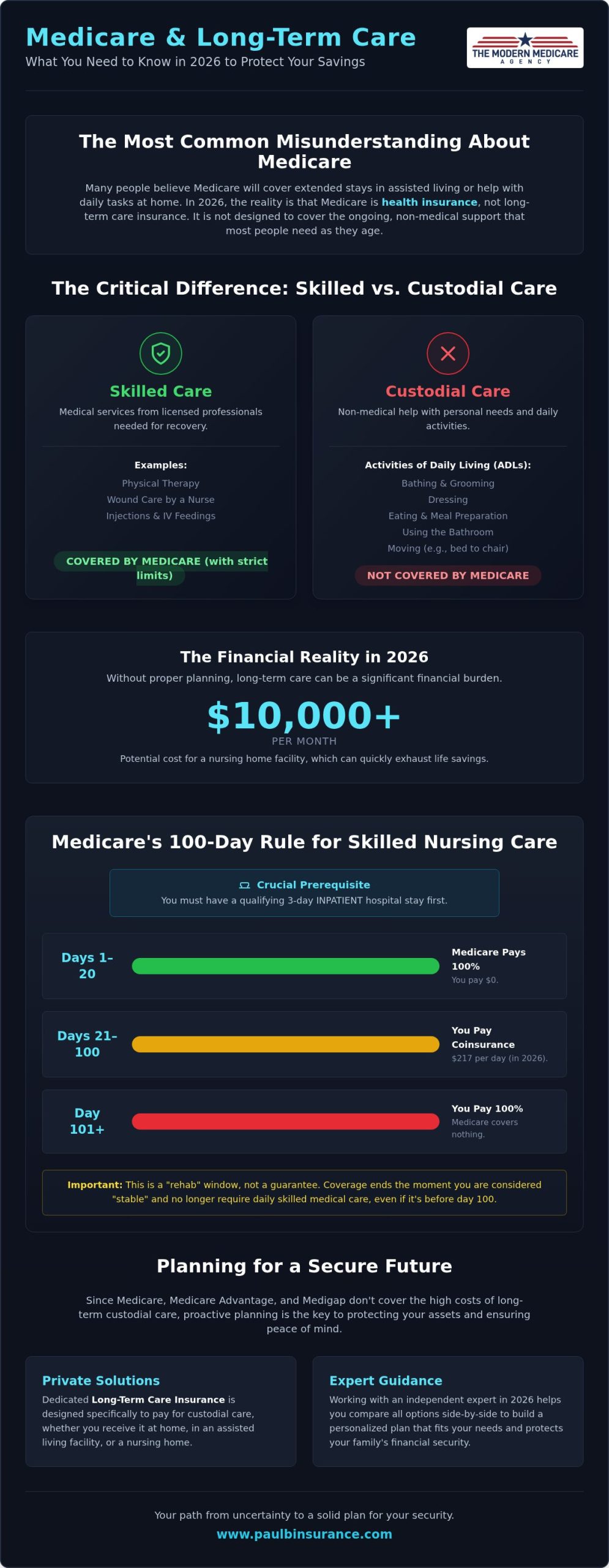
Understanding the difference between these two terms is the key to your entire plan. Skilled care involves medical services provided by licensed professionals, like a physical therapist or a registered nurse. Custodial care is non-medical help provided by aides or family members to help you get through the day. Here is the reality we must face together: custodial care is the one thing Medicare almost never covers.
Why 2026 is the Year to Start Your Care Plan
Waiting for a health crisis to happen is the most expensive way to handle your future. In 2026, the cost of home health aides and assisted living continues to climb at a rate that outpaces many retirement incomes. When you work with an independent broker, we look at the entire map of your retirement. We help you compare medicare coverage for long term care against private options side-by-side. This ensures you aren’t just buying a policy, but building a safety net that protects your peace of mind and your family’s financial security before a crisis forces your hand.
Does Medicare Cover Long-Term Care? The Reality Check
Let’s be very clear from the start. Original Medicare is not designed to pay for your long-term living expenses or help with daily activities. While many people hope that medicare coverage for long term care is a standard benefit, the truth in 2026 remains the same: Medicare is health insurance, not stay-at-home or nursing home insurance. It focuses on medical recovery from a specific injury or illness rather than the ongoing support many of us need as we age.
If you look at the official Medicare coverage rules, you’ll see that it only steps in for what is called “Skilled Nursing Facility” (SNF) care. This is a very specific type of short-term rehabilitation. Medicare only pays if you are actively improving or if you need professional medical staff to maintain your current condition. The moment you are “stable” and just need help with meals or getting around, Medicare stops paying. This is why understanding the gaps is so important for your peace of mind.
In 2026, these rules are tied to a “Benefit Period.” This period begins the day you are admitted to a hospital or SNF and ends when you haven’t received any skilled care for 60 days in a row. If you go back to the hospital after that 60-day break, a new period starts, and you’ll likely have to pay the 2026 Part A deductible of $1,736 again.
The 100-Day Rule for Skilled Nursing
Medicare uses a strict timeline for how much it will help with a stay in a skilled facility. For the first 20 days of your stay, Medicare usually pays the full cost. However, for days 21 through 100, you are responsible for a daily coinsurance of $217 in 2026. Once you hit day 101, you are responsible for 100% of the costs. It’s a common mistake to view this as a 100-day “living” benefit. In reality, it is a 100-day “rehab” window that can end much sooner if the facility decides you no longer need skilled medical attention. If you’re worried about these daily co-pays, you might want to explore how a Medigap plan can help cover those costs.
The 3-Day Inpatient Hospital Stay Requirement
This is often the most frustrating hurdle for families. To qualify for any SNF coverage, you must have a “qualifying” hospital stay. This means you must be an inpatient for at least three consecutive days. Many seniors are held in the hospital for “observation” rather than being officially “admitted.” Even if you spend three nights in a hospital bed, if your status was observation, Medicare won’t pay a single dime for your subsequent nursing home stay. Always ask the hospital discharge planner directly: “Is this stay coded as inpatient or observation?” Getting that answer early can save you tens of thousands of dollars.
Medicare Advantage and Medigap: Do They Help with LTC?
It’s a common relief to hear that you have “full coverage,” but in the insurance world, that phrase can be misleading. Many people we talk to believe that because they have a top-tier supplement or a popular private plan, their future nursing home stays are fully handled. While these plans provide incredible value for medical needs, they don’t change the basic definition of medicare coverage for long term care. Even the most comprehensive plans are still tied to Medicare’s strict rules about medical necessity.
To truly protect your family, you need to understand where these plans excel and where they leave a gap. While Medicare handles the doctors and hospitals, Medicaid’s role in long-term care is often what people are actually looking for when they need help with daily living. If you don’t qualify for Medicaid, you’ll need to look at how your current Medicare plan fills the smaller holes. To get a better sense of your options, you can learn more about Medicare Advantage plans and how they function in 2026.
Medigap: Closing the Gap on Co-pays
Medicare Supplement plans, often called Medigap, are designed to pay the costs that Original Medicare leaves to you. If you have a stay in a skilled nursing facility, Medicare requires you to pay a daily co-pay of $217 for days 21 through 100 in 2026. A Medigap plan, such as Plan G, is a wonderful tool because it usually pays that entire $217 daily cost for you. This can save you over $17,000 during a single benefit period.
However, there is a catch you must remember. Medigap only pays if Medicare pays first. If Medicare decides you are no longer “improving” and stops covering your stay, your Medigap plan will also stop paying. It does not provide any coverage for custodial care or long-term stays in assisted living. You can explore Medicare Supplement (Medigap) options to see which plans offer this specific co-pay protection.
Medicare Advantage in 2026: New Support Services
In 2026, about 55% of people on Medicare are enrolled in a Medicare Advantage plan. These private plans have started offering small but helpful “supplemental benefits” that Original Medicare doesn’t provide. You might find a plan that covers a few weeks of meal delivery after a hospital stay or pays for a grab bar to be installed in your shower. Some plans even offer a limited number of hours for a home health aide.
While these perks are helpful, they are not a substitute for a long-term care policy. They are small supports designed to help you recover at home, not a way to fund years of care. Because these “hidden” perks vary so much between companies, we recommend comparing over 40 carriers with an independent broker. We can help you find the specific 2026 plans that offer the most support for your unique situation, giving you a clearer path to certainity.
How to Pay for Care Medicare Won’t Cover
Since we’ve established that medicare coverage for long term care is limited to short-term rehab, you might feel a bit of panic. It’s a natural reaction. How do you protect your home? How do you keep your savings for your spouse or children? In 2026, there are several ways to build a bridge over the gaps Medicare leaves behind. Some involve government help, while others use private tools to keep you in control of your choices. Our goal is to help you move from a state of worry to one of absolute certainty.
Medicaid: The Safety Net with Strings Attached
Medicaid is the primary way many people eventually pay for long-term custodial care. Unlike Medicare, it does cover help with bathing, dressing, and eating in a nursing home or at home. However, it’s a needs-based program. To qualify, you must “spend down” your assets until you have very little left. In 2026, the rules around this are still strict. Most states look back at your finances for five years. They want to make sure you didn’t just give money away to qualify. While this sounds daunting, we can help you understand these boundaries so you aren’t caught by surprise. It’s about knowing the rules before you need them.
Private Options: LTC Insurance and Annuities
If you want to stay in control and protect your assets, private insurance is the most common path. A standalone Long-Term Care Insurance policy is designed specifically to pay for home health aides or assisted living. In 2026, many people are choosing “Hybrid” policies. These combine Life Insurance with LTC protection. If you need care, the policy pays out to cover your costs. If you don’t, your family receives a death benefit. It’s a way to ensure your premiums provide value no matter what happens.
We’re also seeing a rise in Short-Term Care insurance as we move through 2026. These plans are often more affordable and provide coverage for about a year. This is a great middle-ground for those who don’t want a massive premium but need a safety net. Annuities can also be used to create a guaranteed stream of income specifically for care. At The Modern Medicare Agency, we help you compare these specific products from over 40 carriers. We don’t just look at one company; we look at the whole market to find the right fit for your budget. You can talk with an independent advocate today to see which of these options fits your 2026 plan.
Planning for 2026: Your Path to Peace of Mind
The most expensive way to handle your future is to wait for a crisis to happen. When an emergency strikes, your choices narrow quickly. You might find yourself making rushed decisions about nursing homes or home aides while under immense emotional stress. In 2026, the rising costs of these services mean that a lack of planning can drain a lifetime of savings in just a few months. We want to help you avoid that distress by creating a structured path to certainty right now.
It’s natural to feel a bit protective of your independence. Many people worry that discussing medicare coverage for long term care means admitting they are getting older. In reality, having this “Care Conversation” with your family is one of the most loving things you can do. It removes the guesswork for your children and ensures your wishes are respected. By looking at the gaps in medicare coverage for long term care today, you are choosing to stay in the driver’s seat of your own life.
The Advantage of an Independent Medicare Broker
You don’t have to figure this out alone. A “captive” agent usually works for one specific insurance company and can only offer you their limited menu of products. We do things differently. As independent brokers, we have access to over 40 carriers. This allows us to look at the entire market to find the plan that fits your specific health history and budget. Our guidance is provided at no cost to you; our mission is simply to serve as your advocate and educator. We help you see the “whole picture,” including the private options and supplements that protect you where the government plans stop.
Your 2026 Long-Term Care Checklist
Taking the first step doesn’t have to be overwhelming. Use this simple guide to start your journey from uncertainty to security:
- Step 1: Review your current health and family history. Think about your parents’ health journey and your own current needs. This helps us estimate what kind of support you might eventually require.
- Step 2: Assess your savings and what you can afford out-of-pocket. Look at your retirement income and assets. Knowing your “safety zone” helps us determine if you need a full long-term care policy or a more affordable short-term alternative.
- Step 3: Schedule a consultation with Paul Barrett and the team. We’ll sit down with you, listen to your concerns, and compare plans side-by-side until you feel completely confident.
You deserve to enjoy your retirement without the shadow of “what if” hanging over your head. Let’s work together to build a plan that protects your home, your legacy, and your peace of mind. Contact The Modern Medicare Agency for a Clear Path Forward and let us help you navigate the complexities of 2026 with ease.
Take Control of Your Future Today
The path to aging with dignity shouldn’t be paved with fear or confusion. We’ve explored how medicare coverage for long term care is often misunderstood; it’s a health system designed for medical recovery, not a lifestyle support plan for your later years. By recognizing that Medicare stops where custodial care begins, you’ve already taken the most important step toward protecting your home and your legacy.
You don’t have to navigate these complex 2026 regulations alone. As an independent agency licensed in 34+ states, we compare over 40 carriers to find the specific safety net that fits your life. Our mission is to provide the unbiased guidance you deserve. Our focus is entirely on your security and comfort, ensuring you never feel like just another number in a system.
Are you ready to replace your worries with a solid plan? Get a Simple, Unbiased Review of Your Medicare Options and let us help you find your way. You’ve worked hard for your peace of mind; let’s make sure you keep it. We’re here to guide you every step of the way.
Frequently Asked Questions
Does Medicare Part A or Part B cover long-term care?
Medicare Part A covers short-term skilled nursing care for rehabilitation, but neither Part A nor Part B covers long-term custodial care. This is a common point of confusion when families look for medicare coverage for long term care. Part A handles the facility costs during your limited rehab stay. Part B covers the doctors and medical services you receive while there. If you just need help with daily life, these parts won’t pay.
How long will Medicare pay for a nursing home stay in 2026?
Medicare will pay for a maximum of 100 days of skilled nursing care per benefit period in 2026. The first 20 days are usually covered at 100%. From day 21 to day 100, you must pay a daily coinsurance of $217. It is vital to remember that this coverage only lasts as long as you require skilled medical care. If you stop improving, Medicare may stop paying before the 100 days are up.
What is the 3-day rule for Medicare coverage in a skilled nursing facility?
The 3-day rule requires you to be an officially admitted inpatient in a hospital for at least three consecutive days before Medicare will cover a skilled nursing stay. Time spent under observation status doesn’t count toward these three days. This rule is often a surprise for families. Always check with the hospital staff to confirm your admission status is inpatient so you don’t lose your eligibility for rehab coverage.
Will my Medicare Advantage plan pay for a home health aide?
Some Medicare Advantage plans in 2026 offer limited supplemental benefits for home health aides, but these are rarely a full solution. These perks might cover a few hours of help per week or support following a hospital stay. They aren’t designed to provide the comprehensive, ongoing medicare coverage for long term care that most people need for custodial support. Review your specific plan’s Evidence of Coverage to see what limited help is available.
What happens when Medicare stops paying for my nursing home care?
Once Medicare stops paying, you become responsible for 100% of the costs unless you have other insurance or qualify for Medicaid. This transition usually happens on day 101 of a stay or earlier if you no longer need skilled medical services. Many families find this moment incredibly stressful. To prepare, we recommend looking at private long-term care insurance or short-term care policies before a health crisis occurs.
Is there any Medicare plan that covers 100% of long-term care?
No Medicare plan, including Advantage or Medigap, covers 100% of long-term custodial care. Medigap plans can help pay the $217 daily co-pay for days 21 through 100, but they only work if Medicare is already paying. They don’t cover the cost of living in a facility once your medical rehab ends. True long-term care is a separate need that requires a dedicated insurance policy or personal savings.
Can I buy a separate policy just for long-term care if I already have Medicare?
Yes, you can buy a separate policy to fill the gaps Medicare leaves behind. Options include standalone long-term care insurance, hybrid life insurance policies, or short-term care plans. These products are designed specifically to pay for the custodial care that Medicare excludes. We’ll help you compare these side by side with your Medicare plan to ensure you have a complete safety net for 2026 and beyond.
What is the difference between long-term care and hospice care under Medicare?
Long-term care provides help with daily activities for an indefinite period, while hospice care is specifically for medical and emotional support during a terminal illness. Medicare doesn’t cover long-term custodial care, but it has a very robust hospice benefit. Hospice care is usually covered at 100% for those with a life expectancy of six months or less. It focuses on comfort and pain management rather than daily living assistance.

Article by
Paul Barrett
Paul Barrett, CMIP is the founder of The Modern Medicare Agency, an independent Medicare-only brokerage based in Melville, NY. With 18 years of Medicare-exclusive experience, a CMIP designation, and more than 5,000 clients served across 37 states, Paul is one of the most credentialed independent Medicare specialists on Long Island — and one of the most direct.
He represents 40+ carriers with no quotas and no allegiances, which means his recommendations are based entirely on what fits each client's specific situation. He is the author of Medicare Mastery Unlocked and host of the Wise Guys Retirement Talk podcast. His content is grounded in primary sources, real carrier intelligence, and 18 years of watching what happens when people get Medicare right — and when they don't.
📞 631-358-5793 | paulbinsurance.com