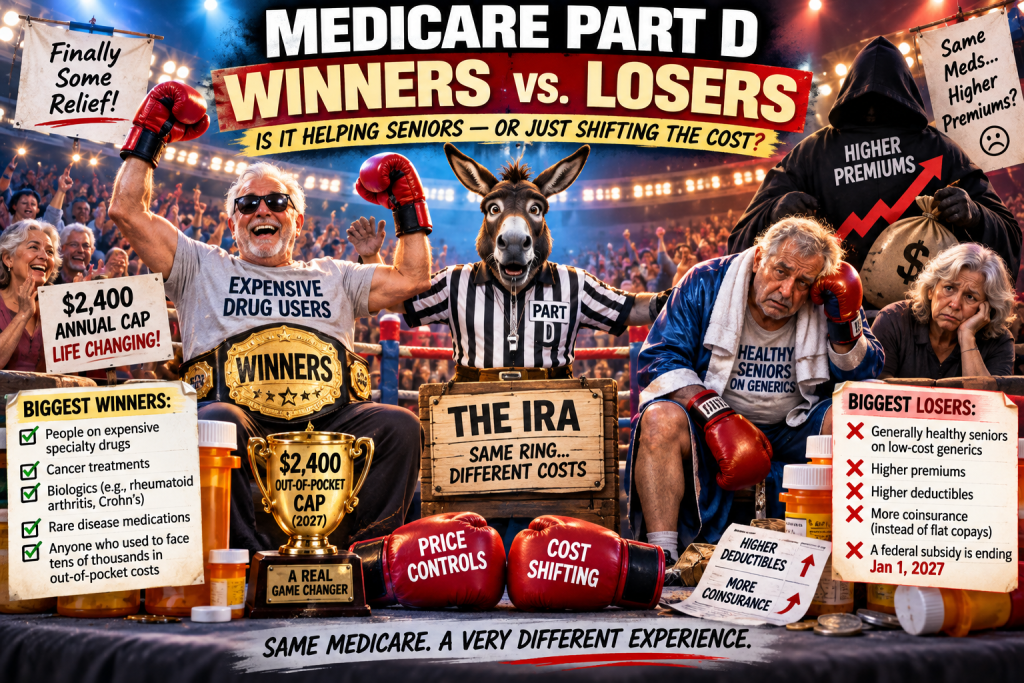
Is Medicare Part D Actually Helping Seniors — Or Just Shifting the Cost?
The Inflation Reduction Act promised to fix prescription drug costs. For some seniors, it genuinely has — in a life-changing way. For others, it’s meant rising premiums for the same handful of cheap generics they’ve always taken. Both things are true at once, and understanding why is the key to understanding your own Part D costs heading into 2027.
Key Takeaways
- The IRA didn’t lower drug prices industry-wide — it capped what any one person pays, then shifted the remaining cost elsewhere in the system.
- If you take expensive specialty drugs, this has likely been a major financial win for you — the $2,100 (2026) / $2,400 (2027) out-of-pocket cap protects against costs that used to run into the tens of thousands.
- If you’re generally healthy and take a few cheap generics, you may be seeing your premium climb to help absorb costs elsewhere in the system, even though your own drug costs haven’t changed.
- Insurers have responded by raising deductibles and shifting from flat copays to coinsurance — a structural change that affects nearly everyone’s cost-sharing, not just high-spenders.
- A temporary federal subsidy that softened premium increases is ending January 1, 2027, and there’s a genuine, active political debate about that decision, which we lay out from both sides below.
The Real Problem: It’s Both Price and Volume
Part D’s cost problem isn’t one thing — it’s two forces compounding each other:
- The drugs themselves are exceptionally expensive. The U.S. pays significantly more for brand-name medications than other developed countries. A single specialty drug can run into the thousands per month without any insurance involved.
- Seniors take a lot of them. The average Medicare beneficiary takes roughly 4 to 5 prescriptions concurrently — and for those managing multiple chronic conditions, that number frequently exceeds 10.
Put those two together, and you get a program under enormous financial strain, which is exactly the environment the IRA’s reforms were designed to address. (For the nuts-and-bolts mechanics of how today’s Part D actually works — deductible, coinsurance, catastrophic phase — see our complete Part D guide rather than us re-explaining it here.)
What Genuinely Got Better
For one specific group of people, this is close to unambiguously good news: anyone who used to face catastrophic annual drug costs.
Before these reforms, someone on high-cost specialty medications — certain cancer treatments, advanced biologics for rheumatoid arthritis — could face $10,000 or more in out-of-pocket costs in a single year, with no ceiling. Today, that same person pays a maximum of $2,400 for the entire year, then $0 for the rest of it. That’s not a modest improvement. For a meaningful number of Medicare beneficiaries managing serious chronic illness, it’s the difference between financial security and genuine hardship.
Where the Bill Actually Went
Here’s the part that doesn’t get explained often enough: capping what patients pay doesn’t make the underlying cost disappear — it moves the remaining liability onto the insurance companies that run Part D plans. And insurers, facing that new financial exposure, responded the way any business facing a large new liability would: by adjusting their pricing and cost-sharing structures.
Two structural shifts are showing up across the market:
- Coinsurance replacing flat copays. A predictable $10 or $20 copay is increasingly being replaced with coinsurance — a percentage of the drug’s cost, often 20-25%. On a $600 drug, 25% coinsurance means $150 at the counter, versus a flat copay that wouldn’t have moved regardless of the drug’s price.
- Deductibles rising toward the federal maximum. More plans are setting their deductible at or near the highest amount currently allowed, meaning you pay closer to full price on your first prescriptions each year before coverage meaningfully kicks in.
(We cover how to actually calculate and prepare for these costs in our guide to understanding Medicare cost-sharing.)
Winners and Losers: The Illustrative Picture

These figures are illustrative, built to show the direction and rough scale of the shift — not a quote for your specific plan or drug list.
This is really the heart of the honest answer to “is this working”: it depends enormously on which of these two groups you’re in.
High-cost enrollees — people managing cancer, severe rheumatoid arthritis, advanced diabetes with expensive medications — are, by most accounts, highly satisfied. The law protects them from exactly the kind of catastrophic cost that used to define worst-case scenarios in retirement healthcare.
Low-cost enrollees — a large number of relatively healthy seniors who take only a few inexpensive generics — are watching their monthly premiums climb to $40 or $50 a month, sometimes just to cover medications that would retail for a few dollars. This is especially pronounced in higher cost-of-living states like New York and California, where it can feel like an unfair penalty for barely using the benefit at all.
Paul’s Honest Take: I hear this frustration constantly from healthy clients on Long Island: “Why is my premium going up when I only take one cheap generic?” The honest answer is that you’re not paying more because your own drugs got more expensive — you’re absorbing part of the cost of protecting the sickest members of your risk pool. That’s genuinely how insurance is supposed to work, but it doesn’t feel that way when the change happens this fast and this visibly. It’s actually the same underlying mechanism driving rising Medigap premiums — a shared risk pool absorbing costs from its highest users. Different program, same math.
The Subsidy Fight: A Fair Look at Both Sides
Layered on top of all this is a specific, currently contested policy decision worth understanding on its own.
When insurers warned in 2024 that these reforms would force sharp premium increases, the previous administration created a temporary Premium Stabilization Demonstration program, paying roughly $9.8 billion in federal funds directly to insurers to soften monthly premium increases. That program is scheduled to end January 1, 2027 — a decision made by the current CMS administration, whose administrator, Dr. Mehmet Oz, has publicly characterized the program as an unnecessary “corporate bailout” for the insurance industry.
The administration’s position: ending the subsidy removes what it considers an unnecessary transfer of taxpayer money to insurance companies. Reporting suggests roughly 75% of standalone Part D enrollees will see some premium increase as a result — about 30% under $10 a month, and roughly 45% landing in the $11–$20 a month range.
The counter-argument from policy analysts: those figures are averages, and some standalone Part D plans in certain regions could see considerably sharper premium spikes than the typical range suggests, since regional variation can be significant.
Both of these can be true simultaneously — a modest increase for most people, alongside real regional outliers — which is exactly why checking your own plan’s actual number during AEP matters more than relying on any national average, regardless of which side of this debate you find more persuasive.
What You Can Actually Do About It
- If you’re a low-cost enrollee frustrated by rising premiums: compare standalone plans carefully every single AEP. Coinsurance-versus-copay structures now vary significantly between plans, and the cheapest plan for your specific situation can change year to year.
- If your income qualifies, look into Extra Help. It can eliminate your deductible entirely and cap copays at a few dollars regardless of a drug’s actual cost. (See our full Extra Help breakdown.)
- Check whether your state runs a State Pharmaceutical Assistance Program (SPAP). Only about 13 states currently do, but if yours is one of them, it can meaningfully lower your costs on top of standard Part D.
- If you’re managing multiple chronic conditions, this is genuinely one of the better times in Part D’s history to be a high-cost enrollee — make sure you understand your catastrophic cap and aren’t leaving any of that protection on the table by staying on a plan that isn’t structured well for your situation.
Frequently Asked Questions
Did the Inflation Reduction Act actually lower drug prices? It capped what individual patients pay out of pocket and directly negotiated lower prices on a growing list of specific drugs, but it didn’t lower the industry-wide cost of prescription drugs broadly. The remaining financial burden for high-cost cases shifted to insurers, who have adjusted premiums and cost-sharing in response.
Why is my premium going up if I only take cheap generic drugs? Your premium reflects the cost of your entire risk pool, not just your personal drug spending. As insurers absorb more liability for high-cost enrollees, that cost gets spread across everyone in the plan, including low-spenders.
Is the premium subsidy ending a permanent decision? As of this writing, yes — CMS has announced the Premium Stabilization Demonstration will end after 2026. Like any federal program, future administrations could revisit this, but there’s no current indication of that happening.
Should I switch to Medicare Advantage to avoid these standalone Part D premium increases? Not automatically. Medicare Advantage plans bundle drug coverage differently and aren’t subject to the same standalone premium subsidy mechanics, but they come with their own network and prior authorization trade-offs. This is worth a specific conversation about your doctors, medications, and budget rather than a blanket switch.
Is this a Democrat or Republican issue? The Inflation Reduction Act was passed under the Biden administration without Republican support, and the current CMS administration made the decision to end the premium subsidy. Reasonable people disagree on the policy merits of both decisions — we’ve tried to present both perspectives fairly above rather than take a side.
The Bottom Line
Asking “is Part D helping or failing consumers” doesn’t have one honest answer — it has two, depending on who’s asking. If you’re managing a serious chronic illness, these reforms have likely been one of the most consequential financial protections Medicare has ever offered you. If you’re healthy and taking a couple of cheap generics, you may be legitimately frustrated by a premium increase that has nothing to do with your own medication costs.
Both experiences are real, and neither one is the whole story. What matters most for your own situation is understanding which side of that divide you’re on, and making sure your specific plan is actually structured well for it — which is exactly the kind of thing worth reviewing before this year’s Annual Enrollment Period.
Call 631-358-5793 or visit paulbinsurance.com to talk through your specific situation.
Paul Barrett, CMIP, is the founder of The Modern Medicare Agency, based in Melville, NY, and has spent 18+ years exclusively helping people navigate Medicare — never life insurance, never annuities, just Medicare. He’s licensed in 37 states, represents more than 40 carriers, and has personally helped over 5,000 clients choose coverage that actually fits their lives.
This piece presents a genuinely contested policy debate. Where perspectives differ — particularly around the premium subsidy decision — we’ve aimed to represent both sides fairly rather than assert a single conclusion. Figures are illustrative and current as of 2026; individual costs vary significantly by plan, drug list, and region.