
Medicare treats the cancer, but it doesn’t always protect your savings. Even in 2026, with updated protections in place, a single diagnosis can lead to significant financial strain. You might feel a heavy sense of worry when you think about the 20% coinsurance that Medicare Part B leaves behind for treatments like chemotherapy. It’s a common concern, and you’re not alone in feeling this way. Many people ask, how does cancer insurance work with medicare to stop these costs from exhausting their hard-earned nest egg? We’re here to act as your guide through this confusion.
We believe you deserve to focus on your health rather than your medical bills. In this article, you’ll learn how a cancer insurance policy provides a lump-sum cash benefit that fills the financial gaps Medicare leaves open. We’ll explore the specific 2026 rules, including the $2,100 out-of-pocket cap for prescription drugs and the reality of non-medical costs like travel and lodging. By the end, you’ll have a clear strategy to protect your peace of mind and your family’s future.
Key Takeaways
- Learn exactly how does cancer insurance work with medicare to provide a direct, lump-sum cash cushion when you need it most.
- Identify the specific gaps in Medicare Part B that could leave you responsible for 20% of your chemotherapy and radiation costs in 2026.
- Understand why your choice between Medicare Advantage and Medigap changes the way you should approach supplemental cancer protection.
- Discover how to use a cash payout to cover non-medical stressors like travel for treatment or daily household expenses.
- See how an independent broker simplifies your search by comparing options from over 40 different insurance carriers to find your best fit.
Understanding Cancer Insurance and Medicare in 2026
It’s 2026, and while Medicare has made some great strides in affordability, the cost of treating a serious illness can still feel overwhelming. You might be wondering, What is cancer insurance? and how it fits into your existing plan. Unlike your standard health coverage, a cancer policy is a supplemental indemnity plan. This means it doesn’t pay your doctor or the hospital directly. Instead, it pays you. This distinction is vital because it changes the focus from simply paying for medical treatment to protecting your lifestyle and your bank account.
Many of our clients ask us, how does cancer insurance work with medicare when they already have a solid plan in place? The answer is simple. It works alongside your Medicare coverage as a financial safety net. While Medicare addresses the clinical side of your care, your cancer policy addresses the personal financial side. It’s not a replacement for your health insurance; it’s a specialized tool designed to handle the extra costs that a standard plan often misses.
How Cancer Insurance Differs from Medicare
Medicare is designed to handle the medical bills. It pays for your hospital stays under Part A and your doctor visits under Part B. However, cancer insurance functions on a lump-sum model. Once you receive a diagnosis that meets the policy terms, the insurance company sends a check straight to your mailbox. There are no networks to worry about. You don’t have to prove how you spent the money. It’s yours to use for whatever you need. Most people use these funds for:
- Paying the 2026 Part B annual deductible of $283.
- Covering the 20% coinsurance for outpatient chemotherapy.
- Handling daily household expenses like your mortgage or groceries.
- Paying for specialized care that might not be in your primary plan’s network.
Why Seniors Consider Supplemental Coverage
In 2026, the financial side of a diagnosis is often called financial toxicity. Even with the new $2,100 cap on Part D prescription drugs, the 20% coinsurance for outpatient services in Part B remains a significant risk. If you have Medicare Advantage, you still face out-of-pocket maximums that can reach $9,250 for in-network care. That’s a lot of money to find in an emergency. A cancer policy acts as a dedicated emergency fund. It removes the stress of wondering which bill to pay first. This peace of mind allows you to focus entirely on getting better, knowing your savings are shielded from the high costs of modern treatment. We believe that having this cushion is one of the best ways to remove anxiety from a difficult process.
What Medicare Covers (and Leaves Behind) for Cancer Care
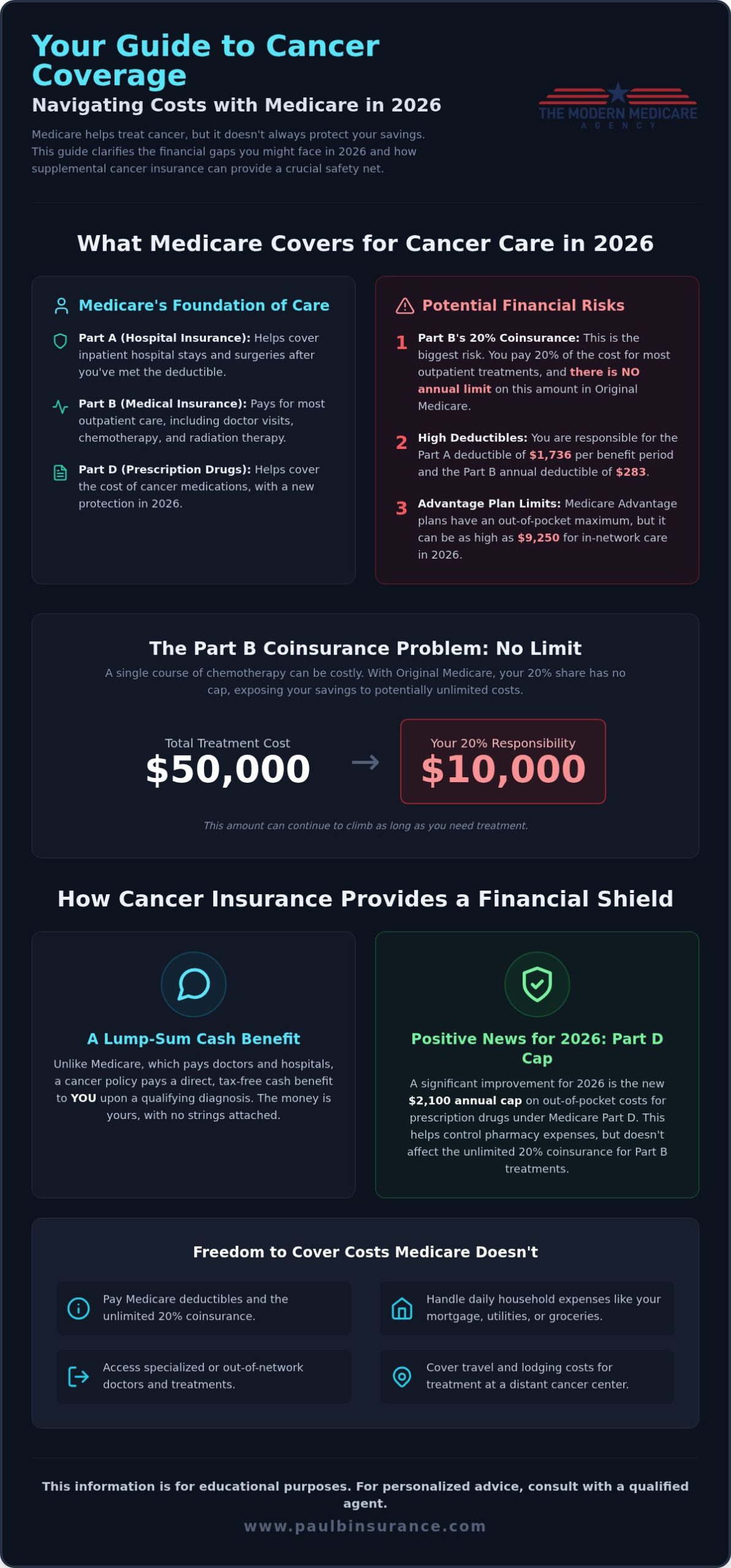
Medicare provides a strong foundation for your healthcare, but it’s rarely a complete solution when a serious diagnosis occurs. In 2026, Medicare Part A helps cover your inpatient hospital stays and surgeries, though you’ll still be responsible for a $1,736 deductible for each benefit period. While this is helpful for the clinical side of your care, the financial gaps quickly begin to appear when you move into outpatient treatment. This is where many people start to ask, how does cancer insurance work with medicare to protect their life savings? The answer lies in addressing the costs that the government program simply doesn’t reach.
Most cancer treatments today, including Medicare coverage for radiation therapy and chemotherapy, fall under Medicare Part B. While Part B pays for a large portion of these services, it leaves you with a 20% coinsurance responsibility. Unlike other types of insurance you might have had in the past, Original Medicare has no annual limit on what that 20% can add up to. This lack of a safety net is often the biggest source of stress for our clients, and it’s exactly why supplemental protection is so valuable.
The Part B 20% Coinsurance Problem
The 20% gap in Part B is the most significant financial risk you face. If a course of treatment costs $50,000, your share is $10,000. For someone on a fixed income, a bill like that can be devastating. Because there’s no out-of-pocket maximum in Original Medicare, these costs can continue to climb as long as you need treatment. Many seniors choose Medicare Supplement Insurance to help cover this specific gap, but even then, non-medical costs can still drain your accounts. This is why a cancer policy is often used as a second layer of security.
Part D and the 2026 Prescription Drug Cap
There’s good news for 2026 regarding your pharmacy costs. Thanks to recent changes, there’s now a $2,100 out-of-pocket cap on what you pay for covered drugs at the pharmacy under Medicare Part D. This is a huge relief for those taking expensive oral medications. However, it’s vital to understand that this cap doesn’t apply to drugs administered in a doctor’s office or clinic, which are still billed under Part B. You can find more details in our Medicare Part D guide. Even with this new pharmacy cap, the total cost of a cancer journey often exceeds what most people have set aside. If you feel uncertain about your current coverage, you can speak with an independent expert to review your options and find a plan that fits your budget.
Medicare Advantage vs. Medigap: Which Needs Cancer Insurance More?
Choosing between Medicare Advantage and Medigap is one of the most important decisions you’ll make for your health. Both options offer more protection than Original Medicare alone, but they handle a serious diagnosis in very different ways. When you’re trying to figure out how does cancer insurance work with medicare, the first thing to look at is your primary plan’s out-of-pocket limit. In 2026, the federally mandated maximum for in-network services on a Medicare Advantage plan can be as high as $9,250. While that cap protects you from total financial ruin, it’s still a very large sum to pay while you’re focused on your recovery.
We often see people caught in the Advantage Gap. This is the period where you’re responsible for 20% of your treatment costs before you finally hit that maximum out-of-pocket limit. If you’re managing a fixed income, paying thousands of dollars for chemotherapy in just a few months can feel impossible. This is where a supplemental policy steps in to act as a bridge, removing the anxiety of how you’ll reach that cap without draining your savings.
Cancer Insurance for Medicare Advantage Members
For those with a Medicare Advantage Guide in hand, you’ll notice that most plans charge a 20% coinsurance for chemotherapy and radiation. If your plan has a $4,500 or $6,000 out-of-pocket limit, you’re responsible for every penny of that before the insurance company takes over 100%. A cancer insurance policy can act as a MOOP-filler. Imagine receiving a $5,000 lump-sum check the moment you’re diagnosed. You can use that money to instantly cover your plan’s out-of-pocket maximum. It transforms a stressful financial hurdle into a manageable situation, allowing you to access the best care without hesitation.
Does Cancer Insurance Help if You Have Medigap?
If you have a Medigap plan, your medical bills are likely already well-covered. Plans like Medigap Plan G pay that 20% coinsurance for you, leaving you with very little medical debt. However, Medigap only pays the doctors and hospitals. It doesn’t pay for the life bills that pile up during treatment. Many of our clients with Medigap still choose a cancer policy because they want protection for non-medical costs. Think about the price of gas for daily trips to a specialist, specialized nutrition, or hiring help around the house. A cancer policy provides the cash for these personal needs, ensuring your lifestyle doesn’t have to change just because your health has. It’s about having a dedicated emergency fund that Medicare simply wasn’t designed to provide.
How a Cancer Insurance Payout Protects Your Savings
Medicare is excellent at paying for clinical needs, but it stops short of covering the reality of living with a serious illness. When people ask, how does cancer insurance work with medicare to protect their lifestyle, they’re often surprised by the flexibility it offers. A cancer policy provides a lump-sum cash payout that you can spend on anything you need. Unlike Medicare, which only pays for “medically necessary” services, this check belongs to you. You don’t have to submit receipts or wait for an approval from an insurance carrier to use your own money. It’s a simple, direct way to ensure your focus stays on healing rather than your bank balance.
Hidden Costs: Travel, Lodging, and Home Care
The most effective treatments are sometimes found at specialized centers far from home. If the best doctor for your condition is several states away, you’ll face significant costs for gas, tolls, and lodging that Medicare won’t touch. These “life costs” can quickly drain a savings account. You might also need to hire help for daily chores like house cleaning or meal preparation while you recover. A cash payout ensures these needs are met without adding to your stress. It also provides a safety net if a spouse or adult child needs to take time off work to serve as your caregiver, helping to replace that lost income during a difficult time.
Protecting Your Retirement Nest Egg
Many seniors worry about dipping into their 401(k) or IRA to pay for high deductibles or experimental treatments that fall outside of standard Medicare networks. Financial toxicity is the heavy burden of out-of-pocket medical and non-medical costs that negatively affects a patient’s quality of life. Using your retirement funds to fight this toxicity can have lasting tax impacts and reduce your future security. Having a dedicated policy allows you to keep your nest egg intact, ensuring a diagnosis doesn’t force you to move or change your standard of living. We’ve seen how having this cushion removes the anxiety of “what if” and replaces it with the certainty of “I’m covered.”
Our goal is to act as your advocate, making sure you have the resources to focus on what matters most. We can help you compare options from over 40 carriers to find a policy that fits your budget and your needs. To get started on building your safety net, you can reach out to our team today for a personalized plan review. We’ll walk you through every step of the process with the patience and care you deserve.
Finding the Right Balance: Next Steps with The Modern Medicare Agency
Choosing the right coverage shouldn’t feel like a solo journey through a maze. In 2026, the options are more numerous than ever, and there is certainly no one-size-fits-all solution for every person. Your neighbor’s plan might be perfect for their situation, but it could leave you exposed to the very financial risks we have discussed. Understanding how does cancer insurance work with medicare is just the first step in your protection strategy. The next is finding the specific combination of plans that shields your unique health needs and your hard-earned retirement savings.
At The Modern Medicare Agency, we see ourselves as your personal advocates and calm guides. We don’t work for the insurance companies; we work for you. Because we are an independent brokerage, we have the freedom to compare options from over 40 different carriers. This independence is what allows us to move you from a state of distress to a state of absolute certainty. We believe that when you have the right information, the confusion disappears, and you’re left with a clear plan for your future.
Why an Independent Broker Makes the Difference
When you talk to a representative from a specific insurance company, they can only offer you what is on their shelf. They’re restricted by their employer’s limited options and might prioritize the carrier’s interests over yours. An autonomous professional, however, has a much wider view. We can look across the entire market to find the plan that fits your specific doctors and medications. We also stay on top of the 2026 landscape, including the first-ever negotiated drug prices and the new $2,100 out-of-pocket cap for Part D. Our support doesn’t end when you sign up. We provide year-round assistance in over 34 states, so you’re never left to handle a complex system on your own. We want to make sure you know how does cancer insurance work with medicare throughout every stage of your health journey.
Schedule Your Free 2026 Medicare Review
Taking the next step is simple and entirely stress-free. You can reach out to Paul Barrett and our dedicated team to schedule a personalized review of your current coverage. This is a conversation, not a sales pitch. During our time together, we will look at your current plan and your drug list to see where you might have gaps. It’s helpful to have your current insurance card and a list of your medications ready for this meeting. We’ll help you determine if your current Medicare Supplement Plan or Advantage plan is still your best option for 2026. Our goal is to remove the anxiety from this process and give you a clear, actionable path forward so you can focus on enjoying your life.
Securing Your Financial Future for 2026 and Beyond
A cancer diagnosis shouldn’t be a financial emergency. By now, you have a clear picture of how does cancer insurance work with medicare to fill the gaps that standard health coverage leaves behind. Whether you’re covering the 20% coinsurance from Part B or handling the travel costs to see a specialist, a lump-sum payout gives you the freedom to focus on what matters most. You don’t have to navigate these 2026 changes alone.
We’re here to act as your advocate. As an independent broker, we compare options from over 40 insurance carriers to find the fit that protects your savings and your peace of mind. We proudly serve clients in 34 states with heart and empathy, ensuring you always have a patient guide by your side. It’s our mission to move you from a state of uncertainty to one of absolute confidence.
Ready for peace of mind? Schedule a free, simple Medicare review with Paul Barrett today.
You deserve to feel secure in your coverage. Let’s work together to build a plan that lets you focus on your health and your family without the stress of unexpected bills.
Frequently Asked Questions
Does Medicare Part B cover chemotherapy in 2026?
Medicare Part B covers chemotherapy and other anti-cancer drugs administered in a clinic or doctor’s office. In 2026, you’re responsible for the $283 annual deductible and 20% of the total treatment cost. Since Original Medicare has no out-of-pocket limit for this 20% responsibility, costs can escalate quickly. This is why many seniors ask how does cancer insurance work with medicare to provide a cash cushion for these uncapped medical expenses.
Can I buy cancer insurance if I already have a Medicare Advantage plan?
Yes, you can absolutely purchase a cancer insurance policy while enrolled in a Medicare Advantage plan. In fact, many Advantage members use these policies to help cover their plan’s Maximum Out-of-Pocket limit, which can be as high as $9,250 in 2026. The cash payout from a cancer policy provides immediate funds to meet your plan’s cost-sharing requirements for chemotherapy or radiation treatments without draining your personal savings.
Is there a waiting period for cancer insurance policies?
Most cancer insurance policies include a waiting period, typically 30 days from the effective date of the policy. If a diagnosis occurs during this initial window, the policy usually won’t pay the lump-sum benefit. It’s important to secure coverage while you’re healthy to ensure the protection is active when you need it. We can help you review specific carrier rules to find a plan with terms that fit your individual needs.
Will cancer insurance pay for my mortgage while I’m in treatment?
Yes, because the benefit is paid as a lump-sum check directly to you, you have complete control over how the money is spent. You can use the funds to pay your mortgage, utility bills, or groceries while you’re focusing on recovery. Medicare only pays for medical services, but cancer insurance provides the flexibility to maintain your household and lifestyle during a difficult health journey. It acts as a personal financial safety net.
What happens to my cancer insurance if I switch Medicare plans?
Your cancer insurance policy is a standalone product that remains active even if you change your Medicare coverage. Whether you move from a Medicare Advantage plan to a Medigap plan or switch your Part D provider in 2026, your cancer policy stays with you as long as premiums are paid. This stability is a key part of how does cancer insurance work with medicare to provide long-term peace of mind regardless of changes to your primary insurance.
Does the 2026 Part D $2,000 cap make cancer insurance unnecessary?
The new $2,100 out-of-pocket cap for Part D in 2026 is a significant benefit for pharmacy prescriptions, but it doesn’t solve every financial problem. It doesn’t apply to drugs administered in a clinical setting or the 20% coinsurance for outpatient services. Additionally, the cap won’t help with non-medical costs like travel or lodging. Cancer insurance remains a necessary layer of protection for these expenses that even the improved Medicare rules don’t cover.
Can I get cancer insurance if I’ve already had cancer in the past?
Eligibility depends on the carrier’s rules and your specific health history. Most companies require you to be cancer-free for a set period, often between five and ten years, to qualify for a new policy. If you have a history of cancer, we can use our access to 40+ carriers to see if any providers offer coverage for your situation. It’s always best to have a personalized review to see what options are available.
How much does a typical cancer insurance policy cost for a senior?
Monthly premiums for these policies are determined by your age, health status, and the size of the lump-sum benefit you choose. Most seniors find these plans to be an affordable way to add a significant layer of financial security to their retirement plan. We don’t provide direct underwriting, but we can help you compare multiple carriers to find a rate that fits your budget. This ensures you get the protection you need without overspending.

Article by
Paul Barrett
Paul Barrett, CMIP is the founder of The Modern Medicare Agency, an independent Medicare-only brokerage based in Melville, NY. With 18 years of Medicare-exclusive experience, a CMIP designation, and more than 5,000 clients served across 37 states, Paul is one of the most credentialed independent Medicare specialists on Long Island — and one of the most direct.
He represents 40+ carriers with no quotas and no allegiances, which means his recommendations are based entirely on what fits each client's specific situation. He is the author of Medicare Mastery Unlocked and host of the Wise Guys Retirement Talk podcast. His content is grounded in primary sources, real carrier intelligence, and 18 years of watching what happens when people get Medicare right — and when they don't.
📞 631-358-5793 | paulbinsurance.com