




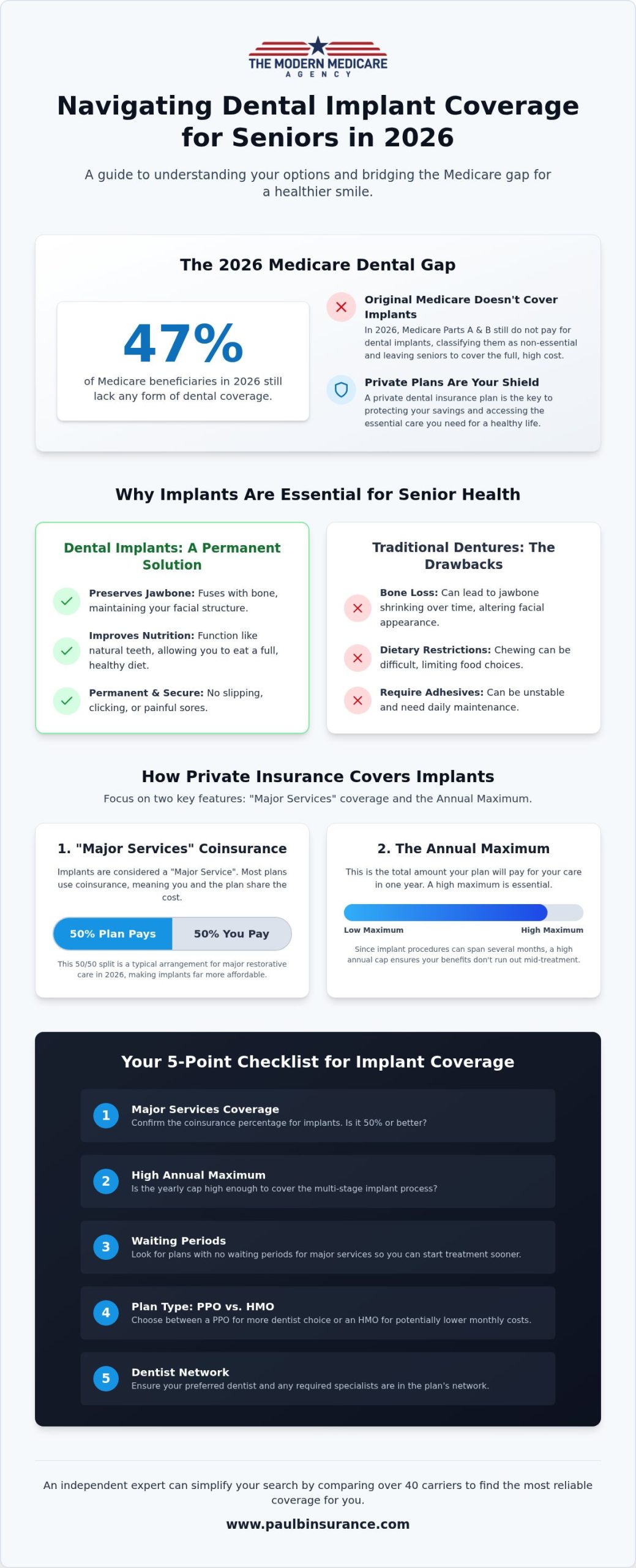
Did you know that in 2026, nearly half of all Medicare beneficiaries still lack any form of dental coverage? It’s a startling reality to face, especially when you’re looking at the high cost of a single tooth implant or a full mouth restoration. Finding reliable dental insurance that covers implants for seniors is often the only way to make these life-changing procedures affordable without draining your savings.
We understand how frustrating it is to realize that Original Medicare won’t help with the surgery you need to eat, speak, and smile comfortably. The confusion over plan exclusions and the fear of “gotcha” waiting periods can make the whole process feel overwhelming. You shouldn’t have to navigate these complex systems alone or feel unprotected while you’re just trying to maintain your health.
This guide will show you exactly how to bridge the gap between what Medicare offers and the coverage you actually need in 2026. We’ll explore plans with high annual maximums, compare no-waiting-period options, and simplify the complex insurance choices available this year. By the end, you’ll have a clear path to reducing your out-of-pocket costs and reclaiming your peace of mind.
Key Takeaways
- Understand why Original Medicare doesn’t cover dental implants in 2026 and how a private plan can protect your savings.
- Learn the secret to finding dental insurance that covers implants for seniors by focusing on “major services” coverage and high annual maximums.
- Discover how to skip long waiting periods so you can start your dental restoration journey without unnecessary delays.
- See the difference between PPO and HMO plans to choose the right balance of dentist choice and monthly cost for your needs.
- Find out how an independent expert can compare over 40 carriers to ensure you’re getting the most reliable coverage available this year.
Medicare and Dental Implants: 2026 Coverage Guide
Many seniors in 2026 are surprised to find that Original Medicare still treats dental health as a luxury. Even with all the medical advancements we’ve seen, Parts A and B generally don’t pay for routine dental care. They certainly don’t cover the surgical process of getting implants. This leaves you in a tough spot when you want a permanent solution for missing teeth. Finding dental insurance that covers implants for seniors becomes more than just a financial choice. It’s about protecting your quality of life and your savings.
It’s genuinely frustrating to feel like you’ve done everything right for your health, only to be told your smile isn’t a priority by the system. You shouldn’t have to choose between a healthy mouth and your retirement budget. We see this “missing piece” in coverage every day, and we know how much stress it causes. Think of a private dental plan as a protective shield that fills this gap, ensuring you aren’t left vulnerable to high costs.
The 2026 Medicare Dental Gap Explained
The government often classifies implants as “cosmetic” or “non-essential.” This narrow view ignores the reality of how oral health affects your whole body. When Medicare leaves this gap, it’s not just about aesthetics. It’s about the risk of infection, shifting teeth, and the inability to eat a balanced diet. This gap leaves many seniors vulnerable to health complications that could have been avoided. A private dental insurance plan serves as a necessary bridge between your Medicare benefits and the actual care you need to stay healthy.
Why Implants Are Essential for Senior Health
Why are so many people choosing implants over traditional dentures this year? It comes down to your long-term health and nutrition. If you can’t chew properly, your diet suffers, which can lead to other medical issues. Implants are designed to function exactly like natural teeth. If you want to understand the technical side, you can learn more about what dental implants are and how the procedure works.
One of the biggest benefits is how they preserve your jawbone. Unlike dentures that sit on top of the gums, implants fuse with the bone. This prevents the bone from shrinking over time, which helps maintain your facial structure. They don’t slip. They don’t cause painful sores. They are a permanent solution that offers incredible peace of mind. You deserve to eat what you want and speak clearly without worrying about your teeth. That’s a level of security that traditional dentures simply can’t match.
Understanding How “Major Services” Coverage Works for Implants
When you look at a dental policy in 2026, you will notice that procedures are grouped into categories. Finding dental insurance that covers implants for seniors means looking closely at the “Major Services” column. This is where insurance companies place complex procedures like implants, crowns, and bridges. Because these treatments are more involved, the insurance company treats the bill differently than they would for a simple cleaning.
The most important term to understand here is coinsurance. This is just a simple way of saying you and the insurance company are splitting the bill. While the official Medicare website confirms that Original Medicare generally won’t pay for these services, private plans in 2026 typically offer a 50/50 split. This means the plan pays for half of the cost of the implant, and you cover the other half. It is a straightforward shared cost that helps make the surgery much more accessible than paying the full amount on your own.
Defining “Major Restorative” Care
Major restorative care includes any dental procedure that replaces missing teeth or repairs significant damage to your tooth structure. Implants, crowns, and bridges are grouped together because they all require similar lab work and surgical precision. When you are reviewing a plan summary, don’t let the technical terms confuse you. Simply look for the category that covers “Major Restorative” work to find the percentage the plan will pay toward your implants.
The Role of the Annual Maximum
The annual maximum is the most money an insurance company will pay for your dental care in a single year. Think of it as a “cap” on your benefits. For seniors in 2026, having a high annual maximum is vital because implants often require multiple stages over several months. If your plan has a low cap, you might run out of benefits before the final crown is even placed.
If you are looking for a way to bundle these benefits with your health coverage, you might want to look at Medicare Advantage Plans 2026 to see how they handle dental caps. Many seniors find that choosing a plan with a higher limit gives them the freedom to complete their treatment without worrying about the money running out mid-year. If you want to see how these limits look in practice, you can explore a dental insurance plan that prioritizes these higher maximums and clear coverage rules.
Comparing the Best Dental Plan Types for Implant Coverage
Choosing the right plan in 2026 isn’t just about finding the lowest monthly cost. It’s about making sure your preferred oral surgeon is actually in the network. Because implants are a multi-stage process, you need a plan that offers both flexibility and reliable coverage. Most seniors find themselves choosing between three main options: PPO plans, HMO plans, or dental discount programs. Each has its own set of rules for how they handle major restorative work.
If you are looking for a detailed comparison of specific carriers, you might find Forbes Advisor’s best dental insurance for implants helpful for seeing how different companies stack up this year. However, the first step is always deciding which model fits your lifestyle. Do you want the freedom to choose any specialist, or are you more focused on keeping your monthly premiums as low as possible? Let’s look at how these options work for someone needing dental insurance that covers implants for seniors.
PPO Plans: The Gold Standard for Choice
Preferred Provider Organization (PPO) plans are the most popular choice for seniors in 2026. The reason is simple: they offer the most freedom. With a PPO, you aren’t locked into a small list of dentists. You can visit any oral surgeon you trust, though you will save more money if they are part of the plan’s network. This flexibility is vital for implants because you might already have a specialist in mind for your surgery.
PPO plans also provide out-of-network benefits. Even if your chosen surgeon doesn’t participate in the plan, the insurance company will often still pay a portion of the bill. You can explore different carrier options and see which Dental Insurance Plans offer the best network of specialists in your area. This freedom of choice provides a level of security that other plan types often lack.
Dental Discount Plans: A Low-Cost Alternative?
Sometimes you need dental work done immediately and don’t have time to wait for a traditional insurance policy to kick in. This is where dental discount or savings plans come into play. These aren’t actually insurance. Instead, they are membership programs that give you access to reduced rates at participating dentists.
The biggest advantage of a discount plan in 2026 is the lack of waiting periods. You can often sign up on a Monday and get your discounted procedure on a Tuesday. While they don’t “pay” for the procedure like insurance does, they can significantly lower the total bill. The trade-off is that you pay the entire discounted amount out of your own pocket, but for some, the immediate savings are worth it.
HMO plans are another option, typically offering the lowest premiums. However, they require you to stay within a very strict network and usually need a referral from a primary dentist before you can see a specialist. For complex implant surgery, many seniors find the HMO restrictions too limiting and prefer the open access of a PPO.
5 Factors Every Senior Should Check Before Buying Implant Coverage
Finding dental insurance that covers implants for seniors shouldn’t feel like a guessing game. In 2026, the fine print matters more than the glossy brochure. You need to ensure the plan covers all three parts of the process: the implant body, the abutment, and the crown. If a plan only covers the crown, you could still be left with a massive bill for the surgery itself. We want to make sure you have the full picture before you sign anything.
You should also take a close look at the 2026 deductible requirements for major services. Some plans have a separate, higher deductible just for surgery. It’s also vital to consider the carrier’s reputation. Do they have a history of paying senior claims without a fight? A plan is only as good as its promise to pay when you’re sitting in the dentist’s chair. We focus on carriers that treat seniors with the respect and clarity they deserve.
Navigating Waiting Periods in 2026
Waiting periods are a common hurdle that can delay your smile for months. Insurance companies use them to stop people from signing up only when they need an expensive procedure, a practice they call “buy and bolt.” However, if you’ve had continuous dental coverage, many 2026 plans will waive this period entirely. This is especially helpful if you’re already coordinating your health care with Medicare Supplement Insurance to ensure all your medical needs are met. We can help you find those specific “no waiting period” options so you can start your treatment right away.
The “Missing Tooth Clause” Trap
A missing tooth clause is a rule stating that your insurance won’t pay to replace a tooth that was already gone before your plan began. This is the most common reason implant claims are denied for seniors today. If you lost a tooth years ago and finally want an implant in 2026, a plan with this clause won’t help you at all. This is exactly why working with an independent broker is so valuable. We scan the fine print of over 40 carriers to find the ones that don’t use these restrictive traps. If you want to avoid these common pitfalls, we can help you compare a dental insurance plan that actually covers what you need.
How an Independent Broker Simplifies Your Search for Dental Coverage
Searching for the right plan can feel like standing in the middle of a storm. There are so many voices telling you what to do, yet very few actually listen to your specific needs. This is where the difference between a captive agent and an independent broker becomes clear. A captive agent works for one insurance company and can only offer you their specific products. If their plan doesn’t fit your needs, they don’t have another option to show you. An independent broker from The Modern Medicare Agency works for you, not the insurance companies. We are here to act as your calm, patient guide through a system that often feels designed to confuse you.
Our mission at The Modern Medicare Agency is to protect you from choosing a plan that doesn’t deliver on its promises. By comparing 40+ carriers, we ensure you aren’t overpaying for 2026 coverage or getting stuck with a policy that has hidden restrictions. We understand the nuances of dental insurance that covers implants for seniors because we specialize in serving those on Medicare. We know which companies are senior-friendly and which ones make the claims process difficult. You deserve an advocate who prioritizes your peace of mind over a sales quota.
Why 40+ Carriers Beat a Single Option
The 2026 market is full of “hidden gems” that you might never find on your own. Some smaller carriers offer incredible benefits for major restorative work but don’t have the massive advertising budgets of the household names. Because we are independent at The Modern Medicare Agency, we can find these options for you. Our advice is always unbiased because we have no loyalty to any single brand. You can learn more about our commitment to this approach by reading about our Medicare Brokers philosophy. We believe that more choices lead to better outcomes for your health and your wallet. We take the time to explain every option in simple terms so you never feel pressured.
Getting Your Personalized Dental Comparison
We have designed our process at The Modern Medicare Agency to be as simple and stress-free as possible. You don’t need to spend hours researching fine print or comparing complicated spreadsheets. All we need to get started is your zip code and the name of your preferred dentist. From there, we do the heavy lifting for you. We will look at the 2026 plans in your area and find the dental insurance that covers implants for seniors with the highest annual maximums and the fewest “gotcha” clauses.
Our goal at The Modern Medicare Agency is to move you from a state of uncertainty to a place of absolute certainty. You should be able to walk into your dentist’s office knowing exactly what is covered and how much you will save. If you’re ready to see your options, we can provide a personalized dental insurance plan comparison that fits your unique situation. Let us be your partner in this journey, removing the anxiety from the process and helping you reclaim your healthy smile in 2026.
Secure Your Healthy Smile in 2026
Finding the right plan in 2026 doesn’t have to be a lonely journey. You’ve learned that while Medicare leaves a gap, finding dental insurance that covers implants for seniors is the key to protecting both your health and your retirement savings. By focusing on plans with high annual maximums and watching out for restrictive clauses, you can turn a daunting dental bill into a manageable investment in your quality of life.
You shouldn’t have to settle for limited options or confusing fine print. As independent brokers for over 40 carriers, we provide the personalized, empathetic support you need to make an informed choice. We specialize in senior-specific coverage and are here to act as your advocate every step of the way. If you’re ready for clarity, you can get a personalized 2026 dental insurance comparison from Paul Barrett today. We’ll help you find the right fit so you can smile with confidence again. Your peace of mind is just a conversation away.
Frequently Asked Questions
Does dental insurance cover the full cost of implants for seniors?
No, it typically doesn’t cover the full cost. Most plans in 2026 use a coinsurance model where they pay a percentage, usually around 50%, up to an annual maximum. You’ll likely be responsible for the remaining balance. It’s important to get a pre-treatment estimate so you know exactly what your share will be before the surgery starts. This helps avoid any surprises when the final bill arrives.
How long is the typical waiting period for dental implants in 2026?
Most individual plans require a waiting period of 6 to 12 months for major services like implants. Insurance companies use these periods to ensure people stay on the plan long term rather than just signing up for one expensive procedure. However, some carriers offer plans that waive these periods if you can prove you had prior continuous coverage. We can help you compare these specific options to see if you qualify for a waiver.
Can I get dental insurance that covers implants immediately?
Yes, you can find dental insurance that covers implants for seniors with no waiting period, but your options may be more limited. Some carriers specialize in day one coverage for major restorative work. While these plans might have different structures for how they pay out in the first year, they allow you to start your treatment right away. We look through over 40 carriers to find these specific immediate coverage opportunities for our clients.
What is the best dental insurance for seniors with no waiting period?
The best plan depends on your specific needs and the dentists in your area. In 2026, many seniors prefer plans that offer immediate coverage for major services, even if the initial coinsurance percentage is lower in the first year. We recommend looking for a plan that combines no waiting period with a high annual maximum. This ensures you can start your surgery now and still have enough benefit left to cover the crown later.
Do Medicare Advantage plans cover dental implants in 2026?
Many Medicare Advantage plans in 2026 do include dental benefits that may cover a portion of implant costs. However, these benefits vary significantly between different carriers and locations. Some plans might have a lower annual maximum than a standalone dental policy, which could limit how much of the surgery is paid for. We can help you review your specific Advantage plan to see how it compares to independent dental insurance options.
What happens if I have a missing tooth clause in my policy?
If your policy has a missing tooth clause, the insurance company won’t pay to replace any tooth that was already gone before your coverage started. This is a common trap that leads to denied claims for many seniors. To avoid this, we look for plans that don’t include this restriction. It’s one of the most important fine print details we check when we are helping you find dental insurance that covers implants for seniors.
Is it better to get a PPO or an HMO for dental implants?
For most seniors, a PPO is the better choice for implant surgery because it offers the freedom to choose your own specialist. HMOs usually require you to stay within a very small network and often need a referral from a primary dentist. Since implant surgery is a specialized field, having the flexibility to see the oral surgeon you trust is vital. PPOs also provide some coverage if you choose to go out of network.
How much is the annual maximum for senior dental plans usually?
In 2026, typical annual maximums range from $1,500 to $5,000 depending on the plan you choose. For a multi-stage procedure like an implant, you should aim for a plan on the higher end of that scale. A low maximum can be used up quickly by the surgery itself, leaving you to pay the full cost of the abutment and crown. We prioritize finding plans that offer the highest possible caps to protect your budget.

Article by
Paul Barrett
Paul Barrett, CMIP is the founder of The Modern Medicare Agency, an independent Medicare-only brokerage based in Melville, NY. With 18 years of Medicare-exclusive experience, a CMIP designation, and more than 5,000 clients served across 37 states, Paul is one of the most credentialed independent Medicare specialists on Long Island — and one of the most direct.
He represents 40+ carriers with no quotas and no allegiances, which means his recommendations are based entirely on what fits each client's specific situation. He is the author of Medicare Mastery Unlocked and host of the Wise Guys Retirement Talk podcast. His content is grounded in primary sources, real carrier intelligence, and 18 years of watching what happens when people get Medicare right — and when they don't.
📞 631-358-5793 | paulbinsurance.com