




What if the only thing standing between you and the mobility you deserve is a single misunderstood word on a doctor’s form? It’s deeply frustrating to deal with the rising costs of specialized gear while trying to decode medicare coverage for durable medical equipment in 2026. You just want to feel safe and independent in your own home without the constant fear of a surprise bill or a denied claim. We understand that this process often feels like a maze designed to keep you out, but it doesn’t have to stay that way. You deserve a guide who simplifies the complex so you can breathe easier.
This guide shows you exactly how to get your gear covered so you can focus on your health instead of the paperwork. We’ve simplified the rules to give you total clarity and peace of mind. You’ll learn exactly which items are on the 2026 covered list, how the choice between renting and buying affects your bank account, and why having an independent advocate makes all the difference. By the end of this article, you’ll have a clear path to getting the tools you need with confidence.
Key Takeaways
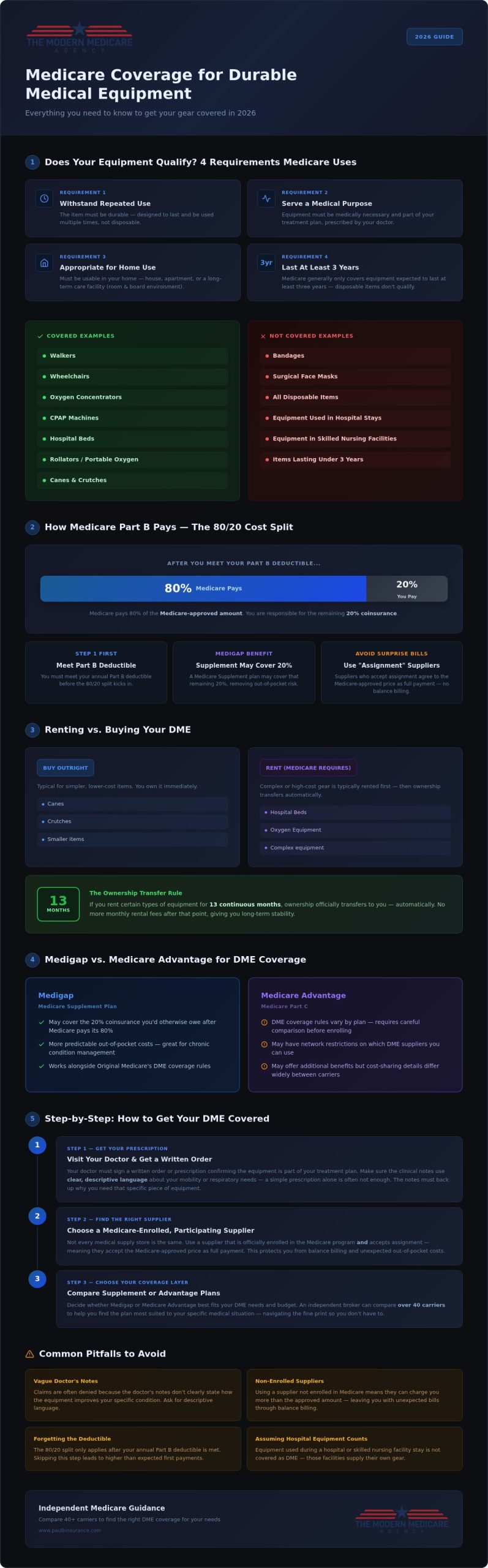
- Understand the four specific requirements equipment must meet to qualify for coverage, ensuring you don’t waste time on items that won’t be approved.
- Learn how the 80/20 cost-sharing split works in 2026 and why meeting your Part B deductible is the first step toward lower out-of-pocket costs.
- Compare how Medigap and Medicare Advantage plans handle medicare coverage for durable medical equipment so you can choose the most predictable path for your budget.
- Follow a simple two-step process to secure a valid prescription and find a participating supplier who accepts Medicare’s approved payment amounts.
- Discover how an independent broker can help you navigate the fine print and compare over 40 carriers to find the best fit for your specific medical needs.
What is Durable Medical Equipment (DME) Under Medicare?
If you’ve ever felt overwhelmed by insurance terms, you aren’t alone. Simply put, durable medical equipment is gear designed to help you complete your daily tasks safely and comfortably. To understand your options, it helps to look at the standard durable medical equipment definition used by healthcare providers. Medicare uses a specific set of rules to decide what they will pay for. For an item to qualify, it must be able to withstand repeated use, serve a medical purpose, and be appropriate for use in your home. Understanding these basics is the first step toward securing medicare coverage for durable medical equipment without the typical stress.
One rule that surprises many people in 2026 is the lifespan requirement. Medicare generally only provides coverage if the equipment is expected to last at least three years. This is why items like walkers, wheelchairs, oxygen concentrators, and CPAP machines are covered, while disposable items like bandages or surgical face masks are not. The goal is to provide you with reliable tools that support your independence over the long term.
What Counts as ‘Medically Necessary’ in 2026?
Your doctor plays the most important role in securing medicare coverage for durable medical equipment. For Medicare to consider an item necessary, your healthcare provider must sign a written order or prescription. This document proves that the gear is a vital part of your treatment plan. In 2026, claims are often questioned because the doctor’s notes don’t clearly state how the equipment improves your specific condition. You can avoid these delays by ensuring your doctor uses clear, descriptive language about your mobility or respiratory needs during your visit. A simple prescription isn’t always enough; the clinical notes must back up why you need that specific piece of equipment to stay safe.
The ‘Home Use’ Rule Explained
Medicare requires you to use this equipment in your home. This definition is friendlier than you might think. It includes your private house, an apartment, or even a long term care facility that provides a room and board environment. However, equipment used while you are staying in a hospital or a skilled nursing facility usually isn’t considered DME because those facilities provide the gear themselves. There’s a helpful exception for mobile equipment. Items like portable oxygen or rollators are still covered even if you use them outside to stay active; as long as their primary purpose is to help you function within your living space. This ensures you have the freedom to move around your community while still meeting the program’s requirements.
How Medicare Part B Pays for Your Medical Supplies in 2026
Paying for your medical equipment shouldn’t feel like a gamble. In 2026, the way Medicare handles these costs is designed to be predictable, provided you know where to look. Once you’ve met your Part B deductible for the year, Medicare typically pays 80% of the approved cost for your gear. You’re responsible for the remaining 20% coinsurance. If you have a Medicare Supplement plan, it may cover that remaining 20% for you, which can provide a huge sense of relief when you’re managing a chronic condition.
One detail that often causes confusion is the “Medicare-approved amount.” This is the specific price Medicare has agreed to pay for a piece of equipment. To avoid unexpected bills, you must use a supplier that accepts “assignment.” This means they agree to accept the Medicare-approved price as full payment. If a supplier isn’t enrolled and participating, they can charge you more than the approved amount through balance billing. Understanding these Medicare Part B DME coverage rules helps you avoid those stressful financial surprises.
Renting vs. Buying: Which Will You Do?
Whether you rent or buy often depends on the type of equipment you need. For smaller items like canes or crutches, you’ll usually buy them outright. However, for more complex gear like hospital beds or oxygen equipment, Medicare generally requires a rental. A key rule to remember in 2026 is the 13-month ownership transfer. If you rent certain types of equipment for 13 continuous months, the ownership officially transfers to you. This transition is automatic, giving you long-term stability without ongoing monthly rental fees.
Finding a Medicare-Enrolled Supplier
Not every medical supply store is the same. To protect your wallet, you must use a supplier that’s officially enrolled in the Medicare program. If you choose a supplier that doesn’t have this status, Medicare won’t pay the claim, and you’ll be responsible for the entire bill. Before you sign any paperwork, ask the supplier: “Do you accept Medicare assignment?” If the answer is yes, you can move forward with confidence. This simple step is the most effective way to ensure your medicare coverage for durable medical equipment stays affordable and stress-free. If you’re feeling unsure about which suppliers in your area are the best fit, working with an independent broker can help you verify those details quickly.
Medigap vs. Medicare Advantage: Which Covers DME Better?
Choosing between these two paths often feels like a fork in the road. One path offers lower monthly costs but more rules; the other offers higher premiums but total financial predictability. When you are looking for medicare coverage for durable medical equipment, the right choice depends on how much certainty you need. Original Medicare with a Medigap plan is often the most straightforward way to handle equipment costs. Medicare Advantage plans can be more affordable month-to-month, but they often require more steps before you get your gear.
At The Modern Medicare Agency, we help you weigh these options without any pressure. We compare over 40 carriers to see which plan structure aligns with your specific health needs. Whether you prefer the freedom of Medigap or the bundled benefits of Advantage, we ensure you have the full picture before you decide. Our goal is to move you from a state of confusion to a state of absolute certainty.
The Medigap Advantage for DME
A Medigap plan works alongside Original Medicare to fill the gaps in your coverage. Since Medicare Part B only pays 80% of the cost, you are usually left with a 20% bill. For expensive items like power wheelchairs or complex respiratory systems, that 20% can lead to significant sticker shock. If you learn more about Medicare Supplement (Medigap) plans, you’ll see they are designed to pick up that remaining cost. This means you can walk into a supplier’s office knowing exactly what you’ll pay. You can also read our guide on Medicare Supplement Insurance to see how this protection works across different plan types.
Medicare Advantage (Part C) Rules for Equipment
Medicare Advantage plans must cover the same items as Original Medicare, but they often add their own set of rules. In 2026, data shows that 99% of enrollees face prior authorization requirements for durable medical equipment. This means your insurance company needs to “okay” the gear before you can bring it home. If you skip this step, you might be responsible for the entire cost. These plans also rely on specific networks. Using a supplier outside your plan’s network could significantly increase your out-of-pocket expenses. While these plans include an annual spending limit to protect you, the process of getting your equipment requires more planning. You can explore our Medicare Advantage Guide to see if these rules work for you.
The Step-by-Step Guide to Getting Your DME Covered
Getting the gear you need to stay safe shouldn’t feel like a full-time job. While the paperwork can seem daunting, following a clear, chronological path helps remove the anxiety from the process. The road to medicare coverage for durable medical equipment is much smoother when you take it one step at a time. By being proactive, you can ensure that your equipment is ready when you are.
- Step 1: Visit your doctor to establish medical necessity and get a written prescription.
- Step 2: Confirm your supplier is officially enrolled and “participating” in the Medicare program.
- Step 3: Verify if your specific plan requires prior authorization before you receive the item.
- Step 4: Review the Medicare-approved amount with your supplier to estimate your 20% share.
- Step 5: Keep copies of all prescriptions and clinical notes in case of a future claim review.
Working With Your Doctor
Your doctor’s notes are the foundation of your claim. For 2026, it is vital that your medical records use specific language that describes your “functional limitations” rather than just your diagnosis. For example, instead of just saying you have arthritis, the notes should explain how it prevents you from moving safely from your bed to the bathroom. This detail proves to Medicare that the equipment is a necessity for your daily life.
You must also satisfy the face-to-face visit requirement. The Face-to-Face rule for 2026 requires you to meet with your doctor in person or through an approved telehealth session specifically to discuss your need for the equipment within six months before the order is written. Without this documented meeting, Medicare will likely deny the claim, even if the equipment is clearly needed.
What to Do if Your Claim is Denied
If a supplier asks you to sign an Advance Beneficiary Notice (ABN), pay close attention. This document is a warning that the supplier believes Medicare might not pay for the item; by signing it, you agree to pay the full cost if the claim is rejected. If you do receive a denial, don’t panic. You have a legal right to appeal the decision. The process is often as simple as providing more detailed notes from your doctor or correcting a small clerical error on the original form.
Navigating a denial can be exhausting when you’re already dealing with health challenges. This is where having a dedicated advocate makes a world of difference. If you’re facing a difficult denial or just want to ensure your plan choice supports your needs, contact The Modern Medicare Agency for expert, impartial support. We can help you look at the fine print and find a path toward the certainty you deserve.
Navigating the DME Maze with a Trusted Medicare Broker
Trying to find the right medicare coverage for durable medical equipment often feels like trying to solve a puzzle with missing pieces. The “best” plan for your neighbor might be a disaster for you if they use a cane while you require a complex respiratory system. This is because every insurance carrier in 2026 has different contracts with suppliers and varying rules for what they consider medically necessary. You shouldn’t have to spend your days reading through dense policy booklets just to find out if your walker is covered. You deserve a clear path and a guide who knows the way.
At The Modern Medicare Agency, Paul Barrett and our team act as your personal advocates. We don’t work for the insurance companies; we work for you. Because we are an independent brokerage, we compare over 40 different carriers to find the one that fits your specific medical needs and your budget. We move you from a state of uncertainty to one of absolute confidence by showing you exactly how each plan handles the equipment you rely on every day. This is the value of an autonomous professional who prioritizes your needs over a restricted representative with limited options.
Personalized Plan Comparisons
We believe in a methodical approach to choosing your coverage. We look at your specific prescriptions and equipment needs together to ensure there are no surprises waiting for you at the pharmacy or the supply store. This allows us to find the perfect balance between your monthly premiums and your DME coinsurance. If a plan has a low premium but high out-of-pocket costs for the gear you need, we’ll point that out immediately. You can see why an independent Medicare broker can help you avoid these common traps by providing an unbiased view of the entire market.
Your Advocate for 2026 and Beyond
Your health isn’t static, and your insurance support shouldn’t be either. If your equipment needs change mid-year, you don’t have to face the insurance company alone. We provide year-round support to help you understand your options and navigate the claims process as your life evolves. Our mission is to keep Medicare simple, clear, and deeply human. We want to remove the anxiety from the process so you can focus on your well-being. If you’re tired of the confusion and want to feel protected, schedule a simple, no-pressure chat with Paul Barrett today. Let us be the champion you need to navigate 2026 with total peace of mind.
Take Control of Your Health Needs in 2026
You now have the tools to secure the equipment you need for a safe and independent life. We’ve covered how successful medicare coverage for durable medical equipment starts with a clear doctor’s note and a supplier who accepts assignment. Whether you prefer the predictability of Medigap or the bundled options of Medicare Advantage, knowing the rules helps you avoid unexpected bills. You don’t have to manage these complex decisions alone.
Paul Barrett and The Modern Medicare Agency provide independent guidance by comparing over 40 top carriers to find your perfect fit. We offer zero-cost consultations to ensure you feel protected and empowered every step of the way. Let’s make Medicare simple. Click here for a free, personalized plan review with Paul Barrett. You deserve the peace of mind that comes with expert support. We’re here to help you move forward with total confidence.
Frequently Asked Questions
Does Medicare cover CPAP machines for sleep apnea in 2026?
Yes, Medicare covers CPAP machines for obstructive sleep apnea in 2026 after you complete a formal sleep study. You’ll typically start with a three-month trial period to ensure the device is helping you sleep better. If your doctor documents that the therapy is effective during this time, Medicare continues to pay for the rental and the necessary supplies like masks and filters. It’s a structured path that protects your long-term health.
Will Medicare pay for a walk-in tub or bathroom safety grab bars?
Medicare generally doesn’t cover walk-in tubs or bathroom grab bars because they are considered home modifications rather than medical equipment. While these items definitely help with safety, they don’t meet the strict medically necessary definition for standard medicare coverage for durable medical equipment. However, some Medicare Advantage plans in 2026 offer these as supplemental benefits. It’s always best to have an expert check your specific plan’s extra features for you.
How often can I get a new wheelchair or walker through Medicare?
You can typically get a replacement wheelchair or walker every five years if your current equipment is no longer functional. Medicare may also cover a new item sooner if your medical condition changes significantly and your old equipment no longer meets your needs. Your doctor must provide a new prescription and clinical notes explaining why the replacement is vital for your safety and mobility within your home environment.
Does Medicare Part B cover diabetic testing supplies like glucose monitors?
Yes, Medicare Part B covers blood glucose monitors and the related testing supplies as durable medical equipment. This includes test strips, lancets, and control solutions. If you use insulin, you might qualify for a continuous glucose monitor as well. These supplies are essential for managing your health safely. We can help you verify which brands are preferred by your specific 2026 insurance carrier to keep your out-of-pocket costs low.
What happens to my DME coverage if I switch from Original Medicare to an Advantage plan?
If you move to a Medicare Advantage plan, your equipment coverage must be at least as good as Original Medicare. However, your choice of suppliers might change to fit the plan’s network. You may also face new prior authorization requirements before the plan approves the equipment. We compare over 40 carriers at The Modern Medicare Agency to ensure your transition doesn’t interrupt the medicare coverage for durable medical equipment you rely on daily.
Can I get Medicare to cover a hospital bed for my home?
Medicare covers hospital beds for home use if your doctor proves that you require special positioning or attachments that a standard bed cannot provide. This might include the need to elevate your head or feet more than 30 degrees due to heart or respiratory issues. Your medical records must clearly show that a regular bed would worsen your condition or prevent you from resting safely. This ensures you have the right support.
Is oxygen equipment a rental or a purchase under Medicare rules?
Oxygen equipment is almost always a rental rather than a purchase under 2026 Medicare rules. Medicare makes monthly payments to your supplier for 36 months of continuous use. After that point, the supplier must continue to provide the equipment and maintenance for another 24 months at no additional equipment cost to you. This five-year cycle ensures you always have access to working equipment and the oxygen you need to breathe safely.
Do I need a specific type of doctor to order my medical equipment?
You don’t need a specialist to order your equipment; any doctor or healthcare practitioner enrolled in Medicare can write the prescription. This includes your primary care physician, a physician assistant, or a nurse practitioner. The most important factor is that they’re the one treating you for the specific condition that requires the gear. They must also perform the required face-to-face visit to document your medical necessity for the equipment clearly and accurately.

Article by
Paul Barrett
Paul Barrett, CMIP is the founder of The Modern Medicare Agency, an independent Medicare-only brokerage based in Melville, NY. With 18 years of Medicare-exclusive experience, a CMIP designation, and more than 5,000 clients served across 37 states, Paul is one of the most credentialed independent Medicare specialists on Long Island — and one of the most direct.
He represents 40+ carriers with no quotas and no allegiances, which means his recommendations are based entirely on what fits each client's specific situation. He is the author of Medicare Mastery Unlocked and host of the Wise Guys Retirement Talk podcast. His content is grounded in primary sources, real carrier intelligence, and 18 years of watching what happens when people get Medicare right — and when they don't.
📞 631-358-5793 | paulbinsurance.com