
A long term care elimination period is the stretch of time between the day you qualify for benefits and the day your policy actually starts paying, generally ranging from no wait up to several months. During that window, you cover the full cost of care yourself. The trade-off is simple: pick a shorter wait and your premium climbs; pick a longer one and you’re betting on having enough cash reserves to bridge the gap.
TL;DR:
- The elimination period starts once a certified care need arises, not when you first feel you need help, and can be once-per-lifetime or per-episode.
- Choosing a longer elimination period reduces premiums but increases out-of-pocket costs if your daily care expenses are high, especially without sufficient savings.
- Policies may count calendar days or service days for the elimination period, with service days requiring actual paid care visits, affecting how long you wait before coverage begins.
- Medicare usually does not count toward the elimination period except for limited skilled nursing care after hospitalization, making the wait mostly your financial responsibility.
- Hybrid policies with retroactive payment features can offset some wait costs, and understanding precise policy language is crucial to accurately estimate your financial exposure.
Table of Contents
- How the Long Term Care Elimination Period Actually Works
- Elimination Period Options and the Premium Trade-Off
- Calendar Days or Service Days: Which One Is Your Policy Using?
- Does Medicare Count Toward the Elimination Period?
- Choosing the Right Elimination Period: A Step-by-Step Checklist
- A Broker’s View: Where Clients Get the Elimination Period Wrong
- The Real Problem With Elimination Period Advice
- How Paulbinsurance Can Help You Compare Elimination Periods
- Sources
- FAQ
How the Long Term Care Elimination Period Actually Works
The clock on your elimination period doesn’t start the moment you feel like you need help. It starts when you hit a specific benefit trigger, usually defined as needing hands-on or standby assistance with two or more activities of daily living (bathing, dressing, eating, transferring, toileting, continence), or a diagnosed cognitive impairment like dementia. An insurer has to certify that trigger before anything counts.
That certification requirement trips up a lot of people. You might assume the wait began when Mom moved into assisted living, but the ACL’s guidance on receiving long-term care insurance benefits makes clear the insurer’s own assessment or your doctor’s certification usually has to happen first. Depending on the contract, the actual start event might be the first day of paid service, the date a claim gets approved, or the date of facility admission. Read your policy’s definitions section closely. It’s often written more precisely than the marketing brochure suggested.
One more detail that matters more than people expect: whether your elimination period is once-per-lifetime or per-episode. A once-per-lifetime clause means you satisfy the wait one time, ever, and never face it again even if you leave care and come back later. A per-episode clause can reset the clock after a gap in services, which turns an intermittent care situation into a repeated financial hit.

Elimination Period Options and the Premium Trade-Off
Most long-term care insurance policies offer elimination periods of various common lengths, and insurers price them like a deductible measured in time rather than dollars. Choosing a longer wait generally lowers your premium, according to Congress, because the insurer is taking on less near-term claims risk. A 90-day wait is the most common middle ground, partly because it sometimes lines up with a short skilled-care stay that Medicare would otherwise cover.
The premium savings are real, but so is the exposure. Here’s what an unfunded wait actually costs at different daily care rates, based on illustrative figures from LTC Tree’s elimination period breakdown:
A few things to weigh against that table:
- A lower premium on a 90 or 180-day wait only pays off if you can genuinely cover five figures in out-of-pocket care costs without touching retirement savings you can’t afford to disturb.
- Some hybrid long-term care policies build in a zero-day elimination period for home care specifically, even when facility care carries a longer wait.
- Certain hybrid products include retroactive payment features, meaning once your claim clears, the carrier reimburses the days you already paid for during the wait, according to the American Association for Long-Term Care Insurance. That single feature can change the entire math on whether a longer elimination period is worth the premium savings. You can read more about how these hybrid structures work on Paulbinsurance’s hybrid long-term care guide.
Calendar Days or Service Days: Which One Is Your Policy Using?
This is the counting-rule distinction that catches more people off guard than anything else in the contract. A calendar-day elimination period counts every day, whether or not you received care that day. A service-day (or visit-based) elimination period only counts days you actually received and paid for covered care, according to LTC Tree’s guide to elimination period mechanics.
That distinction matters most for home care. If you’re getting help three visits a week and your policy requires 90 service days, you’re not looking at 90 calendar days. You’re looking at roughly 30 weeks, more than seven months, to log 90 actual visits.
Before you sign anything, check the policy for these terms:
- Calendar days vs. service days (sometimes labeled “days of confinement”)
- What counts as a “covered expense” for elimination period purposes
- Whether a home-care waiver reduces or eliminates the wait for in-home services
- How “confinement” is defined if the policy uses that word instead of “care received”
Pro Tip: Ask your agent to show you the exact contract clause defining the elimination period, not just the policy summary. Summaries often say “90 days” without specifying calendar or service days, and that gap can cost you months.
Does Medicare Count Toward the Elimination Period?
Rarely, and only under narrow conditions. Medicare does not pay for custodial long-term care, the kind of help with daily living tasks that most long-term care policies are built to cover. Medicare show it pays only for limited skilled nursing or home health services, and only after a qualifying hospital stay and under strict time and condition limits.
That’s why the 90-day elimination period pairs reasonably well with Medicare for some claimants: a short Medicare-covered skilled nursing stay can occupy part of that wait without you paying for it directly. But this alignment isn’t automatic. If your need is custodial rather than skilled, Medicare won’t touch it, and you’re covering the entire elimination period yourself. For a fuller breakdown of where the two programs diverge, see Paulbinsurance’s comparison of long-term care insurance and Medicare.
One practical habit protects you either way:
- Submit invoices and proof of paid services to your carrier promptly, ideally within the window your carrier recommends, according to John Hancock’s claims guidance.
- Keep dated receipts for every paid caregiver visit, since undocumented care often doesn’t count toward the wait at all.
Choosing the Right Elimination Period: A Step-by-Step Checklist
Picking a wait length isn’t a guess. It’s a math problem with a few inputs you can actually pin down.
- Calculate your first-bill reserve. Multiply your local daily care cost (often $150 to $350) by the wait length you’re considering. A 90-day wait at $250 a day means you need roughly $22,500 in accessible savings, not retirement accounts you’d pay penalties to touch.
- Request quotes at two wait lengths. Ask for premiums at both 60 and 90 days on the same coverage amount. The gap tells you exactly what you’re paying for that extra 30 days of protection.
- Match the wait to your care setting. Home care with intermittent visits stretches a service-day wait far longer than a calendar-day wait in a facility. Factor that into which counting method you can tolerate.
- Weigh your family’s caregiving capacity. If a spouse or adult child can realistically cover care during the wait, a longer elimination period carries less risk than it would for someone with no support at home.
- Confirm the contract language before you buy. Check for home-care waivers, retroactive payment clauses, and whether the elimination period is once-per-lifetime or per-episode.
Pro Tip: If your household could absorb a 60-day wait without financial strain but a 90-day wait would force you to liquidate investments, the 60-day option is worth the higher premium. Peace of mind has a price, and in this case it’s usually smaller than people assume.
A Broker’s View: Where Clients Get the Elimination Period Wrong
An experienced Medicare and long-term care insurance broker can help consumers make sense of policy language that insurers rarely explain in plain terms. The most common misstep clients bring to consultations is assuming their elimination period counts calendar days when the contract actually specifies service days, a mistake that can quietly stretch a 90-day expectation into seven or eight months of paid care.
The second recurring pattern involves intermittent home care. Clients who plan around three visits a week are often shocked to learn how long it takes to accumulate 90 service days under that schedule. An independent broker’s real value here isn’t selling a policy. It’s reading the counting-rule language before you sign and flagging hybrid features, like retroactive payment, that change the entire financial picture of the wait.
The Real Problem With Elimination Period Advice
Most guidance on elimination periods treats it as a simple premium calculation: pick a longer wait, save money, done. That advice skips the part that actually determines whether a policy works for you, which is how the carrier counts the days.
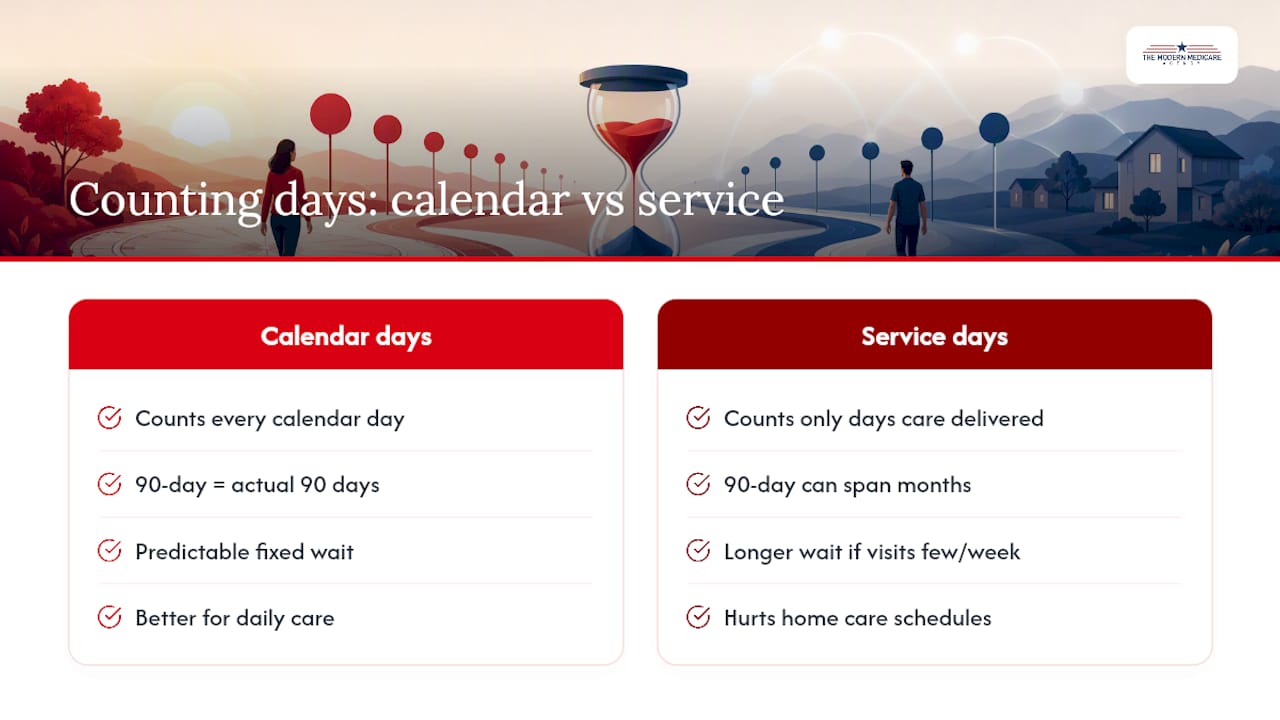
A 90-day elimination period sounds identical on two different policies until you learn one counts calendar days and the other counts service days. For anyone planning on home care delivered a few times a week rather than daily, that difference can turn a three-month wait into the better part of a year. I’d rather see someone choose a 60-day wait they fully understand than a 90-day wait they misjudged by four months.
The other blind spot is cash math. Too many people choose an elimination period based on the premium quote alone, without running the actual dollar exposure at their local care costs. Do that calculation before you compare a single premium. Retroactive payment features in hybrid policies are worth real weight in that decision too. They don’t eliminate the wait, but they change what the wait costs you once your claim is approved.
— Paul
How Paulbinsurance Can Help You Compare Elimination Periods
Reading elimination period language across two or three carrier contracts side by side is tedious work, and getting it wrong costs real money. Insurance brokers may work with multiple carriers, which can provide a comparison of counting rules, waiver clauses, and hybrid retroactive payment features instead of a single company’s sales pitch.

If you’re weighing a 60-day wait against a 90-day wait, or trying to figure out whether a hybrid policy’s zero-day home care waiver actually fits your situation, bring your current policy documents, recent care invoices if you have them, and a clear sense of your preferred care setting to a consultation. A knowledgeable insurance team can walk through the exact contract language with you, not just the summary sheet, and show you what each option costs against your own numbers. Start by reviewing Paulbinsurance’s Medicare supplement and long-term care insurance page and requesting a no-pressure policy comparison.
This article is general information, not a substitute for advice from a qualified financial advisor. Consult a qualified financial professional about your own circumstances before acting on anything here.
Sources
- Receiving Long-Term Care Insurance Benefits | ACL
- Medicare
- AALTCI: Comparing hybrid long-term care insurance policy benefits
- Satisfy the elimination period | John Hancock
FAQ
Do All Long-Term Care Policies Have an Elimination Period?
Nearly all traditional long-term care insurance policies include one, typically ranging from 0 to 180 days, though some hybrid products waive it for home care specifically.
How Long Will Medicare Cover a Nursing Home Stay?
Medicare only covers skilled nursing facility care for a limited period after a qualifying hospital stay, and it does not pay for ongoing custodial long-term care at all.
What Happens if I Never Use My Long-Term Care Insurance?
You keep paying premiums with no benefit payout unless your policy includes a return-of-premium or hybrid life insurance feature; a broker can help you evaluate whether that risk fits your plan before you buy.
What Conditions Disqualify You From Long-Term Care Insurance?
Insurers commonly decline applicants with existing cognitive impairment, certain progressive illnesses, or a recent history of falls and hospitalizations, though underwriting standards vary by carrier.
How Is the Elimination Period Different From an Insurance Deductible?
A traditional deductible is a dollar amount you pay before coverage kicks in, while an elimination period is measured in days of care you pay for before benefits start, regardless of the total cost.