
What if the health condition you’re worried about today doesn’t actually stop you from getting a lower premium? Many seniors feel trapped in their current plans as 2026 rates continue to rise, fearing that a single “yes” to medigap underwriting questions will result in an immediate denial. It’s completely normal to feel anxious about disclosing your medical history, especially when you’re just looking for the security and peace of mind you deserve. You shouldn’t have to feel “locked in” to a plan just because you’re managing a chronic condition.
I understand how overwhelming these rules can feel, but you don’t have to handle this alone. This guide will walk you through the exact health questions insurance companies ask and show you how to prepare for the process with total confidence. You’ll learn which conditions carriers often accept, which ones are automatic “knockouts,” and whether you live in one of the 15 states with a “Birthday Rule” that lets you skip underwriting entirely. We’ll start by breaking down the specific questions you’ll face and the simple steps you can take to secure the coverage you need without the stress.
Key Takeaways
- Learn exactly what to expect by reviewing the standard 2026 medigap underwriting questions about your health history and physical metrics.
- Discover the difference between “passable” health conditions and those that might lead to a denial, helping you choose the right carrier the first time.
- Find out if you live in a state with unique protections like the “Birthday Rule” that allow you to change your plan without answering any medical questions.
- Understand how an independent broker can pre-screen your health profile against dozens of carriers to find the one most likely to approve your application.
- Transition from a state of uncertainty to total peace of mind by learning how to match your health profile with the most lenient insurance providers.
What is Medigap Medical Underwriting and Why Does it Matter?
Underwriting often sounds like a technical, scary word. In reality, it’s just the process insurance companies use to decide if they can accept your application. While Medigap plans offer incredible security, they don’t work like the employer plans you might be used to. In most states, companies have the legal right to look at your health history. They do this by asking specific medigap underwriting questions to see if you meet their internal guidelines.
Why is 2026 such a critical year to understand this? We’re seeing a trend where more seniors want to switch plans to escape rising premiums, but carriers are also using faster, digital tools to check medical records. Unlike Medicare Advantage, which accepts everyone regardless of health, Medicare Supplement Insurance (Medigap) usually requires you to “qualify” if you’re outside your initial enrollment window. It’s a journey from uncertainty to certainty, and knowing the rules is your first step.
The Purpose of the Health Questionnaire
Insurance companies use your health data to predict future medical claims. They look at your height, weight, and any medications you take to determine your eligibility. At The Modern Medicare Agency, we view this as a matching game rather than a hurdle. Every carrier has different rules for 2026. One company might decline an applicant for a condition that another company is perfectly happy to cover. Because we’re independent, we can shop around to find the carrier that views your health history in the most favorable light.
When is Underwriting Required?
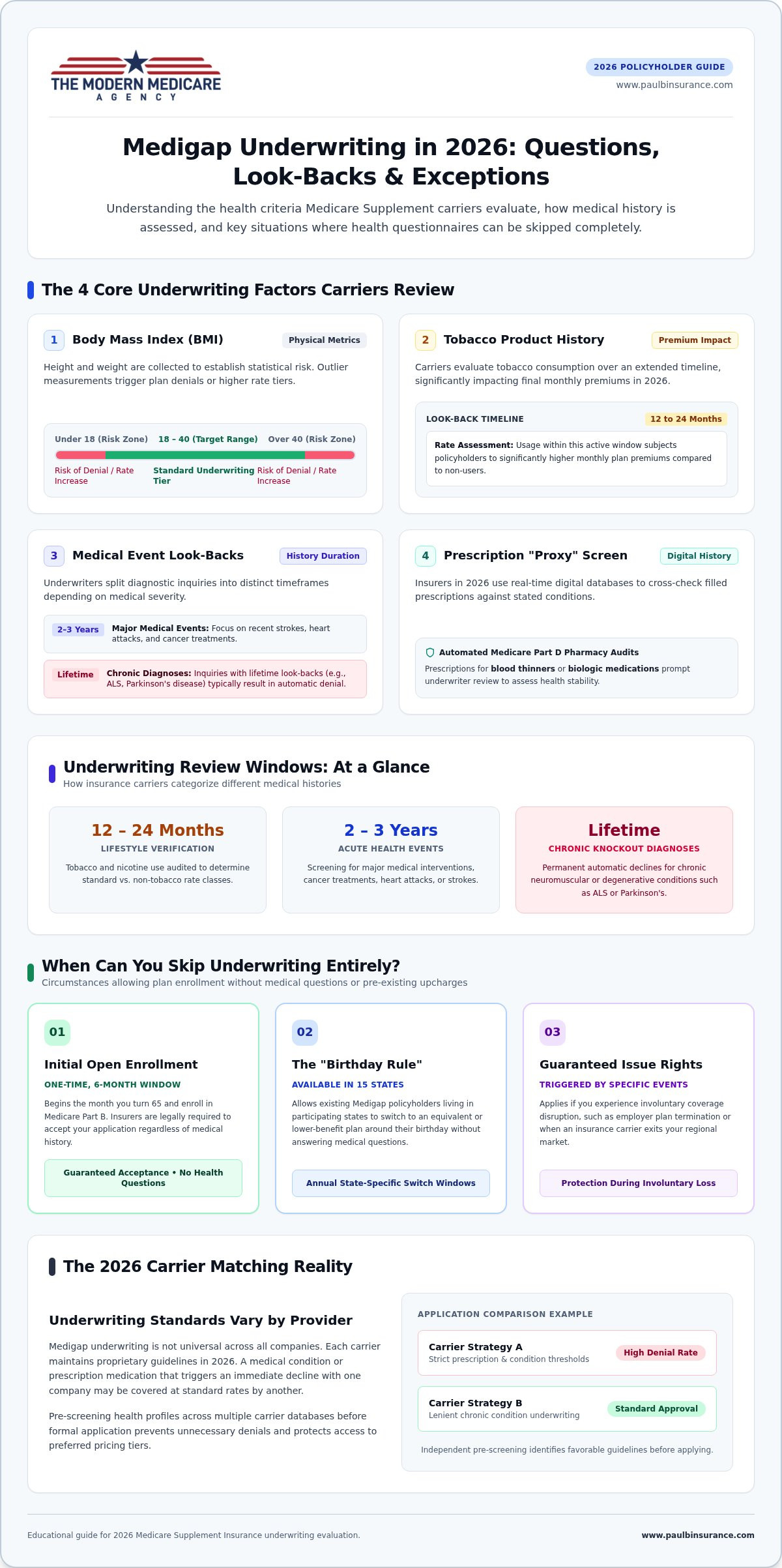
The best time to avoid health questions is during your one time, six month Open Enrollment Period. This window opens the month you’re 65 and enrolled in Medicare Part B. During this time, you have a “get out of underwriting free” card. Companies must accept you, and they can’t charge you more for pre-existing conditions.
If you’re looking to switch plans later in life, you’ll typically need to answer medigap underwriting questions. However, there are “enrollment miracles” like Guaranteed Issue rights. These apply if you lose employer coverage or if your plan leaves the market. Additionally, if you live in a state with year-round open enrollment or a “Birthday Rule,” you might be able to switch plans without any health questions at all. We’re here to help you figure out exactly where you stand so you can move forward with confidence.
What are the Most Common Medigap Underwriting Questions?
When you look at a 2026 application, you’ll notice it’s designed to be efficient. Most insurance companies now use instant digital databases to verify your history, but the core medigap underwriting questions still start with your physical metrics. Your height and weight are used to calculate your Body Mass Index (BMI). Insurers look for a specific range because a BMI over 40 or under 18 can lead to rate increases or even a denial. It’s not about judgment; it’s about the statistical risk of future health complications that carriers want to avoid.
Tobacco use is another major factor that impacts your 2026 rates. If you’ve used any tobacco products in the last 12 to 24 months, you can expect to pay a significantly higher premium. Then there’s the “look-back” period. Most carriers focus on major events like heart attacks, strokes, or cancer treatments that occurred within the last two to three years. However, certain chronic conditions fall under a “lifetime” look-back. This means if you’ve ever been diagnosed with something like Parkinson’s or ALS, the carrier will likely decline the application. This is why understanding medical underwriting and pre-existing condition exclusions is so important before you start the process.
Prescription Drug “Proxy” Questions
Your medicine cabinet tells a story that carriers listen to closely. Even if you don’t list a specific condition on the form, insurers use your Medicare Part D history as a proxy to verify your health. In 2026, companies use real-time tools to see every prescription you’ve filled in the last few years. If they see a blood thinner or a specific biologic medication, it might trigger a follow-up call from an underwriter. They want to know why you’re taking it and if the condition is stable. If you’re worried about how your medications might affect your eligibility, you can reach out to us for a quick review of your list before you apply.
The “Have You Ever” vs. “In the Last Two Years” Distinction
The phrasing of these questions matters immensely. Some questions ask if you have “ever” been diagnosed with a condition, while others only care about the last 24 months. For instance, a heart stent placed five years ago might be perfectly fine for one carrier but a problem for another if they have a longer look-back window. Honesty is essential. If a digital record check finds a discrepancy, it can lead to an automatic denial. We help you interpret this confusing language so you can answer accurately and find the carrier most likely to welcome you.
Which Health Conditions Lead to a Medigap Denial?
I know how stressful it is to hear the word “denial.” It feels like a door is closing on your financial security, but I want to reassure you that the process isn’t as black and white as it seems. In 2026, we view health conditions through a simple traffic light system. Green lights are minor issues like well-controlled high blood pressure or high cholesterol. If you’ve been on the same medication for years and your readings are stable, most carriers won’t hesitate to approve you. Yellow lights are conditions that might require a bit more explanation, such as a doctor’s statement or a slightly higher premium due to your height and weight.
Red lights are conditions that typically lead to an automatic decline, but even then, there’s hope. A denial from one company does not mean you’re uninsurable. Because every carrier has different 2026 guidelines, our job is to find the one that says “yes” when others say “no.” Understanding the Medicare guidelines on Medigap medical underwriting is the first step in realizing that your health history doesn’t have to define your future coverage.
Automatic “Knockout” Conditions
There are certain chronic or serious diagnoses that almost all private insurers consider too high of a risk outside of a protected enrollment window. These “knockout” conditions include active cancer treatments, End-Stage Renal Disease (ESRD) requiring dialysis, and major heart procedures like a bypass or stent placement performed within the last two years. Chronic progressive conditions such as Parkinson’s, Multiple Sclerosis, and severe COPD also fall into this category. If you have a pending surgery scheduled, like a hip or knee replacement, carriers will usually ask you to wait until you’ve fully recovered and been released from care before they’ll evaluate your medigap underwriting questions.
Borderline Cases and Underwriter Discretion
Many conditions fall into a gray area where the specific details of your treatment matter most. Diabetes is a perfect example. If you manage it with oral medication and your A1C is stable, you’re often a “green light.” However, if you require more than 50 units of insulin daily or have developed complications like neuropathy, it becomes a red flag. Stability is the key word here. Carriers want to see that your health hasn’t changed significantly in the last 12 to 24 months. If you’re still learning What Is Medicare Supplement Insurance? and how it applies to your specific health profile, remember that a calm, expert guide can help you navigate these borderline cases to find a fair offer.
Can I Get Medigap Without Answering Health Questions?
Is it actually possible to skip the health questionnaire entirely? For many of our clients in 2026, the answer is a resounding yes. While most states allow insurers to ask medigap underwriting questions, several “escape hatches” exist that protect your right to switch plans regardless of your medical history. One of the most popular is the “Birthday Rule.” As of 2026, 15 states, including West Virginia and Wyoming, allow you to change to a plan with equal or lesser benefits around your birthday each year. This rule is a game-changer for those who feel stuck in a plan with rising premiums but worry their health has changed too much to qualify elsewhere.
You might also avoid underwriting through what we call “Trial Rights.” If you joined a Medicare Advantage plan for the first time and decided within 12 months that it wasn’t the right fit, you generally have a legal right to switch back to a Medigap policy. These protections are designed to give you a safety net. However, timing is everything. In most of these situations, you have a strict 63-day window from the date your prior coverage ends to secure a new policy without answering a single health question. If you miss that window, you may be subject to full medical screening.
New York and Connecticut: The “No Underwriting” States
Living near our office in Melville, New York, or just across the border in Connecticut provides a unique advantage that most of the country doesn’t have. These states require insurers to offer Medicare Supplement (Medigap) Plans through year-round, continuous open enrollment. This means you can apply to switch your plan at any time, and the company cannot turn you down or charge you more based on your health history. In 2026, these states use “community rating,” which ensures that everyone pays the same premium regardless of their age or medical conditions. It’s the ultimate form of peace of mind for seniors navigating a complex system.
Guaranteed Issue Situations (GI Rights)
Sometimes, you get a fresh start because of circumstances beyond your control. These are known as Guaranteed Issue (GI) rights. A common scenario in 2026 is when a Medicare Advantage plan decides to leave a specific service area or stop serving Medicare beneficiaries altogether. If this happens to you, or if you move out of your plan’s service area, you qualify for a GI window. This allows you to buy a Medigap policy without facing medigap underwriting questions. Because these rules vary so much by state and situation, it’s always best to contact us for a personalized review of your eligibility before your current coverage ends.
How an Independent Broker Helps You Navigate Underwriting
Facing a list of health questions alone can feel like walking through a minefield. You might worry that one wrong answer will end your chances of getting better coverage. This is where the difference between a captive agent and an independent broker becomes vital. A captive agent works for just one insurance company. If that company’s medigap underwriting questions don’t fit your health profile, that agent has nowhere else to take you. They’re restricted by the very system you’re trying to navigate.
As independent brokers at The Modern Medicare Agency, we aren’t tied to any single carrier. We have access to over 40 insurance companies across 34 states. This allows us to perform a thorough pre-screening before you ever submit an official application. We check your health history against the internal underwriting guides of every carrier we represent. This matching process ensures we only apply to the companies most likely to offer you a “green light.” It’s a journey from distress to certainty, guided by someone who is strictly on your side.
The “Modern” Way to Compare Plans
We use our 2026 database to identify which carriers are currently the most lenient for specific conditions. If you’ve had a heart stent or manage mild diabetes, we know which companies have shortened their look-back periods this year. Our priority is your long-term security, not a quick sale. By working with a Medicare broker, you gain a dedicated advocate who understands the nuances of the 2026 market. If we do face a denial, we don’t give up. We immediately pivot to a “Plan B” strategy, which might involve looking at a different carrier or exploring state-specific protections like the Birthday Rule mentioned earlier.
Your Peace of Mind is Our Priority
You shouldn’t have to fear the medigap underwriting questions on an application. Most of the time, the anxiety of the unknown is much worse than the reality of the process. We’re here to remove that mystery and provide a structured path to a solution. You can get a personalized health pre-assessment today by reaching out to our team in Melville. We’ll review your medications and health history with the same care and patience we’d give our own family members. Medical underwriting is a journey we take together to ensure you always have the protection you deserve.
Secure Your Financial Peace of Mind for 2026
Navigating the transition to a new plan doesn’t have to be a source of stress. You’ve learned that medical history isn’t always a barrier; it’s often just a matter of finding the right carrier that understands your specific needs. Whether you’re benefiting from a state “Birthday Rule” or utilizing your Guaranteed Issue rights, there are many paths to achieving the coverage you deserve. You don’t have to feel trapped in a plan with rising premiums just because you’re worried about medigap underwriting questions. Options are always available.
At The Modern Medicare Agency, we’re committed to being your calm, patient guide through this entire process. We can compare 40+ carriers at once to find the most lenient options for your unique health profile. As an independent and unbiased brokerage licensed in 34+ states for 2026, our only goal is to protect your interests. Let us help you navigate the underwriting maze; contact Paul Barrett and the team today for a stress-free review. You have the power to make an informed choice, and we’re honored to walk beside you every step of the way.
Frequently Asked Questions
Will I be denied Medigap if I have high blood pressure or cholesterol?
No, you typically won’t be denied if your high blood pressure or cholesterol is well-controlled with medication. Insurance carriers view these as standard conditions of aging. As long as your readings are stable and you haven’t had recent dosage changes or hospitalizations, most 2026 carriers will approve your application. We help you identify which companies have the most favorable view of these common health markers to ensure a smooth approval.
How far back do Medigap underwriting questions go in 2026?
Most 2026 medigap underwriting questions look back two to three years for major events like heart attacks or cancer. However, certain chronic conditions like Parkinson’s or dementia often fall under a “lifetime” look-back window. It’s important to read the phrasing carefully. Some questions ask about your health in the last 24 months, while others ask if you’ve ever been diagnosed with a specific condition. We can review these timeframes with you.
What happens if I lie on my Medigap health application?
If you provide inaccurate information, the insurance company can deny your application or cancel your policy later for material misrepresentation. In 2026, carriers use instant digital tools to check your prescription history and medical records. They will likely see the discrepancy before the policy is even issued. It’s always best to be honest. If you’re worried about a specific condition, we can find a carrier that is more likely to accept it.
Can I switch Medigap plans if I am currently in the middle of medical treatment?
You generally cannot switch plans while you are in the middle of active treatment or have a pending surgery. Carriers want to see that your condition is stable and that you’ve been released from care. For example, if you’re scheduled for a knee replacement, you’ll usually need to wait until after physical therapy is finished to apply. This ensures the underwriter can accurately assess your long-term health status before they approve the new coverage.
Are there any Medigap plans that never require medical underwriting?
There isn’t a specific plan “letter” that skips health questions, but certain states and situations allow you to avoid them. Residents of New York and Connecticut enjoy year-round enrollment without medigap underwriting questions. Additionally, if you qualify for a Guaranteed Issue right or live in a state with a “Birthday Rule,” you can join any available plan without proving you are in good health. We can check if you meet these special criteria.
Do I have to provide my full medical records for Medigap underwriting?
You rarely have to provide physical medical records because insurers now use digital databases to verify your history instantly. These systems pull your prescription fill history from the last several years within seconds. While an underwriter might occasionally request a “doctor’s statement” for clarification on a specific condition, the process is much faster and less invasive than it used to be. This modernization helps us get you an answer on your eligibility much quicker.
What is the “Birthday Rule” for Medigap and which states have it in 2026?
The “Birthday Rule” allows you to switch to a plan with equal or lesser benefits around your birthday without health questions. In 2026, this rule is active in 15 states, including California, Oregon, Illinois, and West Virginia. It’s a wonderful protection that prevents you from being locked into a plan with high premiums. If you live in one of these states, we can help you time your application to take full advantage of this window.
If I am denied by one Medigap carrier, will it affect my other applications?
A denial from one company does not automatically mean you’ll be denied by another. Every carrier has its own internal field underwriting guide. One company might be strict about a recent stent placement, while another might be perfectly comfortable with it after two years. Because we work with over 40 different carriers, we can often find a “Plan B” option even if your first choice wasn’t a match for your health profile.

Article by
Paul Barrett
Paul Barrett, CMIP is the founder of The Modern Medicare Agency, an independent Medicare-only brokerage based in Melville, NY. With 18 years of Medicare-exclusive experience, a CMIP designation, and more than 5,000 clients served across 37 states, Paul is one of the most credentialed independent Medicare specialists on Long Island — and one of the most direct.
He represents 40+ carriers with no quotas and no allegiances, which means his recommendations are based entirely on what fits each client's specific situation. He is the author of Medicare Mastery Unlocked and host of the Wise Guys Retirement Talk podcast. His content is grounded in primary sources, real carrier intelligence, and 18 years of watching what happens when people get Medicare right — and when they don't.
📞 631-358-5793 | paulbinsurance.com