
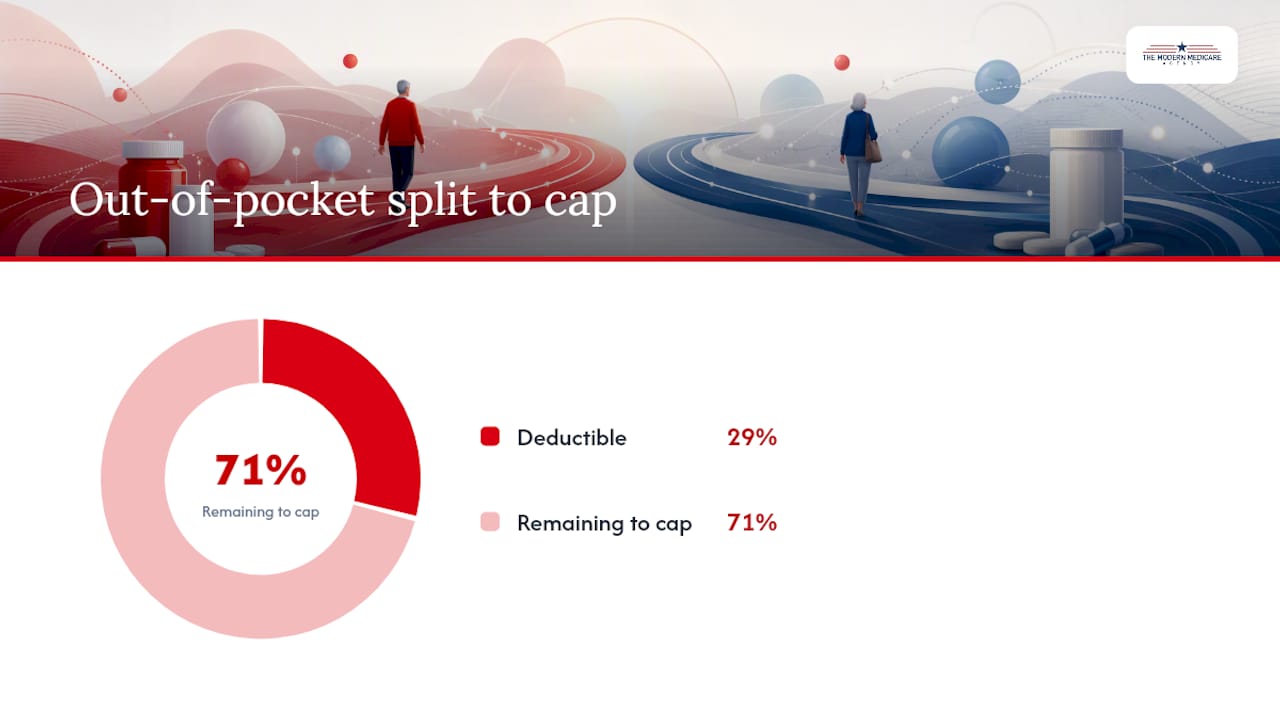
The Part D deductible is what you pay in full before your plan chips in; the copay or coinsurance is what you pay after that point, and only for covered drugs. In 2026, the most any plan can charge as a deductible is $615, and once your out-of-pocket drug spending hits $2,100, you owe nothing more for covered Part D drugs the rest of the year. If you qualify for Extra Help, the deductible often disappears entirely.
TL;DR:
- Most plans in 2026 cap the Part D deductible at $615, which resets annually and may be lower or waived if you qualify for Extra Help.
- Coinsurance can be ten times more expensive than copays for the same drug, especially in higher tiers, affecting out-of-pocket costs significantly.
- Reaching the $2,100 out-of-pocket threshold moves you into catastrophic coverage, where you pay nothing for covered drugs for the rest of the year.
- Many plans now include coinsurance at higher tiers, shifting costs more to beneficiaries, with fewer plans offering no deductible options.
- Checking formulary details, tier placement, and potential discounts before enrollment ensures accurate cost estimates and plan suitability.
Table of Contents
- What a Part D Deductible Actually Is
- Copay vs Coinsurance: The Real Difference
- The Three Coverage Stages and Where Cost Sharing Changes
- How Extra Help Changes the Math
- A Checklist for Comparing Deductible vs Copay Tradeoffs
- Why You Can Trust This Breakdown
- Which Drugs Skip the Deductible Entirely
- Part D Plans vs Medicare Advantage Drug Coverage
- Practical Ways to Lower Your Out-of-Pocket Costs
- What the 2026 Redesign Means for Your Wallet
- Get Help Comparing Part D Plans With Paulbinsurance
- Sources
- FAQ
What a Part D Deductible Actually Is
The deductible is the amount you pay out of your own pocket for covered prescriptions before your Part D plan starts sharing the cost. Medicare caps this figure at $615 for 2026, but plenty of plans set it lower, and some carry no deductible at all. Until you hit that number, you’re paying the plan’s negotiated price for your drugs in full, not a discounted rate.
A few things about how this plays out in real life:
- Some plans exempt certain drugs, usually preferred generics, from the deductible so you pay a copay from your very first fill.
- The deductible resets every January 1, regardless of how close you came to meeting it the year before.
- A single 90-day supply of a maintenance drug can burn through the whole deductible in one transaction.
Say your monthly cholesterol medication costs $80 at your plan’s negotiated rate. Fill one costs you the full $80. Fill two costs $80. By fill eight, you’ve paid $615 and moved past the deductible into the next phase of coverage, sometimes called initial coverage.
Copay vs Coinsurance: The Real Difference
A copay is a flat dollar amount, like $10 for a generic, regardless of what that drug actually costs the plan. Coinsurance is a percentage of the drug’s price, so your bill moves with the price tag. Both are forms of cost sharing that generally kick in only after you’ve cleared the deductible, when one applies.
Plans tend to follow a predictable pattern:
- Tier 1 (preferred generics) usually carries a small fixed copay, often $0 to $10.
- Tier 2 (generics) and Tier 3 (preferred brands) typically use slightly higher copays, sometimes $20 to $50.
- Tier 4 and 5 (non-preferred and specialty drugs) almost always switch to coinsurance, frequently 25% to 33% of the cost.
Here’s why that tier structure matters for your wallet. A $5 copay on a $200 drug costs you $5, full stop. But 25% coinsurance on that same $200 drug costs you $50, ten times more for the identical prescription. That gap is exactly why checking whether your medications fall under copay or coinsurance tiers matters more than comparing premiums alone.
The Three Coverage Stages and Where Cost Sharing Changes
Every Part D plan moves through the same three stages, and your cost sharing looks different in each one.
- Deductible stage: You pay 100% of the covered drug’s cost until you hit your plan’s deductible, which is capped at $615 in 2026.
- Initial coverage stage: You pay a copay or coinsurance, and the plan covers the rest, until your total out-of-pocket spending reaches the 2026 threshold of $2,100.
- Catastrophic coverage: Once you reach that $2,100 cap, you owe $0 for covered Part D drugs for the remainder of the calendar year.
What counts toward that $2,100 figure, often called true out-of-pocket costs or TrOOP, includes your deductible payments, your copays and coinsurance, and amounts paid on your behalf by Extra Help or most manufacturer discounts on brand-name drugs. It does not include your monthly premium.
How fast you reach the cap depends entirely on your prescriptions. Someone on a couple of generic maintenance drugs might never get past the initial coverage stage in a given year. Someone starting an expensive specialty biologic could blow through the deductible and the entire $2,100 cap within one or two fills, landing in catastrophic coverage by February. That’s part of why understanding the catastrophic coverage cap matters before you pick a plan, not after you’re already sick.
How Extra Help Changes the Math
Extra Help, also called the Low-Income Subsidy, rewrites the cost-sharing rules for eligible beneficiaries. Depending on your income and asset level, you may pay no deductible at all and face only minimal copays for the rest of the year.
Under full Extra Help, copays typically run around $5.10 for generics and $12.65 for brand-name drugs per fill, figures that stay flat even for expensive specialty medications. Some enrollees pay $0 for benchmark plans with no premium at all.
- Eligibility is based on income and resource limits that adjust annually.
- You can apply through Social Security or your state Medicaid office.
- Even partial Extra Help can meaningfully lower what you’d otherwise pay toward the deductible.
If your income is limited, checking Extra Help eligibility before you enroll in a Part D plan can change which plan actually makes sense for you.
A Checklist for Comparing Deductible vs Copay Tradeoffs
Premiums are the easiest number to compare and the least useful one on its own. Run through this list before picking a plan:
- Monthly premium, including any Part D late enrollment penalty that might apply to you.
- Deductible amount, and whether any tiers are exempt from it.
- Copay or coinsurance amount for each tier that includes your actual medications.
- Specialty tier coinsurance percentage, since that’s where costs spike fastest.
- Formulary placement, confirming your specific drugs are covered and at what tier.
- Pharmacy network and mail-order pricing, since preferred pharmacies often charge less.
A plan with a rock-bottom premium and a $615 deductible can end up costing you far more over a year than a plan with a higher premium and no deductible, especially if you take even one brand-name maintenance drug. The tradeoff only favors the low-premium plan if you take few or no medications.
Ask a plan representative or agent these six questions: What’s my deductible? Is my specific drug covered, and at what tier? Is that tier a copay or coinsurance? What’s my expected annual cost, not just my premium? Does my pharmacy count as preferred? What happens if my drug’s tier changes mid-year?
Pro Tip: If you’re starting an expensive new medication, ask your pharmacist about filling a shorter supply first. Medicare allows less than a full month’s fill in some cases, and paying proportionally less can soften the deductible hit while you confirm the drug works for you.
Why You Can Trust This Breakdown
Paul Barrett has worked directly with Medicare beneficiaries since 2007, and Paulbinsurance built its approach around education first, not pressure. The agency’s independent agents walk consumers through Part D, Medicare Advantage, and Medigap side by side, rather than pushing whatever pays the largest commission.
For plan-specific verification, always check the Medicare Plan Finder, read the plan’s formulary directly, and call the plan to confirm your drugs and tier placement before you enroll.
Which Drugs Skip the Deductible Entirely
Not every prescription is subject to the deductible, and knowing which ones aren’t can change how you plan your first few months of coverage. Many plans voluntarily exclude certain preferred generic drugs from the deductible phase, letting you pay a small copay from day one instead of the full negotiated price.
Vaccines covered under Part D, including the shingles vaccine, generally aren’t subject to any cost sharing at all under current rules, deductible included. Insulin products are a special case: thanks to the insulin cost cap, covered insulin can’t cost you more than $35 for a month’s supply, and that cap applies whether or not you’ve met your deductible. Some plans also carve out select chronic-condition drugs, like certain diabetes or high-blood-pressure medications, from the deductible as a way to encourage medication adherence.
None of these exclusions are guaranteed across every plan. Whether a drug skips the deductible depends entirely on that specific plan’s formulary design, which is exactly why two plans covering the identical drug can produce very different first-quarter costs. The only way to know for certain is to check the plan’s Summary of Benefits or formulary document before you enroll, not after your first prescription rings up at full price.
Part D Plans vs Medicare Advantage Drug Coverage
Standalone Part D plans and Medicare Advantage plans that include drug coverage (MA-PDs) follow the same basic federal rules: the same $615 maximum deductible, the same $2,100 out-of-pocket cap, and the same three coverage stages. Where they differ is in how aggressively they use each cost-sharing tool.
KFF’s analysis of 2026 plan data found that 82% of MA-PD enrollees are now in plans that charge a deductible, and coinsurance has become more common at higher tiers across both plan types. That’s a meaningful shift because MA-PDs have historically leaned on $0 deductibles as a selling point bundled with medical coverage. Fewer plans are doing that now.
The practical difference for you usually comes down to bundling. An MA-PD wraps your drug coverage into the same plan as your doctor visits and hospital stays, often with a single combined provider network. A standalone Part D plan pairs with Original Medicare or a Medicare Supplement policy, giving you more flexibility on which doctors you see but requiring you to manage drug coverage separately. Neither structure exempts you from the deductible and copay mechanics described above. The real comparison point is the specific plan’s deductible amount, tier copays, and formulary, not which broad category it falls into.
Practical Ways to Lower Your Out-of-Pocket Costs
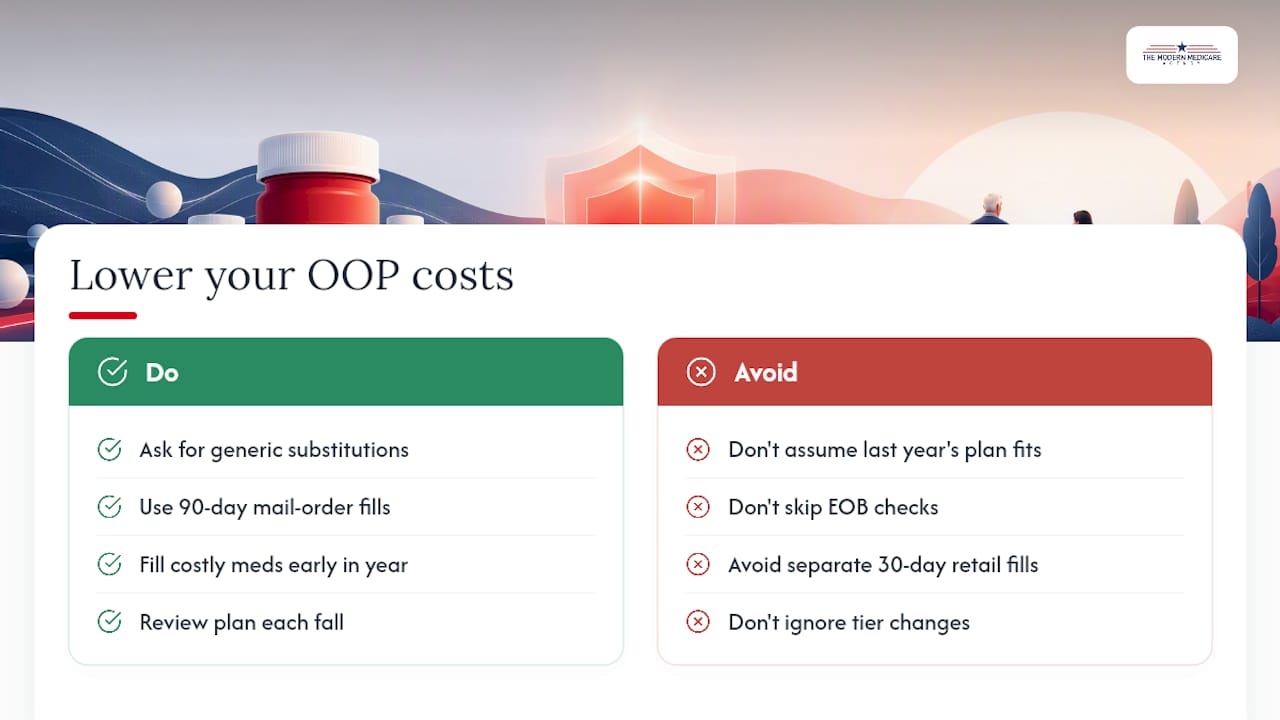
A few habits consistently save real money across a plan year. First, request generic substitutions whenever your doctor allows it; generics almost always sit on the lowest copay tier, while brand-name equivalents often trigger coinsurance. Second, use mail-order pharmacy options when your plan offers preferred pricing there, since a 90-day mail-order fill is frequently cheaper per dose than three separate retail fills.
Third, time expensive fills strategically. If you know a costly medication is coming, filling it early in the year gets you through the deductible faster, after which every other prescription that month benefits from copay or coinsurance pricing instead of the full price. Fourth, check your Explanation of Benefits regularly. Drug tiers and formularies change mid-year more often than beneficiaries expect, and a drug that was Tier 2 in January can shift to Tier 3 by June.
Finally, revisit your plan every fall during open enrollment rather than assuming this year’s plan still fits. KFF’s data shows deductibles and coinsurance use both climbed in 2026, which means a plan that was your best deal last year might not be this year. Comparing your total expected annual cost, not just the premium, against strategies for lowering prescription costs each fall is the single habit that saves beneficiaries the most money over time.
What the 2026 Redesign Means for Your Wallet
The $2,100 cap is a genuine win: no more open-ended coinsurance once you hit that number. But the tradeoff is more plans leaning on deductibles and coinsurance to fund that predictability, exactly what KFF’s 2026 data shows happening across the market. Estimate your full-year drug cost, not just the premium, and get an agent’s help if you’re on specialty medications.
— Paul
Get Help Comparing Part D Plans With Paulbinsurance
Paulbinsurance is the alternative to guessing your way through a formulary spreadsheet alone. We compare deductibles, copay tiers, and coinsurance across plans side by side against the actual drugs you take, then explain the tradeoffs in plain language before you commit to anything.

If your income is limited, we’ll also walk you through whether you qualify for Extra Help, since that alone can wipe out a $615 deductible. Our support doesn’t stop at enrollment either. We check in annually to make sure your plan still fits as formularies and pricing shift year to year. Visit our Medicare Part D plan comparison page to start a free, no-pressure review of your current coverage against what’s actually available in your area for 2026.
Sources
Figures and definitions in this article come from Medicare’s official cost breakdown, the Medicare prescription drug coverage guide (PDF), KFF’s 2026 Part D cost-sharing analysis, and AARP’s Part D overview.
This article is general information, not a substitute for advice from a qualified financial advisor. Consult a qualified financial professional about your own circumstances before acting on anything here.
- How much does Medicare drug coverage cost? | Medicare
- Medicare Part D enrollment, premiums, and cost sharing in 2026 | KFF
FAQ
Does Medicare Part D Have Copays?
Yes, most Part D plans use copays for lower drug tiers, usually generics, and switch to coinsurance for higher tiers like specialty drugs. Whether you owe a copay from your first fill depends on if your plan waives the deductible for that tier.
Does Medicare Pay 100% After the Deductible?
No, Medicare and your plan share costs after the deductible through copays or coinsurance until you hit the 2026 out-of-pocket cap of $2,100. Only after reaching that cap do you pay $0 for the rest of the year.
What Do Most People Pay for Medicare Part D?
Costs vary widely based on which drugs you take and which plan you choose, since premiums, deductibles up to $615, and copay or coinsurance amounts all differ by plan in 2026. The only reliable way to know your own cost is comparing plans against your specific medication list through Paulbinsurance or the Medicare Plan Finder.
Do I Still Have to Pay a Copay if I Reach My Deductible?
Yes, meeting your deductible moves you into the initial coverage stage, where you pay a copay or coinsurance instead of the full price. Those payments continue until your total out-of-pocket spending reaches the $2,100 cap, after which covered drugs cost $0.