
A Long-Term Care Partnership policy lets you shield a dollar of savings for every dollar the policy pays toward your care, once you apply for Medicaid. That protection doesn’t erase the rest of Medicaid’s rules. You still have to meet your state’s income limits and prove a medical need for long-term care, and the protection itself varies depending on where you bought the policy and where you live when you need it.
TL;DR:
- Asset protection only applies to resources that Medicaid considers countable, and it does not impact income eligibility requirements or medical necessity proof.
- Partnership policies must include inflation protection, guaranteed renewal, and state approval, with provider licensing and underwriting remaining comparable to standard long-term care policies.
- Eligibility for protection depends on actual claims paid, not the policy’s total benefit limit, so low utilization means limited asset shielding.
- Reciprocity of protection when moving between states varies; some states honor benefits from others, but it is important to verify before purchasing.
- Purchasing an approved Partnership policy can simplify estate planning, but it does not replace other legal tools and offers protection only up to claims paid, not the entire estate.
Table of Contents
- What Is a Long-Term Care Partnership, and How Does Dollar-for-Dollar Protection Work?
- Which Policy Features Make a Plan Partnership-Qualified?
- Does Your State Have a Partnership Program, and What Happens if You Move?
- Who Actually Benefits From a Partnership Policy, and What Does It Cost?
- How Do You Buy a Partnership Policy, and What Should You Ask an Agent?
- Credentials and Where to Go for Personalized Help
- How Partnership Policies Change Your Estate Planning Math
- Where Partnership Policies Fall Short
- What Happens After You Buy: Applying and Receiving Benefits
- What Most People Get Wrong About This
- Get Help Choosing the Right Long-Term Care Coverage
- Sources
- FAQ
What Is a Long-Term Care Partnership, and How Does Dollar-for-Dollar Protection Work?
A Long-Term Care Partnership policy is a private long-term care insurance policy that meets specific state and federal standards, allowing the state to link its benefits to Medicaid’s asset rules. The framework exists because of Section 6021 of the Deficit Reduction Act of 2005, which gave states the authority to build these programs and tie policy payouts directly to Medicaid asset disregards.
Here’s the mechanic that makes it worth understanding: if your policy pays out a substantial amount in long-term care benefits before you ever apply for Medicaid, you get to keep a corresponding amount in assets that would otherwise count against you. Medicaid normally requires you to spend down savings to a few thousand dollars before it pays for nursing home or home care. A Partnership policy lets you skip that spend down, dollar for dollar, up to what the policy has actually paid.
California’s Department of Health Care Services describes this as lifetime asset protection tied to the benefits paid out, and it explains that the protected amount can also be excluded from estate recovery after death, up to that same dollar figure.
That last point trips people up constantly:
- Asset protection only covers resource limits. It doesn’t touch Medicaid’s income test.
- You still need a documented medical need for nursing home or long-term care services.
- Protection applies to countable assets, not automatically to every asset you own.
- The dollar amount protected grows only as your policy actually pays claims, not the policy’s total coverage limit.
Pro Tip: Don’t confuse the policy’s maximum benefit with your protected asset amount. If your policy has a $300,000 lifetime maximum but has only paid $80,000 in claims so far, you’ve protected $80,000, not $300,000.
Which Policy Features Make a Plan Partnership-Qualified?
States don’t approve just any long-term care policy for Partnership status. The policy has to check specific boxes, and if it doesn’t, you get regular long-term care coverage with none of the Medicaid asset protection.
The standard requirements include:
- Inflation protection. Tax-qualified long-term care plans commonly require automatic inflation protection so benefits keep pace with rising care costs over the life of the policy, a feature outlined by LTC Feds.
- Guaranteed renewability. The insurer can’t cancel your coverage just because you filed claims or got older.
- Tax-qualified status. The policy meets federal tax-qualified long-term care standards, which affects both benefit triggers and potential tax treatment of premiums.
- State approval. Your state’s insurance department has to specifically approve the policy as Partnership-qualified. A generic long-term care policy from an approved insurer doesn’t automatically count.
- Licensed, trained producers. Agents selling Partnership policies typically must complete state-mandated training before they can sell one.
Medical underwriting still applies the same way it does for any long-term care policy. Insurers ask about your health history, current conditions, and functional status, and they can decline coverage or charge more based on risk. Partnership status changes what happens with Medicaid later. It does nothing to change how you qualify medically for the policy itself now.
Pro Tip: Ask any agent to show you the state approval letter or documentation number for the specific policy, not just a verbal assurance that “it’s Partnership-qualified.” Approval is policy-specific, not company-wide.
Does Your State Have a Partnership Program, and What Happens if You Move?
Partnership programs exist state by state, and the rules aren’t identical everywhere. Connecticut, California, Indiana, and New York were the original states to pilot the concept, and the long-term care insurance industry’s own history traces most current programs back to those four. Since then, most states have adopted some version of the dollar-for-dollar model, though a handful still use older, different structures from before the federal expansion.
Reciprocity is where things get complicated. Some states honor Partnership protection earned in another Partnership state if you move, but not all of them do, and the details depend on both your old state’s and new state’s rules. California’s program materials note this variation directly and advise checking with both states before assuming your protection travels with you.
Availability also shifts over time. New York’s program pages have historically flagged that insurers can stop offering new Partnership policies in a state even while current policyholders keep their protection, so what’s sold today may look different in a few years.
To confirm your own status:
- Check your state Department of Insurance website for a current list of approved Partnership insurers.
- Check your state Medicaid or long-term care agency page for eligibility and reciprocity language.
- Use Usa if you’re not sure which office handles this in your state.
Who Actually Benefits From a Partnership Policy, and What Does It Cost?
The Partnership model fits a specific financial profile best: middle-income households with meaningful savings, maybe $150,000 to $500,000 in assets, who want to protect an estate without qualifying for Medicaid the traditional way, by spending nearly everything first.
If you’re already near Medicaid’s asset limits, dollar-for-dollar protection doesn’t buy you much. If you have several million dollars, a Partnership policy’s protection ceiling may fall well short of what you’re trying to shield, and other estate planning tools might matter more.
Premiums depend on a few core factors:
- Age at purchase. Buying in your mid-50s to early 60s typically costs meaningfully less than waiting until your late 60s.
- Benefit length and daily/monthly benefit amount. More coverage costs more, predictably.
- Inflation protection option. Required for Partnership qualification, and it adds cost compared to a policy without it.
- Health underwriting results. Existing conditions can raise premiums or trigger a decline.
For a detailed breakdown of what these premiums actually look like across ages and benefit levels, Paulbinsurance’s guide on long-term care insurance costs walks through realistic ranges. The tradeoff is straightforward even without exact numbers in front of you: more inflation protection and a longer benefit period mean higher premiums today, in exchange for more protected assets down the road.
How Do You Buy a Partnership Policy, and What Should You Ask an Agent?
Buying the right policy takes a few concrete steps, not guesswork.
- Check your state’s approved insurer list. Your Department of Insurance or Medicaid agency site should list which companies currently sell Partnership-qualified policies in your state, since not every long-term care insurer participates.
- Find an agent trained specifically on Partnership policies. Agents typically need state-required training to sell these, a signal you can and should ask about directly.
- Get written proof of Partnership status. Ask for the state approval documentation for the exact policy, not just the insurer’s general reputation.
- Compare at least two or three quotes. Premiums and inflation protection structures vary more than people expect between carriers.
- Confirm reciprocity if you plan to move. Ask specifically whether your protection would carry to any state you’re considering for retirement.
When you’re on the phone or in a meeting with an agent, run through this list:
- Is this specific policy Partnership-qualified in my state right now?
- How exactly does the inflation protection adjust benefits each year?
- What’s this carrier’s premium increase history on similar policies?
- Is reciprocity guaranteed if I move, or does it depend on the destination state?
- Will my protected assets be excluded from estate recovery, and up to what amount?
Pro Tip: If an agent can’t answer the reciprocity question specifically for the state you’re considering retiring to, treat that as a request for homework, not a dead end. Get it in writing before you buy.
Red flags worth walking away from: pressure to sign before you’ve seen written Partnership documentation, vague answers about premium increase history, or an agent who can’t explain how inflation protection actually calculates your growing benefit.
Credentials and Where to Go for Personalized Help
Paul Barrett has worked with Medicare consumers since 2007, and Paulbinsurance’s independent agents built their approach around education first, on the theory that good coverage decisions require actually understanding your options, not just picking a name you recognize. That same philosophy applies to long-term care planning, where the stakes and the state-by-state complexity make an informed conversation worth more than a quick online quote.
For more background before you talk to anyone, Paulbinsurance’s guide on what long-term care insurance covers and its comparison of long-term care insurance versus Medicare fill in the coverage gaps this article doesn’t cover in depth.
How Partnership Policies Change Your Estate Planning Math
Partnership protection changes the sequencing of estate planning decisions more than it changes the goal. Without it, protecting assets from long-term care costs usually means irrevocable trusts, gifting strategies started years in advance, or accepting that a nursing home stay could consume a large share of an estate. With Partnership coverage in place, a chunk of your assets stays protected without any of that advance legal work, simply because the insurance policy did the protecting.
That doesn’t mean it replaces estate planning entirely. A Partnership policy protects assets up to what it has paid in benefits, and most policies have a lifetime maximum well below the total value of a larger estate. For someone with a $200,000 lifetime benefit maximum and a $700,000 estate, the policy handles a meaningful slice of the exposure, not the whole picture. Trusts, powers of attorney, and beneficiary designations still matter for everything the policy doesn’t reach.
Partnership protection also interacts with how you’d otherwise plan around Medicaid’s five-year lookback period for asset transfers. Because protected assets don’t need to be given away or transferred to qualify for Medicaid, the policy can reduce pressure to make risky gifting decisions under a deadline. That’s a real advantage for people who’d rather not hand assets to family members years before they might need care, just to stay under Medicaid’s resource limits.
Where Partnership Policies Fall Short
The protection has real limits worth knowing before you buy, not after.
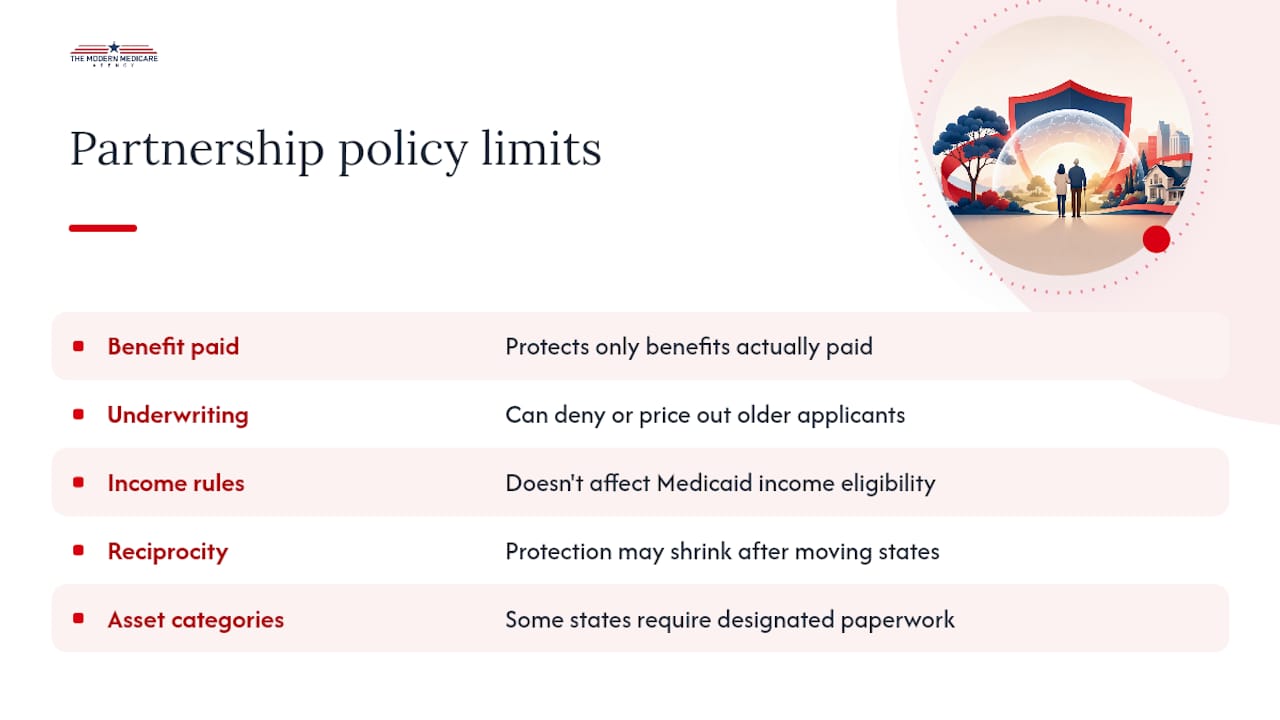
Partnership status only ever protects an amount equal to what the policy has actually paid in benefits, never the policy’s total coverage maximum. If you need care for a shorter period than expected, or die before using much of the benefit, the protected amount stays small no matter how generous the policy looked on paper.
Medical underwriting can still deny you coverage or price you out, especially if you wait until your late 60s or 70s to apply, when health conditions become more common. The policy protects assets from Medicaid’s resource test specifically. It does nothing for Medicaid’s income eligibility rules, which vary by state and can disqualify you even with a fully protected asset base.
Reciprocity gaps are a real limitation, not a theoretical one. If you buy a Partnership policy in one state and later move somewhere that doesn’t recognize it, or recognizes it differently, your protection may shrink or work differently than you planned. And because insurers can stop selling Partnership products in a given state, the version of the program available today might not look the same in ten or fifteen years, even though existing policyholders typically keep what they already have.
Finally, Partnership protection doesn’t cover assets outside the policy’s specific state-defined categories in every case. Some states use designated forms to track which assets count as protected, which means paperwork and periodic verification become part of the deal, not a one-time setup.
What Happens After You Buy: Applying and Receiving Benefits
The timeline from purchase to actual benefit payment runs in stages, and each one matters for when asset protection kicks in.
After you buy an approved policy, coverage starts once the policy is in force, but Partnership asset protection doesn’t activate until the policy actually pays benefits. That means the protection is zero on day one and grows only as claims get paid. If you need care five years after buying the policy, and it pays $40,000 that year, you’ve protected $40,000, not the policy’s full benefit ceiling.
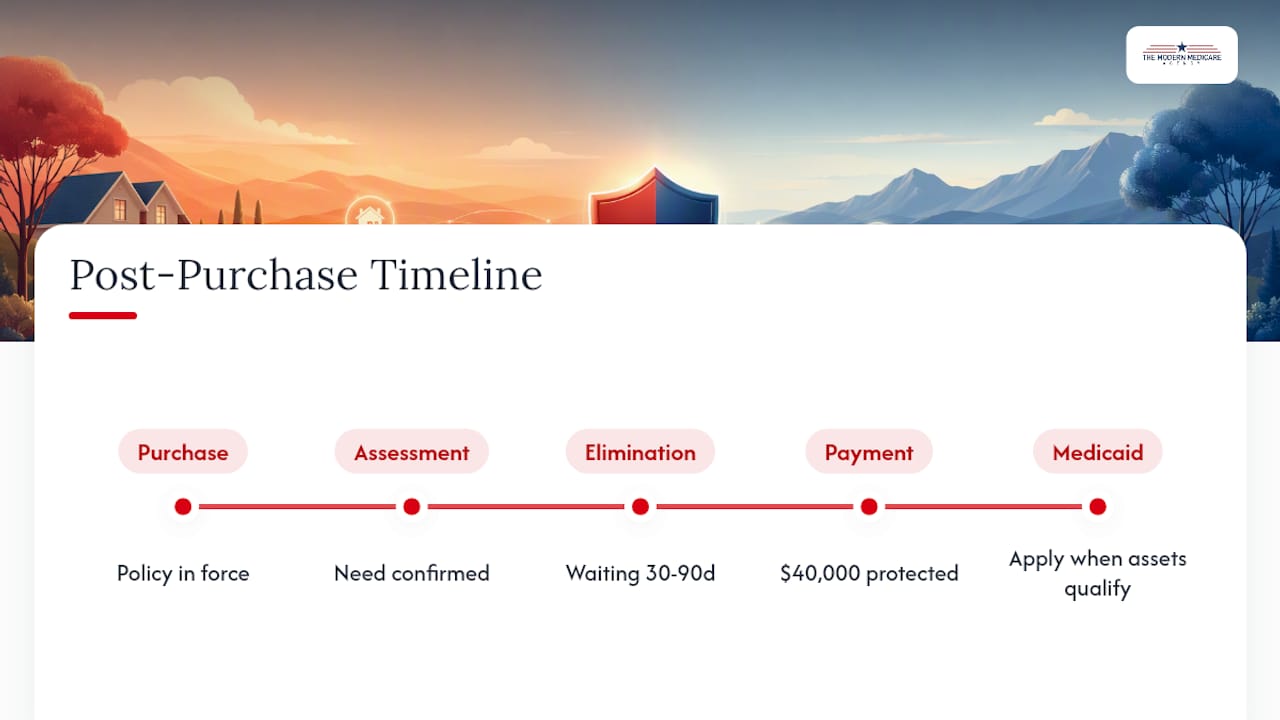
To trigger benefits, you typically need to meet the policy’s specific benefit triggers, usually an inability to perform a set number of activities of daily living, or a cognitive impairment diagnosis, confirmed through a licensed health professional’s assessment. Once triggered, most policies pay according to their elimination period, a waiting window (often 30, 60, or 90 days) before benefits start.
When you eventually apply for Medicaid, Washington’s Health Care Authority is explicit that you don’t need to exhaust your policy’s benefits first. You can apply for Medicaid as soon as your countable assets, adjusted for the protected amount your policy has paid, fall within your state’s limit. Medicaid will still evaluate your income separately, and approval depends on both tests passing, not just the asset side.
What Most People Get Wrong About This
The biggest misconception readers bring to Partnership policies is treating asset protection as a substitute for Medicaid eligibility itself, rather than one piece of it. It isn’t. You can have every dollar protected and still fail to qualify because your monthly income exceeds your state’s limit. That distinction gets lost in most marketing materials, which tend to lead with the dollar-for-dollar hook and bury the income test in fine print.
The second thing conventional advice underplays is reciprocity risk. Most consumers buy a policy assuming the protection is portable, and for many people it is, but not universally, and not automatically. If retirement plans include a move to a different state, that question deserves a direct answer before signing anything, not an assumption based on what worked for a neighbor or relative in a different state years ago.
What should come first, in my view, is verifying state approval and inflation protection terms before comparing premiums. Price comparisons feel productive, but they’re meaningless if the policy you’re comparing isn’t actually Partnership-qualified in the state where you’ll eventually need Medicaid. Get the qualification question settled first. Everything else, cost, benefit length, carrier reputation, is a secondary decision built on that foundation.
— Paul
Get Help Choosing the Right Long-Term Care Coverage
Working through Partnership rules, inflation protection requirements, and reciprocity questions on your own is a lot to sort out before you even start comparing carriers. An education-first approach to long-term care insurance helps consumers understand which policies in their state actually carry Partnership status before committing to anything.

Independent agencies that work across multiple insurers can offer comparisons instead of promoting whichever policy pays the best commission. That matters more with Partnership policies than almost any other insurance product, since state approval status and inflation protection terms differ by carrier and change over time. If you’re weighing long-term care insurance options alongside other coverage decisions, like Medicare Supplement plans or annuities to help fund care costs, a single conversation can cover both. Reach out to Paulbinsurance to review your state’s current Partnership-qualified options and get a straight answer on what your assets would actually look like protected.
Sources
- Long Term Care Insurance (LTCP / LTC Feds)
- Partnership Policy Information | DHCS
- Long-term care partnerships | Washington State Health Care Authority
FAQ
Which States Have Long-Term Care Partnership Programs?
Most states now run some version of a Partnership program, though the specific rules and available insurers vary. The long-term care insurance industry’s overview traces the concept back to four pioneer states, and your state Department of Insurance website will confirm current participation and approved insurers.
What Are the Four States That Pioneered Long-Term Care Partnerships?
California, Connecticut, Indiana, and New York ran the original Partnership pilot programs before the Deficit Reduction Act of 2005 authorized broader state adoption. Those four states shaped the dollar-for-dollar asset protection model most current programs still use.
Does a Long-Term Care Partnership Policy Replace Traditional Long-Term Care Insurance?
No. A Partnership policy is a traditional long-term care insurance policy that also meets state and federal requirements, like inflation protection and tax-qualified status, that qualify it for Medicaid asset disregards. Every Partnership policy is a long-term care policy, but not every long-term care policy is Partnership-qualified.
Do You Have to Exhaust Partnership Benefits Before Applying for Medicaid?
No, you don’t have to use up all your policy’s benefits first. Washington’s Health Care Authority confirms you can apply for Medicaid once your countable assets, adjusted for the protected amount, fall within your state’s resource limit, though you still need to meet income and medical eligibility separately.
Does Partnership Protection Cover Your Entire Estate?
No, protection only covers an amount equal to what your policy has actually paid in benefits, not your total estate or the policy’s maximum benefit ceiling. Larger estates typically need additional estate planning tools alongside a Partnership policy to cover the gap.
What Does the Popular Financial Advice on Long-Term Care Insurance Miss?
Common financial guidance often steers people toward self-funding long-term care through savings rather than buying insurance, but that advice rarely accounts for Partnership programs specifically. Partnership policies change the math by letting you protect savings dollar for dollar against Medicaid spend down, which is a different calculation than the general case against long-term care insurance that gets repeated in broader personal finance advice.