
A Part D tiering exception lets you ask your plan to charge the lower copay that applies to preferred drugs, for a covered drug that’s stuck on a higher cost tier. You, your prescriber, or an appointed representative can file it, but the process only moves once your prescriber submits a written supporting statement explaining why the preferred alternative won’t work for you. Get that statement started today; it’s the piece that starts your plan’s decision clock.
TL;DR:
- Filing a tiering exception requires a detailed supporting statement from the prescriber that explains why preferred alternatives are ineffective or harmful for the patient.
- Specialty-tier drugs are typically excluded from tiering exception eligibility, and filing for these usually results in an automatic denial.
- The plan’s decision clock begins only after receiving the prescriber’s supporting statement, with decisions made within 72 hours for standard requests.
- A denial can lead to a multi-level appeal process, where providing more detailed clinical evidence increases chances of success.
- Most speed and success depend on clear communication between the patient, prescriber, and plan, with expert help from Medicare agents when necessary.
Table of Contents
- What Is a Part D Tier Exception, and How Is It Different From a Formulary Exception?
- Who Can File a Tiering Exception, and When Does It Make Sense?
- What Does the Prescriber’s Supporting Statement Need to Say?
- How Do You Submit the Request, and How Long Does the Decision Take?
- What Happens at the Pharmacy If Your Exception Is Approved?
- What If Your Tiering Exception Is Denied?
- Your Checklist and Sample Wording for the Prescriber’s Office
- When It Makes Sense to Call an Agent Instead of Filing Alone
- How Paulbinsurance Helps With Part D Costs and Appeals
- Sources
- FAQ
What Is a Part D Tier Exception, and How Is It Different From a Formulary Exception?
A tiering exception only works for drugs already sitting on your plan’s formulary. You’re not asking your plan to cover something new. You’re asking it to charge you the same cost-sharing it charges for the preferred drugs on that tier, because a non-preferred drug on your list works better or is safer for you.
That’s a different request from a formulary exception, which asks the plan to cover a drug that isn’t on its list at all, or to waive a utilization rule like step therapy. Prior authorization is different again. It’s a plan’s gatekeeping step before it will cover certain drugs regardless of tier. Confusing these three trips up a lot of beneficiaries, and picking the wrong form wastes days you don’t have.
- Tiering exception: drug is covered, you want a lower copay.
- Formulary exception: drug isn’t on the list, or a coverage restriction blocks it.
- Prior authorization: a separate approval step your plan requires before covering the drug at any tier.
One hard limit applies across the board: specialty-tier drugs are generally off-limits for tiering exceptions. Federal rules let plans exclude their highest, priciest tier from this process entirely, so filing one for a specialty drug usually gets an automatic denial.
Who Can File a Tiering Exception, and When Does It Make Sense?
You can file the request yourself, but most plans move faster when the prescriber’s office handles it directly, since they already have the clinical documentation. A caregiver or family member can also file on your behalf if they’re named as your appointed representative on file with the plan.
Not every high copay is a tiering problem. Sometimes it’s just where you are in your coverage year.
- You’re eligible to file if you, your prescriber, or your representative believes a lower tier alternative would be less effective or cause adverse effects.
- You’re probably not dealing with a tiering issue if the high cost hit right after you moved from the deductible phase into initial coverage, or vice versa.
- Before filing anything, call your pharmacist or your plan and ask them to confirm whether the high price is a tiering issue or a phase-of-coverage issue.
That one phone call, as Medicare Interactive points out, can save you from filing paperwork for a problem a tiering exception won’t actually fix.
What Does the Prescriber’s Supporting Statement Need to Say?
CMS grants a tiering exception when the plan determines the requested drug is medically necessary, based specifically on what the prescriber writes. A vague note saying “patient prefers this drug” won’t cut it. The statement has to explain, in clinical terms, why the preferred tier alternatives would be less effective for this patient or would likely cause harm.
Here’s what a complete statement generally includes:
- The specific diagnosis the drug treats.
- Which preferred alternatives were tried, and the dates they were tried.
- What happened, whether it was no improvement, a bad reaction, or an interaction with another medication.
- Why the requested drug is expected to work where the alternatives didn’t.
- Any lab results, visit notes, or documented adverse events that back up the claim.
A weak statement says the patient “does not tolerate” the alternative. A strong one says the patient tried the preferred drug for six weeks, developed a documented rash requiring discontinuation, and has since stabilized on the requested drug with no adverse effects.
Pro Tip: Bring your prescriber a one-page timeline of every drug you’ve tried for this condition, with rough dates and what happened. Most clinicians write a sharper supporting statement in five minutes when they don’t have to dig through your chart first.
How Do You Submit the Request, and How Long Does the Decision Take?
Start with the CMS model coverage determination request form, which works with any Part D plan, or use your specific plan’s own version if it has one. Either way, the paperwork alone isn’t enough.
- Fill out your section of the form with your plan ID, drug name, and prescriber contact information.
- Get the prescriber’s supporting statement attached or faxed separately using the plan’s designated line.
- Submit through the fastest channel your plan offers, usually fax or a secure online portal; mail is the slowest option and should be a last resort.
- Keep your fax confirmation or portal submission ID somewhere you can find it.
- Ask your prescriber to note in writing if delaying the drug would seriously jeopardize your health, which supports an expedited review.
Here’s the detail that surprises most people: the plan’s decision clock doesn’t start ticking until it actually receives the prescriber’s statement, not when you mail your own form. Once that statement is in hand, plans must decide within 72 hours for a standard request and 24 hours for an expedited request when waiting could seriously harm your health. If you’ve already paid out of pocket and get approved retroactively, reimbursement timing follows the same clock once the plan processes your claim.
What Happens at the Pharmacy If Your Exception Is Approved?

Once your plan approves the exception, it has to apply the cost-sharing of the lowest applicable preferred tier for that drug, not some in-between rate. If your plan has multiple preferred tiers, you get whichever one applies to comparable drugs.
The change usually shows up at your very next fill; you generally don’t need to wait for a new billing cycle. That’s a meaningful shift for someone who’s been paying a non-preferred coinsurance rate for months.
The approval is good through the end of the current plan year, not indefinitely. When you re-enroll or your plan changes its formulary during annual enrollment, you’ll want to recheck whether the same tiering issue exists under the new plan year’s rules, since formularies get rebuilt every year and your drug could land on a different tier.
What If Your Tiering Exception Is Denied?
A denial isn’t the end of the road. It’s the start of a formal appeals ladder with real deadlines attached, and missing one of those windows can cost you months.
- Level 1, redetermination: file within 60 days of the denial notice, and ask your prescriber to add any missing clinical detail the plan flagged as insufficient.
- Level 2, Independent Review Entity (IRE): if redetermination fails, the case moves to an outside reviewer who evaluates it independently, often consulting directly with your prescriber.
- Level 3, Administrative Law Judge (ALJ): available once your case meets a minimum dollar threshold, with its own filing window after the IRE decision.
- Levels 4 and 5: Medicare Appeals Council review, then federal district court, each carrying separate deadlines and dollar thresholds.
The pattern that repeats at every level: a denial almost always comes down to the plan saying the clinical documentation didn’t meet the standard. Going back to your prescriber for a more detailed statement before you refile at the next level is usually more productive than resubmitting the same paperwork and hoping for a different reviewer. For a fuller walk-through of each level, see this guide to appealing a Medicare coverage denial.
Your Checklist and Sample Wording for the Prescriber’s Office
Handing your prescriber’s staff a checklist saves phone calls and speeds up the whole process. Here’s what belongs in the packet:
- Your name, Medicare number, and Part D plan ID.
- The exact drug name, dose, and the tier it’s currently on.
- A list of preferred alternatives already tried, with approximate dates.
- What happened with each alternative (ineffective, adverse reaction, interaction).
- A note on urgency if expedited review is warranted.
Give the clinician’s office sample language to adapt, such as: “Patient trialed [drug name] for [duration] with [documented outcome]. [Requested drug] is medically necessary because [reason].” Short, factual, and dated.
Track everything as you go. Write down the date you submitted the form, the fax confirmation number or portal ID, and the date you expect a response based on the 72 or 24-hour clock.
Pro Tip: Set a calendar reminder for the exact hour your decision is due. If you haven’t heard anything by then, call the plan that same day; a missed internal deadline on their end is grounds to escalate immediately rather than wait it out.
When It Makes Sense to Call an Agent Instead of Filing Alone
An experienced Medicare agent can help navigate plan decisions with an education-first approach that emphasizes understanding your options before any enrollment decision. An independent agent can review your plan’s formulary before you file, help make sure the form and supporting statement line up with what CMS expects, and follow up if a deadline slips. That kind of second set of eyes matters most when an appeal is already underway and the clock is running.
— Paul
How Paulbinsurance Helps With Part D Costs and Appeals
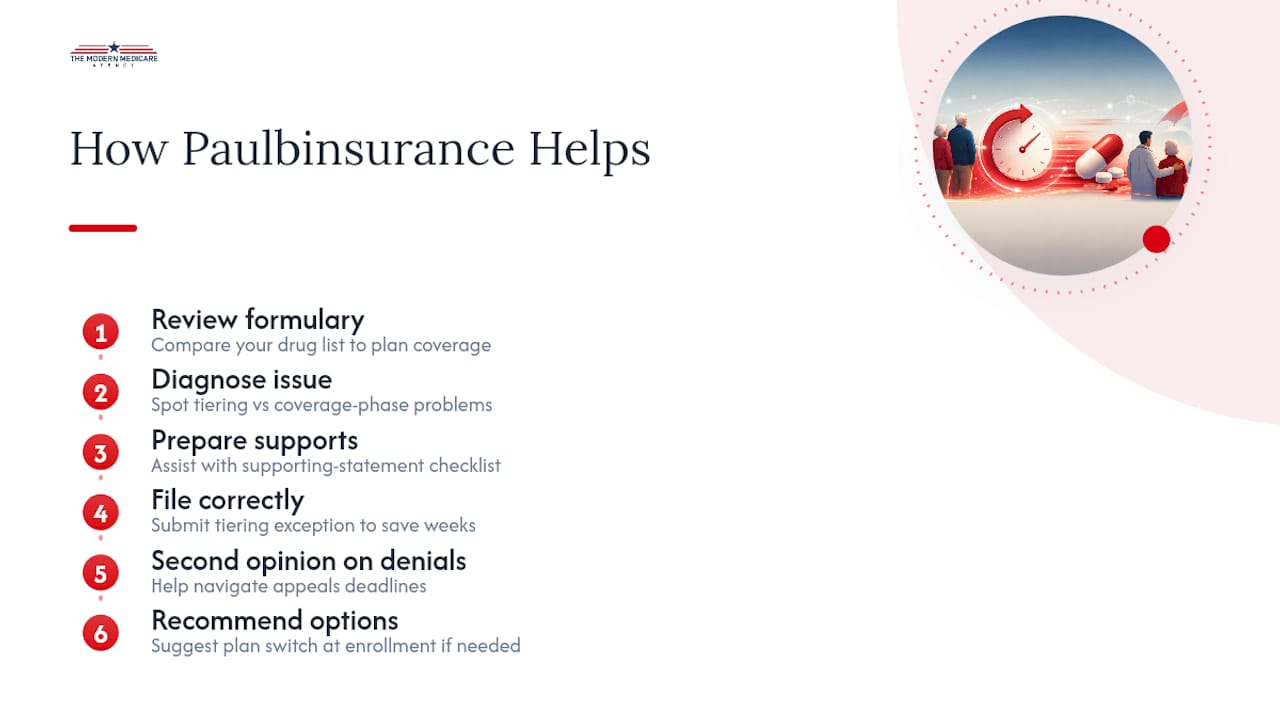
Filing a tiering exception correctly the first time saves weeks compared to a denial and a redetermination cycle. An independent broker can provide guidance focused on what actually lowers your cost, rather than retaining you on a particular carrier’s book.

An independent agent can review your current formulary, identify whether your situation resembles a tiering or coverage-phase issue before you file, and assist with the supporting-statement checklist alongside you or your prescriber. If you’re staring at a denial letter and the appeals deadlines feel like a maze, that’s exactly when a second opinion pays for itself. And if your tiering trouble is really a sign your whole Part D plan is a poor fit for your drug list, it may be worth comparing options during your next enrollment window rather than fighting the same battle every year.
Reach out through the Medicare Part D plan help page for a free plan review, and Paul Barrett’s team will help you figure out whether a tiering exception, a plan switch, or both make sense for your situation.
This article is general information, not a substitute for advice from a qualified doctor. Consult a qualified healthcare professional about your own circumstances before acting on anything here.
Sources
- Medicare
- Exceptions – CMS
- Requesting a tiering exception – Medicare Interactive
- 42 CFR § 423.578 – Exceptions process – LII / Cornell
FAQ
How Can I Request a Tiering Exception for Medicare Part D?
Ask your prescriber to submit a supporting statement along with the CMS model coverage determination request form to your plan. The decision clock starts once the plan receives that prescriber statement, and standard requests get a decision within 72 hours.
What Are the Changes to Medicare Part D Tiers in 2026?
Formularies and tier placements get rebuilt annually, so a drug’s tier can shift year to year even without a rule change. Check your plan’s current formulary each fall during annual enrollment, since a previously approved tiering exception only lasts through the current plan year.
How Do I Get a Tier Exception Approved for a Medication?
Approval depends almost entirely on the strength of your prescriber’s supporting statement, specifically documented proof that preferred alternatives were tried and were either ineffective or caused adverse effects. Once approved, the plan must apply the lowest applicable preferred tier’s cost-sharing to your drug.
What Medications Are Excluded From Medicare Part D Tier Exceptions?
Drugs on a plan’s specialty tier are generally excluded from the tiering-exception process entirely. If your drug falls there, a formulary exception or a plan-switch review is usually the more realistic path forward.