




What if the biggest threat to your 2026 retirement budget isn’t inflation or the stock market, but a single cracked tooth? It’s a stressful realization many face when they discover that traditional Medicare still leaves a significant gap in oral healthcare. You’ve worked hard for your peace of mind, yet searching for dental insurance plans for seniors on medicare often leads to more questions than answers. It’s completely normal to feel overwhelmed by high out-of-pocket costs for crowns or the confusing waiting periods that delay the care you need today.
I understand how important it is to feel secure in your coverage. That’s why I’ve created this clear, expert comparison to help you fill those gaps in 2026. You’ll learn exactly how to distinguish between insurance and discount plans while avoiding the hidden traps that catch many people off guard. We’ll look at how to lower the cost of major procedures and ensure your specific dentist is in the network. By the end of this guide, you’ll have a simple, step-by-step path to finding the protection you deserve without the typical industry headache.
Key Takeaways
- Understand why Original Medicare leaves a gap in your care and how to protect your 2026 budget from expensive dental surprises.
- Compare the benefits of traditional insurance against discount plans to decide which path offers the most peace of mind for your specific situation.
- Find out how to skip long waiting periods and identify the dental insurance plans for seniors on medicare that cover your current dentist.
- Follow a calm, step-by-step process to align your new dental coverage with your existing Medicare Advantage or Medigap plan.
- See how partnering with an independent guide gives you access to dozens of carriers, ensuring your needs always come before the insurance company’s bottom line.
Understanding Why Original Medicare Leaves Your Dental Health Behind
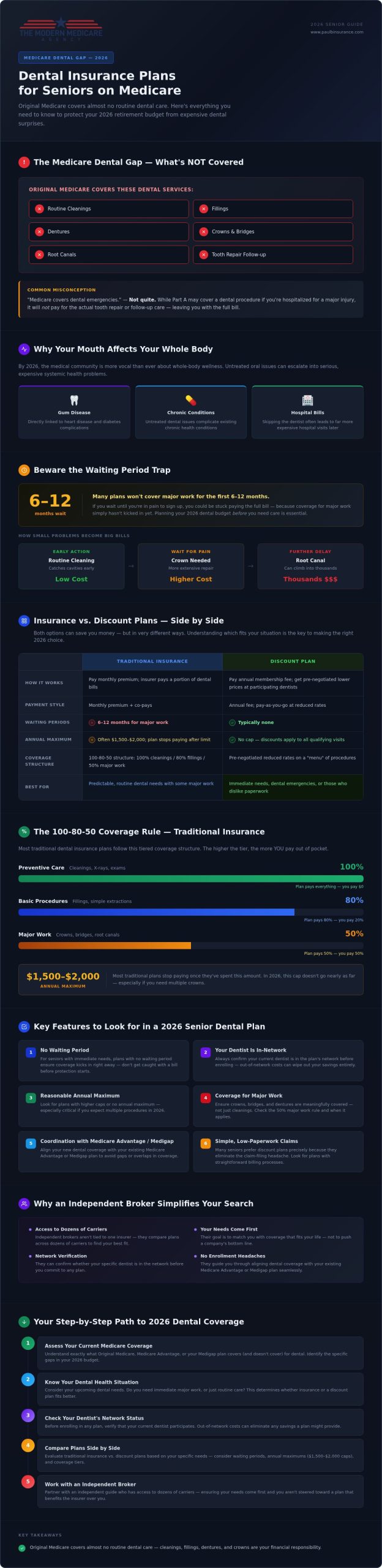
It’s a frustrating discovery for many seniors in 2026. You’ve planned your retirement carefully, yet you find that the system you relied on has a significant hole. Most people assume that once they enroll, their basic health needs are fully met. Unfortunately, Original Medicare coverage limitations mean that routine dental work like cleanings, fillings, and dentures aren’t covered at all. This gap forces many to search for specific dental insurance plans for seniors on medicare to avoid paying entirely out of pocket.
There’s a common misconception that Medicare will step in during a “dental emergency.” While Part A might cover a dental procedure if you’re hospitalized for a major injury, it won’t pay for the actual tooth repair or the follow-up care. If you have a severe infection or a broken tooth that needs a crown, you’re usually on your own. This lack of coverage often leads to higher medical bills later on, as untreated oral issues can complicate other chronic conditions.
The Hidden Connection Between Oral and Systemic Health
By 2026, the medical community has become even more vocal about “whole-body” wellness. We now know that your mouth isn’t an island. For seniors, untreated gum disease is directly linked to more serious issues like heart disease and diabetes. When you skip the dentist because of the cost, you aren’t just risking a tooth; you’re risking your overall health. Investing in a dental insurance plan helps you stay ahead of these problems, ultimately saving you from expensive hospital visits and long-term complications.
Why Waiting Until You Have a Toothache Is a Financial Mistake
Waiting for pain to strike is a risky strategy that often backfires. In the dental world, small problems grow into expensive nightmares very quickly. A simple cleaning can catch a cavity early. If you wait until it hurts, you might be looking at a crown or an even more expensive root canal. These costs can easily climb into the thousands, which is a heavy blow to a fixed income.
You should also be aware of the “Waiting Period Trap.” Many plans won’t cover major work for the first six to twelve months after you sign up. If you wait until you’re in pain to look for dental insurance plans for seniors on medicare, you might find yourself stuck with the full bill because the plan’s coverage for major work hasn’t kicked in yet. Planning your 2026 dental budget now is the best way to ensure you have protection when you actually need it.
Dental Insurance vs. Dental Discount Plans: Which Is Best for Seniors?
Choosing between traditional insurance and a discount plan can feel like trying to solve a puzzle with missing pieces. Both options aim to save you money, but they work in very different ways. When you’re looking at dental insurance plans for seniors on medicare, the first step is understanding which model fits your lifestyle and your budget for 2026. It’s helpful to remember what Medicare covers for dental services, which is unfortunately very little, leaving you to decide how to fund your own care.
Traditional insurance is what most of us are used to. You pay a monthly premium, and in exchange, the company pays a portion of your dental bills. Discount plans, however, are more like a warehouse club membership. You pay an annual fee to join, and in return, you get access to a pre-negotiated “menu” of lower prices at participating dentists. In 2026, many seniors are gravitating toward these discount options because they offer a pay-as-you-go approach without the paperwork of claims.
Traditional Dental Insurance: Pros and Cons
The biggest benefit of a standard dental insurance plan is predictability. Most follow a “100-80-50” structure. This means the plan usually covers 100% of cleanings, 80% of basic fillings, and 50% of major work like bridges. It feels secure because you know your routine visits are “free.” However, many seniors find the annual maximums frustrating. Most plans stop paying once they’ve spent a certain amount, often around $1,500 to $2,000. In 2026, that amount doesn’t go nearly as far as it used to, especially if you need multiple crowns.
Dental Discount Plans: The Faster Alternative?
If you have a dental emergency right now, a discount plan might be your best friend. These plans typically have no waiting periods. You can sign up today and get a discounted price on a crown tomorrow. There are also no annual maximums, so if you need $10,000 worth of dental restorations, you get the discount on every single dollar. The catch is the network. You must use a dentist who has agreed to the plan’s rates. If your favorite dentist isn’t on that specific list, the plan won’t help you at all. If you’re feeling stuck between these two paths, speaking with an independent broker can help you see which network includes your local providers.
Key Features to Look for in a 2026 Senior Dental Plan
Choosing the right coverage is about more than just finding a low price. It’s about ensuring your 2026 budget isn’t wiped out by a single procedure. When you compare dental insurance plans for seniors on medicare, you should prioritize an annual maximum of at least $2,000. In 2026, costs for major work have continued to rise, and a lower limit might leave you paying for half of your treatment yourself. You also want to look specifically for implant coverage, as this is one of the most requested benefits that many basic plans still exclude.
Understanding these details is vital because your oral health directly affects your quality of life. Looking at oral health statistics for older adults shows that dental needs only increase as we age. This is why a plan that covers major restorations on day one is so valuable. Finding a policy that eliminates the typical six to twelve month waiting period can save you from months of discomfort and rising costs.
Evaluating the Provider Network
Network size is often the difference between a plan you love and one you never use. In 2026, you’ll mostly choose between PPO and HMO structures. A PPO plan usually gives you more freedom to see any dentist, though you’ll save more by staying in-network. An HMO is often cheaper but restricts you to a specific list of providers. Before you sign anything, call your dentist’s office to confirm they are still participating in that specific network for the 2026 calendar year. Going out-of-network without a PPO plan can mean the insurance company pays nothing at all.
Decoding the Fine Print on Major Services
Even the dental insurance plans for seniors on medicare that look great on paper can have hidden traps. One of the most common is the “Missing Tooth Clause.” This rule states that if you lost a tooth before the policy started, the plan won’t pay to replace it with a bridge or implant. You should also watch out for waiting periods that only apply to major services. Some plans cover cleanings immediately but make you wait a full year for a crown. Always ask about “Prior Authorization” requirements too. This simply means your dentist must get the insurance company’s approval before starting expensive work to ensure the claim will be paid. Working with an independent guide can help you find a dental insurance plan that skips these hurdles and protects your savings.
How to Choose the Right Plan for Your Specific Dental Needs
Finding the right fit for 2026 starts with a simple look in the mirror. Before you look at brochures, take a moment to audit your current dental health. Are you only needing routine cleanings, or do you have a bridge that feels a bit loose? Knowing your expected needs helps you avoid paying for more coverage than you use. It also prevents you from being underinsured when a major procedure arises. Once you have a clear picture of your health, you can begin to look at how different dental insurance plans for seniors on medicare interact with your primary health coverage.
The next step involves looking at your current health plan setup. You want to ensure your dental coverage doesn’t conflict with your primary medical insurance. For many, this means checking if a plan allows you to keep the dentist you’ve trusted for years. If you’re planning for significant work like new dentures or multiple crowns in 2026, matching the plan’s strengths to your specific needs is the best way to find peace of mind.
Matching Plans to Your Medicare Setup
Your choice often depends on which version of Medicare you’ve chosen. If you have a Medicare Supplement (Medigap) plan, you’ll likely need a standalone dental policy. These plans often provide the most flexibility because they aren’t tied to a specific health network. On the other hand, a Medicare Advantage plan might already include some dental benefits. However, these built-in benefits are often limited. You might find that adding a separate dental insurance plan provides the extra security you need for expensive 2026 procedures without disrupting your main health coverage.
The ‘Total Cost’ Calculation
Calculating the total cost of a plan is about more than just the monthly premium. You have to consider the deductible, which is the amount you pay before the insurance kicks in. In 2026, some plans offer a $0 deductible for preventative care but require $100 or more for major work. You should also check for “bundle” opportunities. Many carriers now allow you to combine dental, vision, and hearing into one package. This can often reduce your total monthly cost while simplifying your paperwork and reducing your overall out-of-pocket spending.
A critical term to understand is the “Maximum Out-of-Pocket” limit. The maximum out-of-pocket limit is the highest amount you will pay for covered dental services in a year before your insurance company pays for everything else. Knowing this number gives you a “worst-case scenario” for your 2026 budget. If you’re feeling unsure about which math works best for your retirement income, contact us for a clear, side-by-side comparison of your best options.
Why Partnering with an Independent Broker Simplifies Your Search
Searching for the right coverage shouldn’t feel like a second job. By now, you’ve seen how complex the options for 2026 can be. Between waiting periods and network restrictions, it’s easy to feel stuck. This is where an independent broker makes all the difference. Unlike an agent who works for a single insurance company, we have the power of choice. We compare over 40 different carriers to find the one that actually fits your life. Our loyalty is to you, not a corporate bottom line.
When you look for dental insurance plans for seniors on medicare, you deserve a guide who sees the whole picture. We don’t just hand you a brochure and walk away. We look at your current health needs and your existing Medicare setup to ensure everything works together. If a claim gets denied or a dentist leaves a network mid-year, we’re your advocates. We handle the phone calls and the paperwork so you don’t have to. The best part is that our help comes at no cost to you.
The Modern Medicare Agency Difference
Paul Barrett founded this agency with a simple mission: to protect and empower seniors. He understands that the 2026 regulatory environment can be confusing. Our team is trained to explain these changes in plain English. We remove the stress of plan overload by filtering out the noise. You won’t face high-pressure tactics here. Instead, you’ll find a patient partner who listens first and advises second. We focus on clarity because we know that clarity leads to peace of mind.
Your Path to Peace of Mind
Working with us is a straightforward, methodical process. First, we’ll listen to your concerns and audit your 2026 needs. Next, we’ll present a clear, side-by-side comparison of the top-rated dental insurance plans for seniors on medicare in your area. Once you’ve chosen a path, we’ll handle the enrollment for you. Our support continues long after you sign up. We’re here for every question and every dental emergency that might come your way. Let us help you find the perfect dental plan today.
Taking the Next Step Toward Dental Certainty
Your journey from confusion to clarity starts with understanding that you don’t have to face the 2026 Medicare gap alone. We’ve explored how the right choice depends on your specific needs; you might prioritize the predictable coverage of traditional insurance or the immediate savings of a discount plan. Remember to watch for those hidden waiting periods and ensure the plan includes your trusted dentist. Finding the right dental insurance plans for seniors on medicare is ultimately about protecting your health and your hard-earned retirement savings from unexpected costs.
You deserve a partner who puts your needs first. As an independent brokerage, we offer access to over 40 carriers and provide expert guidance led by Paul Barrett to ensure you find the perfect fit. Our consultations are always at no cost to you, focusing entirely on your peace of mind. Get a personalized, unbiased dental plan comparison for 2026 today. We’re here to help you move forward with confidence, knowing your smile is protected for years to come.
Frequently Asked Questions
Does Medicare Part B cover any dental procedures in 2026?
Medicare Part B does not cover routine dental procedures like cleanings, fillings, or dentures in 2026. It only covers dental services that are an integral part of a covered medical procedure, such as a jaw reconstruction after an accident. For everything else, you are responsible for the full cost. This is why many people look into dental insurance plans for seniors on medicare to protect their savings from high out-of-pocket expenses.
What is the best dental insurance for seniors with no waiting period?
The best option depends on your specific 2026 needs, but many “Day One” plans are specifically designed to cover major work immediately. Some PPO plans offer this feature in exchange for a slightly higher premium. Alternatively, dental discount plans never have waiting periods, allowing you to save on a crown or bridge the same day you join. We can help you compare these side-by-side to see which one fits your budget best.
Can I have a standalone dental plan if I already have Medicare Advantage?
Yes, you can absolutely add a standalone dental policy even if your Medicare Advantage plan already includes some dental benefits. Many Advantage plans in 2026 have low annual maximums or limited coverage for major procedures like implants. Adding a separate dental insurance plan can provide a much higher level of protection. This ensures you aren’t stuck with a massive bill if you need extensive restorative work that your primary plan doesn’t fully cover.
Do dental discount plans work at any dentist?
No, dental discount plans only work with dentists who have joined that specific plan’s network. These providers agree to accept a lower, pre-negotiated rate for their services. If you visit a dentist who isn’t a member of the plan, you won’t receive any savings. Before signing up, it is vital to check the provider directory or ask your current dentist if they participate in the specific discount network you are considering for 2026.
Are dental implants covered by senior dental insurance plans?
Many modern dental insurance plans for seniors on medicare now offer coverage for implants, but it isn’t universal. In 2026, you’ll find that top-tier plans often cover about 50% of the cost after a waiting period. Some plans still list implants as an exclusion, so you must read the fine print carefully. We specialize in finding plans that specifically include these high-cost procedures to ensure your smile remains healthy without breaking your bank account.
How much does a typical senior dental plan cost per month in 2026?
Monthly costs vary based on the level of coverage you choose and where you live. Generally, a basic plan covering preventative care might be more affordable, while comprehensive plans that cover major work like crowns and dentures will have higher premiums. It’s important to look at the total value rather than just the monthly price. We can provide a clear comparison of 2026 rates from over 40 carriers to help you find the most cost-effective option.
Is there a limit on how much dental insurance will pay per year?
Yes, most traditional insurance plans have an annual maximum, which is the total amount the company will pay for your care in a single year. In 2026, many seniors look for plans with a limit of at least $2,000 to keep up with rising costs. Once you hit this limit, you are responsible for any additional expenses. Dental discount plans are a popular alternative because they typically have no annual maximums at all.
What is the difference between a dental PPO and a dental HMO for seniors?
The main difference lies in your freedom to choose a dentist. A PPO plan allows you to see any provider, though you’ll save more money if you stay in-network. This is often the preferred choice for seniors who already have a favorite dentist. An HMO plan usually has lower premiums but requires you to use a specific primary dentist within their restricted network. If you go outside that network with an HMO, the plan typically pays nothing.

Article by
Paul Barrett
Paul Barrett, CMIP is the founder of The Modern Medicare Agency, an independent Medicare-only brokerage based in Melville, NY. With 18 years of Medicare-exclusive experience, a CMIP designation, and more than 5,000 clients served across 37 states, Paul is one of the most credentialed independent Medicare specialists on Long Island — and one of the most direct.
He represents 40+ carriers with no quotas and no allegiances, which means his recommendations are based entirely on what fits each client's specific situation. He is the author of Medicare Mastery Unlocked and host of the Wise Guys Retirement Talk podcast. His content is grounded in primary sources, real carrier intelligence, and 18 years of watching what happens when people get Medicare right — and when they don't.
📞 631-358-5793 | paulbinsurance.com