




A Medicare MSA pairs a Medicare-funded savings account with a high-deductible Medicare Advantage plan. You control the deposited money starting early in your coverage year, but you’re on the hook for any remaining deductible if you need care before that deductible is met. The upside is flexibility and provider choice; the downside is a real gap between what Medicare deposits and what you might owe out of pocket. MSAs also skip Part D entirely, and not everyone qualifies to enroll.
TL;DR:
- Medicare deposits vary by year and plan, but the typical deductible can be roughly double the deposit amount, creating a significant cash gap to consider.
- Enrolling late results in a prorated deposit, meaning your initial savings may be insufficient if you face high costs early in the year.
- Having other insurance such as Medicaid, VA benefits, or retiree coverage generally disqualifies you from enrolling in an MSA plan.
- MSA plans do not include prescription drug coverage, requiring a separate Part D plan that won’t count toward the MSA deductible.
- The main risk is a large, unfunded care gap early in the year, especially if your provider or billing process isn’t familiar with MSA plans.
Table of Contents
- What Is a Medicare MSA Plan?
- How the Deposit and Deductible Actually Interact
- What This Looks Like With Real Numbers
- Who Qualifies for a Medicare MSA Plan
- How to Compare and Enroll in an MSA Plan
- MSA Plans and Your Other Coverage
- Account Rules, Taxes, and Smart Questions to Ask
- Managing Your MSA Funds Once You’re Enrolled
- Where Medicare MSA Plans Fall Short
- Coordinating Care and Billing Under an MSA
- What’s Changed With MSA Plans Recently
- An Agent’s Take on When an MSA Actually Makes Sense
- Get a Free Comparison Before You Choose a Plan
- Sources
- FAQ
What Is a Medicare MSA Plan?
A Medicare Medical Savings Account plan has two working parts. First, there’s a high-deductible Medicare Advantage plan that covers your Part A and Part B services once you hit the deductible. Second, there’s a medical savings account, funded by Medicare itself, that you draw on to pay for care before that deductible kicks in.
Medicare deposits money into the account either at the start of the calendar year or, if you enroll mid-year, a prorated amount tied to your first month of coverage, according to CMS guidance on MSA plans. You don’t pay a monthly premium for the plan itself in most cases, though that varies by plan and location.
What counts toward your deductible matters just as much as how much Medicare deposits. Generally:
- Medicare Part A costs (hospital stays, skilled nursing) count toward the deductible
- Medicare Part B costs (doctor visits, outpatient services) count toward the deductible
- Part D prescription copays typically do not count
- Dental, vision, and hearing costs usually don’t count unless the specific plan says otherwise
That last point trips people up. You can spend down your MSA balance on plenty of health costs, but not everything you’d expect chips away at the deductible itself.
How the Deposit and Deductible Actually Interact
The number that matters isn’t the deposit amount by itself. It’s what’s left over after you subtract that deposit from your annual deductible. Medicare calls this the gap you’re responsible for funding, and it’s the single most important calculation anyone considering an MSA should run before enrolling, based on how Medicare’s own examples illustrate the math.
Here’s the general sequence of how a plan year plays out:
- Medicare deposits funds into your account (full amount in January, or a prorated amount if you join later in the year).
- You use that money to pay for covered Part A and Part B services as they come up.
- Once your spending plus the deposit reaches the plan’s deductible, you’re covering the shortfall yourself.
- After the full deductible is satisfied, the plan starts paying for covered services.
- Your out-of-pocket maximum caps your total exposure for the remainder of the year.
MSA plans generally don’t use a provider network. You can see any doctor who accepts Medicare, which is a real advantage for people who travel or split time between states.
Pro Tip: Before you enroll, subtract the deposit from the deductible and ask yourself honestly whether you could cover that difference in cash within a few weeks if you were hospitalized. If the answer is no, an MSA probably isn’t the right fit this year.
What This Looks Like With Real Numbers
Medicare’s published examples make the gap easier to picture. If a plan deposits a certain amount and has a deductible roughly double that amount, you’re responsible for the difference in Part A and Part B costs before the plan starts paying anything, as illustrated in Medicare’s MSA examples.
A typical claim progression might look like this:
- You visit a doctor early in the year; the MSA covers the bill, and your balance drops.
- A few months later, you have a minor procedure; you pay from the account until it’s empty, then out of pocket.
- Once your combined spending equals the $3,000 deductible, the plan begins paying its share of covered services.
- Any spending beyond that point is subject to the plan’s cost-sharing rules until you hit the out-of-pocket maximum.
These figures are illustrative only. Actual deposit and deductible amounts vary by plan, carrier, and ZIP code, and they can change from one plan year to the next.
Who Qualifies for a Medicare MSA Plan
You need Medicare Part A and Part B and must live in the plan’s service area to enroll. Beyond that baseline, several types of coverage disqualify you automatically.
You generally cannot enroll in an MSA plan if you have any of the following:
- Employer or union retiree health coverage that pays before you meet the deductible
- TRICARE or VA benefits that cover the same services
- Federal Employees Health Benefits Program (FEHBP) coverage
- Medicaid, in most circumstances
- Hospice care already elected under Original Medicare
CMS explains that having other insurance that would pay medical expenses during your MSA deductible period typically makes you ineligible, since it defeats the purpose of a high-deductible design, according to Medicare’s plan eligibility rules. If you already hold a Medigap policy, keep in mind it generally won’t help you while you’re in an MSA. Medigap can’t be sold to someone already enrolled in an MSA plan, and an existing policy typically doesn’t reduce your MSA deductible exposure. If you have retiree coverage through a former employer, check the fine print carefully; some retiree plans count as disqualifying coverage even if the premium is low.
How to Compare and Enroll in an MSA Plan
Start by checking plan availability through Medicare.gov’s plan finder tool, then request the plan’s Evidence of Coverage (EoC) document, which spells out the exact deposit, deductible, and cost-sharing details for that specific plan year.
Enrollment timing follows the same general windows as other Medicare Advantage options:
- Initial enrollment: tied to your first eligibility for Medicare, generally a seven-month window around your 65th birthday.
- Annual Election Period: October 15 through December 7, for switching plans effective the following January.
- Special circumstances: some qualifying life events open shorter windows outside these dates.
If you enroll outside of January, your deposit gets prorated for the months remaining in the enrollment period, so a mid-year sign-up won’t get the full annual deposit amount. Before you sign anything, confirm the deposit amount, the deductible, who administers the account, how the payment card works, and read the EoC in full rather than relying on a summary flyer.
MSA Plans and Your Other Coverage
Medicare MSA plans do not include prescription drug coverage. If you want drug benefits, you’ll need to enroll separately in a standalone Part D plan, and any Part D copays you pay won’t count toward your MSA deductible, according to CMS’s MSA guide. That’s a separate premium and a separate deductible track to budget for.
Medigap and MSAs generally don’t mix well. Insurers can’t sell you a new Medigap policy once you’re enrolled in an MSA, and keeping an old one adds a monthly premium while doing little to close your MSA deductible gap, since Medigap covers Original Medicare cost-sharing, not MSA plan cost-sharing.
The broader rule to remember: any other insurance that would pay your medical costs during the deductible period usually disqualifies you from the MSA in the first place. That includes most employer retiree plans, TRICARE, VA benefits, and FEHBP coverage. Medicaid recipients face similar restrictions in most states, so check your specific situation with a licensed agent before assuming you qualify.
Account Rules, Taxes, and Smart Questions to Ask
Every MSA plan has a bank or account administrator that manages the funds, and mechanics differ from plan to plan. Some issue a debit card, others require you to pay out of pocket and submit for reimbursement.
Key things to nail down:
- Who holds and administers the account (the bank name matters if you want to check balances online)
- Whether the plan issues a payment card and how providers are expected to bill it
- When exactly the deposit becomes available for spending
- What happens if a provider doesn’t accept the plan’s payment method
On the tax side, distributions from a Medicare Advantage MSA require you to file IRS Form 8853 with your annual return, even in years when no taxable income results from the account. Keep every receipt for qualified medical expenses; the IRS instructions make clear that documentation matters if your return is ever questioned.
Pro Tip: Ask the plan or your agent these five questions before enrolling: What’s the exact deposit amount? What’s the deductible? What’s the out-of-pocket maximum? When does the deposit post? And who’s the bank or vendor administering the account?
Managing Your MSA Funds Once You’re Enrolled
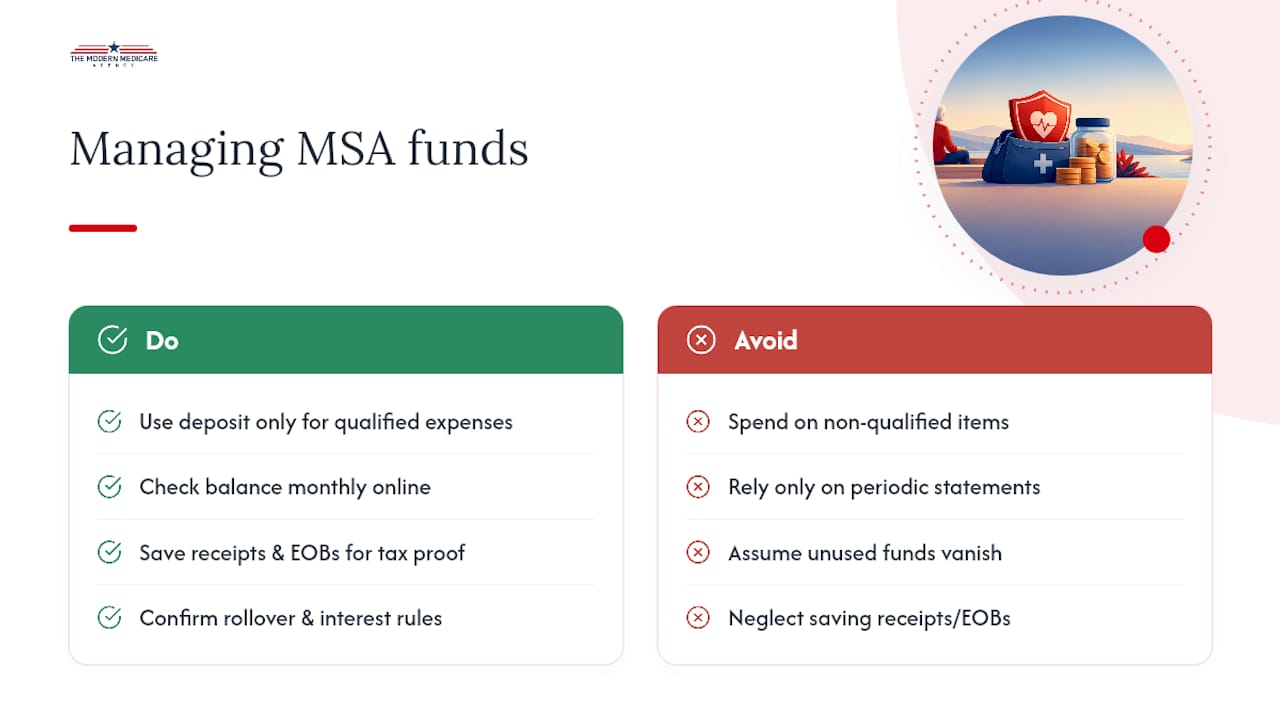
Treat the deposit as a dedicated health fund, not spending money for anything else. Since the account only reimburses qualified medical expenses under the plan’s rules, spending it on non-qualified items can trigger tax consequences and won’t help you toward your deductible.
Track your balance monthly rather than waiting for a statement to surprise you. Most administrators offer online access, and knowing your remaining balance helps you decide whether to delay an elective procedure until after your deductible is met or handle it now while funds are available.
Save every receipt, invoice, and explanation of benefits connected to money you pull from the account. This isn’t optional bookkeeping. It’s what backs up your Form 8853 filing and protects you if the IRS asks questions about a distribution.
Consider timing elective care strategically. If you’re close to meeting your deductible late in the year, pushing a non-urgent procedure a few weeks might mean the plan pays a larger share instead of your account absorbing the full cost.
Don’t assume unused funds vanish. Balances generally roll over, which is part of why MSAs appeal to people who stay healthy most years and want to build a cushion for a future year with higher costs. That said, rollover rules and any interest earned depend on your specific account administrator, so confirm the details rather than assuming.
Where Medicare MSA Plans Fall Short
The biggest risk is the unfunded gap itself. If you face a costly health event early in the year, before your deposit and spending have caught up to the deductible, you could owe thousands of dollars out of pocket in a short window. That’s a real cash-flow risk for anyone without accessible savings.

Provider networks are typically nonexistent with MSA plans, which sounds like a benefit until you consider that some providers may hesitate to bill an MSA plan the way they would a standard Medicare Advantage or Medigap policy. Ask about this directly rather than assuming every doctor’s office handles it smoothly.
Part D exclusion is another limitation people underestimate. Pairing an MSA with a standalone drug plan means juggling two separate deductibles and two separate cost-sharing structures, which complicates budgeting for anyone on multiple prescriptions.
Plan availability is limited compared to standard Medicare Advantage plans. Not every county offers an MSA option, and the ones that exist may change deposit and deductible terms from year to year, so a plan that worked well for your budget one year might look different the next.
Finally, MSAs don’t suit people who expect frequent, predictable medical costs. If you’re managing a chronic condition with regular specialist visits, a standard Medicare Advantage plan or Medigap policy with predictable copays will likely serve you better than a plan built around a large deductible.
Coordinating Care and Billing Under an MSA
Because MSA plans skip network restrictions, you can see any provider who accepts Medicare. That flexibility comes with a small catch: you need to confirm each provider knows how to bill an MSA plan correctly, since it’s less common than standard Medicare Advantage billing.
Keep your MSA card or account information handy at every appointment, and ask the front desk whether they’ve billed an MSA plan before. If a provider seems unfamiliar with the process, you may need to pay out of pocket and submit the claim to your account administrator for reimbursement instead of having it billed directly.
Request an itemized statement after every visit, even for routine care. This gives you a clear record of what applied toward your deductible and helps you track your running balance against the annual figure in your Evidence of Coverage.
If you receive care while traveling, the same rules apply since MSA plans work nationwide with any Medicare-accepting provider. Just be prepared to handle billing manually more often when you’re away from your regular providers, since unfamiliar offices may need extra guidance on how the plan works.
What’s Changed With MSA Plans Recently
Medicare adjusts Part A and Part B premium and deductible figures every year, and those updates affect the broader cost picture even though they don’t directly change your specific MSA plan’s deposit or deductible amounts. The 2026 Medicare Parts A and B premium and deductible figures released by CMS give useful context for anyone budgeting alongside an MSA plan, since your MSA deductible interacts with the same underlying Medicare-covered services.
Plan availability and specific deposit and deductible amounts are set annually by each carrier offering MSA plans, and these figures can shift from one year to the next even in the same county. That’s why checking the current year’s Evidence of Coverage matters more than relying on last year’s numbers or a general article for exact figures. If you enrolled in an MSA a few years ago, it’s worth reviewing whether the same plan is still the best fit given any changes to the deposit amount, deductible, or your own health needs.
An Agent’s Take on When an MSA Actually Makes Sense
MSAs tend to suit a specific kind of beneficiary: someone with enough savings to comfortably absorb the unfunded gap, who doesn’t expect major medical costs in the near term, and who values the freedom to see any Medicare provider without network restrictions. Frequent travelers and snowbirds often fall into this group, since the lack of a network solves a real problem for them.
They tend to fit poorly for beneficiaries with limited cash reserves or a chronic condition requiring regular, predictable care. In those cases, a standard Medicare Advantage plan with fixed copays or a Medigap policy with more predictable cost-sharing usually makes more financial sense than absorbing a large deductible gap.
If you’re weighing an MSA against other options, we can run a side-by-side comparison of the deposit, the deductible, how a standalone Part D plan pairs with it, and your enrollment timing, so you’re deciding with real numbers instead of guesswork.
— Paul
Get a Free Comparison Before You Choose a Plan
Reading about deposits and deductibles only gets you so far. What actually matters is how those numbers play out against your own health history, your travel habits, and your savings cushion, and that’s where an independent second opinion earns its keep. We work with many carriers, so we don’t steer you toward a single company’s plan because it’s the only one available.

A free review with our team walks through the deposit-versus-deductible math for the MSA plans available in your area, checks how a standalone Part D plan would pair with it, and compares that against what a standard Medicare Advantage plan or Medigap policy would cost you for the same coverage. We’ll also walk through enrollment timing so you don’t miss a window or end up with a prorated deposit you weren’t expecting.
If you’d rather start with drug coverage first, our Part D guide breaks down how standalone plans work. Either way, reach out to schedule a no-cost consultation and get plan numbers specific to your ZIP code instead of national averages.
This article is general information, not a substitute for advice from a qualified financial advisor. Consult a qualified financial professional about your own circumstances before acting on anything here.
Sources
- Your Guide to Medicare Medical Savings Account (MSA) Plans | CMS
- Instructions for Form 8853 (2025) — Department of the Treasury, IRS
FAQ
What Are Medicare MSA Plans?
A Medicare MSA plan combines a high-deductible Medicare Advantage plan with a savings account that Medicare funds on your behalf. You use the account to pay Part A and Part B costs before the deductible is met, and the plan takes over cost-sharing once you’ve met it, according to Medicare’s official MSA overview.
Do Medicare MSA Plans Include Part D?
No. MSA plans do not include prescription drug coverage, and Part D copays don’t count toward the MSA deductible. You’ll need a separate standalone Part D plan if you want drug benefits alongside your MSA.
What Is an MSA in Medicare Terms?
MSA stands for Medical Savings Account, a type of Medicare Advantage plan that pairs a high deductible with a Medicare-funded account you draw on for covered care. It’s built for people comfortable managing a cash-flow gap in exchange for provider flexibility and no network restrictions.
Can You Have an MSA and Medicaid Together?
Generally, no. Having Medicaid alongside an MSA typically disqualifies you from enrollment, since Medicaid would pay costs during the deductible period that the MSA design assumes you’re covering yourself, per CMS eligibility guidance. If you have Medicaid or expect to qualify soon, a Medicare Advantage plan without a high deductible is usually a better fit.
How Do I Know if an MSA Plan Is Available Where I Live?
Check Medicare.gov’s plan finder tool using your ZIP code, since MSA availability varies significantly by county and carrier. If a plan is listed, request its Evidence of Coverage document to see the exact deposit and deductible figures before comparing it against other Medicare Advantage options.