
A surrender charge is a contractual penalty for pulling money out of an annuity too soon, and it usually starts around 7% to 10% of the withdrawal in year one before shrinking each year after. If you’re weighing whether to cash one out, your first move isn’t math, it’s paperwork: pull your contract, find the surrender schedule and free-withdrawal clause, and confirm exactly where you stand before you touch a dime.
TL;DR:
- Surrender charges typically start at 7% to 10% of the contract value in the first year and decrease annually until they reach zero after about eight years.
- Most contracts include a free-withdrawal allowance of around 10%, which can be used annually to avoid surrender charges on partial withdrawals.
- If interest rates rise, market value adjustments may reduce your surrender amount, while falling rates can increase it, depending on the contract terms.
- Surrendering an annuity before age 59½ incurs an additional 10% IRS penalty on taxable earnings, on top of the surrender charge.
- Confirm any hardship waivers, free-look periods, or partial 1035 exchanges with your insurer before surrendering to avoid unnecessary costs.
Table of Contents
- What Are Annuity Surrender Charges and Why Do They Exist?
- How Annuity Surrender Charges Are Calculated
- What Are the Tax Consequences of Surrendering an Annuity?
- Free Withdrawal Provisions: Your Penalty-Free Escape Hatch
- How Market Value Adjustments Affect Your Surrender Value
- Waivers and Exceptions That Can Eliminate the Charge
- How to Avoid or Reduce Annuity Surrender Charges
- Your Pre-Surrender Checklist
- An Independent Agent’s Take on Annuity Penalties
- Get a Second Opinion Before You Surrender
- Where to Verify These Rules Yourself
- Sources
- FAQ
What Are Annuity Surrender Charges and Why Do They Exist?
Every annuity contract has a surrender period, usually running three to 10 years, with six to eight years being the most common range. The insurer sets this schedule at issue, and it’s spelled out in the contract you signed, not something that shifts later. Some contracts also run rolling surrender periods, meaning each new premium payment starts its own clock, so a contract you’ve held for six years might still have newer money locked up for two more.
Insurers aren’t charging this fee out of spite. They front-load costs, including agent commissions and administrative setup, expecting to earn that money back over years of holding your premium. Surrender charges discourage you from treating a long-term annuity like a short-term savings account.
- The surrender period is fixed at issue and disclosed in your contract.
- Rolling periods mean multiple “clocks” can run simultaneously on the same contract.
- The fee exists to recoup upfront insurer costs, not to punish you arbitrarily.
Understanding the “why” matters because it tells you the charge is a fixed cost of early access, not a negotiable fee. That should shape whether you wait it out or pay to get free.
How Annuity Surrender Charges Are Calculated
Surrender schedules typically start around 7% to 10% in year one and decline by roughly 1 percentage point annually until they hit zero. A common example looks like this: 8% in year one, 7% in year two, 6% in year three, and so on down to 0% by year eight.
- Full surrender: The insurer applies the current year’s percentage to your entire contract value, minus any free-withdrawal amount already used.
- Partial withdrawal: Most insurers apply your free-withdrawal allowance first, then charge only the excess above that amount.
- Rolling schedules: If you’ve added premiums over multiple years, each deposit may carry its own surrender clock, so a withdrawal could trigger charges calculated at different rates depending on which “layer” of money you’re pulling from.
Say you have a $100,000 contract in year three of an 8/7/6/5/4/3/2/0 schedule. Pull only $20,000 and the math changes entirely once your free-withdrawal amount is factored in.
What Are the Tax Consequences of Surrendering an Annuity?
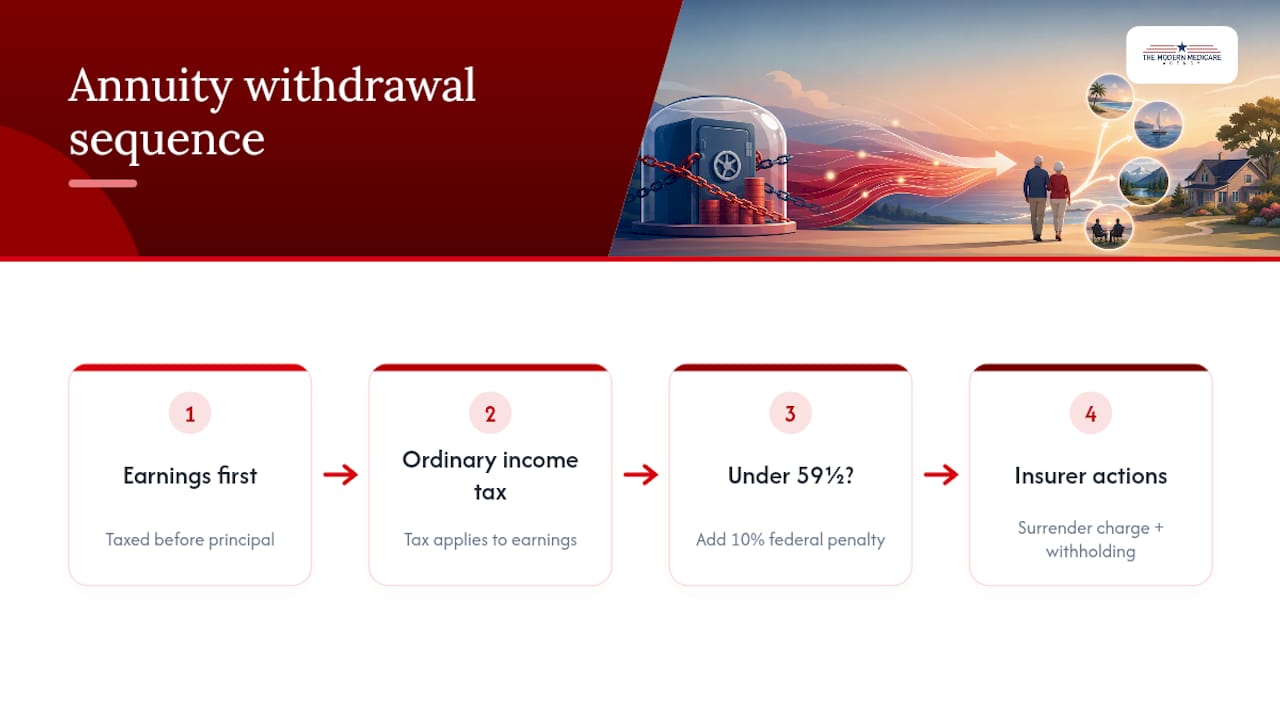
The IRS taxes annuity earnings before your principal, and pulling money out early can trigger an extra penalty on top of any surrender charge. For nonqualified annuities, the IRS treats withdrawals as earnings-first, meaning the taxable portion comes out before your original cost basis. That taxable amount is taxed as ordinary income, not capital gains.
If you’re under age 59½, add a 10% additional federal tax on the taxable portion of the distribution, per IRS Publication 575. This penalty stacks directly on top of whatever surrender charge your insurer applies. It doesn’t replace it. Insurers also typically withhold a portion for taxes automatically, so the check you receive is smaller than the sticker-shock number suggests. For a deeper breakdown of how this penalty applies to specific retirement scenarios, our annuity tax rules guide for retirees walks through common cases.
Free Withdrawal Provisions: Your Penalty-Free Escape Hatch
Most annuities let you withdraw a slice of your contract value each year without touching the surrender charge at all. This is the single most useful tool for anyone worried about needing emergency cash.
- Free-withdrawal allowances commonly run around 10% of contract value per year.
- Insurers generally apply the free amount first, then calculate the surrender charge only on whatever you withdraw above it.
- Some contracts base the 10% on your original premium, others on current contract value, so the actual dollar figure can shift year to year.
Here’s the math: on a $100,000 contract with a 10% free-withdrawal provision, you could pull $10,000 with no charge. Withdraw $15,000 instead, and only the extra $5,000 gets hit with the surrender percentage for that contract year. Confirm whether your insurer applies free withdrawals pro rata across premium deposits or to the oldest money first, since that detail changes how much of a mixed-premium withdrawal actually stays penalty-free.
How Market Value Adjustments Affect Your Surrender Value
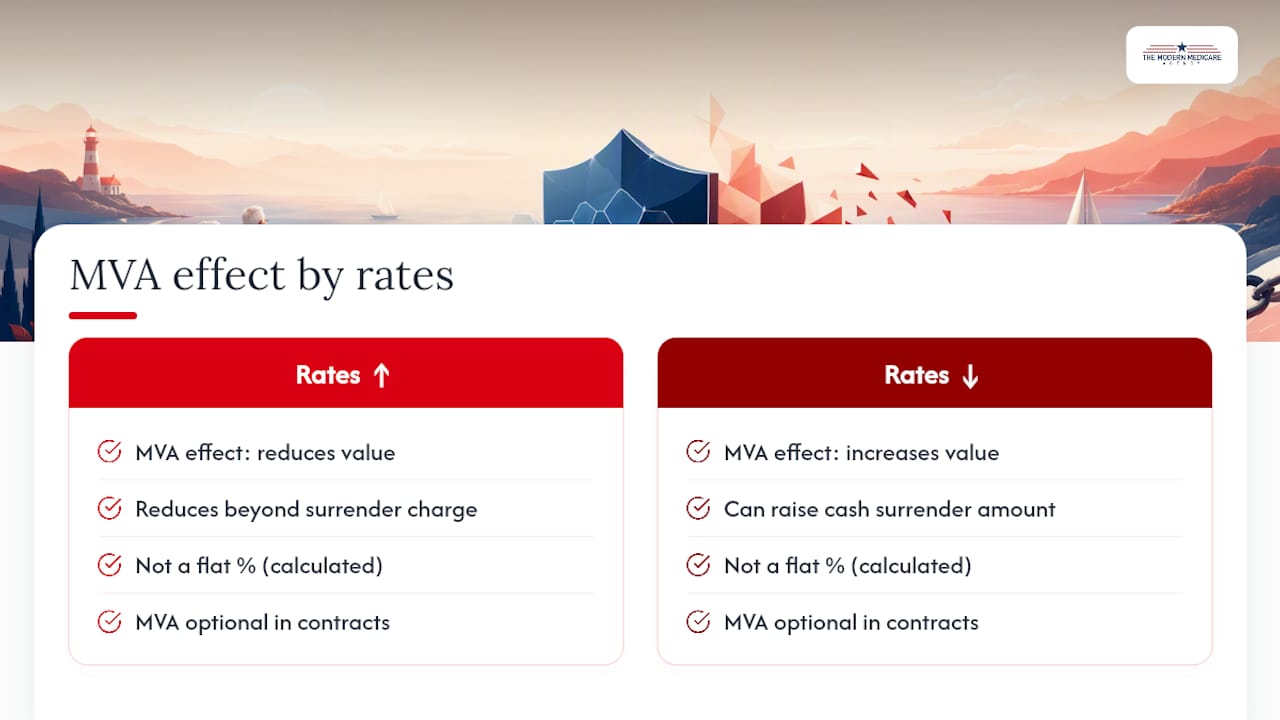
A market value adjustment, or MVA, is a separate mechanism some fixed and fixed-indexed annuities use to adjust your surrender value based on how interest rates have moved since you bought the contract. It’s not listed as a flat percentage like the surrender charge. It’s calculated against current rates.
If interest rates have risen since your purchase, an MVA typically reduces your cash surrender value beyond the stated surrender charge. If rates have fallen, the MVA can work in your favor and actually increase what you receive. Not every contract includes one, so check your specification page for the term “market value adjustment” or “MVA rider” and read exactly how the insurer calculates it.
Waivers and Exceptions That Can Eliminate the Charge
Most annuity contracts include waivers for specific hardship events, and confirming these before you assume you’re stuck paying full freight is worth the phone call. Common triggers include terminal illness diagnosis, admission to a nursing home, and death of the contract owner, though the exact definitions vary by insurer, so read the fine print rather than assuming your situation qualifies.
Newly purchased annuities also come with a free-look period, typically 10 to 30 days, during which you can cancel with no surrender charge at all. If you bought a contract recently and have doubts, check this window immediately, since it closes fast.
How to Avoid or Reduce Annuity Surrender Charges
You have more control here than most people realize, and a few tactics consistently save real money.
- Ladder your annuities. Instead of putting all your money into one contract, spread it across several with staggered surrender periods. This keeps a portion of your money accessible every year while the rest continues earning, and it’s a core strategy for balancing liquidity against guaranteed income. Our 3/5/7 annuity ladder guide breaks down how retirees structure this specifically to avoid Medicare-related income spikes.
- Keep separate liquid reserves. An emergency fund outside your annuity means you never have to tap contract funds during the surrender window in the first place.
- Consider a 1035 exchange carefully. This lets you move cash value tax-free between annuity contracts, but the insurer may still apply surrender charges on the outgoing contract, or start a fresh surrender clock on the new one. It solves a tax problem, not necessarily a fee problem.
- Get a second set of eyes before you act. An independent agent can often spot contract-specific waivers or lower-cost alternatives you’d otherwise miss.
Pro Tip: Before assuming you need to surrender at all, ask whether your contract allows a partial 1035 exchange. Moving only the portion you need can preserve free-withdrawal rights on the rest.
Your Pre-Surrender Checklist
Work through this before signing any surrender paperwork:
- Locate your contract and find the exact surrender schedule and free-withdrawal percentage.
- Estimate both the surrender charge and the tax hit, using IRS Pub. 575 as your reference for the 10% early-distribution rule.
- Call your insurer and ask directly whether an MVA applies and whether any hardship waivers fit your situation.
- If the contract is less than 30 days old, check your free-look rights immediately.
- Get a no-charge contract review from an independent agent before you finalize anything.
An Independent Agent’s Take on Annuity Penalties
Most consumers surrender annuities out of panic, not planning, often without realizing free withdrawals or waivers could have covered their need entirely. Paul Barrett has worked with Medicare-age consumers on exactly this kind of decision since 2007, and the pattern repeats: someone calls the insurer, hears a scary number, and surrenders before checking if a smaller, penalty-free withdrawal would have solved the actual problem. An education-first, independent review, one not tied to a single insurer’s product line, usually catches that mismatch before it costs you five figures.
— Paul
Get a Second Opinion Before You Surrender
We review your annuity contract line by line, free of charge, before you decide anything, no pressure and no push toward a product on that day. As an independent agency with access to multiple carriers, we focus on getting your specific contract right rather than persuading you to surrender or buy a new product.

If you’re staring down a surrender decision, or wondering whether an annuity even still fits your retirement plan, our annuities page walks through the products and review process in more detail. Reach out for a no-cost contract review before you pay a penalty you might not owe. We’ll tell you plainly whether surrendering makes sense or whether a free withdrawal, a waiver, or a 1035 exchange gets you where you need to go for less.
Where to Verify These Rules Yourself
Confirm tax rules directly through IRS Publication 575, review annuity disclosure standards via the SEC’s investor guidance, and check your state insurance department’s consumer annuity guidance for local specifics.
This article is general information, not a substitute for advice from a qualified financial advisor. Consult a qualified financial professional about your own circumstances before acting on anything here.
Sources
FAQ
What is the average surrender charge for an annuity?
Surrender charges commonly start between 7% and 10% in the first contract year and decline roughly 1 percentage point annually over a three to 10 year period, with six to eight years being typical. The exact schedule is set by your specific contract, so check your policy for the precise numbers.
How can I avoid annuity surrender charges?
Stay within your annual free-withdrawal allowance, commonly around 10% of contract value per year, or wait until your surrender period ends. Laddering multiple annuities with staggered surrender dates and confirming hardship waivers before withdrawing are also effective ways to reduce or eliminate the fee.
How is an annuity taxed when it’s surrendered?
Nonqualified annuity withdrawals are taxed as ordinary income on the earnings portion, which comes out before your original principal under IRS rules.
Can an annuity be surrendered at any time?
Yes, most annuity contracts allow a full or partial surrender at any point, though doing so during the surrender period triggers the contractual charge. Newly purchased contracts also have a free-look period, typically 10 to 30 days, that lets you cancel penalty-free if you act quickly.