




What if your health plan actually deposited funds into a dedicated bank account for your care, rather than locking you into fixed copays and narrow doctor networks? If you find yourself wondering what is a medicare medical savings account (MSA), you aren’t alone. Many folks confuse these plans with standard employer HSAs, which creates unnecessary stress when comparing your coverage options for 2026.
It is completely normal to worry about facing a high deductible or fear being caught with out-of-pocket bills before your full coverage kicks in. You might also feel uncertain about how to manage routine prescriptions when an MSA does not bundle drug benefits. You deserve total clarity, straightforward protection, and genuine peace of mind.
This guide will show you exactly how the plan deposit coordinates with your deductible, how unused dollars roll over year to year, and how to arrange standalone drug coverage safely. We will break down every essential rule so you can decide whether an MSA or a traditional Medicare plan best supports your health and budget.
Key Takeaways
- Understand what is a medicare medical savings account (MSA) and how its two core parts work together to give you financial control.
- Discover how annual plan deposits help pay for your medical care and roll over year after year if you stay healthy.
- See how MSAs stack up against traditional Medicare Advantage and Medigap options in 2026 to find the right balance of cost and flexibility.
- Learn why pairing an MSA with a standalone prescription drug plan is necessary to protect your routine medication needs.
- Find out how unbiased independent guidance helps you calculate real out-of-pocket costs and navigate key 2026 enrollment deadlines.
What Is a Medicare Medical Savings Account (MSA) and How Does It Work?
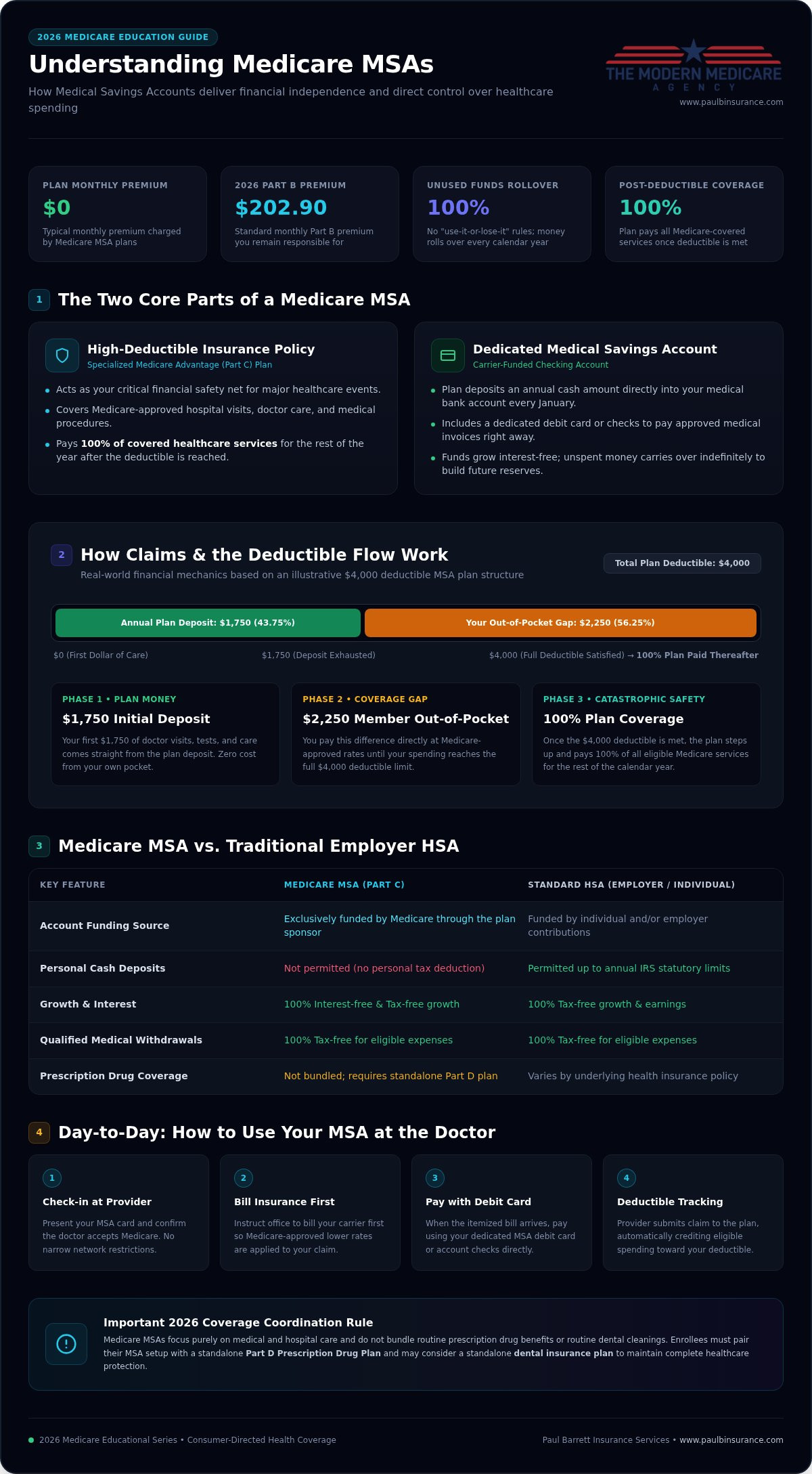
A Medicare Medical Savings Account is a consumer-directed Medicare plan that pairs a high-deductible health policy with a funded savings account to give you direct control over your healthcare spending. In simple terms, an MSA is a specialized type of Medicare Advantage (Part C) plan designed for people who want financial independence rather than managed networks. If you find yourself asking what is a medicare medical savings account (MSA) and how the money flows, the setup is straightforward: Medicare provides funds directly to the private insurer, and that plan deposits cash directly into your medical bank account every year.
While the plan typically charges a $0 monthly premium, you still remain enrolled in Original Medicare. That means you must continue paying your standard monthly Part B premium, which is $202.90 in 2026. The best part? Any unused deposit money remains 100% yours. You never face a “use-it-or-lose-it” deadline; your balance simply rolls over into future years, building a cushion for larger medical needs down the road.
The Two Core Parts: High-Deductible Insurance and a Dedicated Bank Account
Every MSA combines two structural pieces that work in harmony:
- High-Deductible Insurance Policy: This policy acts as your safety net. It covers Medicare-approved hospital visits, doctor care, and medical procedures once you meet your annual plan deductible. After you reach that limit, the plan covers 100% of your covered healthcare services for the rest of the calendar year.
- Dedicated Medical Savings Account: When your coverage starts in January, the insurance carrier deposits a specific dollar amount directly into a special checking account established in your name. You receive a debit card to pay approved medical invoices right away. Because these plans focus purely on medical care and do not bundle routine teeth cleanings, pairing your setup with a standalone dental insurance plan helps protect your overall wellness routine.
Medicare MSA vs. Traditional HSA: Crucial Differences You Must Know
A widespread source of confusion is assuming a Medicare MSA operates like a standard employer-based Health Savings Account. Structurally, an Medical Savings Account (MSA) shares similar tax advantages, but the funding rules are entirely different. With a Medicare MSA, you cannot deposit your own personal cash to get a tax deduction. All deposits come exclusively from the plan sponsor funded by Medicare.
However, both accounts share identical, powerful tax benefits: the funds deposited grow interest-free, and any money you withdraw to pay qualified medical expenses is completely tax-free. If you are exploring what is a medicare medical savings account (MSA) to keep your options flexible, knowing who funds the account removes surprises and gives you a clear financial picture for 2026.
How Medical Claims, Deductibles, and Account Rollovers Operate Day-to-Day
Managing an MSA plan throughout the year follows a straightforward, predictable cycle. When understanding what is a medicare medical savings account (MSA) in practical terms, remember that the plan deposit protects your wallet right from the start. You draw on those deposited funds to cover your initial doctor visits, labs, or diagnostic tests. For instance, in an MSA plan like the one available in Wisconsin with a $4,000 deductible and a $1,750 deposit, your first $1,750 of care comes straight from the plan’s money. That leaves a out-of-pocket coverage gap of $2,250 before hitting the deductible. Once you pay that gap and satisfy your full deductible, the plan steps up and pays 100% of all Medicare-covered services for the remainder of the calendar year.
Managing Doctor Visits: From First Dollar to the Plan Deductible
Visiting a doctor with an MSA is refreshingly smooth. At check-in, present your MSA insurance card to confirm the provider accepts Medicare. Instruct the billing office to bill your insurance carrier first so Medicare-approved rates apply. When the itemized bill arrives, pay it using your dedicated MSA debit card or account checks. The provider submits the claim directly to the plan, which credits every eligible dollar toward your deductible. To see how these mechanics compare to network-based HMOs or PPOs, explore our guide to understanding Medicare Advantage.
What Happens to Leftover Funds at the End of the Year?
Good health rewards you under this design. Unspent account money never disappears on December 31. Because there are no “use-it-or-lose-it” restrictions, every remaining dollar automatically carries over to the next year. If you enjoy a run of healthy years with minimal doctor visits, those annual deposits accumulate into a substantial, interest-earning healthcare reserve. This growing cushion gives you real financial defense against unexpected medical events later in life.
Tax Rules and IRS-Qualified Medical Expenses Explained Simply
The money in your account enjoys special tax advantages as long as you follow basic guidelines:
- Approved Care: You can spend funds tax-free on IRS Publication 502 expenses, which include doctor copays, dental treatments, vision exams, hearing aids, and physical therapy.
- Tax Protection: Withdrawals used for qualified medical expenses are 100% tax-free. If you pull money out for non-medical reasons after age 65, that withdrawal is taxed as regular income; prior to 65, it faces income tax plus a 50% penalty.
- Record Keeping: Keep your receipts organized in a simple folder so tax-season filing remains quick and stress-free.
If you feel unsure whether your current doctors and anticipated expenses align with this structure, reaching out to Paul Barrett at The Modern Medicare Agency can help you evaluate your options objectively.
Comparing Medicare MSAs to Standard Medicare Advantage and Medigap Plans
Choosing the right coverage comes down to balancing monthly costs against unexpected out-of-pocket risks. When exploring what is a medicare medical savings account (MSA), you quickly see how differently it treats networks, drug coverage, and medical bills compared to traditional plans. In 2026, standard Medicare Advantage plans have an in-network maximum out-of-pocket limit of $9,250 (and up to $13,900 for out-of-network care). An MSA caps your liability at its specific deductible, but requires you to pay the gap between the deposit and that deductible yourself.
| Feature | Medicare MSA | Standard Medicare Advantage | Original Medicare + Medigap |
|---|---|---|---|
| Provider Network | Any doctor accepting Medicare | HMO/PPO network restrictions | Any doctor accepting Medicare nationwide |
| Plan Premium | Usually $0 (plus Part B) | Often low or $0 (plus Part B) | Monthly plan premium (plus Part B) |
| Prescription Drugs | None (must buy Part D) | Usually bundled | Separate Part D required |
| Financial Liability | Deductible minus annual deposit | Copays/coinsurance up to $9,250 | Little to no out-of-pocket costs |
Provider Freedom: Seeing Doctors Without Network Hassles or Referrals
Doctor restrictions cause endless headaches for seniors in traditional managed care. With an MSA, you don’t face strict HMO networks or need specialist referrals. You have the freedom to consult any healthcare provider who accepts Medicare assignment. Just confirm ahead of time that the doctor’s office agrees to bill your specific MSA carrier directly so your claims apply toward your annual deductible.
The Prescription Drug Rule: Pairing Your MSA with Medicare Part D
A major trap for the unwary is prescription drug coverage. Medicare MSAs never include built-in prescription benefits. To ensure you don’t pay full retail prices for your daily medications, you must enroll in a standalone plan. You can explore your options through Medicare Part D prescription plans during standard enrollment windows. For 2026, the national base beneficiary premium for Part D is $38.99, with a maximum deductible of $615. Enrolling promptly also shields you from lifelong late enrollment penalties.
Weighing High Deductibles Against Predictable Medicare Supplement Coverage
If you prefer knowing your exact medical expenses each month, compare the self-funded gap of an MSA with reliable Medigap supplemental plans. Medigap policies charge a monthly premium, but in return, they cover nearly all copays and deductibles for Medicare-approved care. For anyone managing chronic health conditions requiring frequent clinical care, Medigap offers predictable budgeting. For relatively healthy retirees wanting to accumulate rollover deposits, an MSA provides an intriguing path to financial independence.
Is a Medicare Medical Savings Account Right for You in 2026? Pros and Cons
Every health plan carries tradeoffs between upfront savings and potential financial exposure. Getting a complete grasp of what is a medicare medical savings account (MSA) means honestly assessing your personal health habits and emergency savings. If you stay active, rarely visit specialists, and want catastrophic protection with zero monthly plan fees, an MSA lets you accumulate real cash reserves. On the flip side, if you take multiple brand-name prescriptions or manage chronic flare-ups, paying hundreds of dollars out of pocket before reaching the deductible will quickly cause unnecessary stress.
The Clear Advantages: Financial Autonomy and Annual Growth
Having complete control over your healthcare dollars provides unmatched peace of mind. Here is why many self-directed seniors find MSAs appealing:
- Ownership of Funds: The money the insurer deposits belongs to you, growing year after year whenever you stay healthy.
- $0 Plan Premiums: You eliminate monthly overhead expenses while keeping your primary Medicare Part B coverage intact.
- Nationwide Mobility: Domestic travelers and snowbirds enjoy total freedom to seek treatment in any state, entirely bypassing localized network barriers.
The Potential Risks: Navigating the Coverage Gap Safely
The biggest risk lies in the financial gap between your initial account deposit and the plan deductible. Should an unexpected accident or severe illness occur early in January, your deposit funds could run out within weeks. You must pay that remaining deductible entirely on your own before comprehensive 100% coverage activates. Beneficiaries without accessible emergency savings to weather this gap can experience acute financial anxiety during medical crises.
Addressing Routine Care Gaps: Adding Dental and Vision Protection
Standard Medicare MSAs focus squarely on core hospital and medical needs, omitting routine preventive dentistry or vision hardware. Neglecting oral health can lead to complications, so securing an affordable standalone dental insurance plan helps you protect your smile without spending down your MSA medical reserves on basic teeth cleanings and x-rays.
To evaluate whether your local doctors and personal financial situation make an MSA practical for 2026, connect with an independent broker at The Modern Medicare Agency for honest, pressure-free comparisons across top carriers.
How to Review Your 2026 Medicare Options with Independent Guidance
Making a confident choice begins with understanding how all the pieces of your healthcare budget fit together. When you examine what is a medicare medical savings account (MSA) alongside other pathways, you need a clear, realistic picture of your annual expenses. Nearly seven out of ten Medicare beneficiaries do not compare their coverage options each year. That oversight often leads to surprise out-of-pocket costs or missed savings. The annual enrollment period to join or switch Medicare Advantage plans, including MSAs, runs from October 15 to December 7, making advance preparation essential for securing the right fit in 2026.
Calculating Your Total Annual Healthcare Cost Equation
To evaluate any plan accurately, look beyond the monthly premium. Use this simple three-part formula to forecast your real spending:
- Fixed Monthly Costs: Add your monthly Part B premium ($202.90 in 2026) to any separate private plan premiums, such as standalone Part D or dental coverage.
- Prescription Drug Expenses: Calculate your anticipated copays and check whether your medications are subject to your Part D plan’s deductible (capped at $615 in 2026).
- Potential Deductible Exposure: Look at your past healthcare habits. If you choose an MSA, determine whether you can comfortably manage the gap between the insurer’s annual deposit and the plan deductible if an unexpected illness strikes.
Captive Agents vs. Independent Brokers: Why Impartial Guidance Matters
Where you turn for guidance directly impacts your coverage options. A captive agent represents only a single insurance company, which limits your choices to whatever plans that one company sells. An independent broker acts as your personal advocate. At The Modern Medicare Agency, founder Paul Barrett and his team maintain access to more than 40 leading carriers across 34+ states nationwide. This autonomous approach means we evaluate whether an MSA, a comprehensive Medigap policy, or a traditional Medicare Advantage plan matches your specific budget and health profile without high-pressure sales tactics. Best of all, independent broker guidance comes at zero extra cost to you.
Simple Steps to Get Clear, Stress-Free Advice Today
Removing anxiety from your Medicare planning is simple when you take it step-by-step. Gather a quick list of your current prescriptions, daily dosages, and preferred doctors or clinics. Once you have those details in hand, schedule a calm, educational consultation to review your 2026 options. Having an experienced, ethical professional guide you through the details turns a confusing system into genuine peace of mind.
Take Confident Steps Toward Your 2026 Healthcare Peace of Mind
Choosing the right path for your health coverage doesn’t have to feel overwhelming. Now that you understand what is a medicare medical savings account (MSA), you can weigh its unique balance of annual insurer deposits and high deductible requirements against traditional coverage. If you are healthy, value seeing any Medicare provider without network restrictions, and want unused dollars rolling over year after year, an MSA offers genuine financial control. However, if predictable monthly medical expenses and comprehensive drug coverage matter most, pairing Original Medicare with a Medigap policy may serve you better.
You never have to navigate these decisions alone. If you want pressure-free guidance tailored to your specific doctors and budget, connect with Paul Barrett at The Modern Medicare Agency. As independent advocates licensed across 34+ states, our team provides unbiased plan comparisons across more than 40 leading carriers with zero added broker fees. We are here to protect your interests, answer every question with patience, and help you step forward into 2026 with total confidence.
Frequently Asked Questions
Can I contribute my own money to a Medicare Medical Savings Account?
No, you cannot make personal contributions to this account. Unlike employer-sponsored HSAs, all deposits originate strictly from the private plan sponsor using funds provided by Medicare. You cannot add your own personal cash to get an income tax deduction. Understanding this distinction is key to answering what is a medicare medical savings account (MSA) and knowing how its financing differs from standard retirement accounts.
Does a Medicare MSA include prescription drug coverage?
No, Medicare MSAs never bundle Part D prescription benefits into their coverage. If you need daily maintenance medications, you must enroll in a standalone Medicare Part D plan during an approved enrollment window. Failing to set up creditable drug coverage when you first become eligible can lead to permanent late enrollment penalties, so securing a separate drug plan remains a vital step.
What happens to the money in my Medicare MSA if I don’t spend it this year?
Any unspent balance remains safely in your dedicated account and carries over automatically. These accounts have no “use-it-or-lose-it” rules. If you stay healthy and have minimal medical expenses across several consecutive years, your deposits accumulate and earn interest. That growing balance creates a reliable financial cushion for any major healthcare needs that might arise down the road.
Can I see any doctor I want with a Medicare Medical Savings Account?
Yes, you can visit any licensed healthcare provider who accepts Medicare assignment nationwide. You don’t have to worry about provider networks or getting specialist referrals before making an appointment. You only need to verify in advance that the doctor or facility agrees to bill your specific MSA carrier directly so your claims are properly tracked against your annual deductible.
How does the high deductible work in a Medicare MSA plan?
You pay for your healthcare services using your deposited account funds first, and then pay out of pocket until you meet the full deductible. Once your eligible medical spending satisfies that deductible, the insurance policy covers 100% of all Medicare-approved healthcare services for the rest of the year. This structure caps your financial liability while giving you direct control over your early-year spending.
Are the deposits and withdrawals in a Medicare MSA taxable?
Deposits and qualified withdrawals are completely tax-free. As long as you spend the funds on IRS-approved medical expenses, you owe no taxes on the withdrawals or any earned interest. If you withdraw money for non-medical reasons after age 65, that money is taxed as regular income. If you do so before 65, it faces ordinary income tax plus a 50% penalty.
Can I switch from a Medicare MSA to a standard Medicare Supplement or Advantage plan?
Yes, you can switch during the Annual Enrollment Period between October 15 and December 7 each year. You can also evaluate options if you qualify for a Special Enrollment Period. If you switch to a standard Medicare Advantage plan, your existing MSA funds stay yours for future qualified medical expenses. However, moving to a Medigap policy may require medical underwriting depending on your state.

Article by
Paul Barrett
Paul Barrett, CMIP is the founder of The Modern Medicare Agency, an independent Medicare-only brokerage based in Melville, NY. With 18 years of Medicare-exclusive experience, a CMIP designation, and more than 5,000 clients served across 37 states, Paul is one of the most credentialed independent Medicare specialists on Long Island — and one of the most direct.
He represents 40+ carriers with no quotas and no allegiances, which means his recommendations are based entirely on what fits each client's specific situation. He is the author of Medicare Mastery Unlocked and host of the Wise Guys Retirement Talk podcast. His content is grounded in primary sources, real carrier intelligence, and 18 years of watching what happens when people get Medicare right — and when they don't.
📞 631-358-5793 | paulbinsurance.com