




An annuity income rider is an add-on that can guarantee a lifetime paycheck by using a notional benefit base, and it can be worthwhile when you need protection against outliving your money. But that guarantee comes at a cost, and it depends entirely on the insurer standing behind it, so compare fees, withdrawal rates, and carrier ratings before signing anything.
TL;DR:
- The benefit base grows separately from the account value, often at a higher rate, but surrendering early only releases the account value, not the benefit base.
- Fees typically range from 0.75% to 1.25% of the benefit base annually, significantly lowering guaranteed income over long retirement periods.
- Activation age influences withdrawal rates, with around 4.5% at age 60 and approximately 5.5% at age 70, affecting annual guaranteed income.
- Rider types vary from lifetime withdrawal guarantees to long-term care protection, each with different costs, rules, and flexibility implications.
- Evaluating riders requires detailed comparisons of withdrawal percentages, rollup methods, fees, and carrier strength, not just the advertised rollup rate.
Table of Contents
- What is an income rider, and how is it different from your account value
- How rollup rates, withdrawal percentages, and fees actually produce your income
- Which rider type fits your retirement goals
- The real trade-offs behind the marketing
- How to evaluate a rider before you buy
- Why Paul B Insurance treats rider math as the whole conversation
- Where the conventional advice on income riders gets it wrong
- How Paul B Insurance can help you compare riders
- Where to verify these numbers yourself
- Sources
- FAQ
What is an income rider, and how is it different from your account value
An income rider is an optional feature you add to an annuity contract that guarantees a stream of lifetime income, calculated from a separate number called the benefit base rather than from the actual cash sitting in your contract. This distinction confuses more retirees than almost anything else in the annuity world, and misreading it leads to real disappointment.
Your account value, sometimes called the accumulation value or cash value, is the money you could actually withdraw in a lump sum or move to another investment. The benefit base is a notional figure, meaning it exists only on paper to calculate your guaranteed income. It typically grows through a rollup rate for a set number of years, then converts to a lifetime withdrawal amount once you activate the rider.

Say you put $200,000 into a fixed index annuity with an income rider. Your account value might grow modestly based on index performance, while your benefit base grows separately, often faster, because the insurer applies a rollup credit specifically for income calculation purposes. If you surrender the contract early, you get the account value, not the benefit base. That gap surprises people who assumed the bigger number was theirs to keep.
You typically elect the rider when you first buy the contract, though some carriers offer a limited window to add one after issue. A few terms are worth learning before you go further:
- Benefit base: the notional value used to calculate your guaranteed withdrawal amount, not spendable cash.
- Rollup rate: the annual rate at which the benefit base grows before you start taking income.
- Withdrawal percentage: the rate applied to the benefit base once you activate the rider, determining your annual guaranteed income.
- Vesting: the waiting period, often several years, before the rider’s full guarantees or bonus features apply.
How rollup rates, withdrawal percentages, and fees actually produce your income
The math behind an income rider comes down to two numbers multiplied together: the benefit base and the withdrawal percentage. Understanding how each grows, and what the rider costs you along the way, is the difference between reading an illustration and actually understanding it.
Rollup rates in 2026 commonly range from about 5% to 8% a year, applied either as simple growth or compounded, depending on the contract, according to Annuity. A simple rollup of 6% adds a flat percentage of the original benefit base each year. A compounding rollup adds 6% of the current, already-grown balance, which produces a noticeably larger benefit base over a 10 to 15 year deferral period. Always ask which method your contract uses, because carriers rarely lead with this detail in sales materials.
Withdrawal percentages rise with the age at which you activate income. Typical figures run around 4.5% at age 60 and roughly 5.5% at age 70, since the insurer expects to pay a shorter stream of income the later you start, per Annuity.org. Say your benefit base grows to $350,000 by age 70 and your contract offers a 5.5% withdrawal rate at that age. Your guaranteed lifetime income would be $19,250 a year, paid regardless of how long you live or what happens to the underlying account value.
Fees are where riders quietly erode value. Annual charges most commonly run from about 0.75% to 1.25% of the benefit base, with some contracts charging up to roughly 1.50%, and insurers may calculate the fee against the benefit base or deduct it from the account value, according to Annuity. On that same $350,000 benefit base, a 1% fee costs $3,500 a year, deducted whether or not the underlying account grows that year.
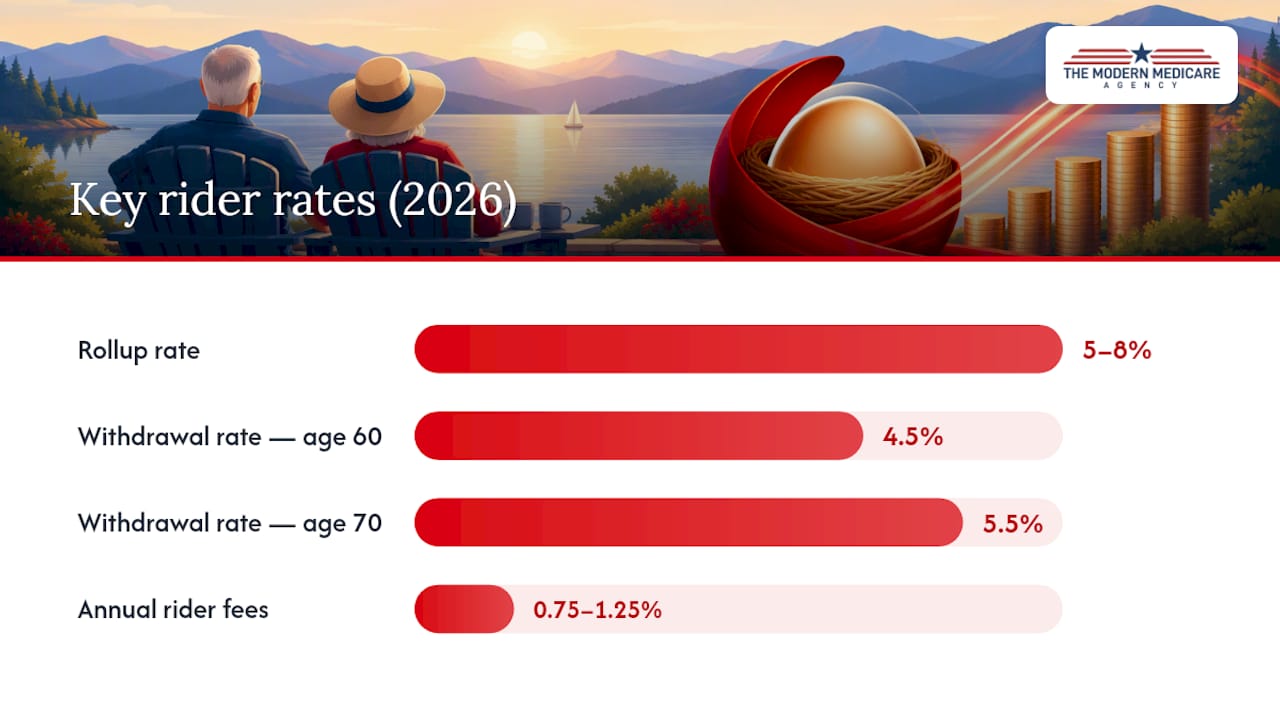
Rider fees in 2026 typically run 0.75% to 1.25% of the benefit base annually, meaning that the cost on your specific contract depends on the size of your benefit base, regardless of market performance, according to Annuity.com.
Vesting and activation rules matter just as much as the math. Most riders require you to wait a specified number of years, often five to ten, before the benefit base reaches its full guaranteed growth or before bonus credits apply. Withdrawing money from the account value before you activate the rider, even a modest amount, usually reduces the benefit base proportionally or resets the rollup calculation, which can quietly shrink your future guaranteed income. Some contracts also use bonus rollups or issue bonuses that inflate the benefit base early, financed by higher embedded fees or less favorable crediting terms elsewhere in the contract, according to Annuity Journal.
- Ask whether your rollup is simple or compounded, since the difference compounds into thousands of dollars over a decade.
- Confirm whether fees are deducted from the account value or calculated against the benefit base.
- Find out exactly how many years of vesting apply before you can activate full guaranteed income.
Which rider type fits your retirement goals
Income riders come in several designs, and the right one depends on whether you want flexibility, a higher guaranteed number, or protection against a specific risk like long-term care.
- GLWB (guaranteed lifetime withdrawal benefit) lets you take guaranteed withdrawals for life without ever annuitizing the contract, so you keep access to any remaining account value. This fits retirees who want a lifetime income floor but also want the option to leave money to heirs or adjust their plan later.
- GMIB (guaranteed minimum income benefit) requires you to annuitize, converting the contract into a pension-style income stream. It typically suits buyers who are comfortable giving up flexibility in exchange for a higher guaranteed starting income than a comparable GLWB might offer.
- GMWB (guaranteed minimum withdrawal benefit) guarantees the return of your original premium through a series of withdrawals rather than a lifetime payout, so once the total withdrawn equals your premium, the guarantee is satisfied. It offers less longevity protection than a GLWB but often carries a lower fee.
- COLA (cost-of-living adjustment) riders increase your income over time, either by a fixed percentage or tied to a measure like CPI. A fixed 2% annual increase starts lower than a level payout but can overtake it within 10 to 15 years, so the breakeven point depends on how long you expect to draw income.
- Long-term care riders increase your monthly payout, sometimes by multiples, if you meet qualifying activities-of-daily-living conditions, according to Annuity.com. These can be more cost-effective than standalone long-term care insurance for buyers who cannot medically qualify for a dedicated LTC policy.
- Death benefit and return-of-premium (ROP) riders protect your heirs or your original deposit if you die before income begins or before the account is exhausted, but adding this protection usually reduces either your withdrawal percentage or your rollup rate.
The real trade-offs behind the marketing
Income riders solve a genuine problem, running out of money in your eighties or nineties, but they solve it at a cost that carriers do not always spell out clearly.
The advantages are real: lifetime income you cannot outlive, joint or spousal continuation options, the ability to layer in long-term care protection, and inflation adjustments if you choose a COLA feature. The disadvantages are just as real. Ongoing fees compound over a 20 or 30 year retirement. Adding a rider to a fixed index annuity often means accepting lower caps or participation rates on the underlying index credits, since the insurer has to pay for the guarantee somehow, according to Investopedia. Surrender charges can also apply if you need to exit the contract early.
- Riders marketed as “no-cost” often shift the cost into lower crediting rates or caps rather than eliminating it entirely.
- Every fee dollar is deducted whether or not the account grows that year, which matters most in flat or down markets.
- Carrier solvency underpins the entire guarantee, since a lifetime income promise is only as good as the company backing it.
Carrier strength is not a marketing detail, it is the foundation of the whole guarantee. The SEC and FINRA both note that annuity guarantees depend on the issuing insurer’s financial strength, and recommend checking carrier ratings before relying on any lifetime income promise, according to the SEC’s investor bulletin on variable annuities. State guaranty associations offer a backstop if an insurer fails, but the coverage caps vary by state and are not equivalent to government insurance, according to FINRA.
Pro Tip: Ask every carrier for both a percentage-fee illustration and a net-dollar illustration showing exactly what you keep after fees in years 10, 20, and 30, not just the composite fee rate.
How to evaluate a rider before you buy
A good rider evaluation is really a short list of specific numbers and a comparison against alternatives, not a gut feeling about the salesperson.
- Ask for the exact withdrawal percentage at your specific activation age, not a generic range, since a single year can shift the number meaningfully.
- Confirm the rollup rate and whether it compounds or applies simply, and get it in writing.
- Get the fee expressed as both a percentage of the benefit base and a dollar amount for your specific contract size.
- Ask exactly how the fee is deducted, from account value or benefit base, and how often.
- Find out the vesting period and what happens to your benefit base if you withdraw money before activation.
- Ask about survivor payout rules if you are married or want continued income for a spouse.
- Request modeled dollar scenarios for best, median, and worst-case market performance, and compare the net income against a plain single premium immediate annuity (SPIA) or a bond ladder over 20 to 30 years, a method Annuity.org recommends for judging real value.
- Ask for the carrier’s current financial strength rating and the agency that issued it, then verify it independently on AM Best, Moody’s, or S&P.
- Ask directly whether the contract uses a bonus rollup or issue bonus, and if so, what it costs elsewhere in the contract.
- If you are considering a 1035 exchange from an existing annuity, understand that it typically restarts your surrender charge period and may increase total long-term fees, according to the SEC’s guide to variable annuities.
Why Paul B Insurance treats rider math as the whole conversation
Paul Barrett has worked with Medicare and retirement insurance consumers since 2007, with an education-first approach that applies directly to annuity riders: the goal is to help you understand the number on the illustration before you sign anything. Retirees 40,000 in 15 Years, walks through exactly how fee drag compounds over time when you subtract rider fees from projected growth year by year instead of just looking at a single percentage. Every guarantee still depends on the insurer’s solvency, so we always point clients toward independent rating checks and state guaranty fund limits before relying on any lifetime income promise.
Where the conventional advice on income riders gets it wrong
Most articles on income riders treat the rollup rate as the headline number, when the withdrawal percentage and fee structure usually matter more to your actual retirement paycheck. A big rollup rate on paper means little if the withdrawal percentage at your activation age is mediocre or the fee has been quietly eating the benefit base for a decade.
The bigger blind spot is that people shop riders the way they shop interest rates, comparing one number across contracts, instead of running a net-dollar projection against a plain SPIA or a simple bond ladder. A rider is not automatically the better tool just because it is more flexible. Flexibility costs money, and for some retirees, particularly those with a shorter time horizon or a pension already covering fixed expenses, that flexibility is not worth the fee.
If you take one thing from this guide, prioritize the net-dollar illustration over the percentage pitch. Ask what you actually keep in year 20, not what the rollup rate sounds like in year one.
— Paul
How Paul B Insurance can help you compare riders
Choosing an income rider means weighing fee structures, withdrawal percentages, and carrier strength against your own retirement timeline, and that comparison gets clearer with a second set of eyes that has no reason to push you toward a bigger commission. An independent Medicare insurance broker can provide a review that is not limited to any single company’s offerings.

A personalized review typically covers:
- A free educational walkthrough of your current or prospective annuity statements and rider terms.
- Modeled dollar comparisons showing net income under different rollup, withdrawal, and fee assumptions.
- A look at how a rider interacts with your broader retirement goals, including any long-term care expectations.
Bring your most recent annuity statement, a rough sense of your retirement income needs, and any healthcare or long-term care concerns you want the contract to address. You can start by visiting our annuities page to schedule a personalized review.
Where to verify these numbers yourself
These sources back the figures and mechanics covered above, and they are worth bookmarking if you want to double-check anything before you sign a contract.
- The SEC’s investor bulletin on variable annuities explains why carrier financial strength underlies every lifetime guarantee.
- Annuity breaks down typical 2026 rollup and withdrawal percentages by age.
- Annuity details typical fee ranges and how long-term care riders work.
- Investopedia’s rider analysis covers the hidden trade-offs behind “no-cost” rider marketing.
- Our own fixed annuities guide explains base annuity mechanics before you layer a rider on top.
This article is general information, not a substitute for advice from a qualified financial advisor. Consult a qualified financial professional about your own circumstances before acting on anything here.
Sources
- SEC investor bulletin: variable annuities
- Annuity
- Annuity
- Annuity riders: which ones are worth it? — Investopedia
FAQ
How do income riders work on annuities?
An income rider guarantees lifetime income by applying a withdrawal percentage to a notional benefit base, which typically grows through a rollup rate before you activate income. The benefit base is not cash you can withdraw in a lump sum, only the guaranteed account value is.
What did Warren Buffett say about annuities?
This article does not have a verified source for a specific Warren Buffett statement on annuities, so we cannot attribute a claim to him here. If you have seen a quote attributed to him, verify it against a primary source before treating it as fact.
What does Dave Ramsey say about income annuities?
This article does not have a verified source covering a specific position from Dave Ramsey on income annuities. For an informed view on rider costs and mechanics, rely on primary sources like the SEC and FINRA rather than secondhand summaries of media commentary.
How much will a $100,000 annuity pay out per month?
The payout depends entirely on your activation age, the contract’s withdrawal percentage, and whether you added an income rider, so there is no single answer. Using a sample withdrawal rate of around 5.5% at age 70 on a benefit base that has grown through rollups can generate monthly lifetime income, but the exact amount depends on your contract terms and activation age. You should request a specific illustration from the carrier for your exact age and contract terms, as described by Annuity.org.