




What if the right Medicare choice isn’t the plan with the most features, but the one that fits your needs? In 2026, comparing options can feel overwhelming when you’re weighing your doctors, prescriptions, and the care you may need. It’s understandable to worry that one missed detail could matter later. Feeling confident in your Medicare decision starts with checking what matters to you, not searching for a plan that’s best for everyone.
This guide offers a practical way to compare your options. You’ll learn what to review, including whether your doctors and prescriptions are covered and how to check important plan details. You’ll also find ways to organize your questions so you can make an informed choice without feeling rushed.
An independent Medicare broker can help explain available options and compare plans against your priorities, while leaving the decision in your hands. You don’t have to enroll right away to make progress. Start by gathering the details that matter to you, then take one manageable next step.
Key Takeaways
- Start with your priorities to identify which plan trade-offs matter most to you in 2026.
- Use the same comparison process for Medicare Advantage, Medigap, and Part D options.
- Check your doctors, prescriptions, costs, and coverage details against current official plan materials.
- Feeling confident in your Medicare decision means knowing what you’ve checked and which questions still need answers.
- If something remains unclear, pause and seek help comparing options before making your choice.
Feeling Confident in Your Medicare Decision Starts With Your Priorities
Medicare choices can feel confusing when several plan details seem equally important. That doesn’t mean you’re missing something or making a poor decision. It means you’re weighing options that may handle costs, providers, prescriptions, and care differently. In 2026, start by defining what matters most to you before comparing plans.
A confident Medicare decision is a personal, informed choice based on needs and priorities you’ve taken time to check.
What does feeling confident in your Medicare decision mean?
Feeling confident in your Medicare decision doesn’t mean finding a plan that promises to suit every possible future need. No one can know exactly what care they may need later. Confidence comes from understanding the trade-offs, checking the details that matter to you, and knowing why an option fits your current priorities.
It’s reasonable to ask questions, take time to compare, or find that you need to verify something before moving forward. Those are thoughtful steps, not signs that you’re falling behind. For a broad introduction to the parts and history of the Medicare program, you can review this overview, then focus your plan research on your circumstances.
Which personal details should guide your decision?
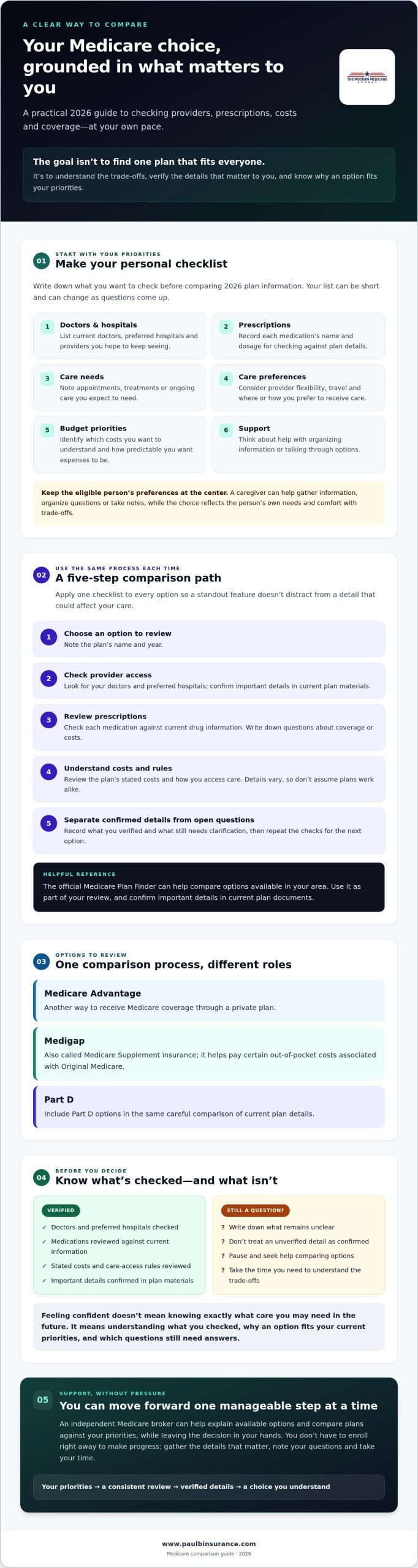
Start with a short list. It doesn’t need to be perfect. The goal is to make your priorities visible so you can refer to them while reviewing 2026 plan information.
- Doctors and hospitals: List your current doctors, preferred hospitals, and providers you’d like to keep seeing.
- Prescriptions: Record each medication, including its name and dosage, so you can check it against plan details.
- Care needs: Note appointments, treatments, or ongoing care you expect to need, while remembering that future needs can change.
- Care preferences: Consider whether you value flexibility in choosing providers, expect to travel, or have preferences about where and how you receive care.
- Budget priorities: Identify which costs you want to understand clearly and how predictable you’d like your health expenses to be.
- Support: Consider whether you want help organizing information or discussing options with someone you trust.
A caregiver can help gather documents, organize questions, or take notes during a conversation. Keep the eligible person’s preferences at the center, though. The decision should reflect their doctors, routines, concerns, and comfort with the trade-offs. With your list in hand, you can compare options against your own priorities instead of relying on general impressions.
A Step-by-Step Way to Compare Medicare Options in 2026
Once you know what matters to you, use the same process for every option you consider. This helps prevent one appealing feature from overshadowing a detail that may affect your care. In 2026, check current plan materials and use official Medicare resources to verify details. If something isn’t clear, record it as a question rather than treating it as confirmed.
Using one checklist for every option makes differences easier to see and keeps your choice grounded in your priorities.
How do you compare plans without getting lost in the details?
- Choose an option to review. Compare plans available to you, and note each plan’s name and year.
- Check provider access. Look for your doctors and preferred hospitals, then confirm important details using current plan materials.
- Review prescriptions. Check each medication against the plan’s current drug information. Record unanswered questions about coverage or costs.
- Understand costs and rules. Review the plan’s stated costs and how you access care. Details vary, so don’t assume one plan works like another.
- Mark what’s confirmed. Separate verified answers from items you still need to clarify, then repeat the checks for the next option.
The official Medicare Plan Finder tool can help you compare options available in your area. Use it as one part of your review, and confirm important details in current plan documents before deciding.
Which Medicare option deserves a closer look?
These options serve different roles. Medicare Advantage is another way to receive Medicare coverage through a private plan. A Medicare Advantage guide can explain how this type of plan works. Medigap, also called Medicare Supplement insurance, helps pay certain out-of-pocket costs associated with Original Medicare. Learn more in this Medigap overview. Part D is prescription drug coverage, so review its medication details when comparing drug coverage.
These categories aren’t interchangeable, and the right comparison depends on your situation. Keep your notes beside the official materials as you review your 2026 options. If a provider, prescription, cost, or rule remains unclear, pause and get an answer before treating it as settled. A steady process can make feeling confident in your Medicare decision more achievable, without requiring you to predict every future care need.
Check Doctors, Prescriptions, Costs, and Coverage Before You Decide
A plan feature may sound helpful on paper, but the key question is whether it fits your life. A wide choice of providers won’t help as much if your preferred doctor isn’t included. Drug coverage matters when it works for the medications you take. In 2026, plan availability and details can differ, so check each option using current materials rather than relying on general descriptions.
Verify your doctors and prescriptions against current plan information before you decide.
Are your doctors, hospitals, and prescriptions covered?
Search the plan’s current provider directory for your doctors and preferred hospitals. Directories can change, so contact the provider and the plan to confirm important details, including whether a provider participates in the plan you’re considering. Check every medication against the plan’s current drug information, including any plan-specific limits or requirements listed there. For help understanding prescription coverage, read this Medicare Part D guide.
How can you compare costs and coverage fairly?
Use the categories and terms in each plan’s official 2026 materials. Consider how often you expect to use care, which services you may need, and whether the plan’s stated rules fit your preferences. Don’t assume a feature means the plan will meet your particular needs. If something is unclear, ask the plan to explain it and record the answer before comparing further.
| What to check | Questions to ask | Where to verify |
|---|---|---|
| Doctors and hospitals | Are my providers included, and can I continue seeing them under this plan? | Current provider directory, provider office, and plan materials |
| Prescriptions | Are all my medications listed, and what coverage rules apply? | Current drug list and plan documents |
| Costs | Which cost categories apply, and how might my expected care use affect what I pay? | Current official plan materials |
| Coverage and rules | Are there exclusions, referrals, prior approvals, or service-area limits I should understand? | Plan documents and direct confirmation from the plan |
Keep a note of anything you can’t confirm, such as whether a particular service is covered or how a plan’s rules apply to you. Ask the plan directly before treating an assumption as fact. This helps you compare a plan’s features with what you actually need, without expecting every option to suit every person.
Use This Final Medicare Decision Checklist to Resolve Doubts
Before choosing a Medicare option in 2026, review what you’ve confirmed and what still needs an answer. A short written checklist can help you spot loose ends and discuss specific questions with a plan or qualified adviser. It supports your decision, but it doesn’t replace current plan documents or official guidance.
What questions should you answer before choosing?
Use this checklist for the plan you’re considering. Beside each answer, note where you found the information and when you checked it. Plan details can change, so keeping the source with your notes makes it easier to confirm that you’re using current information.
- Doctors and facilities: Have I checked whether the doctors and hospitals that matter to me are included? Did I confirm important details with the provider and the plan?
- Prescriptions: Have I checked each medication against the plan’s current drug information?
- Costs and coverage: Do I understand the relevant costs, covered services, and plan rules from current materials?
- Questions: Have I written down anything I couldn’t confirm, along with who can verify it?
A simple note can be enough: “Question: Is my specialist included? Source checked: provider directory. Follow up with: plan.” This separates what you know from what you still need to confirm, without relying on memory.
What if you still feel unsure?
Try to identify why. Is information missing, have you received conflicting answers, or are you weighing two priorities that point to different options? Each situation calls for a different next step. For missing details, contact the plan. If answers conflict, ask for clarification and record who provided it. If priorities compete, revisit which needs matter most to you.
Pause if an important question is unresolved. There’s no need to treat uncertainty as a reason to choose immediately. Gather the relevant plan materials, write down the exact question, and ask the plan or a qualified adviser to clarify it. Advice can help you understand your options, but no checklist or adviser can guarantee a particular outcome.
Feeling confident in your Medicare decision doesn’t require knowing exactly what your future health needs will be. It means you’ve checked the details that matter, recorded what remains uncertain, and made a thoughtful choice. If you’d like help organizing your questions and comparing Medicare options, you can talk through your Medicare options with an independent broker.
Get Personal Help and Move Forward at Your Own Pace
You don’t have to sort through every Medicare detail alone. An independent broker can help organize your questions, compare available options against your stated needs, and explain how plan details differ. The guidance should make your choices clearer, not make the choice for you. You remain in control of whether and when to move forward.
What can an independent Medicare broker help you understand?
A broker can explain Medicare Advantage, Medigap, and Part D options and help identify details to verify, such as provider access, prescription coverage, costs, and plan rules. Bring your priorities and questions to the conversation. Ask how an option matches your needs, what trade-offs to consider, and which details to check in current plan materials.
The Modern Medicare Agency helps eligible individuals compare Medicare Advantage, Medigap, and Part D plans from more than 40 carriers. It provides personalized guidance. Carrier participation and available plans can vary, so confirm current 2026 options and details directly before relying on a comparison.
How can you take a clear next step?
Before speaking with an adviser, gather your current plan information, your list of doctors and prescriptions, and any unanswered questions. It may help to sort questions into groups, such as providers, medications, costs, and coverage rules. Then you can use the conversation to work through what’s still uncertain rather than starting from scratch.
The Modern Medicare Agency provides year-round support across more than 34 states. Confirm that support and service availability apply to your circumstances, and remember that ongoing support doesn’t mean plan details remain unchanged. For a 2026 decision, verify important information against current plan materials.
Feeling confident in your Medicare decision doesn’t require having every answer before you ask for help. It can begin with a clear conversation, a few specific questions, and enough time to consider what you learn. An independent broker can explain options and help you compare, but the decision remains yours.
If you’d like to explore a personal comparison, bring your questions and take the conversation one step at a time. There’s no need to decide before you feel ready.
Take Your Next Medicare Step With Confidence
In 2026, a sound Medicare choice starts with your priorities, not a search for one plan that suits everyone. Compare options using the same questions, and check current plan information for your doctors, prescriptions, costs, and coverage rules. If something is unclear, write it down and get an answer before you decide.
That’s what feeling confident in your Medicare decision can look like: understanding what you’ve checked, knowing how an option fits your needs, and being comfortable with the trade-offs. You don’t have to predict every future health need or rush into a choice.
The Modern Medicare Agency is an independent brokerage that helps people compare Medicare Advantage, Medigap, and Part D options from more than 40 carriers, with personalized guidance and year-round support. Confirm current details and available options for your situation, then use any conversation to ask questions and clarify choices. The decision remains yours.
If you’d like help organizing your comparison, talk through your Medicare options at your own pace. Contact The Modern Medicare Agency to discuss your questions and compare available plans. You can move forward when you feel ready.
Frequently Asked Questions
How can I feel confident in my Medicare decision?
Start with the details that matter most to you, such as your doctors, prescriptions, preferred care arrangements, and budget priorities. Compare each option using the same checklist, and verify answers in current 2026 plan materials. Write down anything you still need to confirm. Feeling confident in your Medicare decision doesn’t mean finding a plan that’s right for everyone. It means understanding the choice and its trade-offs for your needs.
What should I compare before choosing a Medicare plan?
Compare how each plan fits your care needs and preferences. Check whether important doctors and facilities are included, how your prescriptions are handled, what costs apply, and which plan rules may affect access to care. Use current official materials for specifics, since details can differ between plans. If something isn’t clear, write down the question and confirm it with the plan or a qualified adviser before relying on an assumption.
Is Medicare Advantage or Medigap better for me?
Neither option is automatically better for everyone. Medicare Advantage and Medigap are different types of coverage, each with features and trade-offs to consider. Your doctors, care preferences, prescription needs, and budget priorities can guide your comparison. Review current plan information and make sure you understand how each option works. An adviser can explain the choices and help you compare them, but the decision should remain yours.
Can I change my Medicare decision if my needs change?
You may have options to make a change, but what’s available depends on your circumstances and the rules in effect at the time. Don’t assume you can change every plan whenever you want. Check current official Medicare information and the plan’s materials for applicable choices and timing. If your health needs, providers, or prescriptions change, confirm how those changes may affect your coverage before taking action.
How do I know whether my prescriptions are covered?
Check each medication against the current drug information for the plan you’re considering. Review details that may affect coverage, access, or what you pay, and confirm anything you don’t understand with the plan. Prescription information can vary by plan and may change, so don’t rely on an old list or a general description. A qualified adviser can also help you identify which details to verify.
Should I ask a Medicare broker for help choosing a plan?
A Medicare broker can help you understand and compare available options, explain unfamiliar terms, and organize questions around your needs. Ask which types of plans they can discuss and how they compare options from different carriers. The Modern Medicare Agency helps eligible individuals compare Medicare Advantage, Medigap, and Part D plans. You remain the decision-maker, and important details should be verified using current plan documents.
What if I still feel unsure after comparing Medicare plans?
Pause and identify what’s behind the uncertainty. You may be missing a fact, getting conflicting answers, or weighing personal priorities that point in different directions. Write down the specific questions you need answered and who may be able to verify them. Contact the plan or a qualified adviser for clarification. Taking time to resolve an important concern can be more helpful than choosing based on pressure or guesswork.

Article by
Paul Barrett
Paul Barrett, CMIP is the founder of The Modern Medicare Agency, an independent Medicare-only brokerage based in Melville, NY. With 18 years of Medicare-exclusive experience, a CMIP designation, and more than 5,000 clients served across 37 states, Paul is one of the most credentialed independent Medicare specialists on Long Island — and one of the most direct.
He represents 40+ carriers with no quotas and no allegiances, which means his recommendations are based entirely on what fits each client's specific situation. He is the author of Medicare Mastery Unlocked and host of the Wise Guys Retirement Talk podcast. His content is grounded in primary sources, real carrier intelligence, and 18 years of watching what happens when people get Medicare right — and when they don't.
📞 631-358-5793 | paulbinsurance.com