




Could a health condition or prescription affect your Medigap application? It depends on more than your medical history. The medicare supplement underwriting questions an insurer asks may cover diagnoses, medications, and other health details, but when you apply can matter just as much.
It’s understandable to feel uneasy about sharing health information when you’re choosing coverage. A diagnosis doesn’t automatically mean you’ll be declined, and some enrollment periods and state-specific protections may limit when medical underwriting applies. In 2026, understanding your timing and protections can help you approach the application with more confidence.
This guide explains the health information an application may request, what to gather before you apply, and how underwriting can vary by insurer and state. You’ll also learn how Medigap Open Enrollment and guaranteed issue rights may affect your options. Insurers make underwriting decisions, but clear, impartial guidance can help you understand the questions and compare plans calmly.
Key Takeaways
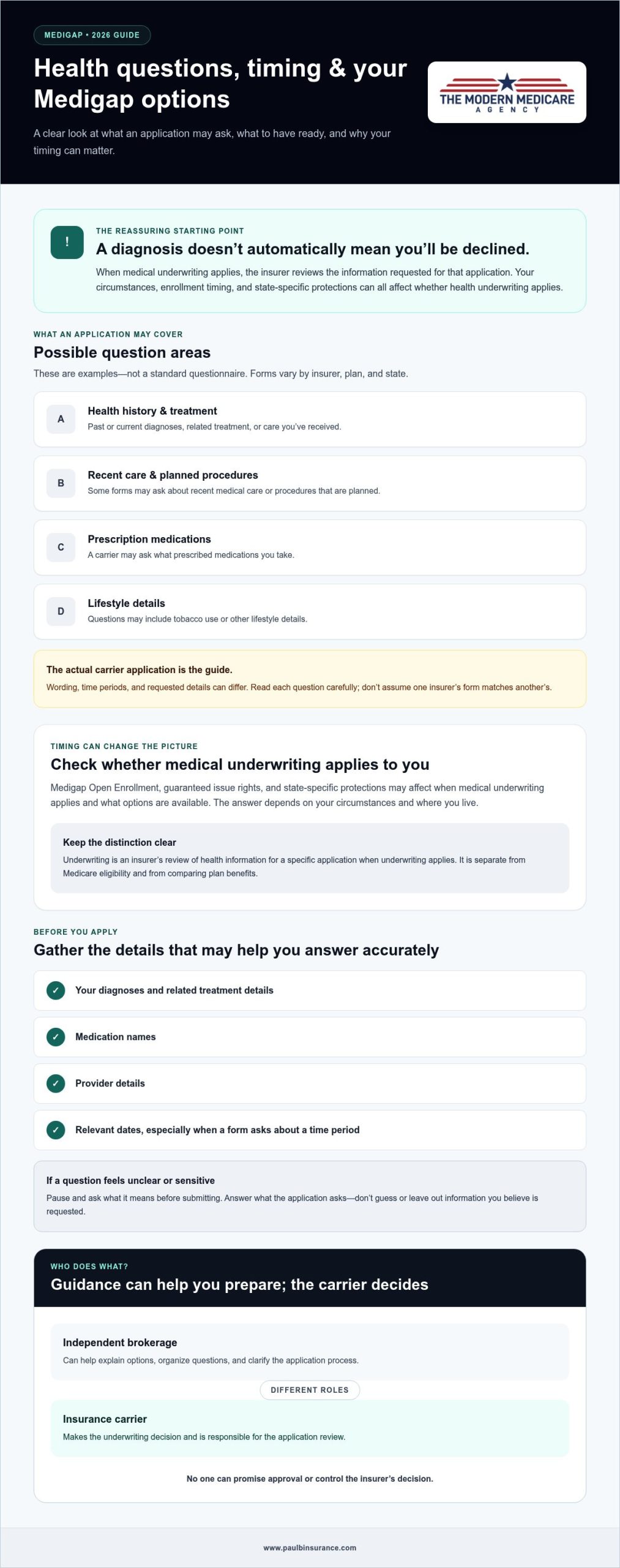
- Medicare supplement underwriting questions may cover health history, current care, medications, and lifestyle, but the exact application varies by insurer.
- Before applying, gather details about your diagnoses, medications, providers, and relevant dates so you can answer accurately.
- Check whether your enrollment timing or state-specific protections may affect whether medical underwriting applies in 2026.
- An independent brokerage can help you understand options and organize questions, while the insurance carrier makes the underwriting decision.
Medicare Supplement underwriting questions: what the application is trying to learn
Sharing personal health information can feel uncomfortable, especially when you’re still weighing your coverage choices. In 2026, it helps to know that an application’s health questions are part of an insurer’s review when medical underwriting applies. The questions and review process can vary by insurer, plan, and state, so one person’s experience may not match another’s.
Medigap underwriting is an insurer’s review of health information for a specific application when underwriting applies. The questions and decision process aren’t identical for every applicant. The carrier, not an independent agency, decides how to assess an application. An agency can explain options and help clarify questions, but it can’t promise approval or control the insurer’s decision.
What does a Medigap underwriting review mean?
Underwriting is separate from determining whether you’re eligible for Medicare. It’s also different from comparing plan benefits. If a carrier reviews an application, it uses the information requested to evaluate that application under its rules. Whether health review applies depends on your circumstances and any protections available where you live.
Start by understanding the coverage itself. Learn the basics of Medicare Supplement coverage, including how it works alongside Original Medicare. For a neutral overview of Medigap, you can also review how these policies fit into Medicare and how plan letters describe standardized benefits.
Why might an application ask about health?
When a review is part of the process, health questions help an insurer assess the application. Depending on the carrier’s form, questions may cover topics such as:
- Past or current diagnoses and related treatment
- Recent medical care or planned procedures
- Prescription medications
- Tobacco use or other lifestyle details
This list describes possible topics, not a standard questionnaire. The exact wording, time period covered, and information requested can differ among insurers and states. Read each question carefully and answer based on what it asks. A diagnosis or medication alone doesn’t tell you what the carrier’s decision will be. The insurer reviews the application as a whole under its process.
If anything is unclear, pause and ask for an explanation before submitting the form. An independent brokerage can help you understand available Medigap options and organize questions, while the carrier remains responsible for underwriting and the final application decision.
What Medicare Supplement underwriting questions might appear on an application?
There isn’t one standard questionnaire for every Medigap application. In 2026, the questions you see can depend on the carrier, the plan, and the rules that apply where you live. The actual form matters more than a general list of examples. Use the carrier’s application as the authoritative list of questions you need to answer.
Medicare supplement underwriting questions may address health history, current conditions, recent care, prescription medications, or lifestyle details such as tobacco use. These are possible categories, not a guarantee that every application will cover each one. Some forms may ask about specific diagnoses or treatments, while others may use broader wording or different time periods.
Health history, treatment, and medication questions
An application may ask whether you’ve been diagnosed with a condition, received treatment, had recent medical care, or take prescribed medication. Before you begin, have medication names, provider details, and relevant treatment dates nearby. This is preparation, not a checklist of information every carrier will request. Check the application to see what applies.
Pay close attention to questions about time periods. A form might ask about a defined period or use wording that requires you to consider a particular kind of care. The look-back period and the conditions named can differ by carrier, so don’t assume one insurer’s application tells you what another will ask. For general background on Medigap, visit the official Medicare website.
How to handle unclear or sensitive questions
Take your time with each question. If a word or time period is unclear, ask the insurer or a licensed insurance professional what it means before submitting the application. Don’t guess, leave out information you believe is requested, or change an answer to make your health history sound different. The carrier decides how the information affects its review.
For example, if a question asks about treatment within a certain period and you’re unsure whether a follow-up appointment counts, ask for clarification rather than deciding on your own. Keep a note of the explanation, then check that your response matches the form’s wording. Accurate, complete answers help the carrier review the information requested, though they can’t guarantee a particular outcome.
If you’re comparing coverage while preparing, review Medigap options with an independent brokerage. A broker can help you organize questions and understand available choices, but the insurer handles underwriting and makes the application decision.
When can Medigap underwriting affect your application or options?
Timing can affect whether a Medigap insurer may review your health information. In 2026, federal protections generally include a one-time Medigap Open Enrollment Period that begins when you’re 65 or older and enrolled in Medicare Part B. During this six-month period, you can generally buy any Medigap policy sold in your state without medical underwriting. Other protections may apply in certain situations, but eligibility and state rules matter.
If you apply outside a protected period, an insurer may be able to consider your health history, depending on your circumstances and state law. Before relying on a protection, confirm your Part B start date, the event affecting your coverage, and the rules currently in effect where you live. Medicare.gov and your state insurance department are useful places to verify details.
How enrollment timing can change the questions that matter
During your initial Medigap Open Enrollment Period, health questions generally shouldn’t be used to decide whether you can buy a policy. Later applications may involve medical underwriting unless a federal or state protection applies. Check the dates and rules for your situation before applying. Don’t assume that turning 65, changing plans, or losing coverage automatically gives you the same protections.
What guaranteed-issue rights may mean
Guaranteed-issue rights can protect some people in specific circumstances, such as losing certain types of health coverage. They may limit an insurer’s ability to use health information to deny a policy, but the qualifying event, available plans, and application deadline all matter. For many federal guaranteed-issue situations, the period to act is limited, often to 63 days. Confirm your eligibility and specific deadline through current Medicare.gov and state guidance.
The table below is a starting point, not a determination of your rights. Verify every rule and deadline for your circumstances in 2026.
| Situation | Questions to verify | Next step |
|---|---|---|
| Initial Medigap Open Enrollment Period | When did Part B begin, and does the six-month window apply? | Confirm your Part B start date and state options. |
| Loss of other health coverage | Does this event qualify for federal or state protections, and what is the deadline? | Keep coverage notices and confirm the applicable dates promptly. |
| Applying at another time | Can the insurer ask health questions, or does a state rule protect you? | Check current state guidance and the carrier’s application process. |
Once you’ve checked timing and protections, explore Medigap plan information to understand available coverage options. Medicare supplement underwriting questions may matter for some applications, but a broker can help you understand what to verify. The insurer makes the underwriting decision.
How to prepare for Medicare Supplement underwriting questions
Getting organized before you start can make a Medigap application feel more manageable. Preparation doesn’t mean guessing what an insurer will ask. It means having useful information nearby, checking the actual application, and knowing what to clarify before you submit it.
Information to gather before you apply
Keep these details handy as a starting point. The carrier’s application will tell you what it actually needs, so you may not be asked for everything on this list.
- Make a current medication list. Note medication names and, if available, the prescribing provider. Don’t assume every medication will be requested.
- Jot down relevant health details. Record diagnoses, treatment, providers, and dates that may help you answer accurately. Use the wording and time periods on the application to decide what is relevant.
- Gather coverage and enrollment information. Have your current policy details and Medicare Part B start information available. Keep related notices or documents nearby if they may explain a change in coverage.
- Check the insurer’s document instructions. Confirm which records or other information the selected carrier requests. Don’t send extra personal health records unless the insurer asks for them.
- Review the completed application. Before submitting, compare your answers with each question. Correct anything inaccurate and ask for clarification if you’re unsure what a question means.
Questions to ask before submitting an application
A few direct questions can help you understand the process. Ask whether health questions apply to your enrollment circumstances, whether state protections may be relevant, and what documents the insurer needs. You can also ask what happens after submission and how the carrier will communicate its decision.
Compare coverage and application requirements before choosing where to apply. If a question is unclear, contact the insurer or a licensed insurance professional rather than guessing or leaving information out. A broker can explain options and help organize your questions, but the insurance carrier reviews the application and makes the underwriting decision.
For additional Medicare Supplement plan guidance, review coverage options as you prepare. If you’d like help comparing available Medigap choices and understanding what to verify, connect with an independent Medicare brokerage.
Compare Medigap choices with help, not pressure
You don’t have to make sense of every detail alone. A practical next step is to confirm whether underwriting may apply to your situation, read the carrier’s actual application, and compare the Medigap options available to you. Asking focused questions can help you understand both the coverage and the application process before deciding how to proceed.
How an independent Medicare broker can support your comparison
An independent broker can help explain differences among plans and clarify what to ask about an application. The Modern Medicare Agency helps people compare Medicare Advantage, Medigap, and Part D options from more than 40 carriers. The agency offers personalized guidance and year-round support across more than 34 states.
A broker can help you organize your questions, but doesn’t make underwriting decisions. The insurance carrier reviews the application and decides whether to accept it. Guidance can make your choices clearer, but no broker can promise a particular application outcome.
When comparing plans, ask which options fit your coverage priorities, whether health questions apply to your enrollment circumstances, and what information the carrier requests. You can also ask how the carrier will communicate its decision. A clear explanation should help you understand the process without pressure to apply before you’re ready.
A simple next step for 2026
Gather your questions, note your enrollment dates, and review the application from the carrier you’re considering. Then compare the available options at a pace that feels comfortable. The phrase medicare supplement underwriting questions can sound daunting, but these steps can help you focus on the facts that apply to your situation.
For personalized help understanding your choices, explore Medicare Supplement plan guidance. Before applying in 2026, verify current federal protections and any state-specific rules that may affect your timing or options. Your circumstances matter, and the carrier makes the final underwriting decision.
Take your next step with confidence
In 2026, understanding medicare supplement underwriting questions starts with checking when you plan to apply, reviewing the insurer’s actual questions, and preparing accurate information about your health and coverage. Questions and review processes vary, and state-specific protections may affect your options. Confirm the current rules for your circumstances before submitting an application.
You don’t have to compare Medigap choices on your own. The Modern Medicare Agency is an independent brokerage that helps people compare options from more than 40 carriers, with personalized guidance and year-round support across more than 34 states. A broker can help you understand plan differences and organize questions, while the insurance carrier makes underwriting decisions.
If you’d like a calm conversation about your choices, talk through your Medicare options with a helpful guide. You can take time to understand the process, ask questions, and choose your next step with greater confidence.
Frequently Asked Questions
What questions do Medicare Supplement underwriting applications ask?
Applications may ask about your health history, current conditions, treatment, prescription medications, recent medical care, and sometimes lifestyle details such as tobacco use. The exact questions and time periods vary by insurer, so there isn’t one standard questionnaire. Review the carrier’s actual application and have relevant information nearby. These medicare supplement underwriting questions help the insurer assess your application when medical underwriting applies.
Can a Medigap insurer deny coverage because of my health?
Possibly, if medical underwriting applies and no federal or state protection prevents a health-based decision. The carrier reviews your application and makes the decision; a particular diagnosis or medication alone doesn’t determine the result. During certain protected enrollment periods, insurers generally can’t use your health to deny coverage. Check current federal and state rules for your circumstances before applying, especially if you’re outside your initial enrollment window.
Do all Medicare Supplement companies ask the same health questions?
No. Insurers may use different application wording, ask about different health details, and consider different time periods. State rules can also affect applications and protections. Don’t rely on one company’s questionnaire to predict what another will ask. Read the application for the plan and carrier you’re considering, and ask the insurer or a licensed insurance professional to clarify wording you don’t understand.
When can I get a Medigap policy without medical underwriting?
Generally, you have a one-time, six-month Medigap Open Enrollment Period that begins when you’re 65 or older and enrolled in Medicare Part B. Certain qualifying events may also provide guaranteed-issue protections, and some states have additional rules. Eligibility and deadlines depend on your situation. In many federal guaranteed-issue cases, you have 63 days to act. Verify current 2026 requirements with Medicare.gov and your state insurance department.
Should I answer Medigap underwriting questions honestly?
Yes. Read each question carefully and answer accurately based on what it asks. If a term or time period is unclear, ask the insurer or a licensed insurance professional before submitting the form rather than guessing, leaving out information, or changing an answer. The insurer determines how your responses affect its review. Careful, complete answers help the carrier evaluate the application, though they can’t guarantee acceptance or a particular outcome.
Can I switch from Medicare Advantage to Medigap without underwriting?
It depends on your circumstances. Switching from Medicare Advantage to Original Medicare doesn’t automatically give you the right to buy a Medigap policy without medical underwriting. You may have a federal guaranteed-issue right or state-specific protection in certain situations, but eligibility and timing matter. Before changing coverage, confirm whether a protection applies, what deadline you must meet, and whether the Medigap plan you want is available under that right.
How should I prepare for a Medicare Supplement application?
Before applying, check your enrollment timing and whether health questions may apply. Have a current medication list, relevant diagnoses and treatment details, provider names, and dates available, along with your policy and Medicare Part B information. Then review the carrier’s actual application and confirm which documents it requests. Compare plan options and ask for clarification before submitting. An independent broker can explain choices, but the insurer makes underwriting decisions.

Article by
Paul Barrett
Paul Barrett, CMIP is the founder of The Modern Medicare Agency, an independent Medicare-only brokerage based in Melville, NY. With 18 years of Medicare-exclusive experience, a CMIP designation, and more than 5,000 clients served across 37 states, Paul is one of the most credentialed independent Medicare specialists on Long Island — and one of the most direct.
He represents 40+ carriers with no quotas and no allegiances, which means his recommendations are based entirely on what fits each client's specific situation. He is the author of Medicare Mastery Unlocked and host of the Wise Guys Retirement Talk podcast. His content is grounded in primary sources, real carrier intelligence, and 18 years of watching what happens when people get Medicare right — and when they don't.
📞 631-358-5793 | paulbinsurance.com