




If you’re wondering how to explain medicare choices to my family, start by remembering that you don’t need to have every answer. The most useful first step is to ask what the person choosing coverage wants help understanding. Medicare terms can be confusing, and relatives may disagree because they want to help. Too much advice, though, can leave the eligible person feeling pressured instead of confident.
A calm, practical conversation can make the options easier to understand while keeping the eligible person in control. This guide explains the main Medicare choices in plain language, offers ways to involve relatives respectfully, and shows how to focus the discussion on doctors, prescriptions, costs, and personal preferences. It also covers what to do when concerns or opinions differ.
Medicare details can change from year to year, so use current 2026 information when reviewing options. The goal isn’t to choose a plan for someone else. It’s to help them compare choices, ask useful questions, and make an informed decision that feels like their own.
Key Takeaways
- Start with reassurance: your family can learn about Medicare together without making every decision in one conversation.
- Explain Original Medicare, Medicare Advantage, Medigap, and Part D in plain language. No single option suits everyone.
- When discussing how to explain medicare choices to my family, center the comparison on the eligible person’s doctors, prescriptions, expected care, costs, and preferences.
- Give each family member a respectful role, such as gathering questions or reviewing current plan documents, while leaving the final choice with the eligible person.
- If comparing options feels difficult, an independent brokerage can offer guidance. The Modern Medicare Agency compares options from more than 40 carriers.
Explain Medicare to Family Without Stress
Your family can learn about Medicare together without deciding everything in one conversation. Choices may feel confusing, and discussions about health, money, and future care can bring up strong emotions. Start with a shared goal: understand the options and identify what needs checking, rather than reaching an immediate decision. In 2026, plan details can vary, so focus first on the person’s needs and questions.
The goal is to understand options together while keeping the decision person-led. The Medicare-eligible person’s needs, consent, and final choice should guide the discussion. Family members can offer support without taking control. Even well-intentioned recommendations can make someone feel pressured if the family hasn’t first listened to what matters to them.
Start by asking what help your family member wants
Before gathering paperwork or comparing coverage, ask what kind of help would feel useful. They might want company while reviewing information, help researching a question, someone to take notes, or simply a patient listener. Their answer may differ from what you expected, so follow their lead.
Ask permission before looking at personal health details, medication lists, or current coverage documents. These are private matters, and the person should decide what to share and with whom. Relatives can help organize information or write down questions without making the choice for them. A neutral Medicare program overview can help everyone understand the basic structure before discussing individual options.
Choose a calm time and one clear goal
Set aside unhurried time when people can listen without juggling other tasks. Agree on one goal for the conversation, such as listing current concerns or identifying information to verify. You might ask: “Are there doctors you want to keep seeing, prescriptions you want to check, or monthly costs you’re concerned about?” Let the eligible person choose where to begin.
Keep the discussion manageable. If it becomes tense or the information feels overwhelming, pause and continue another time. You don’t have to settle every question at once. If a later conversation turns to Medicare Advantage, the Medicare Advantage guide can provide another resource to review together.
A good conversation about Medicare choices is not a sales pitch or a family vote. It’s a chance to listen, clarify concerns, and help the person choosing coverage feel informed and respected.
Explain Medicare choices in plain language before comparing plans
Before comparing plans, make sure everyone understands the basic choices. A useful starting point is to distinguish how someone receives Medicare coverage from the details of a particular plan. In 2026, costs, covered services, provider networks, and drug coverage can differ. Check current plan documents before drawing conclusions about any specific option.
Describe the main Medicare paths without jargon
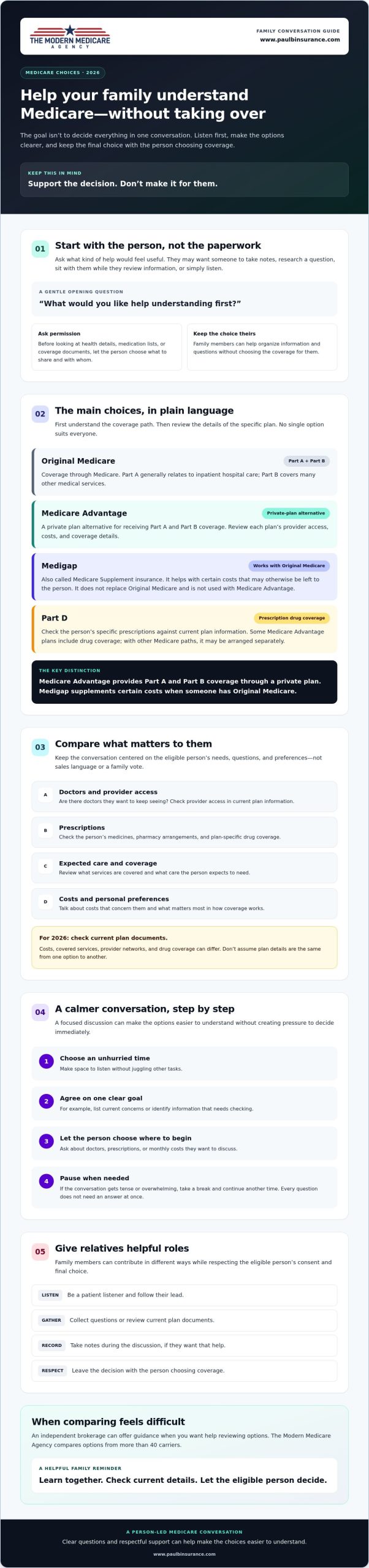
Original Medicare is coverage through Part A and Part B. Part A generally relates to inpatient hospital care, while Part B covers many other medical services. The person receives this coverage through Medicare.
Medicare Advantage is a private-plan alternative for receiving Part A and Part B coverage. Each plan has its own terms, so review its provider access, costs, and coverage details instead of assuming all plans work alike.
Medigap, also called Medicare Supplement insurance, works alongside Original Medicare and helps with certain costs that may otherwise be left to the person. It doesn’t replace Original Medicare and isn’t used with Medicare Advantage.
Here’s the simple distinction: Medicare Advantage provides Part A and Part B coverage through a private plan; Medigap supplements certain costs when someone has Original Medicare.
Explain where prescription drug coverage fits
Part D is Medicare prescription drug coverage. Covered medicines, pharmacy arrangements, and costs vary by plan, so check the person’s current prescriptions against the plan’s 2026 information. Some Medicare Advantage plans include drug coverage. With other Medicare paths, drug coverage may be arranged separately. Don’t assume the same arrangement applies to every plan.
You could put it this way: “First, let’s understand whether you’re considering Original Medicare with a supplement or a Medicare Advantage plan. Then we’ll check how prescription coverage fits and whether your specific medicines are covered.” For more detail, review this Medicare Part D guide.
These definitions can help your family discuss Medicare choices before turning the conversation into a recommendation. If questions remain about Medicare or where to find personal assistance, the official Medicare.gov help page lists ways to get support. Compare options against the eligible person’s priorities, not a universal ranking.
Compare Medicare choices together using needs, not sales language
A side-by-side comparison can make choices easier to discuss, as long as it starts with the eligible person’s priorities rather than a relative’s favorite plan. In 2026, details can vary by plan, location, and individual circumstances. Check current plan documents for the person’s area, and treat anything you haven’t confirmed as a question, not a fact.
Build a family comparison worksheet
With the person’s permission, use a simple worksheet to organize the discussion. Include only personal information they’re comfortable sharing. The aim is to identify what matters and what still needs checking, not to make an instant decision.
| Person’s priority | Questions to verify | Information source |
|---|---|---|
| Doctors and other providers | Can the person continue seeing the providers they prefer? | Current plan materials and provider information |
| Pharmacies and prescriptions | Are preferred pharmacies and current medicines included under the plan’s terms? | Current plan documents and drug information |
| Expected care | What services may be needed, and how does the plan describe its coverage? | Plan documents, with questions noted for follow-up |
| Budget preferences | Which costs should the person review, and what spending concerns matter most? | Current 2026 plan information |
| Flexibility and access | How does the person want to access care, and what plan rules should they understand? | Current plan materials |
If a provider, prescription, or cost detail is unclear, write “confirm” rather than guessing. A Medicare Advantage guide can provide background, but current plan documents are the place to verify specific details.
Keep plan details and family opinions separate
Use separate notes for confirmed facts, the eligible person’s preferences, and relatives’ recommendations. For example, “The plan document says this provider is in network” is a detail to verify against current information. “I’ve heard this plan is best” is an opinion, not proof that it fits this person.
Check provider and prescription information against current 2026 materials. Availability can vary, so don’t assume a plan works the same way for everyone or in every location. If the person is considering Original Medicare with supplemental coverage, a Medigap guide may help explain that type of coverage.
A practical way to explain Medicare choices to your family is to compare what matters to the person, record what’s confirmed, and investigate unanswered questions. The worksheet supports a thoughtful choice, not a universal ranking.
Use a simple step-by-step plan for a respectful Medicare discussion
A clear process can keep a Medicare conversation from turning into a rushed family debate. The eligible person should set the pace and decide what help they want. Plan details may change, so build in time to check current information instead of relying on memory or older summaries.
Prepare the facts and questions before meeting
Ask which information your family member would like help gathering. With their permission, collect current plan documents, prescription details, preferred doctors, and any questions they want answered. Don’t review personal information without their consent, and don’t assume last year’s coverage details still apply.
Agree on a simple goal, such as understanding how a plan handles a particular prescription or checking whether a preferred doctor is included. You might open with: “I’m here to help in the way you prefer. What would you like us to look at first, and what questions should we write down?”
Discuss, verify, and agree on follow-up
During the conversation, take one topic at a time. Invite the eligible person to explain what matters most, then separate confirmed details from anything that still needs checking. If a cost, provider, prescription, or coverage rule is unclear, write it down as a question. Verify it through official Medicare information or current plan documents before comparing choices.
End by reviewing what you learned and agreeing on what happens next. That might mean checking an unanswered question, setting another time to talk, or asking for guidance. Keep follow-up tasks specific and let the eligible person choose who will handle each one.
If an impartial comparison would help, the family can speak with a Medicare broker together. The Modern Medicare Agency is an independent brokerage that compares Medicare Advantage, Medigap, and Part D options from more than 40 carriers and provides personalized guidance. That support can help organize questions without making the decision for the person choosing coverage. For another practical resource, review the Medicare Advantage guide as you prepare questions about 2026 options.
These steps can make the discussion feel less like persuading someone and more like supporting them. Keep the conversation open, verify the details, and leave the final choice with the Medicare-eligible person.
Know when to bring in independent Medicare guidance
Family members can often learn the basics and compare information together. Outside guidance may be useful if plan terms still feel hard to understand, you’re unsure what to verify, or relatives disagree about priorities. It’s an option, not a requirement. The Medicare-eligible person can decide whether they want another perspective and who they’d like involved.
Recognize when the family needs another perspective
An independent brokerage can help organize questions and compare available Medicare Advantage, Medigap, and Part D options. The Modern Medicare Agency compares options from more than 40 carriers. A broker is not Medicare or a government representative, and guidance can’t guarantee that a particular plan will be the right fit.
Before speaking with a broker, the family can agree on questions to ask:
- Which plan choices can you compare for the eligible person’s location?
- How do you make recommendations, and which carriers or plans can you review?
- What details about providers, prescriptions, costs, or coverage still need to be verified?
- What support can you provide, and what decisions remain with the person choosing coverage?
Plan availability and support depend on location and individual circumstances. Confirm that help is available where the person lives, and check plan information against current 2026 documents. An independent comparison can add perspective, but it should support the person’s priorities rather than replace them.
Finish with a decision the eligible person understands
Before making an enrollment decision, review a short summary together: the person’s priorities, the facts you’ve confirmed, the questions still open, and the next steps everyone agreed to. Revisit current 2026 plan documents to check the details that matter to that person. If something is still unclear, pause and seek clarification rather than letting family pressure rush the choice.
The point of explaining Medicare choices to your family is to make information easier to understand while keeping the eligible person’s voice at the center. They can listen to relatives, ask for guidance, and take the time they need. The final choice is theirs.
If a personal comparison would be helpful, you can talk with a Medicare guide. It’s a way to gather information, not a commitment to choose a particular plan.
Move Forward With a Clear, Person-Led Plan
A helpful Medicare conversation doesn’t need to end with every detail settled. It can give your family a shared understanding of the main choices, a short list of questions to verify, and a respectful next step. Keep the comparison focused on the eligible person’s doctors, prescriptions, budget, and preferences. Above all, make sure they feel heard and remain in control of the decision.
If you’re still considering how to explain medicare choices to my family, remember that you don’t have to sort through every question alone. The Modern Medicare Agency is an independent brokerage that compares options from more than 40 carriers and provides personalized guidance and year-round support across more than 34 states. Availability depends on location, so confirm whether support is offered where your family member lives.
For an additional perspective, talk with a Medicare guide. A conversation can help clarify questions without taking the choice away from the person it affects. Contact The Modern Medicare Agency to discuss Medicare Advantage, Medigap, and Part D options with personalized guidance.
Frequently Asked Questions
How do I explain Medicare choices to my family?
Start with the person’s needs, then explain the choices in simple terms before comparing specific plans. A useful approach is to discuss one topic at a time, such as preferred doctors or prescriptions. Check current plan documents for details that affect the person’s location and circumstances. Write down unanswered questions instead of guessing, and let the eligible person guide the pace.
What is the simplest way to explain Medicare Advantage and Medigap?
Medicare Advantage is a private-plan alternative for receiving Medicare Part A and Part B coverage. Medigap, also called Medicare Supplement insurance, works alongside Original Medicare to supplement certain costs. They aren’t interchangeable: Medigap isn’t used with Medicare Advantage. Plan details vary, so explain the basic difference first, then review current 2026 plan information to understand the specific terms, providers, and costs that may apply.
Can my family help me choose a Medicare plan?
Yes, family can help if you want their support. You might ask a relative to gather plan documents, take notes, research a question, or simply listen while you consider your options. Share personal health, prescription, or coverage information only if you’re comfortable doing so. Your family’s role is to help you understand the choices, not to pressure you. The decision should reflect your needs and preferences.
How can I talk about Medicare when my family disagrees?
Keep the conversation focused on your priorities, not on who has the strongest opinion. Ask each person to explain their concern, then separate verified plan details from personal preferences or recommendations. Review one question at a time, such as whether a provider is included, and confirm it using current 2026 plan information. If the discussion gets tense, pause and return to it after everyone has had time to reflect.
What information should we gather before discussing Medicare plans?
With the eligible person’s permission, gather current plan documents, preferred doctors, pharmacies, prescription details, expected care needs, and budget preferences. Make a list of questions, too. For example, note which providers the person wants to keep seeing and which medicines they want to check against plan information. Use current 2026 materials, since details can vary by plan and location. Mark unknown information for follow-up rather than making assumptions.
Can a Medicare broker explain choices to my family?
Yes. A Medicare broker can help explain and compare plan options, but the eligible person remains the decision-maker. The Modern Medicare Agency is an independent brokerage that compares Medicare Advantage, Medigap, and Part D options from more than 40 carriers, with personalized guidance and year-round support across more than 34 states. Confirm service availability where the person lives, and verify specific 2026 plan details before making a decision.
Should my family choose my Medicare plan for me?
No. Family members can help you understand options and gather information, but the plan choice should remain yours. Tell relatives what kind of help you want, and let them know which priorities matter most to you. Before deciding, review current 2026 plan documents and make sure you understand the details that affect your needs. It’s fine to take time, ask questions, or seek another perspective before choosing.

Article by
Paul Barrett
Paul Barrett, CMIP is the founder of The Modern Medicare Agency, an independent Medicare-only brokerage based in Melville, NY. With 18 years of Medicare-exclusive experience, a CMIP designation, and more than 5,000 clients served across 37 states, Paul is one of the most credentialed independent Medicare specialists on Long Island — and one of the most direct.
He represents 40+ carriers with no quotas and no allegiances, which means his recommendations are based entirely on what fits each client's specific situation. He is the author of Medicare Mastery Unlocked and host of the Wise Guys Retirement Talk podcast. His content is grounded in primary sources, real carrier intelligence, and 18 years of watching what happens when people get Medicare right — and when they don't.
📞 631-358-5793 | paulbinsurance.com