




What if Medicare covers a cancer service, but your plan’s network or approval rules still affect where and when you can receive it? In 2026, medicare coverage for cancer treatment depends on more than your diagnosis. It can vary based on whether care is inpatient or outpatient, how a medicine is given, and whether you have Original Medicare or Medicare Advantage.
It’s understandable to feel unsure when you’re already dealing with so much. In general, Part A may help cover inpatient hospital care, Part B covers many outpatient services and treatments, and Part D may cover prescription drugs you take at home. Medigap can help pay some costs associated with Original Medicare. Medicare Advantage plans may have provider networks and plan rules to consider. Coverage and costs depend on your specific plan and treatment.
This guide explains how different parts of Medicare may apply to cancer care, compares Original Medicare with Medigap and Medicare Advantage, and outlines what to review about specialists, hospitals, drug coverage, and prior authorization. Use it to organize your questions before treatment begins and compare your coverage with more confidence.
Key Takeaways
- Medicare coverage for cancer treatment can depend on where care is given, how treatment is delivered, and the rules of your plan.
- Learn which Medicare parts may apply to hospital care, outpatient treatment, prescription drugs, and qualifying clinical trials.
- Compare Original Medicare, Medigap, and Medicare Advantage to understand differences in provider access, drug coverage, and cost-sharing.
- Use a practical review process to check plan documents, treatment details, and potential out-of-pocket costs before care begins.
- Personalized plan comparisons can help you weigh Medicare Advantage, Medigap, and Part D options in 2026.
What Medicare coverage for cancer treatment can include in 2026
Coordinating cancer treatment is demanding enough without having to untangle insurance at the same time. Start by identifying how each service is provided and billed. Medicare coverage for cancer treatment depends on your type of coverage, where care is provided, and any rules that apply to your plan.
With Original Medicare, Part A generally covers eligible inpatient hospital care, while Part B covers eligible outpatient and physician services. Medicare Advantage, also called Part C, provides Part A and Part B benefits through a private plan, which may have network and approval rules. Medigap is optional supplemental insurance that works with Original Medicare to help pay some out-of-pocket costs. Part D covers eligible outpatient prescription drugs according to the plan’s drug list, or formulary. For a general overview of the program and its parts, see Medicare.
Coverage doesn’t mean you’ll have no costs. In 2026, the Part A inpatient hospital deductible is $1,736 per benefit period. The standard Part B deductible is $283, followed by 20% coinsurance for most Part B services. What you pay may differ based on your coverage, other insurance, and the services you receive.
Which parts of Medicare may cover cancer care?
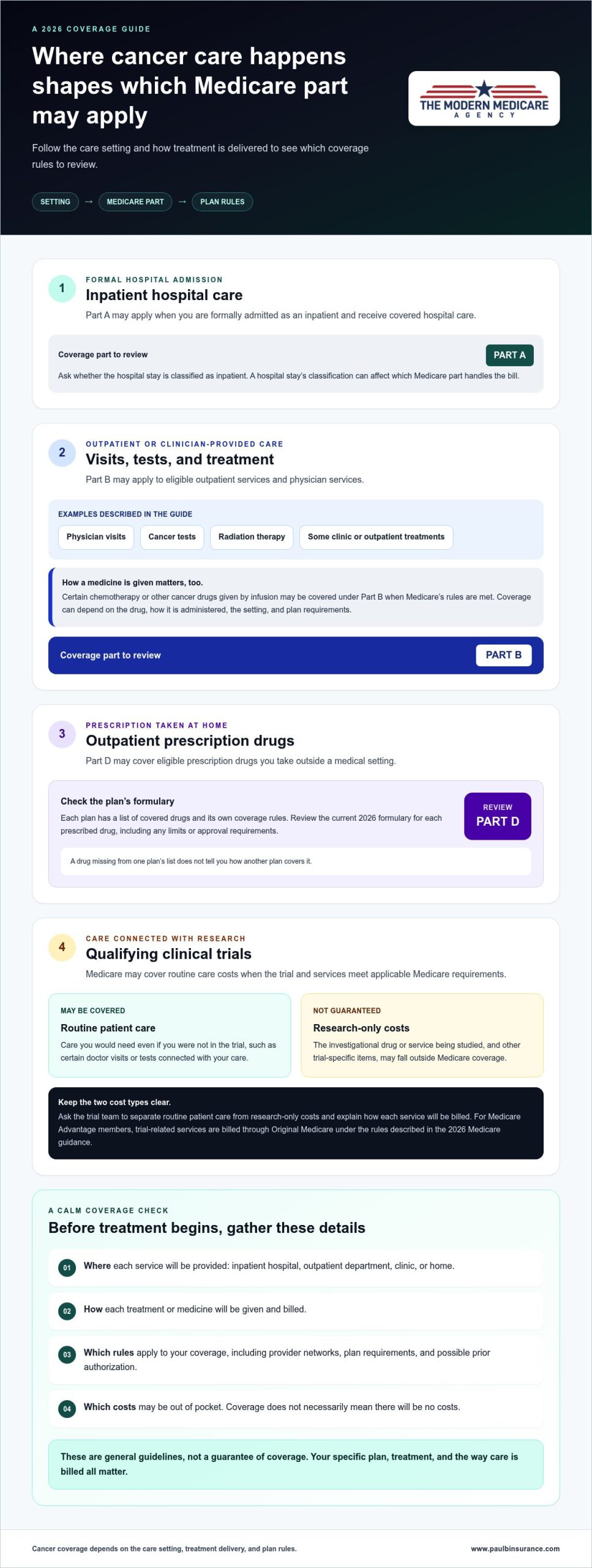
Part A may apply when you’re formally admitted to a hospital as an inpatient and receive covered hospital care. Part B may apply to eligible outpatient services such as physician visits, cancer tests, radiation therapy, and some treatments given in a clinic or hospital outpatient department. Part D may cover prescribed drugs you take outside a medical setting, subject to the plan’s formulary and coverage rules.
These are general categories, not a guarantee that a specific service or drug will be covered. Medicare Advantage plans also have plan-specific terms. If you’re comparing plan types, the Medicare Advantage guide explains key features to consider.
Why the treatment setting matters
The same cancer diagnosis can involve inpatient hospital care, outpatient hospital services, physician appointments, and prescriptions you take at home. Those services may be billed through different Medicare components. For example, a hospital stay classified as inpatient may involve Part A, while outpatient or observation services generally fall under Part B. A prescription filled for home use may instead be considered under Part D.
Where you receive cancer care can help determine which part of Medicare handles the bill. Before treatment begins, ask how each planned service will be classified and review the rules that apply to your coverage.
How Medicare coverage applies to cancer treatment, drugs, and clinical trials
Cancer care can include several types of services, and they may not all be covered through the same part of Medicare. The way a treatment is given and billed can matter as much as its name. These general guidelines can help you identify what to review, but your coverage depends on your plan and the care you receive.
Outpatient treatment and prescription drugs
Treatment provided by a clinician in a doctor’s office or hospital outpatient department may be covered under Part B when it meets Medicare’s coverage rules. This can include certain chemotherapy or other cancer drugs given by infusion, along with related eligible services. Coverage may depend on the drug, how it’s administered, the setting, and your plan’s requirements. Some services or medicines may also need prior authorization.
A prescription you pick up and take at home is generally handled differently. Part D may cover eligible outpatient prescription drugs, but each plan has a formulary, or list of covered drugs, and its own coverage rules. Before treatment starts, check the current 2026 formulary for every prescribed drug, including any limits or approval requirements. A drug’s absence from one plan’s list doesn’t tell you how another plan covers it.
For a closer look at prescription coverage, read this Medicare Part D guide. Comparing plan details can help you understand drug coverage, but it can’t replace advice from your oncology team about treatment choices.
Cancer treatment in a clinical trial
Medicare may cover routine care costs for a qualifying clinical trial when the services meet Medicare’s rules. Routine care can include services you would need even if you weren’t in the trial, such as certain doctor visits or tests connected with your care. The trial and the services must meet applicable Medicare requirements.
That doesn’t mean every trial expense is covered. The investigational drug or service being studied may not be covered, and other trial-specific items may also fall outside Medicare coverage. Ask the trial team to separate routine patient care from research-only costs and explain how each service will be billed. If you have Medicare Advantage, trial-related services are billed through Original Medicare under the rules described in the 2026 Medicare guidance. Understand how this applies to your care before enrolling.
For a more focused coverage review, gather the treatment name, where it will be given, the prescribing clinician, and whether it’s part of a clinical trial. These details give you a clearer basis for understanding how your Medicare coverage for cancer treatment may apply.
Original Medicare, Medigap, and Medicare Advantage: comparing cancer coverage
Choosing coverage during cancer treatment can feel like a choice between provider access and predictable costs. The details matter more than the plan label. In 2026, compare your doctors, treatment locations, prescription drugs, and patient cost-sharing under each option before relying on it for care.
| Coverage option | Provider access | Prescription drugs | Cost-sharing |
|---|---|---|---|
| Original Medicare | Part A and Part B coverage applies to eligible services from providers who accept Medicare. Confirm that each doctor and facility accepts Medicare and is taking patients. | Part D is generally separate. Check the drug plan’s formulary and rules for each prescription. | You pay applicable deductibles and coinsurance. There’s no annual out-of-pocket limit for Original Medicare by itself. |
| Original Medicare with Medigap | Medigap supplements Original Medicare. It generally doesn’t create a provider network or replace Parts A and B. | Part D remains separate. Medigap policies sold today don’t include outpatient prescription drug coverage. | Depending on the policy, Medigap may help pay certain Original Medicare cost-sharing. Benefits and availability can vary. |
| Medicare Advantage | Uses plan-specific provider networks and may have referral or prior-authorization requirements. Rules differ by plan. | Many plans include prescription drug coverage, but not all. Review the plan’s drug list and requirements. | Plan copayments, coinsurance, and out-of-pocket limits vary. Check the 2026 plan documents for details. |
Original Medicare with or without Medigap
With Original Medicare, Part A and Part B cover eligible hospital and medical services under Medicare’s rules. Medigap doesn’t replace this coverage or decide which care Medicare approves. Depending on the policy, it can help pay certain costs left by Original Medicare. Policies aren’t identical, and availability and enrollment rules can vary by state and situation. Read this Medicare Supplement insurance guide to understand how Medigap works alongside Original Medicare.
Medicare Advantage during cancer treatment
Medicare Advantage plans provide Part A and Part B coverage through private plans, but networks and coverage rules are plan-specific. Before treatment, review whether your oncologist, hospital, lab, and other planned facilities participate. Check referral requirements, prior authorization for proposed services, and how the plan handles each prescribed drug. Network or approval rules can affect where and how you receive care, so don’t assume a provider or treatment is covered based on the plan name alone.
For a useful comparison of Medicare coverage for cancer treatment, line up your current providers, expected services, medications, and plan cost-sharing. This makes meaningful differences easier to spot without treating plan comparison as medical advice or assuming any option guarantees access to a particular doctor, treatment, or drug.
How to review cancer treatment coverage and potential out-of-pocket costs
Before treatment begins, an organized review can help you spot coverage questions early. Gather your current plan documents and treatment details from your care team. This can help you plan, but it doesn’t replace medical advice or a formal coverage decision from your plan.
A practical checklist before treatment begins
- List the planned care. Write down your oncologist, hospital or treatment facility, proposed services, tests, and prescribed drugs. Note where each service will take place and how each medicine will be given.
- Check provider participation. For Medicare Advantage, use the current provider directory to review each doctor and facility. With Original Medicare, confirm that providers accept Medicare.
- Review plan rules. Check whether referrals or prior authorization apply to planned services, tests, or treatments. Keep a copy of any written coverage decision and note who issued it.
- Check prescription coverage. For each outpatient prescription, review the current Part D formulary or Medicare Advantage drug list, including any approval requirements or limits.
- Record follow-up contacts. Note the plan department or provider-team contact for coverage questions, and ask how to request a written explanation if coverage is unclear.
Understanding 2026 costs without guessing
Compare costs by category rather than relying on a single estimate. A premium is the amount you pay to keep coverage. A deductible is what you pay for covered care before the plan begins paying under its terms. Copayments are set amounts for services, while coinsurance is a share of the allowed cost. An out-of-pocket limit, where applicable, is the most you pay for covered services under the plan’s rules. It doesn’t include every possible expense, such as premiums or noncovered care.
For 2026, Medicare lists the Part A inpatient hospital deductible as $1,736 per benefit period and the Part B deductible as $283 for the year. After the Part B deductible, coinsurance is 20% for most services. Medicare Part D has a $2,100 out-of-pocket spending cap for covered drugs. Medicare Advantage plans also have plan-specific cost-sharing and limits; the 2026 maximum in-network out-of-pocket limit is $9,250. These figures apply to particular Medicare coverage categories and don’t predict your personal bill. Review current Medicare and CMS materials alongside your plan’s Evidence of Coverage and Summary of Benefits.
To compare plan rules and costs with personal guidance, review available Medicare Advantage plan options. A careful review of Medicare coverage for cancer treatment can clarify what to ask next, while your clinicians remain the best source for treatment decisions.
Choose your next Medicare coverage step with calm, personal guidance
You don’t have to sort through every plan detail at once. Start with the information that connects your care to your coverage: the treatment setting, the doctors and facilities involved, prescribed medications, and the costs and plan rules that apply. Reviewing these details can make Medicare coverage for cancer treatment easier to compare, while decisions about your care stay with you and your treatment team.
What to gather for a plan comparison
Before reviewing coverage, bring together the plan information you have and the details your care team has shared. A simple folder or notes page can help you track questions and answers.
- Your current Medicare coverage and plan documents, including any written coverage decisions.
- The names of your oncologist, other specialists, hospitals, clinics, and treatment facilities.
- The planned services and where each one will be provided, such as in a hospital or outpatient clinic.
- Your prescribed medications, including which are taken at home and which are administered by a clinician.
- Upcoming appointments and any network, referral, prior-authorization, or drug-list questions raised by your care team.
This information helps focus the comparison on your actual needs rather than broad plan descriptions. Keep treatment choices and medical questions with your clinicians. A plan review is for clarifying insurance details, not deciding which treatment is right for you.
Compare options with a Medicare guide
An independent brokerage can help you compare available Medicare Advantage, Medigap, and Part D options, understand differences in provider networks and drug coverage, and review how plan cost-sharing works. The goal is to make trade-offs clearer, not to promise that a plan will cover a particular doctor, medicine, or treatment. Recommendations depend on your needs, location, and the plans available to you in 2026.
The Modern Medicare Agency is an independent brokerage with access to plans from more than 40 carriers and supports clients across more than 34 states. Comparing options across carriers can help you understand the choices available to you. The right fit depends on your circumstances and the terms of each plan.
If you’d like to talk through your options, you’re welcome to get personal Medicare guidance. Bring your plan questions and care details, and take the conversation one step at a time.
Take your next Medicare coverage step with confidence
In 2026, the details of your cancer care matter when reviewing coverage: where treatment will happen, which doctors and facilities are involved, and whether medicines are administered in a clinic or taken at home. Original Medicare, Medigap, Medicare Advantage, and Part D each play different roles. Check provider participation, drug lists, plan rules, and cost-sharing before care begins.
A thoughtful review can make medicare coverage for cancer treatment easier to understand, but it can’t replace medical guidance from your treatment team or a formal decision from your plan. You don’t have to compare every detail alone. The Modern Medicare Agency is an independent brokerage that helps people compare plans from more than 40 carriers, with personalized guidance and year-round support across more than 34 states.
For help understanding available Medicare Advantage, Medigap, and Part D options, get personal guidance comparing Medicare options. Take the process one question at a time and move forward with greater clarity.
Frequently Asked Questions
Does Medicare cover cancer treatment?
Yes, Medicare may cover medically necessary cancer care when it meets Medicare’s coverage rules. Part A generally applies to eligible inpatient hospital care, while Part B covers many eligible outpatient services and treatments. Part D may cover certain prescription drugs you take at home. Your plan type, treatment setting, and specific service or drug all matter, so coverage and out-of-pocket costs vary. Check your 2026 plan documents before treatment.
Does Medicare cover chemotherapy and radiation?
Medicare may cover chemotherapy and radiation when they meet coverage requirements. Part B generally covers eligible chemotherapy drugs given by a doctor or in an outpatient setting, as well as eligible radiation therapy. If care is part of a covered inpatient hospital stay, Part A may apply. Your plan’s rules, including any prior authorization requirements, can affect coverage. Confirm how each planned service will be billed before treatment begins.
Does Medicare cover cancer drugs taken at home?
Part D may cover cancer drugs prescribed for you to take at home, but coverage depends on the plan’s formulary and requirements. Review the current 2026 drug list for each medication and check for restrictions such as prior authorization or quantity limits. Some drugs may be covered under Part B instead, depending on how they’re used and provided. Ask your care team which benefit may apply to each prescription.
Does Medicare Advantage cover cancer treatment?
Medicare Advantage plans cover Part A and Part B services, including eligible cancer care, but each plan has its own provider network and coverage rules. Check whether your oncologist and treatment facility participate, and review any referral or prior authorization requirements for proposed services. If the plan includes prescription drug coverage, check its drug list too. Confirm the details for your specific plan before relying on coverage for treatment.
Can I use Medigap with Medicare Advantage for cancer treatment?
No. Medigap is designed to supplement Original Medicare, not Medicare Advantage. It generally can’t pay Medicare Advantage deductibles, copayments, or other plan costs. If you have Medicare Advantage, review that plan’s own cost-sharing and coverage rules. If you have Original Medicare, a Medigap policy may help pay certain costs, depending on the policy. Availability and enrollment rules can vary, so check the rules that apply to your situation in 2026.
Does Medicare cover cancer treatment in a clinical trial?
Medicare may cover routine care costs connected with a qualifying clinical trial when the trial and services meet Medicare’s requirements. This can include eligible care you would receive even outside the study. Investigational items or services being tested, and other trial-related expenses, may not be covered. Ask the trial team to explain which costs are routine patient care and which are research-only. People with Medicare Advantage should also ask how trial-related services will be billed.
How can I check what my Medicare plan will pay for cancer treatment?
Gather the names of your doctors and facilities, planned services, treatment setting, and prescribed drugs. Review your plan’s current provider directory, Evidence of Coverage, drug formulary, and written rules for referrals and prior authorization. Ask how each service will be billed and request a written coverage decision when needed. These steps can clarify Medicare coverage for cancer treatment and help you understand possible costs, but they don’t replace medical advice from your care team.

Article by
Paul Barrett
Paul Barrett, CMIP is the founder of The Modern Medicare Agency, an independent Medicare-only brokerage based in Melville, NY. With 18 years of Medicare-exclusive experience, a CMIP designation, and more than 5,000 clients served across 37 states, Paul is one of the most credentialed independent Medicare specialists on Long Island — and one of the most direct.
He represents 40+ carriers with no quotas and no allegiances, which means his recommendations are based entirely on what fits each client's specific situation. He is the author of Medicare Mastery Unlocked and host of the Wise Guys Retirement Talk podcast. His content is grounded in primary sources, real carrier intelligence, and 18 years of watching what happens when people get Medicare right — and when they don't.
📞 631-358-5793 | paulbinsurance.com