




Could the timing of your retirement change how Medicare works with your FEHB coverage? For many federal employees, that’s the key question behind medicare for retiring federal employees. The answer depends on details such as when you leave service, whether you can continue FEHB in retirement, and when you enroll in Medicare.
It’s understandable to feel unsure. FEHB and Medicare can work together, but the right approach varies by retiree and FEHB plan. Enrollment timing matters too: missing a deadline may mean a coverage gap or a late-enrollment penalty. And comparing Original Medicare, Medicare Advantage, and FEHB can feel difficult because they’re structured differently.
This 2026 guide walks through those decisions step by step. You’ll learn what to review before leaving federal service, how timing can affect Medicare enrollment, and what to compare across your options. You’ll also get a practical checklist to help organize your transition.
Key Takeaways
- For medicare for retiring federal employees, the right coverage path depends on retirement timing, Medicare eligibility, and FEHB status.
- Compare how Original Medicare and your specific FEHB plan may work together before deciding what coverage to keep.
- Review provider access, prescription coverage, and plan-specific costs when weighing FEHB, Original Medicare, and Medicare Advantage.
- Gather your FEHB documents, retirement estimates, medication list, and preferred providers to make your comparison more personal.
- Once you understand your FEHB situation, compare Medicare Advantage, Medigap, and Part D options with guidance suited to your needs.
Retiring from Federal Service? Start With FEHB and Medicare Timing
Retirement can raise several coverage questions at once: Can you keep your federal health plan? Are you eligible for Medicare? When should you make each decision? There isn’t one Medicare answer for every federal employee. Your age, work status, retirement date, and current coverage all matter.
FEHB, the Federal Employees Health Benefits program, offers health insurance coverage to eligible federal employees and retirees. Medicare is a separate federal health insurance program with its own eligibility and enrollment rules. The Federal Employees Health Benefits Program (FEHB) is distinct from Medicare, although eligible retirees may have both.
Medicare eligibility and eligibility to continue FEHB in retirement are separate questions. Review each one based on your circumstances. Qualifying for Medicare doesn’t by itself establish that you can keep FEHB, and having FEHB doesn’t determine when you qualify for Medicare. For medicare for retiring federal employees, keeping those decisions separate is a useful first step.
Can federal retirees keep FEHB after retirement?
FEHB continuation isn’t automatic for everyone leaving federal service. The Office of Personnel Management (OPM) sets requirements for continuing coverage into retirement, and the rules that apply depend on your situation. Before setting a retirement date, review OPM’s current 2026 guidance and compare its requirements with your enrollment and retirement circumstances. Medicare eligibility alone doesn’t settle the FEHB question.
If you’re still working out whether you qualify for Medicare, review Medicare eligibility separately. That helps keep Medicare qualifications distinct from FEHB continuation rules.
When does Medicare enter the retirement plan?
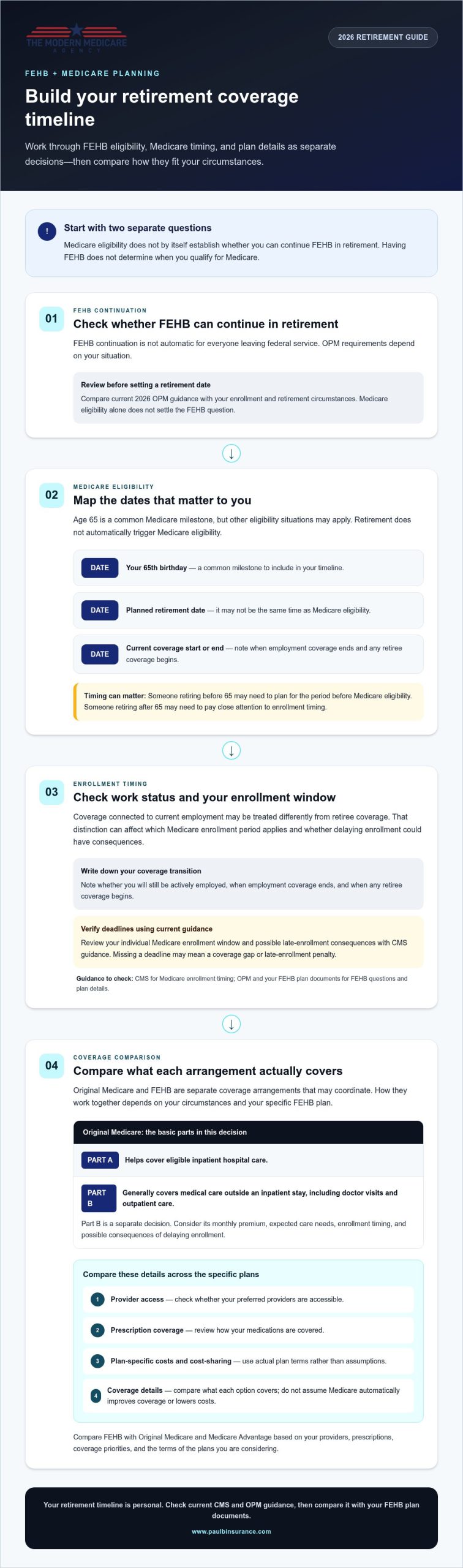
Age 65 is a common Medicare milestone, but other eligibility situations may apply. Retirement doesn’t automatically trigger Medicare eligibility, and turning 65 doesn’t mean you’ll retire at the same time. Someone who retires before 65, for example, may need to plan for the period before Medicare eligibility. Someone retiring after 65 may need to pay close attention to enrollment timing.
Map out the dates that matter to you: your 65th birthday, planned retirement date, and the start or end of any current coverage. Then review your individual Medicare enrollment window using current Centers for Medicare & Medicaid Services (CMS) guidance. For FEHB questions, review OPM guidance and your plan documents. A clear timeline helps you avoid making one decision based on assumptions about the other.
How Medicare Parts A and B May Coordinate With FEHB
Once you’ve established your likely Medicare eligibility and FEHB status, look at what each coverage arrangement does. Original Medicare includes Part A, which helps cover inpatient hospital care, and Part B, which helps cover medical services such as doctor visits and outpatient care. Together, they provide a starting point for comparing benefits, but they don’t automatically replace or duplicate every part of FEHB coverage.
Medicare and FEHB are separate coverage arrangements that may coordinate, but how they work together depends on your circumstances and your specific FEHB plan. Don’t assume one program always pays first or that adding Medicare affects every FEHB plan in the same way. OPM’s guidance on Medicare and FEHB explains the federal benefits context. Your plan documents provide details about your coverage.
What Parts A and B cover in this decision
Part A focuses on eligible inpatient hospital care. Part B generally covers medical care outside an inpatient stay, including services from doctors and other providers. When comparing Medicare with FEHB, look beyond the names of the benefits. Review your plan’s coverage details, provider access, prescription coverage, and cost-sharing alongside the Medicare coverage you’re considering.
Part B is a separate decision from Part A. It can involve a monthly premium, your expected care needs, enrollment timing, and possible consequences of delaying enrollment. In 2026, compare current Medicare information with your FEHB plan documents. Don’t assume either option covers every cost or service you expect.
Why active employment and retirement status matter
Coverage connected to current employment may be treated differently from coverage you have as a retiree. That distinction can affect which Medicare enrollment period applies and whether delaying enrollment could have consequences. The details depend on your circumstances, so a coworker’s experience may not apply to your situation.
Before deciding about Part B, write down whether you’ll still be actively employed, when your employment coverage ends, and when any retiree coverage begins. Then review your enrollment window and possible late-enrollment consequences using CMS guidance. Compare that information with OPM guidance and your FEHB plan documents. For medicare for retiring federal employees, these checks are more useful than relying on a universal payer rule.
After clarifying how FEHB fits your situation, compare Medicare plan paths, including Medicare Advantage options, based on your providers, prescriptions, and coverage priorities.
Compare FEHB With Original Medicare and Medicare Advantage
There’s no single coverage path that fits every federal retiree. As you compare options in 2026, focus on how coverage is arranged, which providers you can see, how prescriptions are covered, and what costs apply under the specific plans you’re considering. Compare actual plan terms rather than assuming that adding Medicare will automatically improve coverage or lower costs.
| Coverage path | Coverage structure | Provider access | Prescription coverage | Costs to review |
|---|---|---|---|---|
| Original Medicare with FEHB | Parts A and B work alongside an FEHB plan, subject to plan terms. | Review Medicare access and the FEHB plan’s provider rules. | Check how the FEHB plan handles prescription coverage and whether separate drug coverage is relevant. | Compare premiums, deductibles, cost-sharing, and any plan-specific coordination. |
| Medicare Advantage | A private plan provides Medicare benefits under its terms. | Check the plan’s service area and provider network rules. | Confirm whether drug coverage is included and which medications are covered. | Review the plan’s premiums and other out-of-pocket costs, along with how it interacts with FEHB. |
Original Medicare with FEHB: questions to compare
Start with your FEHB plan documents. Find out how the plan coordinates with Parts A and B, whether your preferred providers are accessible under its rules, and how prescription benefits work. Compare the plan’s cost-sharing and premiums before and after Medicare enrollment if the documents explain those effects. Don’t assume every FEHB plan coordinates the same way.
Medigap, also called Medicare Supplement insurance, is a separate type of coverage designed to help pay certain costs under Original Medicare. It isn’t the same as FEHB. Consider its role only after reviewing how your FEHB plan and Medicare fit together. This guide to Medicare Advantage also explains a different Medicare coverage structure to compare with Original Medicare.
Medicare Advantage and federal retiree coverage
Medicare Advantage is an alternative way to receive Medicare benefits through a private plan. Plans, networks, and covered services can vary by location and plan terms. Before considering this path, compare provider access, prescription coverage, costs, and how enrollment may affect your FEHB arrangement. Review the plan documents rather than assuming FEHB eligibility continues unchanged or that a plan includes extra benefits or savings.
For medicare for retiring federal employees, the fairest comparison reflects your own providers, prescriptions, expected care, and FEHB plan terms. Putting those details side by side can help you identify what to resolve before choosing a coverage path.
A 2026 Checklist for Making Your Federal Retirement Medicare Decision
Preparation can make Medicare and FEHB choices easier to compare. Use this sequence to organize your decisions, then verify dates, costs, and plan details using current official information for 2026.
- Confirm your retirement eligibility and expected date. Record when you plan to leave federal service and when any current employment coverage is expected to end.
- Review your FEHB status. Note your current enrollment and gather the plan’s latest documents. Review OPM guidance to understand whether you can continue FEHB in retirement and how your plan describes coordination with Medicare.
- Establish your Medicare eligibility. Record the details that affect your eligibility and enrollment timing. Review your individual enrollment window and current rules using CMS guidance rather than relying on someone else’s experience.
- Map out the dates. Put your planned retirement date, Medicare-related dates, and coverage start or end dates on one timeline. Review enrollment steps with CMS and your benefits administrator.
- Gather the information you’ll use to compare options. Collect retirement estimates, FEHB plan documents, a current medication list, preferred doctors and other providers, travel needs, and anticipated care needs.
Build a simple comparison worksheet
For each coverage path you’re considering, record the same details. Use current plan documents rather than memory or general descriptions. A consistent comparison can reveal trade-offs that a single premium or advertised benefit might not show.
- Premiums and deductibles: Record the amounts shown in current 2026 materials and note what each amount applies to.
- Provider access: Check whether your preferred doctors and facilities fit the plan’s access or network rules.
- Drug coverage: Review how your prescriptions are covered, including plan-specific restrictions or costs.
- Out-of-pocket exposure: Compare cost-sharing and any applicable out-of-pocket limits described in the plan documents.
- Coordination: Note how each option describes its relationship with Medicare and FEHB.
Resolve questions before choosing
Does each option give you access to the providers you want? How are your regular prescriptions covered? What costs could you face over the year beyond the monthly premium? Use CMS guidance to confirm enrollment timing, OPM guidance for FEHB continuation and coordination, and your plan documents for coverage-specific details.
For medicare for retiring federal employees, the most useful comparison starts with your needs and verified plan terms. Once your FEHB and timing details are clear, compare your Medicare plan options with an independent brokerage that can help you review Medicare Advantage, Medigap, and Part D plans.
Get Personal Help Comparing Medicare Options Alongside FEHB
Once you’ve reviewed your FEHB status, Medicare eligibility, and timing, compare Medicare plan options against your priorities. The Modern Medicare Agency is an independent brokerage that helps people compare Medicare Advantage, Medigap, and Part D plans from more than 40 carriers. Its personalized guidance focuses on helping you understand and compare Medicare plan choices.
That distinction matters. A Medicare comparison can help you understand your Medicare choices, while your FEHB plan documents and federal benefits guidance explain how FEHB may fit alongside them. No single path is right for every federal retiree. Your location, preferred providers, prescriptions, and coverage priorities all shape the comparison.
What an independent Medicare comparison can clarify
An independent comparison can help you review eligible Medicare plan options and understand their trade-offs in plain language. Consider whether a plan’s provider access suits your needs, how it covers your medications, and how its terms match the priorities you identified. The goal is to make the differences clearer, not to assume one plan works for everyone retiring from federal service.
If prescription coverage is a key part of your decision, review your medications and compare how available options address them. This guide to Medicare Part D coverage can help explain the role of standalone prescription drug coverage as you assess your choices.
Move forward with a clearer plan
Bring your FEHB plan details, retirement timeline, medication list, and preferred providers into the comparison. These details keep the discussion grounded in your needs rather than broad assumptions about federal retirees. You can also identify questions about FEHB coordination to resolve through your plan documents and federal benefits information.
Sorting out medicare for retiring federal employees can feel like several decisions arriving at once. A careful comparison can make Medicare options easier to understand and help you identify what to investigate next. Explore personalized Medicare guidance from The Modern Medicare Agency and take your next step with greater clarity.
Take Your Next Medicare Decision One Step at a Time
In 2026, a clear starting point is to treat Medicare eligibility and continued FEHB coverage as separate questions. Your retirement date, work status, and coverage details can shape when to act, so review your enrollment timing and specific FEHB plan documents.
Then compare your options based on the care you expect, your preferred providers, prescriptions, and plan costs. Original Medicare with FEHB, Medicare Advantage, and other Medicare coverage choices have different terms, and no single path is right for every federal retiree. A thoughtful comparison can help you understand the trade-offs before choosing.
For medicare for retiring federal employees, personalized guidance can make the options easier to sort through. The Modern Medicare Agency is an independent brokerage comparing Medicare plans from more than 40 carriers, with personalized guidance and year-round support across more than 34 states. Its guidance helps you compare Medicare plan options using your needs and coverage priorities.
Explore personalized Medicare plan guidance and move forward with greater clarity.
Frequently Asked Questions
Can federal retirees keep FEHB after they retire?
Some federal retirees can continue FEHB, but it isn’t automatic for every employee. Eligibility depends on meeting OPM’s continuation requirements, so review current 2026 guidance against your enrollment and retirement history before leaving federal service. Medicare eligibility doesn’t establish FEHB continuation eligibility. For medicare for retiring federal employees, treat these as separate questions and clarify both before setting your coverage plans.
Do federal retirees have to enroll in Medicare Part B at age 65?
No, Part B isn’t automatically required for every federal retiree at 65. But delaying can have consequences, including a possible late-enrollment penalty or coverage gap, depending on your circumstances. Whether you can delay without those consequences may depend on the coverage you have through current employment and your enrollment period. Before deciding, confirm your personal timing using CMS guidance and review how your FEHB plan works with Medicare.
Does FEHB count as employer coverage for delaying Medicare Part B?
It may, if your FEHB coverage is based on current employment, but don’t assume retiree FEHB has the same effect. Coverage based on current employment can affect Medicare enrollment timing; coverage continued after retirement may be treated differently. The distinction matters if you’re considering delaying Part B. Review CMS guidance alongside your employment status and FEHB documents.
Is Medicare or FEHB primary for a retired federal employee?
For a retiree enrolled in both, Medicare often pays first for services it covers, with FEHB potentially helping with remaining covered costs. But payer order and benefits can depend on your circumstances and the specific FEHB plan. Don’t rely on a general rule to predict your costs. Review your plan’s coordination provisions and current OPM guidance to understand how claims may be handled for your coverage.
Can I have FEHB and Medicare Advantage at the same time?
It may be possible to have FEHB coverage while enrolled in Medicare Advantage, but the effect depends on the plans and how you arrange your coverage. Medicare Advantage is a private-plan way to receive Medicare benefits, and its service area, provider network, and drug coverage vary. Before enrolling, compare the plan’s terms with your FEHB documents and review how the two arrangements may interact.
Does Medicare cover FEHB premiums or reimburse Part B premiums?
Medicare doesn’t pay your FEHB premiums. Whether an FEHB plan offers any Part B premium reimbursement is a separate, plan-specific question, so don’t assume it applies to your coverage. Review the current 2026 plan brochure or benefits documents for any reimbursement terms and eligibility conditions. Compare the plan’s full costs and coverage rather than basing your decision only on whether a reimbursement is available.
What happens to FEHB if I enroll in a Medicare Advantage plan?
Enrollment in Medicare Advantage doesn’t have one universal effect on FEHB. Your options and how coverage coordinates depend on your FEHB plan, the Medicare Advantage plan, and whether you take any separate action regarding FEHB. Before enrolling, read both plans’ current terms and review OPM guidance. Don’t assume FEHB automatically ends, stays unchanged, or provides duplicate benefits without checking the details.
When should a retiring federal employee compare Medicare plans?
Start comparing before your retirement or Medicare enrollment decisions are due, so you have time to review options and verify dates. Gather your FEHB documents, retirement timeline, medication list, and preferred providers. Then compare Medicare Advantage, Medigap, and Part D choices against your needs and FEHB terms. Enrollment periods depend on individual circumstances, so confirm your dates using CMS guidance and your benefits administrator.

Article by
Paul Barrett
Paul Barrett, CMIP is the founder of The Modern Medicare Agency, an independent Medicare-only brokerage based in Melville, NY. With 18 years of Medicare-exclusive experience, a CMIP designation, and more than 5,000 clients served across 37 states, Paul is one of the most credentialed independent Medicare specialists on Long Island — and one of the most direct.
He represents 40+ carriers with no quotas and no allegiances, which means his recommendations are based entirely on what fits each client's specific situation. He is the author of Medicare Mastery Unlocked and host of the Wise Guys Retirement Talk podcast. His content is grounded in primary sources, real carrier intelligence, and 18 years of watching what happens when people get Medicare right — and when they don't.
📞 631-358-5793 | paulbinsurance.com