




Could an emergency-room visit cost more than urgent care, even when both are covered by Medicare? It depends on more than where you receive care. Medicare coverage for urgent care vs emergency room visits also depends on whether you have Original Medicare or Medicare Advantage, your plan’s cost-sharing rules, and the services you receive.
It’s understandable to worry about a surprise deductible, copayment, or coinsurance bill when you’re already feeling unwell. In 2026, Original Medicare generally covers outpatient urgent-care and emergency-room visits under Part B. After you meet the annual Part B deductible, you typically pay 20% of the Medicare-approved amount. Medicare Advantage plans cover these services too, but copayments and other costs vary by plan.
This guide explains the main coverage differences, what can affect your out-of-pocket costs, and which plan documents to review before you need care. You’ll also learn how to compare your plan’s rules without losing sight of what matters most: if you think you’re having a medical emergency, seek emergency care right away.
Key Takeaways
- Medicare coverage for urgent care vs emergency room visits depends on your type of Medicare, plan rules, and the services you receive.
- A clinician’s bill and a hospital or facility charge may be handled separately.
- Before a nonemergency visit, identify your coverage and review the plan document that explains your cost sharing.
- Compare Medicare Advantage and Original Medicare costs without delaying emergency care when you need it.
- An independent guide can help you compare Medicare plan benefits, while medical decisions remain between you and your care team.
Medicare Coverage for Urgent Care vs. the Emergency Room: The Basic Difference
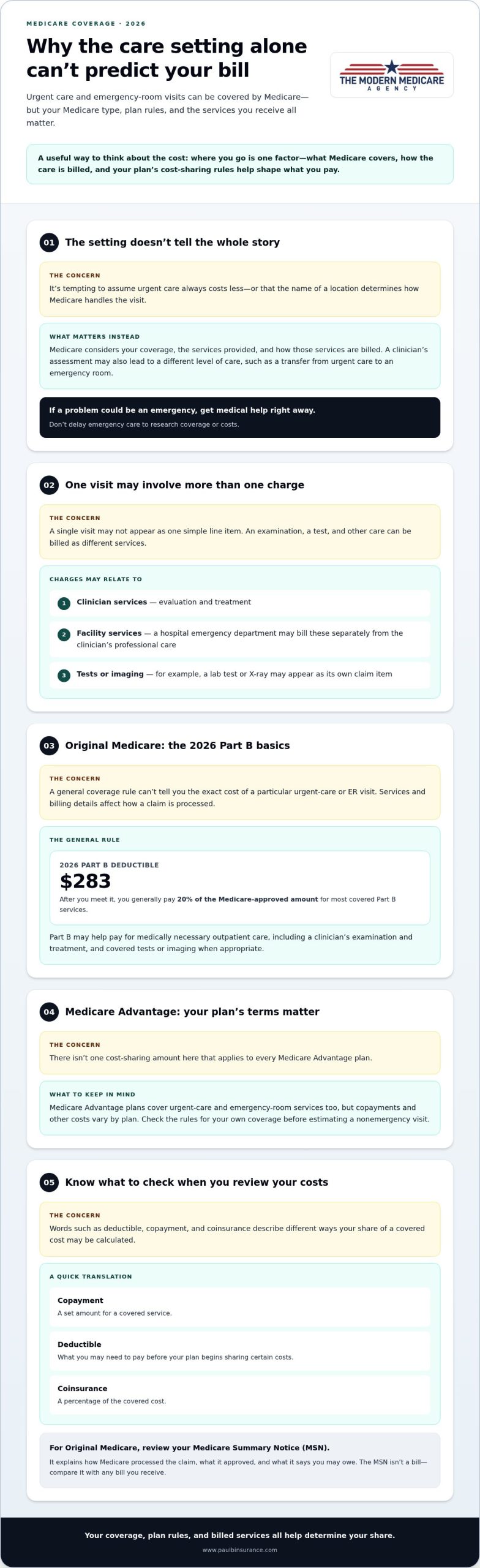
It’s reasonable to wonder whether urgent care or an emergency room will lead to a larger bill. In 2026, the answer depends on your type of Medicare, your plan’s terms, and the services you receive. The care setting matters, but it doesn’t tell the whole story. Medicare coverage for urgent care vs emergency room visits is also shaped by how the services are billed and what your coverage requires you to pay.
What counts as urgent care or emergency care?
Urgent care is unscheduled care for a health problem that needs prompt attention but doesn’t appear to be an emergency. A sore throat, minor cut, or sprain may lead someone to seek this kind of care. An Urgent Care Center generally provides a convenient setting for evaluating and treating non-emergency problems.
Emergency-room care is for symptoms that may threaten life or health and need immediate evaluation. Examples can include severe difficulty breathing, heavy bleeding, or sudden chest pressure. These examples aren’t a way to decide whether a symptom is safe to wait out. If a problem could be an emergency, get medical help right away instead of researching coverage or costs.
At either location, clinicians assess what’s happening. They may recommend a different level of care, including transfer from urgent care to an emergency room if symptoms or findings call for it. The right setting can become clearer after a medical assessment, so don’t assume you can judge the seriousness of a problem from a short list of examples.
Why the same visit can involve different Medicare charges
A visit may generate charges for more than the initial evaluation. The clinician’s services, the facility, tests, and other care can each affect how the claim is processed. For example, an examination and a test may involve different billed services than an examination alone. At a hospital emergency department, facility charges may be separate from the professional charge for the clinician’s services.
Your share may be called a copayment, deductible, or coinsurance. A copayment is a set amount for a covered service. A deductible is what you may need to pay before your plan begins sharing certain costs. Coinsurance is a percentage of the covered cost. Which applies, and how much you owe, depends on your coverage and the services billed.
The location alone can’t predict your final bill. Your Medicare type, plan rules, and the services you receive all help determine what you pay. General coverage principles can explain how Medicare may handle care, but they don’t guarantee a particular 2026 charge. Original Medicare and Medicare Advantage use different cost-sharing approaches, and Advantage plan amounts are plan-specific. The sections that follow explain how to find the rules that apply to your coverage.
How Original Medicare Covers Urgent-Care and Emergency-Room Visits
If you have Original Medicare, outpatient urgent-care and emergency-room professional services are generally covered under Part B when they meet Medicare’s coverage rules. Medicare considers the care you received and how it was billed, not just the name of the place you visited. A visit can include several services, and each may be reviewed separately.
What Medicare Part B may cover during either visit
Part B may help pay for medically necessary outpatient care. In plain language, that’s care needed to evaluate or treat a health problem. It may include a clinician’s examination and treatment, as well as tests or imaging when covered and appropriate. A lab test or X-ray may appear as its own claim item, so the visit’s charges aren’t always represented by a single line.
In 2026, the Part B deductible is $283. After you’ve met it, you generally pay 20% of the Medicare-approved amount for most covered Part B services. The approved amount is what Medicare recognizes for a covered service. Your share can depend on which services were provided and how they were billed, so this general rule doesn’t establish the exact cost of a particular urgent-care or ER visit.
For reliable 2026 details, compare your claim with current Medicare guidance and the relevant CMS materials. The services listed on the claim and Medicare’s rules determine what Medicare pays. That’s why two visits in similar settings can be processed differently.
Why an emergency-room bill may include facility services
A hospital emergency department may bill for facility services as well as the clinician’s professional care. The facility portion relates to services and resources provided by the hospital, while the clinician’s charge reflects their evaluation and treatment. Tests, imaging, and other care may also appear as separate items. How charges are grouped and processed depends on the services and billing details, so don’t assume every hospital visit will have the same breakdown.
KFF’s analysis of outpatient visit costs discusses how outpatient billing can involve multiple services and charges. For your own Original Medicare claim, look for the Medicare Summary Notice (MSN). It explains how Medicare processed the claim, what it approved, and what it says you may owe. It isn’t a bill, so compare it with any bill you receive and follow up if the services or amounts don’t look familiar.
If you’re considering how private plan options differ from Original Medicare, this Medicare Advantage guide can help explain the comparison. Review the rules that apply to your own coverage before estimating what a future visit might cost.
Medicare Advantage vs. Original Medicare: Compare Your Likely Cost Sharing
Your type of Medicare can change how you share the cost of an urgent-care or emergency-room visit. With Original Medicare, covered outpatient services generally fall under Part B’s deductible and coinsurance rules. With Medicare Advantage, you pay the amounts set out in your plan, which may use copayments or other cost sharing for different services. That’s why the answer to medicare coverage for urgent care vs emergency room depends partly on the plan you have, not only the location you visit.
Medicare Advantage plans must cover emergency care, but your cost for a visit depends on the plan’s terms. Emergency coverage differs from routine urgent care: network rules may matter for a nonemergency visit, while emergency care is covered even when you need care outside the plan’s network. Check your plan documents for the details that apply to your circumstances. For a broader look at plan structures and benefits in 2026, see this Medicare Advantage guide.
How Medicare Advantage plan terms affect urgent-care visits
Before a nonemergency visit, look up the urgent-care benefit in your plan’s Evidence of Coverage (EOC). Check the listed member cost, whether the facility is in the plan’s network, and any service-area rules. Also review whether a referral or prior authorization applies to the care you expect. Rules vary by plan, so another member’s copayment or experience may not predict yours.
If you’re away from home, don’t assume an urgent-care location is treated the same as an emergency department. Your plan document explains how routine urgent care is handled, including any network conditions. If symptoms could be an emergency, get medical help immediately instead of delaying care to check plan rules.
How Medigap may fit alongside Original Medicare
Medigap, also called Medicare Supplement insurance, works alongside Original Medicare. Depending on the policy, it may help pay certain out-of-pocket costs left by Medicare, such as applicable deductibles or coinsurance. It doesn’t replace Original Medicare or set one universal price for every urgent-care or ER visit. The services Medicare covers and the policy’s terms still matter.
If you’re weighing how supplemental coverage may fit with Original Medicare, this overview of Medicare Supplement insurance explains the basic role of Medigap. Keep in mind that Medigap and Medicare Advantage work differently. Medigap supplements Original Medicare, while Medicare Advantage provides your Medicare coverage through a private plan.
For a practical comparison, find your EOC and locate the entries for urgent care, emergency care, and related services. Compare those terms with your current Original Medicare cost sharing or Medigap policy, if applicable. This review can help you understand likely costs before a nonemergency visit, while leaving urgent medical decisions to you and your care team.
How to Check Coverage Before a Nonemergency Visit
A little preparation can make a nonemergency visit easier to plan. First, identify whether you have Original Medicare or a Medicare Advantage plan. Then check the coverage information that applies to you. A clinic’s estimate can be useful, but it may not include every service on the final claim.
If symptoms could be an emergency, seek medical help immediately. Don’t delay care to review plan rules, call about a benefit, or estimate your share. The checklist below is for situations that can safely wait while you check your coverage.
- Confirm whether your coverage is Original Medicare or Medicare Advantage.
- For Medicare Advantage, review the 2026 Evidence of Coverage and provider directory for urgent-care benefits, network participation, service-area rules, and any referral or prior-authorization requirements that may apply.
- For Original Medicare, review current CMS coverage information and your Medicare statements to understand how covered services are handled.
- Note the clinic’s name, the services you expect to receive, and any questions about separate clinician or facility charges.
- Keep your plan’s contact details handy in case you need help understanding a benefit before a nonemergency visit.
These steps can help you form a reasonable expectation, not guarantee what Medicare or your plan will ultimately pay. The final decision depends on the services submitted on the claim and the coverage rules that apply.
Which plan documents and details should you review?
For Medicare Advantage, look in the 2026 Evidence of Coverage for the urgent-care benefit and related cost-sharing terms. Use the provider directory to check whether the clinic participates in the plan’s network, and confirm that the directory information is current. For Original Medicare, consult current CMS coverage information and keep your Medicare Summary Notices with your records. Before calling the plan or Medicare, write down the clinic, expected services, and questions you want answered.
What to do if the bill does not match expectations
When a bill arrives, compare it with the Medicare Summary Notice if you have Original Medicare, or the plan’s Explanation of Benefits if you have Medicare Advantage. These statements show how the claim was processed and may explain what was approved, denied, or assigned to you. They aren’t always bills themselves, so check the provider’s statement too.
If a charge is unclear, look for the service description and any denial explanation. Check whether the claim lists a facility charge, clinician service, test, or another item you don’t recognize. Then follow the customer-service or appeal instructions on the official notice. Keep copies of the bill, statement, and notes from any calls. Clear records make it easier to ask a focused question and understand the response.
Reviewing plan terms before a nonemergency visit can make your decision feel more manageable. If you’d like help comparing Medicare Advantage coverage, connect with a Medicare plan guide.
Get Personal Help Comparing Medicare Coverage for Care
Choosing where to seek care is a medical decision, not an insurance decision. If symptoms could be an emergency, get medical help right away. Once you’re safe, you can review how your coverage applies. For nonemergency care, understanding your plan’s network and cost-sharing rules can help you make a more informed choice.
Comparing Original Medicare, Medicare Advantage, or Medigap can feel complicated. An independent Medicare broker can help explain plan benefits and compare options, but can’t replace medical advice or decide what care you need. The goal is to help you understand your coverage so you can make plan choices with more clarity.
When a plan comparison may help
A comparison may be useful if your access to care has changed, a clinic you use is no longer in your network, or you’re reassessing how plan cost sharing fits your needs. Consider your location, the providers and facilities you prefer, and the benefits that matter most to you. The Medicare Advantage plan guide can help explain how plan structures differ, but your own plan documents determine your benefits and costs.
There’s no single plan that’s right for everyone. A useful comparison looks at the whole picture, including coverage rules that may affect urgent care, emergency care, and other services you use. Bring your questions and priorities to the conversation. For example, consider whether staying with certain providers matters to you or whether you want to understand a particular benefit more clearly.
Talk through your Medicare questions with a guide
Personalized guidance can turn plan language into practical questions: Which rules apply to your coverage? What should you look for in the Evidence of Coverage? How do the options available where you live compare with your priorities? The Modern Medicare Agency helps people compare Medicare plans from over 40 carriers and provides year-round support. As an independent brokerage, the agency can help you consider multiple plan choices rather than limiting the comparison to one carrier’s options.
As you compare, keep the distinction clear: insurance information can help you understand likely coverage, but it shouldn’t delay care or replace a clinician’s advice. The details of medicare coverage for urgent care vs emergency room depend on your Medicare type, plan terms, and the services billed. After addressing immediate health needs, an informed review can help you feel more prepared for future care decisions.
If you’d like to talk through Medicare Advantage or Medigap options, start comparing Medicare plan choices with personalized guidance from The Modern Medicare Agency. You can take the time to understand your options and focus on what matters to you.
Make Your Next Medicare Decision With Confidence
Understanding your coverage before a nonemergency visit can make the next step feel more manageable. Set aside your current plan documents and note any questions about access to care or cost sharing. If you think you may be facing an emergency, seek medical help first. Insurance research can wait.
Questions about medicare coverage for urgent care vs emergency room visits can also point to a bigger decision: whether your current coverage still fits your needs. The Modern Medicare Agency provides personalized guidance across more than 34 states, helping people explore Medicare options from multiple carriers. A conversation can help you understand your choices without replacing medical advice.
When you’re ready to talk through Medicare Advantage or Medigap options, talk with an independent Medicare guide about your coverage options. You deserve clear information and the confidence to take your next step at your own pace.
Frequently Asked Questions
Does Medicare cover urgent-care visits?
Yes. Original Medicare Part B may cover medically necessary outpatient urgent-care services, subject to Medicare’s rules and your cost sharing. With Medicare Advantage, check the urgent-care benefit and network details in your 2026 Evidence of Coverage. A visit may include separate services, such as a test, so the final claim may differ from an estimate. The details of medicare coverage for urgent care vs emergency room depend on your coverage and the services submitted.
Does Medicare cover emergency-room visits?
Generally, Medicare covers medically necessary emergency evaluation under applicable Medicare rules. Original Medicare and Medicare Advantage may process the costs differently, and a hospital’s statement may show separate clinician and facility services. If you receive an Explanation of Benefits or Medicare Summary Notice afterward, use it to see how the claim was handled. Check current 2026 CMS information or your plan documents for coverage details, but never delay emergency care to check them first.
Is urgent care cheaper than the emergency room with Medicare?
It can be less costly in some situations, but there’s no universal answer. Your Medicare type, network status, plan cost sharing, facility charges, and services received can all affect what you owe. For nonemergency care, compare the relevant 2026 plan terms and consider whether the clinic participates in your network. If symptoms may be serious or life-threatening, seek emergency care promptly rather than choosing a setting based on cost.
Can I use an out-of-network emergency room with Medicare Advantage?
Medicare Advantage plans must cover emergency care under applicable Medicare requirements, including care at an out-of-network emergency room. Your cost and how the claim is processed still depend on plan terms and the services provided. This differs from routine urgent care, where network or service-area rules may affect coverage. After receiving emergency care, review your 2026 Evidence of Coverage and claim notice. Don’t wait to call your plan before seeking help.
Do I need a referral to visit urgent care with Medicare?
It depends on your coverage. Original Medicare and Medicare Advantage plans may have different referral rules, and Advantage requirements can vary by plan. For a nonemergency visit, check the urgent-care section of your 2026 Evidence of Coverage or contact member services to ask whether a referral or authorization applies. If you already have an appointment, have the clinic name and expected service ready so you can ask about the relevant rule.
What should I do if Medicare denies an urgent-care or emergency-room claim?
Compare the provider’s bill with your Medicare Summary Notice or Medicare Advantage Explanation of Benefits. Find the service in question, read the stated reason for denial, and note any appeal deadline on the official notice. Then follow its instructions and your plan documents, since the next step differs between Original Medicare and Medicare Advantage. If a charge is unclear, contact the number listed on the notice and keep notes of the response.
Does Medigap cover urgent-care or emergency-room costs?
Medigap may help pay certain out-of-pocket costs for services covered by Original Medicare, depending on the policy’s plan type and applicable rules. It doesn’t replace Original Medicare, and you shouldn’t assume a specific visit or charge is covered without reviewing your policy documents. Medigap generally works alongside Original Medicare, not Medicare Advantage. If you’re comparing coverage, check how your policy handles the cost sharing that applies to the services you received.

Article by
Paul Barrett
Paul Barrett, CMIP is the founder of The Modern Medicare Agency, an independent Medicare-only brokerage based in Melville, NY. With 18 years of Medicare-exclusive experience, a CMIP designation, and more than 5,000 clients served across 37 states, Paul is one of the most credentialed independent Medicare specialists on Long Island — and one of the most direct.
He represents 40+ carriers with no quotas and no allegiances, which means his recommendations are based entirely on what fits each client's specific situation. He is the author of Medicare Mastery Unlocked and host of the Wise Guys Retirement Talk podcast. His content is grounded in primary sources, real carrier intelligence, and 18 years of watching what happens when people get Medicare right — and when they don't.
📞 631-358-5793 | paulbinsurance.com