




If you have both Medicare and Medicaid, a D-SNP is built for you. If you only have Medicare but live with a serious chronic condition on the CMS-approved list, a C-SNP is the plan designed around your care. The practical split comes down to this: D-SNPs coordinate two programs and their costs, while C-SNPs coordinate your treatment for a specific illness.
TL;DR:
- Dual eligible plans require Medicare Parts A and B plus active Medicaid; chronic condition plans require a qualifying CMS listed diagnosis, and eligibility is rechecked.
- Before enrolling, match every medication by name and dosage against the formulary, confirm your doctors are in network, and read the plan’s Model of Care.
- Since January 1, 2025, dual eligible members can align plan enrollment with Medicaid managed care, while state affiliations may limit some choices beginning in 2027.
- For dual eligible members who need long term supports, integrated plans can unify billing and appeals, while coordination only plans may keep those processes separate.
Table of Contents
- D-SNP vs C-SNP at a glance
- Who qualifies for each plan and how that gets verified
- What’s actually covered differently between the two
- When you can enroll or switch, and what’s changing with SEPs
- Coordination-only, HIDE, and FIDE D-SNPs explained
- Your decision checklist before you pick a plan
- What Paul Barrett recommends based on 20 years in Medicare
- The real gap in most SNP advice
- Get a personalized review of your D-SNP or C-SNP options
- FAQ
- Sources
D-SNP vs C-SNP at a glance
Before comparing benefits line by line, figure out which column you belong in. The eligibility test is simple, even though the coverage details are not.
- D-SNP (Dual Special Needs Plan): for people enrolled in both Medicare Part A and B and Medicaid, whether full or partial Medicaid benefits.
- C-SNP (Chronic Condition Special Needs Plan): for people with Medicare who have one or more of the 15 CMS-approved chronic conditions, such as diabetes, heart failure, or chronic lung disorders.
- Benefits emphasis: D-SNPs lean toward cost-sharing relief and social support; C-SNPs lean toward specialist access and condition-specific drug coverage.
- Networks: both types typically use narrower networks than standard Medicare Advantage plans, built around the population they serve.
- Enrollment timing: C-SNPs often allow enrollment as soon as you qualify clinically; D-SNPs depend on your active Medicaid status and the plan’s contract with your state.
If you have Medicaid, your next step is checking which D-SNPs in your area are contracted with your state’s Medicaid managed care plan. If you don’t have Medicaid but manage a qualifying condition, your next step is reviewing which C-SNPs near you target that condition and checking their drug formularies. Either way, you cannot enroll in both a D-SNP and a C-SNP at once, so the choice matters.
Who qualifies for each plan and how that gets verified
Eligibility for these two plan types runs on completely different tracks, and both require ongoing proof, not a one-time check.
D-SNP eligibility starts with standard Medicare Part A and Part B enrollment, then adds an active Medicaid eligibility requirement. Some beneficiaries have full Medicaid benefits, others have partial assistance that only covers premiums or cost-sharing, and the specific D-SNPs available to you depend heavily on your state, since Medicaid programs vary by state and each D-SNP has to hold a contract with that state’s Medicaid agency.
C-SNP eligibility is built around the CMS list of 15 approved chronic condition categories, which includes conditions like diabetes, chronic heart failure, end-stage renal disease, and certain lung diseases. A C-SNP can be structured three ways:
- A single-condition plan targeting one diagnosis, such as diabetes alone.
- A multi-condition plan grouping clinically related diagnoses, like several cardiovascular conditions together.
- An insurer-customized group of conditions, which still has to pass CMS review of the plan’s Model of Care.
Eligibility is not permanent for either plan type. Your Medicaid status can change with income or recertification, and your chronic condition status can be reassessed. Plans are required to verify ongoing eligibility, and losing qualification can trigger disenrollment, so it’s worth treating your SNP enrollment as something to revisit every year rather than a one-time decision.
What’s actually covered differently between the two
Both D-SNPs and C-SNPs have to cover everything standard Medicare Part A and Part B covers, and both must include Part D prescription drug coverage. The real differences show up in the extras layered on top.
D-SNP extras generally track the services a dual-eligible beneficiary needs to manage two programs at once: transportation to appointments, long-term services and supports (LTSS) coordination, over-the-counter allowances, and sometimes meal benefits after a hospital stay. How generous these extras are often depends on the plan’s integration level with Medicaid, which we cover in detail in the next section.
C-SNP extras tend to focus on the mechanics of managing one condition well: coordinated access to specialists tied to that diagnosis, care management programs, and drug formularies weighted toward medications used to treat the targeted condition. If you manage diabetes, for example, our partner guide on in-network diabetic supplier status is a useful read for understanding how network status affects your supply costs under either plan type.
- Both plan types must publish a Model of Care (MOC) that describes how they coordinate services for their target population.
- Both must maintain a formulary you can check against your current medications before enrolling.
- Out-of-pocket exposure varies by plan, so comparing MOC documents and formularies side by side is the only reliable way to see real differences.
Pro Tip: Pull the formulary for any plan you’re considering and check your exact medications by name and dosage before you compare premiums or extra benefits.
When you can enroll or switch, and what’s changing with SEPs
Standard Medicare Advantage enrollment windows apply to both D-SNPs and C-SNPs, but each plan type carries its own flexibility layered on top of the standard rules.
- C-SNP enrollment often opens as soon as you can document a qualifying chronic condition, frequently allowing a month-to-month opportunity to enroll outside the standard windows once eligibility is confirmed.
- D-SNP enrollment depends on maintaining active Medicaid status, and CMS introduced an Integrated Care Special Enrollment Period effective January 1, 2025, letting dual-eligible beneficiaries align their D-SNP enrollment with their Medicaid managed care plan.
- The Dual/LIS SEP changes in 2025 narrowed how often some dual-eligible and Low-Income Subsidy beneficiaries can switch plans outside the annual enrollment period, replacing a once-a-month option with more limited windows.
- Looking ahead, provisions in the 2025 CMS final rule tied to §422.514(h) begin taking effect in 2027 and may limit certain D-SNP enrollments to plans affiliated with your state Medicaid managed care organization.
If you’re dual-eligible, keep an eye on your state’s Medicaid MCO affiliations now, since that groundwork will matter more as the 2027 provisions take effect. Our guide to dual-eligible plans for 2026 walks through how Medicaid status and D-SNP enrollment interact in more detail.
Coordination-only, HIDE, and FIDE D-SNPs explained
Not all D-SNPs coordinate with Medicaid the same way, and the level of integration changes what you experience as a member.
- Coordination-only D-SNPs share some information with your Medicaid plan but don’t combine benefits administration, which can mean separate billing and separate appeals processes.
- HIDE (Highly Integrated Dual Eligible) D-SNPs cover certain Medicaid benefits, like LTSS or behavioral health, directly through the same plan.
- FIDE (Fully Integrated Dual Eligible) D-SNPs combine nearly all Medicare and Medicaid benefits under one insurer, with one card, one appeals process, and unified billing.
KFF’s analysis of D-SNPs found that most D-SNP enrollees are in coordination-only plans, with a much smaller share in fully integrated FIDE plans. That matters practically: higher integration tends to mean fewer billing conflicts, a single appeals process instead of two, and smoother delivery of long-term services and supports. Wisconsin’s Department of Health Services notes that coordination works best when the same insurer administers both your Medicaid and Medicare benefits, which is exactly what HIDE and FIDE plans are built to do. You can check a plan’s integration status through CMS integration status lists or your state Medicaid agency’s resources before you enroll.
Your decision checklist before you pick a plan
Once you know which plan type you’re eligible for, run through a short checklist before committing to a specific plan.
- Verify your Medicaid status directly with your state Medicaid agency if you’re considering a D-SNP.
- Confirm your chronic condition is on the CMS-approved list and that you have documentation if you’re considering a C-SNP.
- Read the Model of Care for any plan you’re seriously considering, since it spells out how care coordination actually works.
- Check the formulary against every medication you currently take, by name and dosage.
- Confirm the provider network includes your current doctors and any specialists tied to your condition.
- Check the integration level if you’re looking at a D-SNP, since coordination-only, HIDE, and FIDE plans behave differently.
- Ask about continuity of care protections and how prior authorizations transfer if you switch plans mid-treatment.
When you call a carrier or sit down with an agent, ask directly: which specialists are in-network for my condition, how does prior authorization work for treatment I’m already receiving, and which extra benefits are covered versus just advertised. Our C-SNP guide for chronic conditions and six-question decision guide both walk through these questions in more depth.
Pro Tip: Bring your current medication list and your Medicaid award letter, if you have one, to any plan comparison conversation. It cuts the guesswork in half.
Complex situations, like managing both Medicaid interactions and SEP timing, or reviewing a Model of Care document line by line, are exactly where talking to an agent saves time.
What Paul Barrett recommends based on 20 years in Medicare
Paul Barrett has been helping Medicare consumers choose plans since 2007, and the pattern that shows up most often is beneficiaries picking a plan based on the premium alone, without checking the Model of Care or the formulary first.
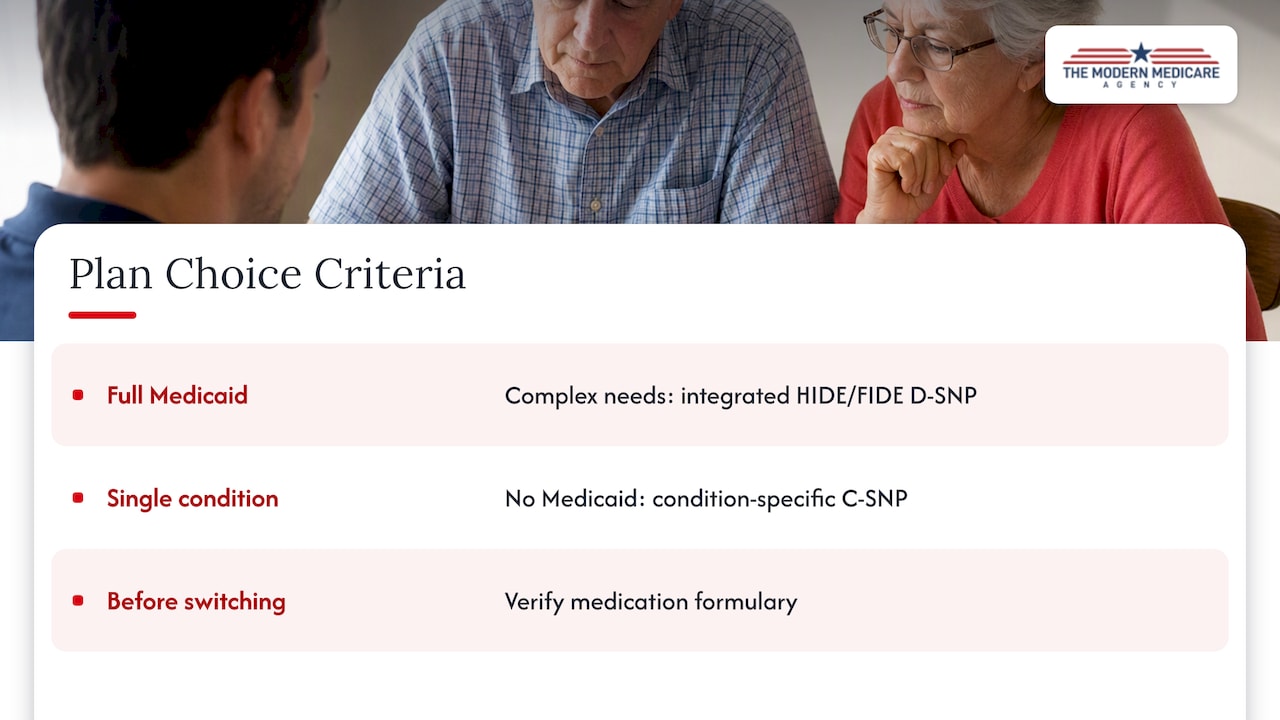
A few practical habits make a real difference. When someone has full Medicaid benefits and complicated social needs, like transportation gaps or home care coordination, prioritizing an integrated HIDE or FIDE D-SNP over a coordination-only plan tends to prevent headaches later. When the primary concern is managing a single serious condition and Medicaid isn’t in the picture, a C-SNP built around that condition usually serves the person better than a generic Medicare Advantage plan. And before switching either type of plan, always confirm formulary coverage for any medication that can’t be interrupted.
A plan review with our team typically starts with a short document checklist (Medicare card, Medicaid award letter if applicable, current medication list) and walks through timing so you’re not caught between enrollment windows.
The real gap in most SNP advice
Most explanations of D-SNPs and C-SNPs stop at eligibility and assume the hard part is done once you know which column you fit in. It isn’t. The harder decision is integration level for D-SNP members and condition-grouping structure for C-SNP members, and those details rarely make it into the basic comparisons people read before enrolling.
The conventional advice to “compare premiums and extra benefits” undersells how much the Model of Care and formulary determine your actual experience. A plan with a generous-sounding benefits list is worthless if your cardiologist isn’t in network or your maintenance medication isn’t covered at a reasonable tier.
If you take one thing from this, prioritize verification over marketing. Confirm your Medicaid status or your condition documentation first, then check integration level or condition grouping, and only then compare the extras everyone else leads with. That order protects you from the plans that look better on paper than they perform in practice.
— Paul
Get a personalized review of your D-SNP or C-SNP options

Choosing between a D-SNP and a C-SNP, or confirming you’re even eligible for one, is exactly the kind of decision that benefits from a second set of eyes. We walk through your Medicaid status, chronic condition documentation, current medications, and provider needs, then compare plan options without pushing you toward any single carrier. Bring your Medicare card, Medicaid paperwork if you have it, and a current medication list, and we’ll help you sort out which plan actually fits. Start with our Medicare Advantage plan guide to see your options or reach out directly for a one-on-one review.
This article is general information, not a substitute for advice from a qualified financial advisor. Consult a qualified financial professional about your own circumstances before acting on anything here.
FAQ
Is a C-SNP Medicare or Medicaid?
A C-SNP is a type of Medicare Advantage plan, not a Medicaid program. It’s designed for people who have Medicare and one or more CMS-approved chronic conditions, regardless of whether they also have Medicaid.
What are the three types of Special Needs Plans?
Medicare recognizes three SNP types: Dual Special Needs Plans (D-SNPs) for people with both Medicare and Medicaid, Chronic Condition Special Needs Plans (C-SNPs) for people with specific chronic conditions, and Institutional Special Needs Plans (I-SNPs) for people living in certain institutional settings or requiring an institutional level of care at home.
Do doctors prefer Medigap or Medicare Advantage plans?
Provider preference varies by practice and isn’t something that can be stated as a universal rule. The better question for your situation is whether a Medigap plan or a Medicare Advantage plan, including an SNP, fits your specific coverage needs, which our Medigap guide can help you evaluate.
Are all Medicare Part D plans the same?
No, Medicare Part D plans differ by formulary, premium, and pharmacy network, even among plans sold in the same area. Checking a plan’s specific drug list against your medications matters more than comparing premiums alone, as explained in our Part D coverage guide.
Can I switch from a C-SNP to a D-SNP if my eligibility changes?
Yes, if you gain Medicaid eligibility, you can generally switch to a D-SNP, and if you lose Medicaid eligibility while still having a qualifying chronic condition, you may be able to move to a C-SNP. Both changes typically require verification of your new eligibility status before the switch takes effect.
Sources
- Special Needs Plans (SNP) | Medicare
- D-SNPs: Integration & unified appeals & grievance requirements | CMS
- Dual Eligible Special Needs Plans: Frequently Asked Questions | Wisconsin Department of Health Services