




What if the best annuity isn’t the one with the biggest projected payout, but the one that fits when you’ll need income? In 2026, figuring out how to choose an annuity that is right for you can feel difficult when unfamiliar terms and contract choices blur together. It’s understandable to want predictable income while still wondering how much access you’ll have to your money.
Start with your retirement-income needs, then weigh each option’s trade-offs. Annuities differ in when payments begin, how payouts are structured, and what access to funds the contract allows. An option that supports steady income later may not suit someone who expects to need more flexibility sooner.
This guide explains how to compare annuity types, payout timing, risk, and contract conditions in plain language. You’ll also find questions to consider before deciding whether an annuity fits your goals. Looking at the choices through the lens of your timeline and priorities can help you make a considered decision without assuming one option is right for everyone.
Key Takeaways
- Identify the retirement-income need you want an annuity to address before comparing options.
- To understand how to choose an annuity that is right for you, consider how payout timing and return approach align with your timeline.
- Compare payout choices and access to funds, then weigh how each contract’s terms affect flexibility.
- Use a checklist to define your goal, set a timeline, compare written terms, and note unanswered questions.
- In 2026, Paul B Insurance, an independent insurance brokerage that offers annuities, can be one place to discuss your priorities.
How to Choose an Annuity: Start With the Retirement Income You Need
Annuity terms can sound unfamiliar, and the decision may feel significant. You don’t need to compare every feature at once. Begin with the income need you want to address. An annuity is an insurance contract in which you pay money in exchange for payments that may begin now or later, depending on the contract. That describes its general purpose, not the specific terms, access rules, or payment options of an individual contract.
In 2026, consider how an annuity might fit alongside your other retirement income, rather than treating it as a complete solution by default. Suitability depends on your goals, when you may need income, what other income you expect, and how much flexibility matters to you. For a broader overview of annuity concepts, see What is an Annuity?
What income need are you trying to address?
Begin with a specific expense or income gap, rather than a product type. You might be planning for regular household costs or for income to supplement other sources later in retirement. These needs can point toward different timelines. List the income you expect from sources such as Social Security, pensions, or retirement savings. Then compare it with the expenses you want that income to cover. The goal is to clarify the gap, not to assume an annuity must fill it.
Next, distinguish between income you may need soon and income you may need later. If your concern is an upcoming expense, consider whether tying up funds could make it harder to respond. If the need is further away, you may have more time before payments are useful. These are starting questions, not a recommendation. The contract determines how a particular annuity works.
What should you decide before comparing annuities?
Write down when you think you may need income, then consider whether that timeline could change. A firm plan and a flexible one may call for different priorities. Also consider how much access to your funds you might need for unexpected costs or changing plans. A product that supports one goal may involve trade-offs elsewhere, so don’t judge an option on its income purpose alone.
- What expense or income gap are you planning around?
- When might you need income, and could that timing shift?
- How important is access to your money if your needs change?
Use your answers to guide the comparison. Read the written contract terms carefully, since broad labels don’t explain every condition. Your tax and financial circumstances can also affect a decision. If you need advice about how an annuity may affect your situation, speak with a qualified financial or tax professional. This groundwork makes it easier to assess how to choose an annuity that is right for you without treating any one option as suitable for everyone.
How Annuity Timing and Types Change the Trade-Offs
Once you’ve identified when income could be useful, compare two separate choices: when payments may begin and how the contract’s value or payments are determined. These features can appear together in different ways, so a category name alone won’t tell you exactly how a contract works. In 2026, use the comparison below to focus your questions, then review the written terms for each option.
| Choice | General approach | Question to consider |
|---|---|---|
| Immediate timing | Income is intended to begin sooner, according to contract terms. | Does the potential timing fit when you expect to need income? |
| Deferred timing | Income is planned for a later point, as set out in the contract. | Could your needs or timeline change before then? |
| Fixed structure | The contract defines interest or payment terms. | What terms apply, and for how long? |
| Variable structure | Value or payments can fluctuate based on investment-related performance and contract terms. | Are you comfortable with the possibility of changes? |
| Indexed structure | Interest crediting may be linked to an index, under the contract’s formula and limits. | How does the contract calculate interest, and what limits apply? |
Immediate or deferred: when might income begin?
Immediate timing is designed for someone seeking income sooner, while deferred timing is intended for income later. Neither label promises a specific start date or payment amount. The contract sets the details, and terms can differ across products. Compare the stated timing with your income timeline. If you don’t expect to need payments yet, ask what the deferred period means for your plans. If you may need income soon, focus on the terms governing when payments can start.
Fixed, variable, or indexed: how does the return approach differ?
A fixed structure spells out interest or payment terms in the contract. A variable structure involves investment options, so its value or payments may move with investment performance. An indexed structure uses a formula connected to an index to determine interest crediting. It doesn’t mean you receive the index’s full market return. Formulas, limits, and other conditions depend on the contract. The Investor.gov guide to annuities offers a neutral overview of common types and considerations.
Use the table to narrow down what you want to investigate, not to decide based on a label. Ask how timing and return structure work together in the specific contract, and read the full written terms. That’s a practical first step in how to choose an annuity that is right for you. If you’d like to discuss your annuity priorities, you can connect with Paul B Insurance, an independent insurance brokerage.
Compare Annuity Payout Choices, Flexibility, and Contract Trade-Offs
Payout choices shape more than the rhythm of income. They can affect who the payments are intended to support and how much access you retain to your money. That creates a balancing act: you may want income that continues over time while also wanting the freedom to respond to emergencies or changing plans. There isn’t one right balance for every household. The written contract is where the details become clear.
Which payout structure fits your household priorities?
Start by asking who needs the income and for how long. A single-life option is generally based on payments for one person’s lifetime. A joint-life option is designed around two people, but the contract explains whether and how payments continue for a surviving person. Terms can differ, so don’t assume that a joint option works the same way across contracts.
You may also see a choice between payments for a fixed period and payments intended to continue for a lifetime. A fixed-period payout is structured around a stated term. A lifetime payout is based on the life or lives named in the contract. These descriptions explain the broad idea, not every condition or outcome. Review the written terms to understand what happens under different circumstances, including how the selected payout choice affects the contract.
If you’re making this decision as part of a household, consider whether one person’s income needs could continue after the other person dies. Then compare how each available payout choice addresses that priority and what other terms change alongside it. The goal is not to choose the option with the most appealing label. It’s to understand the trade-offs the contract sets out.
How should you think about access to your money?
Before prioritizing ongoing income, picture a situation where you might need funds for an unexpected expense or a change in your plans. Would you be comfortable with the contract’s access rules? An annuity intended to provide income may not offer the same flexibility as money kept readily available elsewhere. That doesn’t make one choice automatically better. It means access deserves its own place in the comparison.
Read the contract’s rules for withdrawals and other ways to access funds. Look for any conditions, limits, or charges that may apply, and clarify how they could affect the value or payments. Don’t rely on a brief summary to answer these questions. If a term is unclear, write it down and get a plain-language explanation before making a decision.
- Identify whose income the payout is meant to support.
- Compare fixed-period and lifetime payout terms in writing.
- Consider whether survivor provisions match your household priorities.
- Balance income needs against possible future access to funds.
These questions can help you compare contracts on the details that matter to your life in 2026. As you consider how to choose an annuity that is right for you, weigh the payout structure and access rules together rather than treating either as a minor detail.
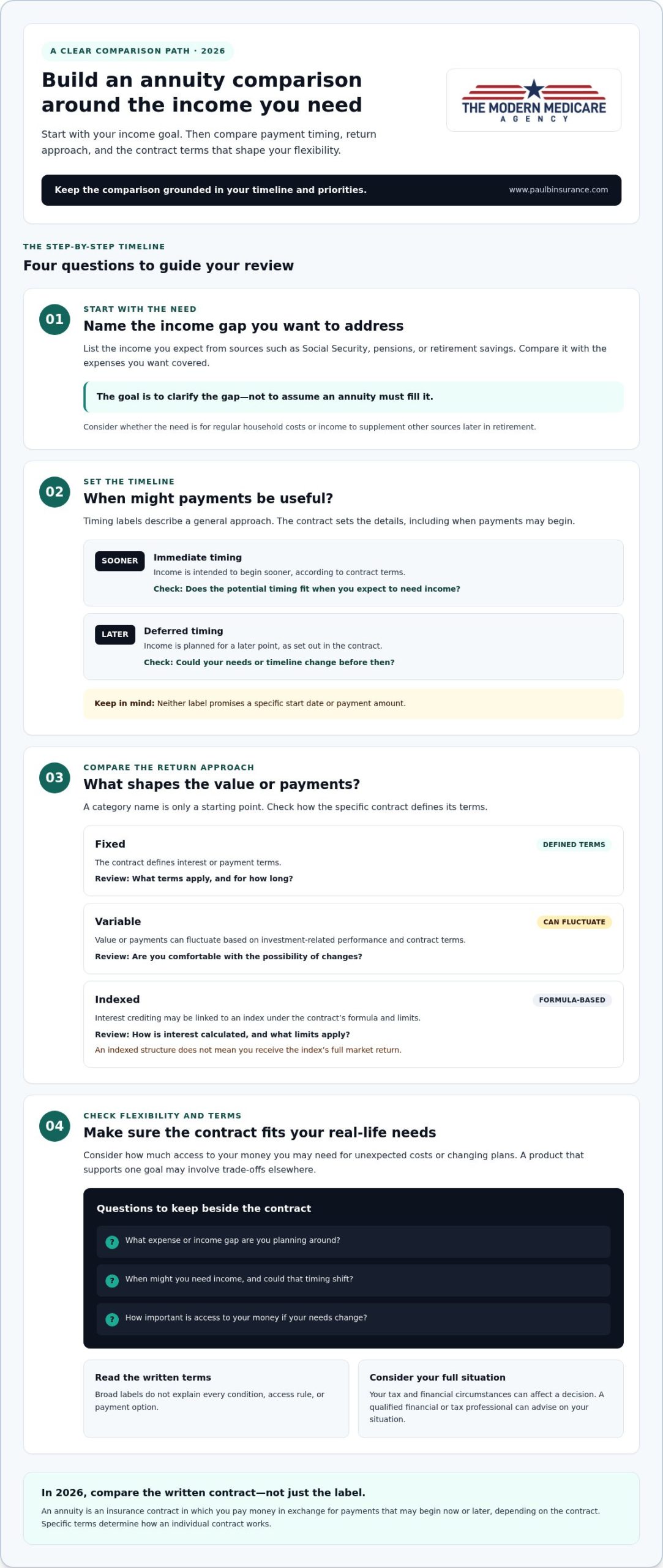
Use This Annuity Comparison Checklist Before Making a Decision
A clear process can make annuity comparisons feel more manageable. In 2026, use this checklist to keep your priorities in view and compare each option on its written terms, not just its category name or a short summary. Move through the steps in order, and keep notes so you can see where options differ.
- Define the goal. Write down the income need you want to address and why it matters to your retirement plans.
- Set a timeline. Note when you may need payments to begin and whether that timing could change.
- Assess flexibility. Consider how much access to funds you might need if your expenses or circumstances shift.
- Compare the written terms. Review payment structure, contract duration where applicable, access provisions, withdrawal rules, applicable charges, and stated limitations.
- Record questions. List every unfamiliar term or point that isn’t clear, then seek an explanation before deciding.
What details should you compare in writing?
For each option, record when payments may start, how the payout is structured, and how long it may last under the contract. Note the rules for accessing funds, including withdrawals and any applicable charges or limitations. Compare the actual contract documents side by side where possible. If an explanation in a summary doesn’t match what you read in the contract, pause and ask for clarification before relying on it.
Which questions should you resolve before choosing?
Ask what the contract says may happen if your income needs or personal circumstances change. Clarify unfamiliar terms, and read the conditions and limits attached to stated guarantees rather than relying on a broad description. If you’re unsure how an option may affect your taxes or legal situation, consider guidance from a qualified tax or legal professional. Clear answers help you make a more informed comparison.
Use your notes to check whether each option still fits the goal and timeline you set at the start. If a key term remains unclear, it’s reasonable to wait until you understand it. This step-by-step approach can help you see how to choose an annuity that is right for you without treating any one option as the default choice.
Ready to talk through your questions? Discuss your annuity questions with Paul B Insurance.
How an Independent Insurance Broker Can Help You Explore Annuities
After comparing your income priorities, timing, and contract questions, you may want to talk them through with someone who discusses insurance options. Paul B Insurance, operating as The Modern Medicare Agency, is an independent Medicare broker that also offers annuities. A conversation can help you organize what matters to you and understand the options being discussed. It doesn’t mean an annuity is automatically the right choice, and it isn’t a substitute for tax, legal, or financial planning advice.
What can you bring to an annuity discussion?
Bring the notes you’ve made so far. A clear picture of your timeline and flexibility needs can help keep the discussion focused on your priorities. Include questions about terms that still feel unclear.
- Your expected income timeline and the need you’re considering
- Your concerns about access to funds and possible changes in your plans
- Your written comparison of payment structures and contract terms
- Any questions about withdrawal rules, charges, limitations, or stated guarantees
You don’t need to arrive with every answer. You can ask for contract language to be explained in plain terms, then compare the explanation with the written documents. If an answer leaves you uncertain, make a note and take time to understand it. The focus should be on learning how an option works and whether its terms align with your priorities, not on being steered toward a particular outcome.
How can you move from uncertainty to a considered next step?
Keep the decision process simple: clarify the income need, compare timing and structures, review the contract terms, and decide whether the trade-offs fit your circumstances. You can pause at any point to revisit a question or get qualified tax or legal guidance if your situation calls for it.
Choosing an annuity is a meaningful decision, but you don’t have to rush through it. In 2026, give yourself room to understand what the contract says and how it relates to your plans. Learning how to choose an annuity that is right for you means weighing the details against your priorities, not relying on a label or someone else’s answer.
If you’d like to discuss your questions and explore annuity options, you can start a conversation about annuity options. There’s no need to have everything figured out before you begin.
Take the Next Step at Your Own Pace
You don’t have to make a decision simply because you’ve started exploring annuities. Give yourself time to sit with the questions that matter most: what you want your retirement income to support, how much flexibility you need, and which contract terms still need a clearer explanation. The more clearly you can express your priorities, the more purposeful your next conversation can be.
Learning how to choose an annuity that is right for you isn’t about finding a one-size-fits-all answer. It’s about deciding whether an annuity’s terms make sense for your circumstances and feeling comfortable with the trade-offs before moving forward. If you’d like to discuss annuity options with Paul B Insurance, talk with Paul B Insurance about annuity options.
Take the process one question at a time. A thoughtful pace can help you move forward with greater confidence.
Frequently Asked Questions
Is an annuity right for everyone?
No. An annuity may not fit every person or retirement goal. For example, someone who expects to use savings for changing expenses may place greater value on access than on arranging future income through a contract. Consider your income timeline, other resources, flexibility needs, and the specific written terms. Compare alternatives, too. In 2026, a careful decision starts with whether the contract addresses a real need in your retirement-income picture.
How do I choose between an immediate and deferred annuity?
Compare the timing with when you expect income to be useful. An immediate annuity is intended to provide income sooner, while a deferred annuity is designed for a later start. For instance, if you expect other income to cover near-term expenses, you may be evaluating a different timeline than someone seeking income sooner. Read the contract’s payment-start terms, since timing rules differ and no category guarantees a particular date.
What is the difference between fixed, variable, and indexed annuities?
These labels describe different approaches to determining returns or payments. Fixed annuities use terms stated in the contract; variable annuities can change with investment performance; and indexed annuities use a contract formula tied to an index. The labels alone don’t explain the full terms or establish a particular result. Before relying on a feature, review the written contract and current product details, including any conditions that affect how returns are calculated.
Can I access my money after buying an annuity?
Possibly, but access depends on the individual contract. Before buying, look for the terms governing withdrawals, when funds may be accessed, and any charges or restrictions that could apply. Think about whether you keep other resources available for an emergency or a change in plans. If the contract’s wording leaves you unsure about what access would mean in a real situation, ask for an explanation in writing before you decide.
How much income will an annuity provide?
There isn’t a reliable general payment amount because income depends on your choices and the terms of a specific contract. Avoid comparing options using a number without understanding how it was prepared. Review a personalized illustration and its assumptions, including the payout choice and timing it reflects. Then compare it with your income need and other resources. An illustration can help you understand a proposal, but it shouldn’t replace reading the contract itself.
What should I compare before choosing an annuity?
Compare the intended income timeline, payout structure, written contract terms, access provisions, and any charges described in the documents. Also consider how the option fits alongside income you already expect and how much flexibility you want to retain. Write down the differences between proposals in the same format. Resolve unclear wording before making a decision, and consider qualified tax or legal guidance if your circumstances call for it.
Can an independent insurance broker help me compare annuities?
An independent insurance broker can discuss insurance options and help you organize questions about your priorities and contract terms. Paul B Insurance, operating as The Modern Medicare Agency, is an independent Medicare broker that also offers annuities. You can bring your notes, ask for unfamiliar wording to be explained, and take time to consider what you learn. This conversation can support your understanding of insurance options, but it isn’t financial planning or a promise of a particular recommendation or result.

Article by
Paul Barrett
Paul Barrett, CMIP is the founder of The Modern Medicare Agency, an independent Medicare-only brokerage based in Melville, NY. With 18 years of Medicare-exclusive experience, a CMIP designation, and more than 5,000 clients served across 37 states, Paul is one of the most credentialed independent Medicare specialists on Long Island — and one of the most direct.
He represents 40+ carriers with no quotas and no allegiances, which means his recommendations are based entirely on what fits each client's specific situation. He is the author of Medicare Mastery Unlocked and host of the Wise Guys Retirement Talk podcast. His content is grounded in primary sources, real carrier intelligence, and 18 years of watching what happens when people get Medicare right — and when they don't.
📞 631-358-5793 | paulbinsurance.com