




Original Medicare covers durable medical equipment (DME) under Part B when it is medically necessary and ordered for use in your home. In 2026 you pay the $283 Part B deductible, then 20% of the Medicare-approved amount, as long as your supplier accepts assignment. That covers items like walkers, hospital beds, oxygen equipment, CPAP machines and, with extra paperwork, power wheelchairs. Below, we walk through the rules, the costs, the paperwork that trips people up and how Medigap and Medicare Advantage change the bill.
TL;DR
- Part B covers medically necessary DME for home use. After the $283 deductible, you typically pay 20% of the Medicare-approved amount.
- Expensive items such as hospital beds, wheelchairs and CPAP machines are usually rented. Medicare pays for 13 months of continuous use, then you own the item.
- Use a supplier that accepts assignment, and in a competitive bidding area, a contract supplier. Otherwise you may pay up front or be denied.
- Medigap can cover some or all of the 20% coinsurance. Medicare Advantage plans have their own networks and copays.
- Power wheelchairs and scooters need a face-to-face exam and a written prescription, and some need prior authorization.
Table of Contents
- What counts as durable medical equipment
- What you pay in 2026
- Rent or buy: the 13-month rule
- Picking a supplier: assignment and competitive bidding
- Power wheelchairs and scooters
- CPAP machines and other respiratory equipment
- How your plan type changes the bill
- Pricing items outside Medicare’s DME benefit
- Our perspective
- Getting help with the plan side
- A checklist before you order equipment
- FAQ
- Sources
What counts as durable medical equipment
Medicare defines DME as reusable medical equipment. The Medicare DME booklet lists home oxygen equipment, hospital beds, walkers and wheelchairs as examples. Other common items include canes, blood sugar monitors, nebulizers and traction equipment.
To qualify, the equipment generally has to meet four tests:
- It is durable, meaning it can withstand repeated use.
- It serves a medical purpose.
- It is appropriate for use in your home.
- A doctor or other enrolled provider orders it because your condition requires it.
The same booklet also covers prosthetic devices, such as ostomy supplies and urinary catheters. If you are looking at artificial limbs or braces, our guide on prosthetics and orthotics coverage goes deeper.
What Medicare does not treat as DME
Equipment you use inside a hospital or a skilled nursing facility stay covered by Part A is the facility’s responsibility, not a Part B DME benefit. Comfort and convenience items, and anything not tied to a medical need, are generally not covered. If you are unsure about a specific item, ask your doctor and the supplier to confirm before you take delivery. Our overview of Part B covered items shows how DME fits alongside other outpatient services.
What you pay in 2026
The cost math is simple, but the rental structure surprises people.
| Cost element | What you pay (Original Medicare, 2026) |
|---|---|
| Part B deductible | $283 per year, per Medicare.gov |
| Coinsurance after deductible | 20% of the Medicare-approved amount |
| Monthly Part B premium | Set separately, see Medicare’s cost page |
| Supplier that does not accept assignment | You may have to pay the full cost up front and wait for reimbursement |
There is no yearly cap on out-of-pocket spending in Original Medicare unless you have supplemental coverage, such as a Medigap policy, according to Medicare.gov. That matters with DME, because 20% of a large bill is still a large bill.
Why the “approved amount” matters
Medicare does not pay a supplier’s sticker price. It pays based on a fee schedule. For 2026, CMS applied a 2% update factor to many DMEPOS fee schedule amounts that were not adjusted using competitive bidding information. Your 20% is calculated on the approved amount, so the same item can cost you different amounts depending on where the fee schedule or competitive bidding rates land in your area.
Worked example
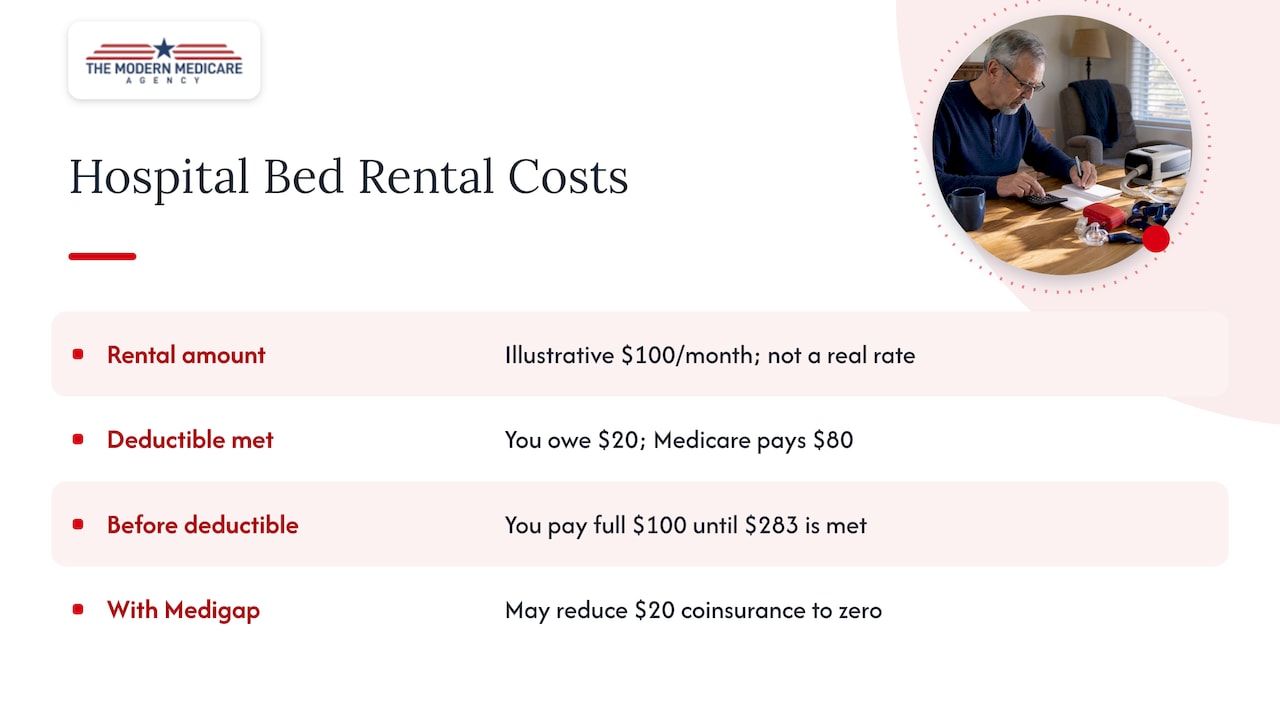
Say your doctor orders a hospital bed for home use and the monthly Medicare-approved rental amount is $100. This number is only for illustration, not a real fee schedule rate. If you have already met your deductible, you owe $20 a month and Medicare pays $80. If you have not, you pay the full approved amount until the $283 deductible is satisfied, then switch to 20%. With a Medigap plan that covers Part B coinsurance, that $20 may drop to zero, depending on the plan.
Rent or buy: the 13-month rule
Medicare rarely writes a check for you to buy expensive equipment outright. For items like hospital beds and wheelchairs, Medicare pays rent for up to 13 months of continuous use. After that, ownership transfers to you. Less costly items such as canes, walkers and blood sugar monitors are classed as inexpensive or routinely purchased, and Medicare may cover the purchase directly.
Two practical points:
- Continuous use matters. A gap in use can affect the 13-month count. Keep using the equipment as prescribed and keep your supplier’s records.
- “Rental” on a claim is normal. You will see it on your Medicare Summary Notice even for equipment you expect to own eventually.
Picking a supplier: assignment and competitive bidding
This is where most surprise bills start. Two checks, before any equipment is delivered:
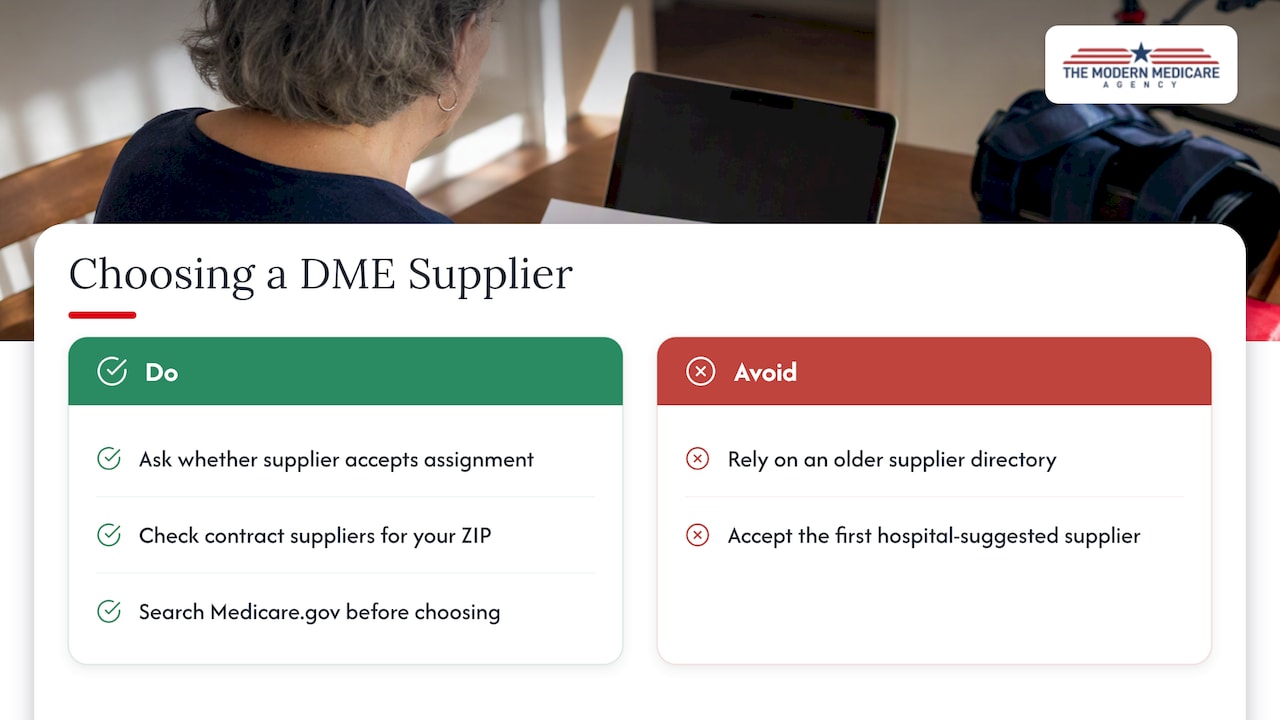
1. Does the supplier accept assignment? Medicare tells you to ask whether a supplier participates and accepts assignment. Suppliers that accept assignment take the Medicare-approved amount as payment in full, so you owe only your deductible and 20%. If they do not, you may be asked to pay the whole amount up front and wait for partial reimbursement.
2. Is the supplier a contract supplier in your area? In areas covered by the Competitive Bidding Program, Medicare pays for certain items only when they come from a contract supplier. The guide notes, for example, that people with both Medicare and Medicaid in a competitive bidding area get off-the-shelf back and knee braces from a contract supplier. Program rules and covered areas change, so verify the current list for your ZIP code rather than relying on an older supplier directory.
The Medicare.gov supplier search lets you find equipment and suppliers near you. Use it before you accept the first supplier a hospital discharge planner suggests.
Power wheelchairs and scooters
Power mobility is the most scrutinized category. Medicare.gov says Part B covers power wheelchairs and scooters only when medically necessary, and you must have a face-to-face examination and a written prescription from a treating provider first. Certain power wheelchair types may also need prior authorization, which your supplier should request and send to Medicare with the required documents.
To keep a claim from stalling:
- Ask your doctor to document why a cane, walker or manual wheelchair does not meet your needs at home. Clinicians often call this the “lesser equipment” question.
- Make sure the exam notes describe your mobility limits in your home, not just in the clinic.
- Confirm the supplier will handle prior authorization, if your model requires it, before you sign anything.
- Keep copies of the prescription and exam record.
For manual wheelchairs, walkers, canes and related devices, see our page on mobility device coverage. If the real obstacle is your home layout, home modification coverage explains what Medicare will and will not pay for.
CPAP machines and other respiratory equipment
CPAP devices follow the same rental pattern. Medicare.gov says that after the deductible you pay 20% of the approved amount for the machine rental and supplies like masks and tubing, if the supplier accepts assignment. Medicare pays to rent the machine for 13 months as long as you use it continuously, and then you own it.
Coverage generally starts with a sleep apnea diagnosis. Ask your doctor what testing and follow-up documentation Medicare requires to keep rental payments going, and ask the supplier how they report your usage. Home oxygen equipment is also DME under Part B, with its own medical necessity documentation, so request the specific requirements from your prescriber.
How your plan type changes the bill
Original Medicare alone
You get the rules above: deductible, 20% coinsurance, no out-of-pocket maximum. You can use any supplier that accepts assignment (and meets competitive bidding rules where they apply).
Original Medicare plus Medigap
Medigap can be a strong tool for DME. Depending on the policy, Medigap can help pay the 20% Part B coinsurance left after the deductible. You can compare plan letters on Medicare’s benefit chart. If you expect ongoing equipment needs such as oxygen, a power chair or long CPAP use, this is worth pricing before you need the equipment, not after. See our Medicare Supplement page for how we approach plan selection.
Medicare Advantage
Advantage plans must cover what Original Medicare covers, but the cost sharing and the supplier network can differ. Medicare.gov notes that costs vary by plan, so read your Evidence of Coverage for the DME copay or coinsurance, whether you need prior authorization, and whether you must use in-network suppliers. A supplier that works fine for a neighbor on Original Medicare may be out of network for you. Our Medicare Advantage guide and plans explained walk through the network questions.
| Original Medicare | Original + Medigap | Medicare Advantage | |
|---|---|---|---|
| Supplier choice | Any that accepts assignment | Any that accepts assignment | Often in-network only |
| Typical cost | Deductible plus 20% | Coinsurance may be reduced or covered, by policy | Plan copay or coinsurance |
| Prior authorization | Certain items | Certain items (Medicare rules) | Plan rules may add more |
| Out-of-pocket cap | None | Depends on policy | Plan has a maximum |
Pricing items outside Medicare’s DME benefit
Some wellness equipment and therapy devices are not Medicare DME, so you pay out of pocket. If you are weighing that kind of purchase against a membership, a U.S. compression therapy cost breakdown shows how a one-time unit price compares with ongoing sessions. Ask your doctor first whether a Medicare-covered alternative fits your condition.
Our perspective
We have helped Medicare consumers since 2007, and DME is one of the places where we see the gap between “Medicare covers it” and “here is what I owe.” The coverage is rarely the problem. The surprises come from three places: a supplier that did not accept assignment, a Medicare Advantage network nobody checked, and a 20% coinsurance on a rental nobody explained.
Our approach is education first. As independent agents with access to 40+ carriers, we can look at how your likely equipment needs interact with a Medigap or Advantage choice, and we do it without pressure. If you already use oxygen, a CPAP or a mobility device, tell us. That changes which plan makes sense far more than a premium comparison does.
One habit we recommend: during your annual coverage checkup, list the equipment you use or expect to need, then confirm your suppliers are still in network and still accept assignment. It takes ten minutes and prevents the most expensive mistakes.
— Paul
Getting help with the plan side
If equipment costs are a worry, we can compare Medigap and Medicare Advantage options for your situation, review your current plan’s DME rules, and explain the tradeoffs in plain language. Start with our Medicare Supplement plans or visit Paul B Insurance to talk with an independent agent. For a broader read, see our 2026 durable medical equipment guide.
A checklist before you order equipment
- Get the prescription or order from an enrolled provider, with your medical need written down.
- Confirm the item is covered for home use under Part B or your plan.
- Ask the supplier if they accept assignment, and whether they are a contract supplier in your area.
- Ask whether prior authorization is needed and who files it.
- Ask whether the item is rented or purchased, and what your monthly cost will be.
- If you have Medicare Advantage, call the plan to confirm the in-network supplier and copay.
- Keep your paperwork and check each Medicare Summary Notice for errors.
If Medicare denies a claim, you have appeal rights. The notice you receive explains how to start, and your doctor’s records are the strongest evidence you can add.
FAQ
Does Medicare cover a power wheelchair?
Yes, when it is medically necessary. You need a face-to-face exam and a written prescription from a treating provider, and some power chairs require prior authorization. You then pay the deductible and 20% of the Medicare-approved amount if the supplier accepts assignment.
Does Medicare cover CPAP machines?
Yes. Part B covers CPAP rental and supplies like masks and tubing. After the deductible you pay 20% of the approved amount, and after 13 continuous months of rental payments you own the machine.
Which Medicare plans cover DME?
Original Medicare covers it under Part B. Medicare Advantage plans must also cover it, but their copays, prior authorization rules and supplier networks can differ. Medigap does not replace Part B; it may help pay your share of the coinsurance, depending on the policy.
Do I own equipment that Medicare rents?
For major rental items, yes, after 13 months of continuous use. Smaller items like canes and walkers may be purchased directly. Ask your supplier which category your item falls under.
Sources
- Durable medical equipment (DME) coverage, Medicare.gov
- Medicare Coverage of DME and Other Devices, Medicare.gov booklet
- DMEPOS Competitive Bidding Program guide, Medicare.gov
- DMEPOS fee schedule CY 2026 update, CMS
- Wheelchairs and scooters, Medicare.gov
- CPAP therapy, Medicare.gov
- Compare Medigap plan benefits, Medicare.gov
- Medicare costs, Medicare.gov
- What does Medicare cost?, Medicare.gov