



An MAPD is a Medicare Advantage plan that bundles your medical coverage and your prescription drug coverage into one plan. “Part D” on its own usually means a standalone prescription drug plan (PDP) that you add to Original Medicare. The drug benefit works almost the same way in both. What changes is everything around it: your doctors, your premiums, your paperwork and your ability to switch later.
This guide walks through the real differences, what each option costs under the 2026 rules, and how to decide. Open enrollment is running right now, so the timing matters.
TL;DR
- A standalone PDP pairs with Original Medicare. An MAPD replaces Original Medicare with a private plan that includes drug coverage. You can’t hold both at once.
- For 2026, Part D has a $2,100 annual out-of-pocket cap on covered drugs, whether the drug coverage sits in a PDP or an MAPD.
- The real trade-off is flexibility versus bundling. Original Medicare plus a PDP lets you see any provider who takes Medicare. An MAPD usually uses a network.
- Both options use a formulary that each insurer designs on its own, so check your exact medications and pharmacy every fall. The Annual Enrollment Period runs October 15 to December 7.
Table of Contents
- What each term actually means
- The rule that catches people: you can’t have both
- MAPD vs. PDP side by side
- The 2026 drug rules that apply to both
- Where the two options really differ
- Who tends to fit each option
- A worked comparison method
- When you can switch
- Our perspective
- How we can help
- FAQ
- Sources
What each term actually means
Part D is Medicare’s prescription drug benefit. It is offered by private companies and helps pay for brand-name and generic drugs. There are two ways to get it:
- A standalone Prescription Drug Plan (PDP). You keep Original Medicare (Part A and Part B) for hospital and doctor coverage and add a PDP for drugs. Many people also add a Medicare Supplement (Medigap) plan to cover what Original Medicare leaves behind.
- A Medicare Advantage Prescription Drug plan (MAPD, also written MA-PD). A private insurer runs your Part A and Part B benefits, plus drug coverage, in a single plan. Many also add extras such as dental, vision or hearing.
So “MAPD vs. Part D” is a bit of a mismatch in terms. The MAPD contains Part D. The real question is whether you want your drug coverage bundled inside a Medicare Advantage plan or separate, alongside Original Medicare.
If you want the full picture of how Advantage plans work, see our Medicare Advantage guide. For the drug side alone, our page on Medicare Part D plans covers the basics.
The rule that catches people: you can’t have both
Many people assume they can keep an MAPD and add a standalone PDP for “extra” drug coverage. You can’t. If you enroll in an MAPD, you are automatically disenrolled from your standalone PDP. The reverse also matters: joining a standalone PDP is a decision about Original Medicare, not about layering coverage on an Advantage plan.
A few special plan types are handled differently, so if you’re in a Special Needs Plan or another unusual arrangement, ask before you change anything.
MAPD vs. PDP side by side
| Original Medicare + standalone PDP | MAPD (Medicare Advantage with drugs) | |
|---|---|---|
| What you hold | Parts A and B, plus a separate drug plan | One private plan that replaces Original Medicare and includes drugs |
| Doctors and hospitals | Any provider that takes Medicare, anywhere in the U.S. | Usually a network (HMO or PPO), sometimes with prior authorization |
| Medigap supplement | Can be added | Not compatible |
| Monthly premium | You pay the PDP premium, plus Part B, plus any Medigap premium | Often lower or $0 plan premium, though you still pay Part B |
| Extras like dental, vision, hearing | Not included in Original Medicare | Often included |
| Drug out-of-pocket cap (2026) | $2,100 | $2,100 |
| Number of cards and bills | Several | One plan to manage |
The network and premium points come straight from Medicare’s own comparison of Original Medicare and Medicare Advantage. Remember that an MAPD’s lower or $0 premium doesn’t mean $0 total cost. Copays, coinsurance and the plan’s medical out-of-pocket limit still apply.
The 2026 drug rules that apply to both
The drug benefit was redesigned under the Inflation Reduction Act, and the same standard rules apply whether you have a PDP or an MAPD.
The $2,100 out-of-pocket cap
For 2026, the Part D program caps annual out-of-pocket spending at $2,100 on covered drugs. After you reach it, you pay $0 in cost-sharing for covered drugs for the rest of the calendar year. The old coverage gap, the “donut hole,” is gone. If you’ve seen older articles, including some of our own, that mention a $2,000 cap, that was the 2025 figure. Our guide on what replaced the donut hole explains the change, and the cap amount is updated by CMS each year.
The deductible
In 2026, the maximum deductible a Part D plan can charge is $615. Until you meet it, you generally pay the full cost of covered drugs, unless your plan covers certain drugs before the deductible. Some plans charge less than the maximum or none at all. This varies by plan, so compare it, not just the premium.
Spreading costs across the year
If one expensive prescription would blow up your January budget, ask about the Medicare Prescription Payment Plan. It is a payment option that spreads your out-of-pocket drug costs across the calendar year instead of charging you at the pharmacy counter. It works with PDPs and MAPDs alike, and many people don’t know it exists. It doesn’t reduce what you owe. It only changes when you pay it.
If you’re budgeting for health costs beyond drugs, for example imaging such as a bone density scan, this DEXA scan cost guide shows what people pay with and without insurance. It’s a useful reminder that a drug plan only covers drugs.
Where the two options really differ
1. Doctor and hospital choice
This is usually the deciding factor. With Original Medicare, you can see any doctor or hospital that accepts Medicare. MAPDs typically work through HMO or PPO networks, and you may need prior authorization for some services. Medicare has a side-by-side look at the plan types if you want to see how an HMO differs from a PPO.
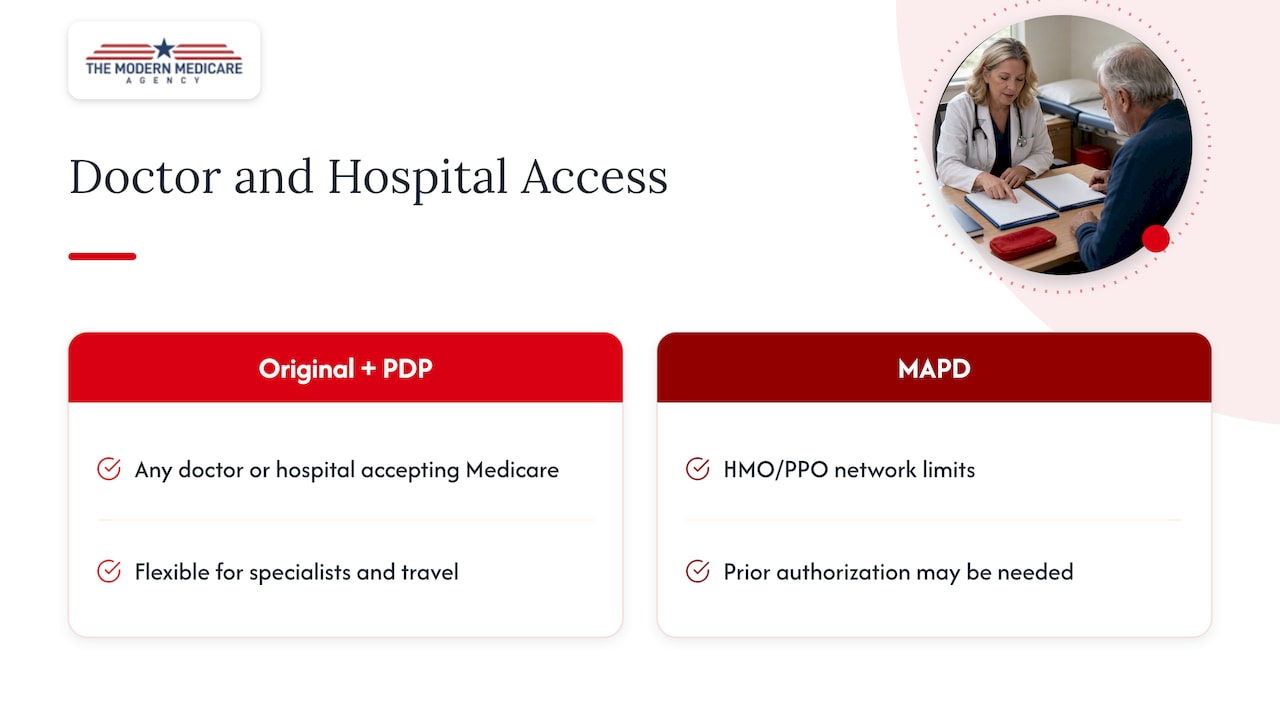
If your specialists, your hospital, or your travel habits matter a lot, Original Medicare plus a PDP is the more flexible path. If your doctors are in a network you like, an MAPD can work well.
2. Total monthly cost
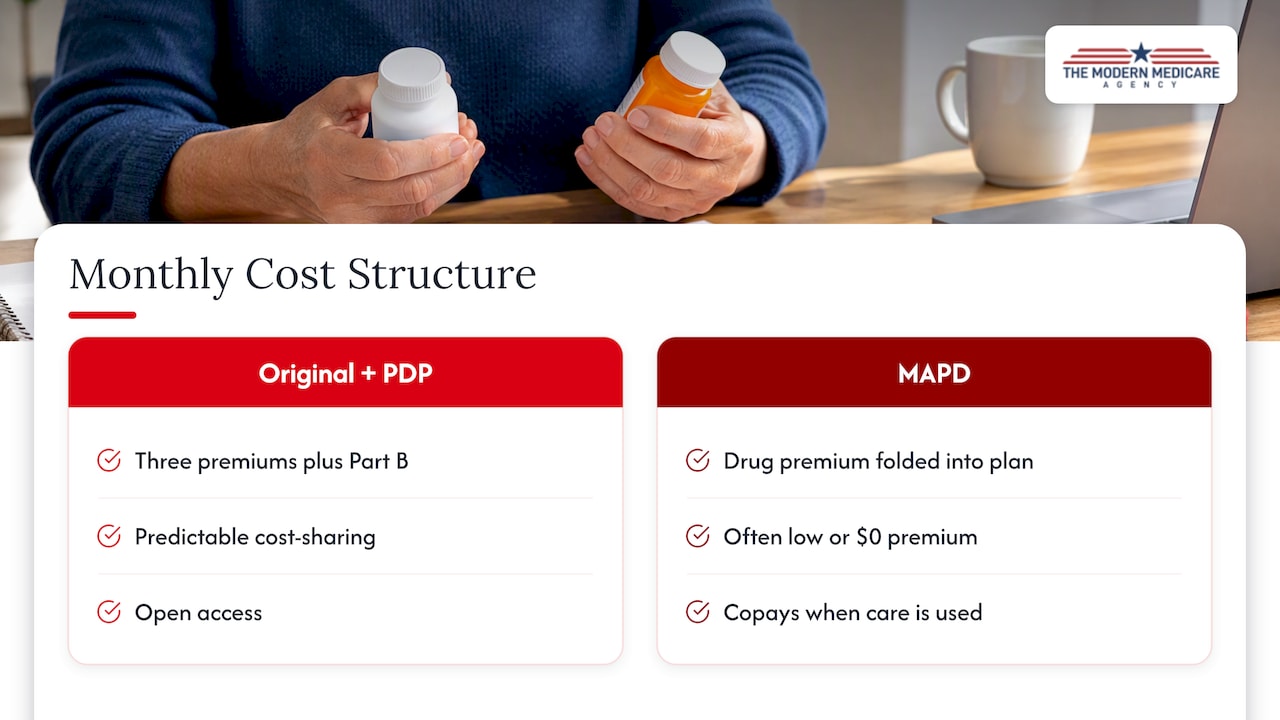
With a PDP, you pay a separate drug premium. With an MAPD, the drug premium is folded into the plan, and many plans have a low or $0 premium. MedPAC has documented a steady shift in enrollment from standalone PDPs toward bundled MA-PD plans, driven by the convenience and often lower premium of a single product.
But compare the whole picture. A person with Original Medicare, a PDP and a Medigap plan pays three premiums plus Part B, in exchange for predictable cost-sharing and open access. An MAPD user may pay less each month but face copays when care is used. Neither is automatically cheaper. It depends on how much care you use.
3. Medigap and the door back
This is the pitfall we flag most often. Medigap policies don’t work with Medicare Advantage. If you leave Original Medicare and a Medigap plan for an MAPD, you may not be able to get that same Medigap plan back later, especially if a health condition would trigger medical underwriting. Rules vary by state and by timing, so talk to a licensed agent before dropping a supplement. Our page on Medicare Supplement plans explains how Medigap works.
4. Extra benefits
Original Medicare doesn’t include routine dental, vision or hearing. Many MAPDs do. If those matter to you, weigh them against network limits. If you stay with Original Medicare, you can still get dental coverage separately, such as a standalone dental plan.
5. The formulary, which is not the same everywhere
No two Part D plans are identical. Each insurer builds its own formulary (the list of covered drugs), its own pharmacy network and its own cost tiers. A drug that’s cheap on one plan may cost far more on another, or not be covered at all. Medicare’s drug coverage guide recommends checking your medications against the plan every year. That applies equally to a PDP and to the drug benefit inside an MAPD. If your drug isn’t on the list, see our explainer on non-formulary drug options.
Who tends to fit each option
These are patterns, not rules. Your doctors and medications decide.
A standalone PDP with Original Medicare may fit if you:
- Want to see any doctor or hospital that takes Medicare
- Have specialists or a hospital that aren’t in many Advantage networks
- Travel often or live in more than one state
- Want a Medigap plan for more predictable medical costs
An MAPD may fit if you:
- Want one plan, one card and one premium for medical and drug coverage
- Are comfortable using a network and getting prior authorization
- Value built-in dental, vision or hearing
- Prefer a low monthly premium and are comfortable with copays
A third group is often forgotten. If you’re retiring from employer coverage, check first whether that coverage includes drug coverage and how it interacts with Medicare. Go through the details with the plan administrator or an agent before you drop it. Going without creditable drug coverage when you’re eligible may lead to a late enrollment penalty, so don’t leave that to chance.
A worked comparison method
Here is how we suggest you compare, whichever side you lean toward.
- List every medication. Include the dose and how often you take it. Add any you may start soon.
- List your doctors, hospital and pharmacy. Note which ones you won’t give up.
- Check each candidate plan’s formulary and tier for every drug, and whether your pharmacy is preferred.
- Add up the year, not the month. Premium, deductible, copays and the $2,100 drug cap. For an MAPD, add the plan’s medical out-of-pocket maximum.
- Ask about the Prescription Payment Plan if one drug would hit hard early in the year.
- Check network status for MAPDs, and ask whether your Medigap options would stay open if you ever switch back.
Our Part D drug coverage guide goes deeper on the drug side. For ways to lower your bill, see how to lower prescription drug costs on Medicare.
When you can switch
The main window is the Annual Enrollment Period, October 15 to December 7 each year. Changes you make then take effect January 1. Today’s date falls inside it, so if you haven’t reviewed your plan for next year, now is the time. Plans change their formularies, premiums and networks every year, so a plan that fit in 2026 may not fit in 2027.
Outside that window, you need a qualifying situation, such as turning 65, moving, or losing other coverage. Ask us if you aren’t sure whether you qualify for a special enrollment period.
Our perspective
We started helping Medicare consumers in 2007, and the most common mistake we see isn’t picking the wrong plan. It’s picking without understanding the trade-off. People hear “$0 premium” and stop reading. Others hear “any doctor” and never check what a drug plan will cost them in a bad year.
We believe in education first. You can’t make a good decision if you don’t know your options. So we don’t start with a plan. We start with your medication list, your doctors and how you use care. Then we look across the carriers we work with and show you how each fits. Sometimes that’s an MAPD. Sometimes it’s Original Medicare with a PDP and a Medigap plan. Neither is the right answer for everybody, and anyone who tells you otherwise is selling, not advising.
We also encourage an annual checkup. Formularies change every year, and so does your health. A five-minute review each fall can save you from a costly surprise in January.
— Paul
How we can help
Paulbinsurance is an independent agency, and our team specializes in Medicare. We help with Medicare Advantage plans, Part D prescription drug plans and Medigap. We’ll compare your medications and doctors against the options available where you live, and keep supporting you after you enroll. If you’d like a personalized review, start on our website.
FAQ
Can you have Medicare Part D and an Advantage plan at the same time?
Not as two separate pieces in the usual case. If your Advantage plan includes drug coverage, that is your Part D coverage, and enrolling in it disenrolls you from a standalone PDP. A few specialized plan types work differently, so ask before changing.
Are all Part D plans the same?
No. Every insurer designs its own formulary, pharmacy network and cost tiers, so the same drug can cost very different amounts across plans. Medicare’s guide advises reviewing your medications against plans each year. Premium alone is a poor way to compare.
Is an MAPD cheaper than a standalone PDP?
Often the monthly premium is lower, and many MAPDs have a $0 plan premium. But you still pay your Part B premium, and you may face copays for medical care. Compare total yearly cost, based on how you use care and which drugs you take.
Does the drug cap differ between an MAPD and a PDP?
No. In 2026, the $2,100 out-of-pocket cap applies to covered drugs under Part D in either type of plan. Once you reach it, you pay nothing more for covered drugs that year.
Sources
- Your Guide to Medicare Drug Coverage (Medicare.gov)
- Compare Original Medicare and Medicare Advantage (Medicare.gov)
- Compare types of Medicare Advantage Plans (Medicare.gov)
- Final CY 2026 Part D Redesign Program Instructions (CMS)
- What’s the Medicare Prescription Payment Plan? (Medicare.gov)
- Structural issues in Part D, April 2025 (MedPAC)