




A dental insurance plan for seniors with no waiting period can make covered care available without the usual delay, but it doesn’t mean every procedure is covered in full. In the United States, preventive care is often covered right away, while basic services may have a six-month wait and major services may have a 12-month wait. The details depend on the plan’s benefits and rules.
It’s understandable to want coverage that starts quickly, especially when dental work can’t wait. The key is to look beyond the phrase “no waiting period” and see which services are covered, what you may pay out of pocket, and whether there are limits on benefits. This guide explains how waiting periods work, compares common plan options, and shows the trade-offs to weigh so you can choose with more confidence in 2026.
Key Takeaways
- Compare preventive, basic, and major-care benefits separately; “no waiting period” doesn’t necessarily mean every service is covered right away or in full.
- Look at the deductible, coinsurance, and annual benefit maximum together to understand what you may pay and where coverage could run out.
- Plans with no waiting period for complex care may cost more, while some dental HMO plans trade broader dentist choice for lower costs and no annual maximum.
- Prior dental coverage may help you qualify for a waiting-period waiver, but eligibility depends on the plan’s rules and whether your coverage continued without a lapse.
- According to the U.S. Department of Health and Human Services, the ACA’s 90-day waiting-period limit applies to group health plans, not individual dental coverage.
What do dental plans cover?
A dental plan with no waiting period may make some covered services available immediately, but that does not mean every service is covered without limits. Preventive care, such as routine cleanings, checkups, and X-rays, is often covered right away. Basic and major care may have separate waiting periods, cost-sharing, and exclusions.
No, crowns, dentures, and implants aren’t automatically covered immediately. Crowns and dentures may fall under major services, which can have a waiting period of 6 to 12 months; implant coverage depends on the plan’s specific benefits.
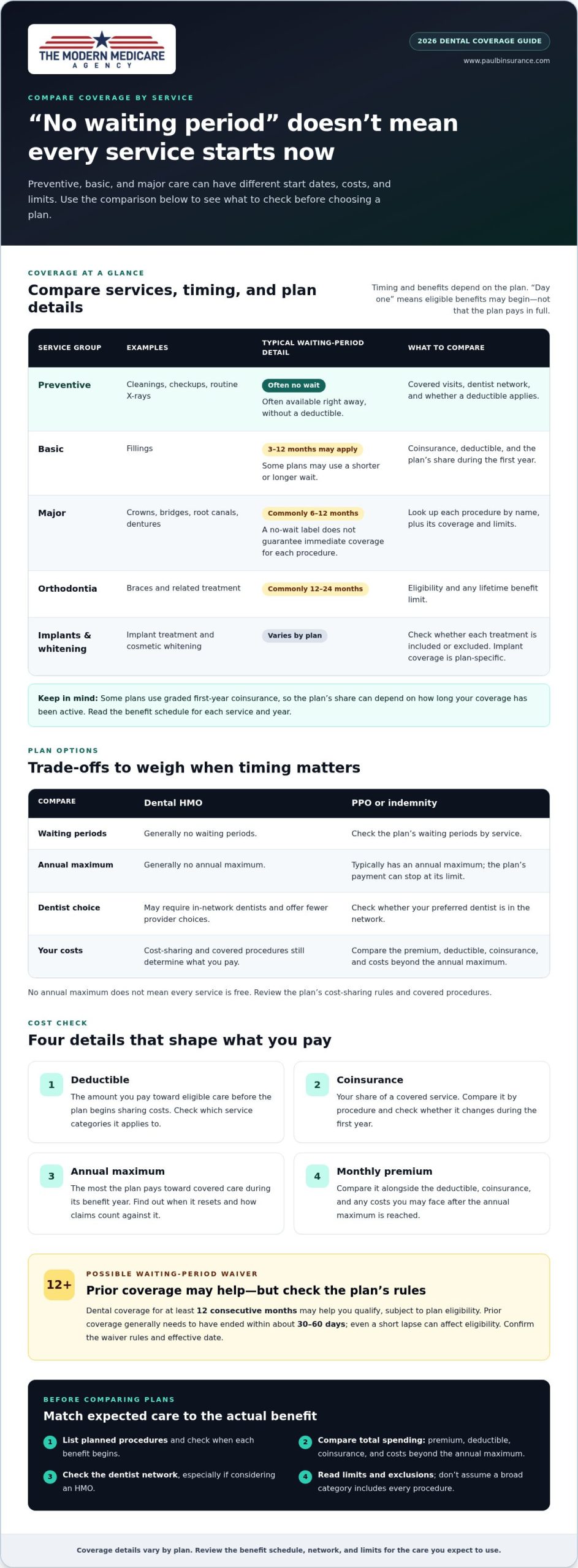
Think of coverage in three groups. Preventive care often has no deductible or waiting period. Basic care includes services such as fillings, and waiting periods can range from three months to 12 months. Major care can include crowns, root canals, bridges, and dentures, with waits commonly lasting 6 to 12 months.
For a senior comparing dental insurance plans in 2026, “day one” describes when eligible benefits can begin, not how much the plan pays. Some plans use graded first-year coinsurance, meaning the plan’s share can depend on how long coverage has been active. Read the benefit schedule for each service and year. Check whether the network includes your dentist, and whether a lifetime limit applies to a specific benefit.
| Coverage option | Examples | Waiting-period or coverage detail | What to compare |
|---|---|---|---|
| Preventive | Cleanings, checkups, routine X-rays | Often available without a waiting period | Covered visits and network rules |
| Basic | Fillings | Three months to 12 months may apply | Coinsurance and first-year share |
| Major | Crowns, bridges, root canals, dentures | Commonly 6 to 12 months | Service-specific coverage and limits |
| Orthodontia | Braces and related treatment | Waiting periods commonly range from 12 to 24 months | Eligibility and lifetime benefit limit |
| Implants and whitening | Implant treatment and cosmetic whitening | Coverage varies by plan | Whether each service is included or excluded |
Continuous prior coverage may help waive a waiting period. A person with dental coverage for at least 12 consecutive months may qualify, subject to plan eligibility. Prior coverage generally needs to have ended within about 30 to 60 days, and even a short lapse can affect eligibility. Review the waiver rules and effective date before comparing benefits.
Choose a plan by matching the care you expect to use with its effective date, coinsurance, network, and benefit limits. For crowns, dentures, or implants, look for each procedure by name rather than assuming “major care” includes it. For whitening, review the exclusions instead of treating cosmetic care as a standard benefit.
Why Choose a Dental Plan With No Waiting Period?
Choosing a plan with immediate benefits can matter when a needed procedure can’t wait through a six-month or one-year delay. In 2026, compare the value of earlier coverage with the plan’s deductible, monthly premium, coinsurance, and annual maximum. A short wait alone doesn’t show how much the plan will pay.
Yes. Dental HMO plans generally have no waiting periods or annual maximums. The trade-offs may include using in-network dentists and having fewer provider choices. No annual maximum doesn’t mean every service is free: the plan’s cost-sharing rules and covered procedures still determine what you pay.
The deductible is the amount you pay toward eligible care before the plan begins sharing costs. Check whether it applies to preventive care, basic services, major procedures, or only some categories. For example, if a plan applies its deductible to a crown, that amount affects your cost before coinsurance is considered.
Next, compare the annual maximum, which is the most a plan pays toward covered care during its benefit year. PPO and indemnity plans typically have an annual maximum; dental HMO plans generally don’t. Once the plan reaches its limit, you pay for further covered care according to the plan’s terms.
- Estimate expected care. List planned procedures, such as fillings or a crown, and check when each benefit begins.
- Compare total spending. Consider premiums alongside the deductible, coinsurance, and any costs beyond the annual maximum.
- Check the dentist network. Confirm whether your preferred dentist is in-network, especially for an HMO with limited choices.
- Look at the benefit year. Find out when the annual maximum resets and how the plan counts claims against it.
A no-wait plan may be useful if you expect care soon, but savings depend on the procedures covered and your share of costs. Compare the benefits, limits, and network together rather than choosing by the waiting period alone. You can review dental insurance plan details as part of that comparison, then weigh the terms against the care you expect to use.
Preventive, basic, and major dental services
In 2026, compare each service category separately because preventive, basic, and major care can start at different times. The category name alone doesn’t tell you the waiting period or the amount the plan pays.
Preventive Care Benefits
Preventive care commonly includes routine cleanings, checkups, and routine X-rays, and plans often cover these without a deductible or waiting period. This differs from basic and major services, which may have a delay before benefits begin. Check how many cleanings the plan covers each year and whether your dentist is in its network. Fluoride may appear in preventive benefits for covered people under age 16, so seniors shouldn’t assume it applies to them.
Basic-Service Waiting Periods
Basic services include care such as fillings. A dental plan may start these benefits immediately, but basic-care waits can range from three months to 12 months; some policies set a six-month wait. This makes basic coverage different from preventive care, which often starts sooner. Check the benefit schedule for the service name, start date, deductible, and coinsurance. Some plans cover Class II basic services at 50%, so compare the plan’s share with your expected care.
Major-Service Waiting Periods
Major services can include crowns, root canals, bridges, and dentures. Waiting periods commonly last six months to 12 months, longer than the usual delay for preventive care. A crown listed as a covered major service may still have a waiting period or benefit limit. Read the plan’s terms for each procedure rather than relying only on the broad “major services” label. Dental implants also require a service-specific coverage review, which is why restorative practices such as Saby Dental advise patients to confirm policy details before scheduling major procedures.
Use a simple comparison method before choosing. First, list the care you expect, such as a cleaning, filling, or crown. Then match each service to its category in the benefit schedule. Record when coverage starts and the percentage or amount the plan pays. This side-by-side comparison shows whether a short wait applies only to cleanings or also to treatment you need.
Orthodontia is another separate category, not a standard extension of preventive or basic care. Plans that cover orthodontia may have a 12-month waiting period; commonly, orthodontia waits range from 12 to 24 months and vary by carrier and state. Check whether the benefit covers the treatment you’re considering and whether a lifetime limit applies. Don’t assume orthodontia begins with other benefits on the same date.
Finally, compare the wording for exclusions and timing across states and plans. A plan may cover a procedure but delay payment, while another may exclude that service. For each item, note the waiting period, the plan’s share, and any limit. This step helps distinguish “covered” from “available now,” especially for crowns, dentures, and implants.
Costs and trade-offs of no-waiting-period plans
In 2026, compare the cost of earlier benefits with the procedures a plan covers. Plans that waive waiting periods for complex care generally have higher premiums than plans with waits. A higher premium may be worthwhile if crowns, dentures, or root canals are planned soon, but the plan’s share and limits still shape your costs.
To compare plans, list the care you expect, then review each plan’s premium, deductible, coinsurance, annual maximum, and effective date. Check the provider network and confirm your dentist participates before choosing. The combination of covered services and cost-sharing matters more than the “no waiting period” label alone.
There isn’t one nationwide list of insurers offering the same plans in every state. Available plans and dentist networks depend on the state and the specific plan, so compare local options using each plan’s provider directory and benefit details.
The federal rule can be confusing. According to the U.S. Department of Health and Human Services, the ACA’s 90-day waiting-period limit applies to group health plans, not individual dental coverage. Stand-alone individual dental coverage is treated as an excepted benefit under 45 CFR 148.220(b)(1). That distinction matters when comparing an individual dental policy with coverage through a group health plan.
A dental HMO is a common option for people seeking coverage without waiting periods. These plans generally have no waiting periods and may not have deductibles or annual maximums. The trade-off is using in-network dentists, often from a more limited provider network. Check whether your dentist is listed and whether the plan’s service rules fit your needs.
A dental savings membership works differently from insurance. It generally has no enrollment or waiting period, but it isn’t insurance coverage. Members access discounts through participating dentists and pay the dentist under the membership’s terms. Compare this arrangement with insurance by reviewing included services, participating providers, and the treatment you expect.
- List planned care: Include specific needs such as a crown, denture, or root canal.
- Compare total terms: Review premiums, deductibles, cost-sharing, and annual limits together.
- Review the network: Find your dentist in the plan directory before enrolling.
- Check prior coverage: Continuous coverage may qualify you for a waiting-period waiver, subject to plan eligibility.
Use these steps to compare insurance with a savings membership and focus on the care you expect. Reviewing dental insurance plan options can help you assess coverage terms alongside network access.
How dental insurance waiting periods work
A waiting period is the time after a dental insurance plan takes effect before it pays benefits for certain services. The delay can differ by service, so “no waiting period” may apply to preventive care but not basic and major treatment. In 2026, read the start date and service categories together before relying on a plan’s headline.
The timing can involve two separate dates: enrollment and when coverage begins. Some plans start coverage on the first day of the month after enrollment, which can be up to 30 days later. A waiting period for a covered service is separate from that start-up gap. Check the policy’s effective date, then count any service-specific delay from the date its terms use.
Basic and major services may have waits of 4 to 12 months. Dental plans commonly use a six-month wait for basic and restorative care, and a 12-month wait for major care. Orthodontia waits commonly range from 12 to 24 months. These periods are not interchangeable: a plan may cover one category while another remains subject to a delay.
Preventive services often work differently from other care. Routine cleanings, checkups, and X-rays are commonly covered immediately, even under plans that delay other treatment. That immediate benefit doesn’t mean a filling, crown, or root canal is payable right away. Match each planned procedure to its listed category and start date.
Prior coverage can affect the wait. A person who held dental coverage from another insurer for at least 12 consecutive months may qualify for a waiver, subject to the plan’s eligibility rules. Prior coverage generally must have ended within about 30 to 60 days, and even a short lapse can make a waiver unlikely. A waiver for employer-sponsored group coverage may not apply to individual direct or exchange policies.
Use this four-step check before enrolling:
- Find the coverage effective date, not just the enrollment date.
- List each service you expect, such as a filling or crown.
- Compare the waiting period and benefit start date for every service.
- Review whether continuous prior coverage meets the waiver rules.
Finally, check how waiting periods interact with the annual maximum. A service may become eligible after its waiting period, while the plan still limits how much it pays during the benefit year. Compare the remaining benefit amount with the services you expect to use. For help reviewing dental coverage options, explore dental insurance plans.
The Modern Medicare Agency: Medicare Advantage Plans
The Modern Medicare Agency helps seniors compare Medicare Advantage Plans when reviewing their broader coverage alongside dental insurance. Its independent guidance can also help you compare Medicare Supplement (Medigap) Plans and Medicare Part D Plans based on your needs. This can be a useful next step if you’re weighing Medicare options and want personalized support.
Medicare plan choices and stand-alone dental coverage are separate decisions, so consider each plan’s benefits and costs on their own terms. The Modern Medicare Agency helps people compare options from multiple carriers and provides year-round support.
For personal help comparing Medicare coverage, contact The Modern Medicare Agency.
Choose a next step that fits your coverage needs
In 2026, think about how dental coverage fits with the care you expect and the rest of your insurance choices. The right next step is not simply choosing the plan with the shortest wait. It’s making a decision you understand, with benefits and limits that make sense for your situation.
As you consider dental insurance for seniors with no waiting period, write down the questions that matter most to you. You may want to understand how a dental plan fits alongside your broader coverage or compare options before deciding. A clear conversation can help turn those questions into a practical next step.
The Modern Medicare Agency offers personalized guidance to help you consider your coverage choices without pressure. Contact The Modern Medicare Agency to discuss your next step. You deserve to feel informed and comfortable as you choose the coverage that works for you.
Frequently Asked Questions
What is dental insurance?
Dental insurance is a policy that helps pay for services listed in its benefits. You pay a premium and may also pay a deductible or part of the treatment cost. For example, a plan might share the cost of a filling but apply different terms to a crown. Before enrolling, compare covered procedures, network rules, cost-sharing, and benefit limits to see how the policy fits your dental needs.
Which dental insurance plans for seniors have no waiting period?
Dental HMO plans are a common option because they generally don’t have waiting periods. Some plans also make preventive services available immediately, even when other procedures have delays. Plan availability and dentist networks differ by state. Compare the start date for each service, then check whether your dentist participates. A plan’s “no waiting period” description alone doesn’t show whether the specific treatment you need is covered right away.
What are the monthly premiums and annual maximums for senior dental plans with no waiting period?
Monthly premiums and annual maximums depend on the plan’s coverage, location, and network structure. Compare the premium with the services you expect to use, not just the advertised start date. PPO and indemnity plans typically set an annual benefit maximum; dental HMO plans generally don’t. Also review deductibles and cost-sharing: a higher maximum doesn’t necessarily mean the plan pays more for every procedure.
Do seniors with Medicare need separate dental insurance, and does Medicare cover dental care?
Original Medicare doesn’t cover routine dental care or procedures such as crowns, fillings, extractions, and root canals. Seniors who want help paying for those services may consider separate dental coverage. Medicare Advantage plans differ from Original Medicare, so review each plan’s benefits rather than assuming dental care is included. Keep dental benefits and medical coverage distinct when comparing what each policy pays.
What exclusions, preexisting-condition rules, or limits apply to no-wait dental insurance?
Coverage depends on the policy’s written terms. Review exclusions for specific procedures, limits on what the plan pays, and any rules affecting treatment already recommended or underway. Check whether a benefit has its own lifetime limit or annual maximum, and whether seeing an out-of-network dentist changes your share. If you’re relying on prior coverage to waive a waiting period, read the eligibility rules and documentation requirements before enrolling.
How do dental discount plans compare with insurance plans that have no waiting period?
A dental discount membership isn’t insurance. It generally has no enrollment or waiting period, but provides discounts for care from participating dentists rather than insurance benefits. Insurance may share costs for covered procedures, subject to its terms and limits. Compare the participating dentist list and treatment discounts with an insurance plan’s premium, covered services, and cost-sharing. The better fit depends on the care you expect and how you prefer to pay.

Article by
Paul Barrett
Paul Barrett, CMIP is the founder of The Modern Medicare Agency, an independent Medicare-only brokerage based in Melville, NY. With 18 years of Medicare-exclusive experience, a CMIP designation, and more than 5,000 clients served across 37 states, Paul is one of the most credentialed independent Medicare specialists on Long Island — and one of the most direct.
He represents 40+ carriers with no quotas and no allegiances, which means his recommendations are based entirely on what fits each client's specific situation. He is the author of Medicare Mastery Unlocked and host of the Wise Guys Retirement Talk podcast. His content is grounded in primary sources, real carrier intelligence, and 18 years of watching what happens when people get Medicare right — and when they don't.
📞 631-358-5793 | paulbinsurance.com