




In 2026, Medicare enrollment is easier when you start with the right date. According to the Centers for Medicare & Medicaid Services, most people become eligible at 65, and the Initial Enrollment Period generally lasts 7 months: it begins 3 months before the month you turn 65 and ends 3 months after it. Understanding how to simplify the Medicare enrollment process starts with knowing whether you need to enroll yourself or will be enrolled automatically.
If the dates, choices, and forms feel like a lot to sort through, that’s understandable. The steps depend on your situation, but you can simplify the Medicare enrollment process by handling one decision at a time.
This guide explains when to enroll, how Original Medicare, Medicare Advantage, and Medigap differ, and when enrollment happens automatically. You’ll also find practical ways to enroll and learn where to get personal guidance, so you can make your next decision with confidence.
Key Takeaways
- Mark your enrollment window early and identify whether your circumstances call for an Initial, Special, or General Enrollment Period.
- Compare Original Medicare, Medicare Advantage, and Medigap by how each handles your medical coverage and plan choices.
- Receiving Social Security benefits may mean automatic enrollment in Parts A and B, so review your enrollment notice and effective dates.
- Choose an enrollment method that feels manageable: eligible people can apply online, by phone, or in person, and personal counseling is available.
- Before deciding about Parts A and B, consider your current health coverage and whether it affects your enrollment timing.
1. Initial Enrollment Period timing
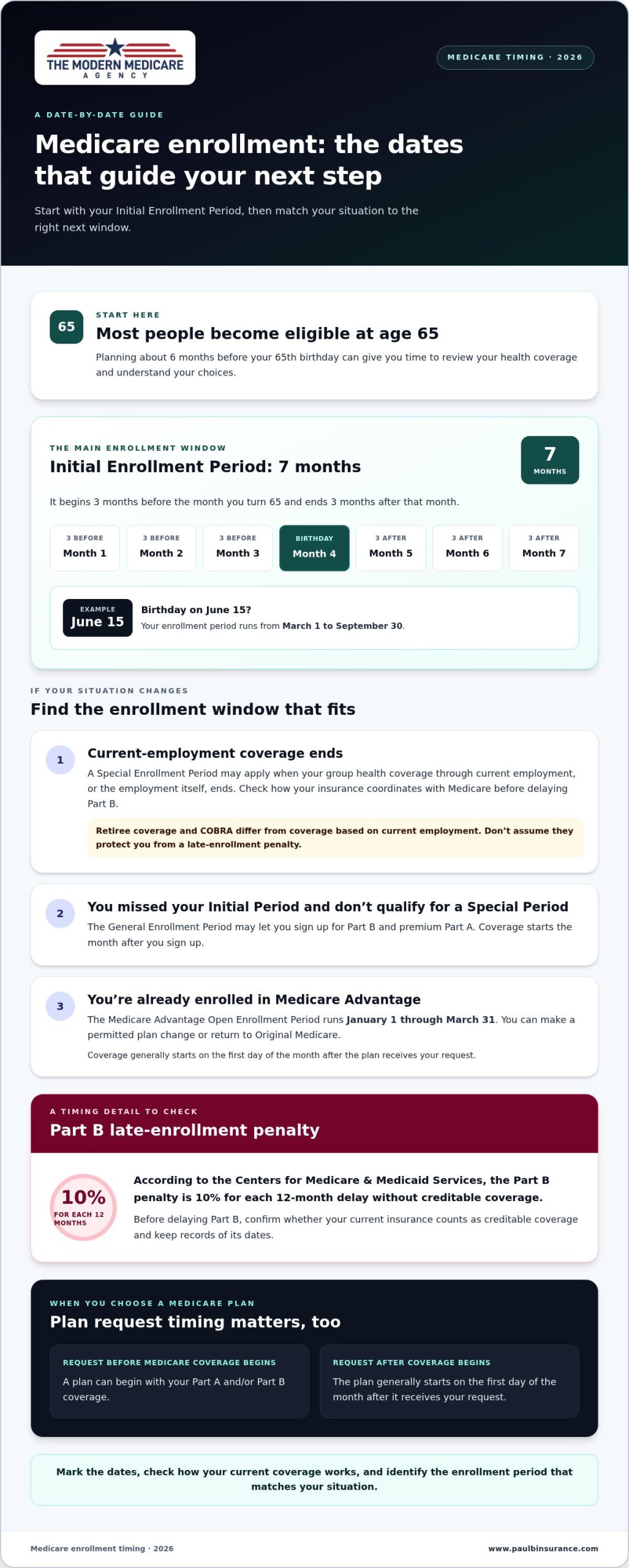
For Medicare enrollment in 2026, start with your age and birthday month. According to the Centers for Medicare & Medicaid Services, people in the United States become eligible for Medicare when they turn 65 years old. The Initial Enrollment Period generally lasts 7 months. It begins 3 months before the month you turn 65 and ends 3 months after it.
For example, if your birthday is June 15, your enrollment period runs March 1 to September 30. Mark those dates on your calendar and decide when to apply. Starting early gives you time to review your health insurance, gather information, and consider how Medicare will work with any other coverage. Planning about 6 months before turning 65 can also give you time to understand your choices.
Enrollment timing affects more than your start date. If you want a Medicare plan to begin with your Part A and/or Part B coverage, submit the plan request before that Medicare coverage starts. If you request to join after your Part A and/or Part B coverage begins, the plan generally starts on the first day of the month after it receives your request. Choosing coverage is a separate step from enrolling in Medicare. For help understanding plan options, explore this Medicare Advantage guide.
Still covered by a group health plan through current employment? A Special Enrollment Period may apply when that coverage or employment ends. Before deciding to delay Part B, find out how your group insurance coordinates with Medicare. Retiree coverage and COBRA differ from coverage based on current employment, so don’t assume they protect you from a late-enrollment penalty. The right timing depends on your coverage type and when it ends.
If you miss your Initial Enrollment Period and don’t qualify for a Special Enrollment Period, the General Enrollment Period may let you sign up for Part B and premium Part A. Coverage starts the month after you sign up. Missing the right period can leave a gap before coverage begins, so identify your next enrollment opportunity as soon as possible.
Delaying Part B without creditable coverage can also have a lasting effect. According to the Centers for Medicare & Medicaid Services, the Part B late-enrollment penalty is 10% for each 12-month delay without creditable coverage. Before delaying, confirm whether your current insurance counts as creditable coverage and keep records of its dates. In 2026, matching your situation to the correct period and acting within its dates can help simplify Medicare enrollment.
2. Original Medicare, Medicare Advantage, and Medigap choices
In 2026, how do you compare plans on Medicare.gov and check whether a provider is covered? Use the plan comparison tool to review available options, then check each Medicare Advantage plan’s provider directory for your doctors and hospitals. Compare prescription coverage and plan details alongside provider access before deciding.
Original Medicare includes Part A, hospital insurance, and Part B, medical insurance. You can generally use providers who accept Medicare, but Original Medicare doesn’t include most prescription drug coverage. Part D is a separate option for prescription drugs. Medigap is supplemental insurance that works with Original Medicare, while Medicare Advantage, also called Part C, is another way to receive Medicare coverage.
To choose between Original Medicare and Medicare Advantage, start with your care needs. List your doctors, hospitals, prescriptions, and regular treatments. Check whether a Medicare Advantage plan includes the providers and services you rely on. If flexibility to see providers who accept Medicare matters most, weigh that against each plan’s specific rules and benefits. A plan that looks simple may not fit your needs if it limits access to the care you use.
If you have a chronic condition, compare details that affect ongoing care, not just the plan name. Check whether your specialists and preferred hospital are in the network and whether your prescriptions are covered. Review how the plan handles services you use regularly. Medicare Advantage plans differ, so compare each option rather than assuming coverage is similar based on a condition or plan label.
Timing matters if you’re already enrolled in Medicare Advantage. In 2026, the Medicare Advantage Open Enrollment Period runs January 1 through March 31. During this period, you can make a permitted plan change or return to Original Medicare. Coverage generally starts the first day of the month after the plan receives your request. If you joined an Advantage plan during your Initial Enrollment Period, you can change plans or return to Original Medicare within the first 3 months you have both Part A and Part B.
Make a short comparison list before enrolling: provider access, prescription coverage, benefits, and how each option fits your expected care. Medicare Advantage plans vary, so review the details for the plan you’re considering. For a closer look at how these plans work, the Medicare Advantage guide can help you understand the differences as you compare.
3. Automatic enrollment for people receiving Social Security benefits
Already receiving Social Security benefits when you become eligible? You’re automatically enrolled in Medicare Parts A and B. You won’t need to submit a separate application for those parts. Automatic enrollment doesn’t choose every type of Medicare coverage for you. Read the enrollment information you receive, note the Part A and Part B effective dates, and keep the documents with your insurance records. Those dates will help you plan your next coverage decision.
Automatic enrollment covers Medicare Part A, hospital insurance, and Part B, medical insurance. It doesn’t mean you’ve selected a Medicare Advantage plan or prescription drug coverage. If you want either option, compare plans separately and follow the enrollment steps for the coverage you choose. For example, if you’re automatically enrolled in Parts A and B, you can still compare Original Medicare and Medicare Advantage based on your providers, prescriptions, and care needs.
Take a few practical steps when your Medicare information arrives. First, check that your name and personal details are correct. Then write down the start dates for both parts and compare them with your existing health insurance. If you’re still working or covered through a spouse’s current employment, find out how that insurance coordinates with Medicare before making changes. Keep relevant plan documents together, especially details about when employer coverage ends.
Automatic enrollment isn’t the same as choosing all available coverage. If you’re not already receiving Social Security benefits, you may need to take action to enroll in Medicare. If you expected automatic enrollment but haven’t received information, check whether your Social Security benefits have started and review your Medicare status through the appropriate government enrollment process. Don’t assume enrollment in Part A means Part B or additional coverage has been selected according to your preferences.
Credentialing software belongs to a different process. Healthcare providers use systems such as PECOS to manage provider enrollment information; those tools do not enroll an individual in Medicare Parts A and B. If you’re a beneficiary, focus on your own enrollment notice and coverage dates, not provider forms or software. Keeping that distinction clear prevents a common mix-up: provider credentialing concerns a clinician’s participation, while your Medicare enrollment concerns your personal health coverage. In 2026, review each document for whose enrollment it describes before taking action.
Online enrollment and preferences for personal assistance
You can enroll in Medicare online, by phone, or in person. Choose the method that feels manageable, then gather your personal details and current insurance information before you start. Applying online may suit you if you prefer working at your own pace. A phone call or in-person appointment can help if you’d like to talk through the steps.
For Medicare enrollment by phone, contact the Social Security Administration at 800-772-1213. You can also visit a Social Security office for in-person assistance. For questions about joining a Medicare plan, call 1-800-MEDICARE at 1-800-633-4227. TTY users can call 1-877-486-2048. These routes can help you separate enrolling in Medicare from choosing a plan.
Want individual guidance without a sales conversation? Your local State Health Insurance Assistance Program, known as SHIP, offers free personalized health insurance counseling. SHIP counselors can help explain Medicare choices and enrollment questions. A Medicare broker can also help you compare plan options and understand how coverage differs. Ask what kind of support you need, such as comparing provider networks, prescription coverage, or plan benefits.
How do you compare Medicare Part D prescription drug plans? List your prescriptions, then compare each plan’s drug coverage and premium. Also consider whether the plan’s terms fit your pharmacy and medication needs. Start with the medicines you take, not just a plan’s name.
Medicare costs can include premiums and other out-of-pocket expenses, depending on your coverage. If you’re concerned about affordability, ask SHIP whether assistance programs may fit your circumstances. The Medicare Improvements for Patients and Providers Act has helped nearly three million low-income Medicare beneficiaries apply for and obtain assistance since 2009. A counselor can help you understand which program questions to raise.
What help can SHIP counselors or local Social Security offices provide? SHIP offers free, personalized counseling about health insurance choices, while Social Security supports Medicare enrollment by phone and in person. Bring your Medicare notices and current insurance details so the conversation can focus on your questions.
Before an appointment or application, write down your questions and keep relevant documents nearby. Include your prescriptions, preferred providers, and current coverage information. In 2026, a clear comparison of enrollment routes, plan benefits, and assistance programs can help you move from uncertainty to a practical next step.
5. Deciding whether to enroll in Medicare Parts A and B
Turning 65 makes Medicare eligibility a real decision, especially if you’re already covered through work. Part A covers hospital care, while Part B covers medical services. Before enrolling or delaying either part, compare Medicare with your current insurance and find out how the two would coordinate. The key question is whether your existing coverage lets you delay Part B without a late-enrollment penalty.
Start with Part A. Most people who qualify at 65 with 10 years of work history can get premium-free Part A, according to Medicare enrollment guidance. That may make enrolling in Part A straightforward, but check how it interacts with your current coverage before making a choice. The details of your employer plan matter, so review its terms and ask the benefits administrator how Medicare enrollment affects your insurance.
Part B requires a premium, so weigh its cost against the protection and timing of your existing medical coverage. Ask whether the insurance is based on current employment and whether it counts as creditable coverage for delaying Part B. Don’t treat retiree coverage or COBRA as interchangeable with current-employment coverage. Confirm when your plan ends and what steps you’ll need to take to avoid a coverage gap.
Use a simple decision process. First, list your current health coverage and its end date. Next, confirm whether it’s based on current employment and whether it qualifies for a Part B delay. Then compare your existing coverage with Medicare’s hospital and medical benefits. Finally, record your decision and the dates that support it. This gives you a clear basis for navigating enrollment instead of relying on assumptions.
For example, if you continue working after becoming eligible, compare your workplace plan with Medicare, including how each covers visits and hospital care. If your employer coverage is ending, plan the transition before it stops. If you delay Part B without qualifying coverage, a late-enrollment penalty may apply. Whether the coverage qualifies and how long you delay are central to that decision.
There isn’t one answer for every household. The deciding factors are your current insurance, employment status, coverage end date, and whether you can manage Part B’s premium. If you need help comparing Medicare plan options after deciding about Parts A and B, get help comparing Medicare coverage.
The Modern Medicare Agency: Medicare Advantage Plans
Once you’ve reviewed your enrollment timing and coverage priorities, The Modern Medicare Agency can help you compare Medicare Advantage Plans. An independent broker can explain how options differ and which details to consider when weighing network access, prescription coverage, and plan benefits. The agency also helps people compare Medicare Supplement (Medigap) Plans and Medicare Part D Plans.
As an independent brokerage, The Modern Medicare Agency compares plans from over 40 carriers and offers personalized, unbiased guidance based on your needs. This can be useful when you want support sorting through choices without rushing your decision. You can discuss your questions and consider your next step with a clear view of the options.
Contact The Modern Medicare Agency to talk through your Medicare coverage choices.
Take your next step with confidence
Medicare decisions feel more manageable when you turn what you’ve learned into a personal action plan. Write down the questions that matter to you, such as how a coverage choice fits your doctors, prescriptions, and preferred way to receive care. A clear list helps you focus on what matters most instead of trying to solve every detail at once.
If you’re still considering how to simplify the Medicare enrollment process, give yourself time to compare carefully and seek guidance where it would help. Your next step doesn’t need to settle every future decision. It can simply bring you closer to coverage that fits your needs and priorities.
The Modern Medicare Agency can help you talk through your Medicare options. Start a conversation about your coverage choices when you’re ready. With a clearer sense of your questions and priorities, you can move forward thoughtfully and feel more prepared for the decisions ahead.
Frequently Asked Questions
When can I join?
For most people, the main opportunity is the 7-month Initial Enrollment Period around their 65th birthday. It starts 3 months before the month they turn 65 and ends 3 months after it. If you’re already covered through current employment, a Special Enrollment Period may apply after that coverage ends. For example, someone turning 65 in June can use the birthday-based period described earlier to plan their application.
Why Don’t More Seniors Enroll Online?
Online enrollment doesn’t suit everyone’s comfort level or support needs. In the Hella Health survey, 63.5% of respondents said they were comfortable using the internet to select a Medicare plan, while 62% of beneficiaries who enrolled used non-online means. Someone who prefers to discuss forms, plan choices, or personal circumstances may find phone or in-person help easier. Choosing another enrollment method is a practical option, not a failure.
What are the basic steps to enroll in Medicare?
First, determine whether you need to enroll in Original Medicare or qualify for automatic enrollment. If you need to enroll yourself, apply for Part A and Part B through Social Security. Then review your coverage choices, including whether you need prescription drug coverage or a Medicare Advantage plan. For example, if you want coverage for a specific prescription, compare drug plans before choosing. Keep your application records and effective-date notices together.
When should I enroll in Medicare to avoid late enrollment penalties?
Enroll during your Initial Enrollment Period unless you have qualifying coverage that lets you use a Special Enrollment Period later. If you delay Part B without creditable coverage, the Centers for Medicare & Medicaid Services states that the late-enrollment penalty is 10% for each 12-month delay. Before postponing enrollment, establish whether your insurance is based on current employment and keep records showing when that coverage begins or ends.
How can I enroll in Medicare online through Social Security?
Eligible people can enroll online through the Social Security Administration. Start by using its Medicare enrollment application, enter the requested information, and review your answers before submitting. Save any confirmation or application details so you can refer to them later. If you’re applying for Part B after having Part A, the Application for Enrollment in Part B is form CMS-40B. People who prefer assistance can also apply by phone or in person.
What documents do I need to apply for Medicare?
The forms depend on what you’re applying for. The Part B enrollment application is CMS-40B, while the Part A application is identified as CMS 18-F-5. Keep your current insurance details and relevant Medicare or Social Security notices nearby as you complete an application. If you’re using a Special Enrollment Period after employer coverage, have information about that coverage and its ending date available to support your enrollment steps.
How do I enroll in Medicare if I am still working or have employer health insurance?
Before deciding whether to enroll in Part B, ask your employer benefits administrator how your group health insurance coordinates with Medicare. Confirm whether the coverage is based on current employment and when it will end. Retiree coverage and COBRA aren’t the same as active-employment coverage for enrollment decisions. If you plan to keep working, record your coverage details and start dates before deciding whether to enroll in or delay Part B.
What are common Medicare enrollment mistakes and how can I avoid them?
Common missteps include assuming enrollment is automatic, overlooking a deadline, treating all employer coverage alike, and choosing a plan without checking prescriptions or providers. Avoid confusion by confirming whether Social Security has enrolled you, saving your effective-date notices, and noting when current insurance ends. Before selecting a plan, compare its provider access and drug coverage with your needs. If a detail is unclear, contact Social Security or a SHIP counselor for guidance.

Article by
Paul Barrett
Paul Barrett, CMIP is the founder of The Modern Medicare Agency, an independent Medicare-only brokerage based in Melville, NY. With 18 years of Medicare-exclusive experience, a CMIP designation, and more than 5,000 clients served across 37 states, Paul is one of the most credentialed independent Medicare specialists on Long Island — and one of the most direct.
He represents 40+ carriers with no quotas and no allegiances, which means his recommendations are based entirely on what fits each client's specific situation. He is the author of Medicare Mastery Unlocked and host of the Wise Guys Retirement Talk podcast. His content is grounded in primary sources, real carrier intelligence, and 18 years of watching what happens when people get Medicare right — and when they don't.
📞 631-358-5793 | paulbinsurance.com