




A nonparticipating Medicare provider who doesn’t accept assignment may charge a Medicare Part B excess charge, up to 15% of the Medicare-approved amount. If you’re asking what a Medicare excess charge is, it’s an extra amount above what Medicare approves for a covered service, separate from your usual coinsurance.
It’s easy to confuse assignment with whether a provider accepts Medicare at all. The key difference is whether the provider agrees to take Medicare’s approved amount as full payment. This guide explains how that choice affects your bill, walks through clear examples of the calculation, and covers how Medigap coverage and state rules may limit excess charges. You’ll also see why the amount on a bill may differ from a simple 15% calculation, so you can better understand what you may owe.
Key Takeaways
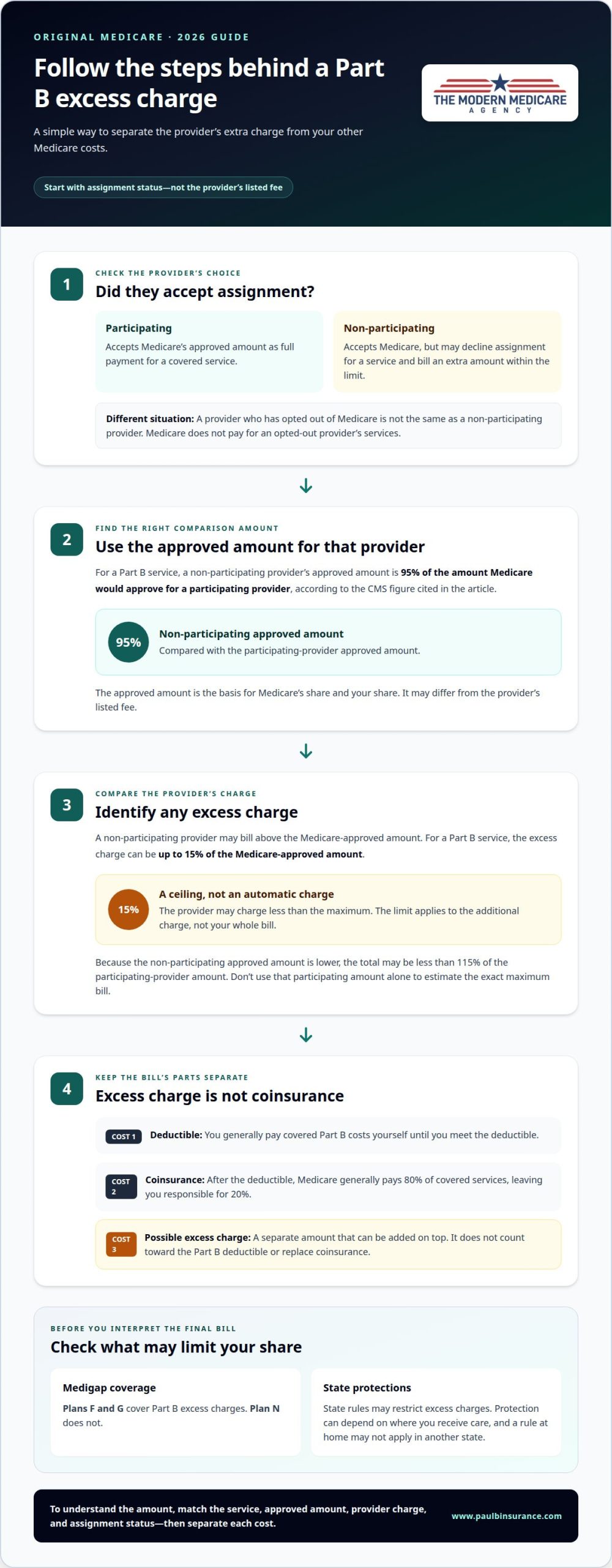
- Assignment affects which approved amount applies. For Part B services, a non-participating provider’s approved amount is 95% of the amount Medicare would approve for a participating provider, according to the Centers for Medicare & Medicaid Services.
- Compare Medigap benefits carefully: Plans F and G cover excess charges, while Plan N doesn’t.
- State protections can depend on where you receive care. A rule that protects you at home may not apply when you’re treated in another state.
- Follow the calculation from the approved amount to the provider’s charge to understand how an extra bill is determined.
What are excess charges?
With Original Medicare, a Part B excess charge can add to your costs for a covered service. Whether one applies depends on whether the provider accepts assignment.
Part B Excess Charge Definition
A Medicare Part B excess charge is an amount a non-participating provider may bill above Medicare’s approved amount. The provider accepts Medicare but hasn’t agreed to accept assignment for the service and hasn’t opted out of Medicare. This charge is separate from your usual share of the bill. Put simply, a Medicare excess charge is an additional amount tied to the provider’s billing choice.
With Original Medicare, participating providers accept Medicare’s rates as full payment for covered services. A non-participating provider may accept Medicare but decline assignment for a particular service. In that case, the provider may bill an excess charge, subject to applicable limits. This charge is separate from your Part B coinsurance and deductible.
You generally pay covered Part B costs yourself until you meet that deductible. Afterward, Medicare generally pays 80% of covered services, leaving you responsible for 20% coinsurance. An excess charge can be added on top of that coinsurance, so meeting the deductible doesn’t remove it.
For example, you may owe regular coinsurance after Medicare pays its share for a covered service. If the provider also bills an excess charge, that amount is a separate part of what you owe. It doesn’t count toward the Part B deductible or replace coinsurance, copayments, or other costs.
Limits on Excess Charges
For a Part B service, an excess charge can be up to 15% of the Medicare-approved amount. That limit puts a ceiling on the extra bill, but it doesn’t mean every non-participating provider charges the full amount. Knowing the cap helps you distinguish an excess charge from coinsurance and compare the bill with Medicare’s approved amount.
The 15% limit concerns the provider’s additional charge, not your total out-of-pocket responsibility. Your deductible and coinsurance remain separate. Also, a provider who has opted out of Medicare is different from a non-participating provider: Medicare doesn’t pay for an opted-out provider’s services. That distinction matters before you estimate what a visit may cost.
To understand a bill, identify the service, the Medicare-approved amount, and whether the provider accepted assignment. Then separate your deductible or coinsurance from any additional charge. For instance, a bill that includes both 20% coinsurance and an excess charge has two distinct components. Keeping them separate makes the provider’s calculation easier to understand.
Assignment is the key distinction, but other factors can affect what you owe. A Medicare Supplement policy or state rule may limit your exposure to excess charges. The following sections explain how these protections work and why the location of care can matter.
Medicare assignment and the Medicare-approved amount
Medicare’s approved amount is the payment basis for a covered service. Assignment determines whether a provider agrees to accept that amount as full payment.
Medicare Assignment
Medicare assignment means a provider agrees to accept Medicare’s approved amount as full payment for a covered service. Participating providers accept assignment; non-participating providers may decline it for some services. A provider that declines assignment may bill an additional amount, within the applicable limit.
According to the Centers for Medicare & Medicaid Services, for a Medicare Part B service, a non-participating provider’s approved amount is 95% of the amount Medicare would approve for a participating provider. This lower approved amount affects how Medicare processes the claim. It also means the approved amount for a non-participating provider differs from the participating-provider amount.
Medicare sets an approved amount for each covered service. This amount is the basis for calculating Medicare’s share and your share, but it may differ from the provider’s listed fee. To understand a bill, compare the service and its approved amount with the provider’s charge and assignment status.
Almost all providers who bill Medicare participate and accept Medicare’s rates as full payment. A non-participating provider can still accept Medicare but may require you to pay the full bill at the time of care. The provider may file the claim, or you may need to submit it yourself. This affects both what you pay upfront and how reimbursement is handled.
Maximum Excess Charge Amount
A Part B excess charge can be up to 15% of the Medicare-approved amount for a service. This limit applies to the additional charge, not to your total bill. Your deductible or coinsurance is separate, so the cap helps identify one part of the amount you may owe.
That calculation illustrates the cap on an excess charge. It doesn’t include every part of your bill, such as coinsurance or any remaining deductible.
The approved amount used in a calculation matters. For a non-participating provider, that amount is lower than the participating-provider amount. As a result, the total charge may be less than 115% of the usual Medicare-approved amount. Don’t assume that adding 15% to a participating provider’s figure will always show the exact maximum bill.
Review the claim details by matching the service, approved amount, provider’s charge, and assignment status. Then separate any excess charge from your other cost-sharing. If you’re comparing how a supplement may handle excess charges, explore Medigap plan coverage as part of that review.
Medigap coverage for excess charges
No. Original Medicare doesn’t pay the excess charge above its approved amount. It pays its share for covered Part B services, while the excess charge is a separate amount the provider may bill.
Medigap, also called Medicare Supplement insurance, can help cover this specific extra cost. Plans F and G cover Medicare Part B excess charges; Plan N does not. The plan letter matters: Medigap policies with different letters can treat the same provider charge differently, even though both work alongside Original Medicare.
Plan F covers Part B excess charges, but it isn’t available to everyone. It’s available only to people who were eligible for Medicare before January 1, 2020. If you became eligible on or after that date, Plan F isn’t an option for you. Plan G also covers excess charges and may be a relevant plan letter to compare.
Plan N does not cover excess charges. If you have Plan N and a non-participating provider bills an excess charge, the policy won’t cover it. This is separate from Plan N’s other benefits, so don’t assume a Medigap policy automatically covers every possible Part B bill. Check the plan letter and benefit description for the specific protection you need.
For example, suppose a provider bills an excess charge after a covered Part B service. Plan G or an eligible Plan F policy covers the charge under its benefit. Plan N does not. The provider’s assignment status and your Medigap plan letter both matter.
When comparing Medigap plans, focus on the excess-charge benefit, not just the plan name. Confirm whether the plan is F, G, or N, then consider how that benefit fits with your Original Medicare coverage. If you already have a policy, review its benefit summary before assuming it will cover a particular charge. The plan letter is a useful starting point.
Medigap coverage for excess charges doesn’t change whether a provider accepts assignment. It affects who may be responsible for an excess amount when one applies. Keep the questions separate: first identify the provider’s assignment status, then check whether your Medigap plan covers the resulting charge.
That distinction can help you compare coverage without confusing the provider’s bill with Medicare’s payment. In 2026, Plan F’s eligibility cutoff remains important, while Plans F and G cover excess charges and Plan N does not. Knowing these differences gives you a practical way to assess this benefit when reviewing Medigap options.
State restrictions on excess charges
State rules can limit or prohibit Part B excess charges for care received in certain states. Protection may depend on both your state of residence and where you receive care.
States Prohibiting Excess Charges
Eight states prohibit Part B excess charges for care received in the beneficiary’s home state: Connecticut, Massachusetts, Minnesota, New York, Ohio, Pennsylvania, Rhode Island, and Vermont. For eligible residents receiving covered care in their own state, this can reduce out-of-pocket costs.
However, home-state protection doesn’t necessarily apply when you travel. Someone protected in their home state may still face excess charges elsewhere. Minnesota shows why both details matter: its providers may not charge Minnesota residents these excess fees, but may charge patients from other states who receive care in Minnesota.
For comparison, consider a Minnesota resident receiving care in Minnesota and an out-of-state patient receiving care there. The state restriction applies differently in these situations. Your state of residence and the service location both affect whether a state rule limits the provider’s bill.
State-Imposed Limits
Some states restrict excess charges without banning them completely. Their rules may cap the extra amount below the federal limit of 15%. The applicable state rule can therefore change how much a provider may bill, making the service location important when estimating your share.
New York sets a 5% limit above the Medicare-approved amount for services covered by its state rule. Certain services outside that rule remain subject to a federal cap of 15% above Medicare’s approved payment amount. The state limit is not universal across every service, so the service itself matters.
These differences mean the same provider charge can have different limits depending on the state rule and service. A 5% state cap applies to services covered by New York’s rule, while the federal 15% cap applies to certain services outside it. Neither figure describes your entire bill, which may include other Medicare cost-sharing.
Before assessing an excess charge, identify where you received care, your home state, and the service involved. Then distinguish a state prohibition from a state limit: a prohibition bars the charge in covered circumstances, while a limit allows an additional amount up to a lower ceiling. This distinction helps you understand whether a bill may include an excess charge or whether a state rule restricts it.
State restrictions are one part of the protection picture. They don’t automatically mean every patient receiving care in a listed state pays the same amount. For example, Minnesota’s rule treats residents and visitors differently, while New York’s 5% cap applies only to services covered by its rule. Checking residence, care location, and service together gives you a clearer view of possible costs.
Examples of excess-charge calculations
A clear calculation separates the provider’s charge from Medicare’s approved amount, then identifies assignment, any excess charge, and your other cost-sharing. It won’t represent every healthcare bill, because each service has its own approved amount.
Your total responsibility may also include other amounts, such as coinsurance or a deductible.
Now compare this with a provider who accepts assignment for the same service. The provider agrees to accept Medicare’s approved amount as full payment for the covered service, so the difference that creates an excess charge doesn’t arise. This is why assignment status matters when you review a bill, along with the service and its approved amount.
A non-participating provider uses a different approved amount. For a Part B service, the approved amount is 95% of what Medicare would approve for a participating provider, according to the Centers for Medicare & Medicaid Services. The excess charge is calculated against the applicable approved amount, not automatically against the participating-provider figure. That distinction explains why a total charge may be less than 115% of the usual Medicare-approved amount.
Keep each part of the bill separate. First identify the covered service and approved amount. Then determine whether the provider accepted assignment, and distinguish any excess charge from your regular Medicare cost-sharing. This breakdown helps you assess the additional amount instead of treating the entire bill as one charge.
Payment timing can also affect what you see. A non-participating provider may require payment in full at the time of care and may or may not file the claim with Medicare. If the provider doesn’t file the claim, you may need to follow up on filing it and any related coverage paperwork. Keep the bill and service details together so the claim can be matched to the right approved amount.
If a bill appears to exceed the applicable limit, keep documentation showing the excess charge, Medicare-approved amount, and service code. Use these details when contacting your Medicare carrier about an appeal.
To understand how a supplement may help with this type of cost, compare Medigap coverage alongside your expected healthcare needs.
The Modern Medicare Agency: Medicare Advantage Plans
The Modern Medicare Agency helps you compare Medicare Advantage and Medicare Supplement (Medigap) plans as you consider your coverage options. If excess charges have raised questions about Original Medicare, understanding how these plan types differ can help you decide what to explore next.
Medigap may be relevant if you want to understand coverage for Part B excess charges. Medicare Advantage Plans offer a different way to receive Medicare coverage. Compare plan benefits and how they fit your healthcare needs. The agency also offers Medicare Part D Plans for prescription drug coverage.
For help reviewing your Medicare plan options, book a free consultation with The Modern Medicare Agency.
Make your next Medicare decision with confidence
Understanding Medicare excess charges can help you ask clearer questions. Next, connect that knowledge to the coverage you want. Consider what matters most: access to particular providers, potential out-of-pocket costs, or how well your coverage fits your needs. These priorities can guide a focused conversation without requiring you to sort through every plan detail at once.
The Modern Medicare Agency helps you compare Medicare Advantage, Medicare Supplement, and Part D plans. Bring your questions and the details you want to compare to a free consultation. Personalized guidance can help you focus on the points that matter as you decide what to explore.
Contact The Modern Medicare Agency to discuss your Medicare coverage questions. You can take the next step at your own pace, with a clearer sense of what you want from your coverage.
Frequently Asked Questions
What is a Medicare excess charge?
A Medicare excess charge is an additional amount a non-participating provider may bill for a covered Part B service. It applies when the provider hasn’t opted out of Medicare but doesn’t accept assignment for that service. For example, if you see an extra line on a bill, compare it with the Medicare-approved amount and the provider’s assignment status. That helps distinguish an excess charge from regular cost-sharing.
How much can a doctor charge above the Medicare-approved amount?
A doctor may charge an excess amount of up to 15% of the applicable Medicare-approved amount. That limit applies to the excess charge, not your full bill. For a non-participating provider, the approved amount is lower than the amount Medicare would approve for a participating provider, so don’t assume the total bill equals 115% of the participating-provider amount. Check which approved amount the bill uses.
Which providers are allowed to bill Medicare excess charges?
A non-participating provider who hasn’t opted out of Medicare may bill an excess charge for a service when they don’t accept assignment. The provider can accept Medicare without agreeing to accept its approved amount as full payment for every service. Some services require assignment even from non-participating providers, including Medicare-covered ambulance services. A provider who has opted out is different: Medicare doesn’t pay for that provider’s services.
What does it mean when a doctor does not accept Medicare assignment?
It means the doctor hasn’t agreed to accept Medicare’s approved amount as full payment for the service. The doctor may ask you to pay the full bill at the time of care and may or may not file the claim with Medicare. If the doctor doesn’t file it, you must submit the claim yourself. Keep the bill and service information together to support your claim.
Which states prohibit or limit Medicare excess charges?
Connecticut, Massachusetts, Minnesota, New York, Ohio, Pennsylvania, Rhode Island, and Vermont prohibit excess charges for care received in the beneficiary’s home state. Some states instead set a lower limit. For example, New York caps charges at 5% for services covered by its rule, while certain other services face the federal 15% cap. Home-state protections may not apply to care received elsewhere.
Do Medicare Supplement (Medigap) plans cover Part B excess charges?
Some Medicare Supplement plans cover Part B excess charges, but the benefit depends on the plan letter. This coverage is separate from Medicare’s payment for a covered service. When reviewing an existing policy, look for its excess-charge benefit rather than assuming every Medigap plan handles the bill the same way. Both the provider’s billing status and your plan’s benefits matter.
Which Medigap plans cover Medicare Part B excess charges?
Medigap Plans F and G cover Part B excess charges; Plan N doesn’t. Plan F is available only to people who were eligible for Medicare before January 1, 2020. For instance, someone comparing Plan G with Plan N should pay attention to this difference, especially if they want a plan that covers excess charges. Review the plan letter and benefit details together.
How can I avoid or dispute a Medicare excess charge?
To avoid excess charges, use Medicare-approved providers who accept assignment. If you dispute a charge, gather the bill, Medicare-approved amount, and service code, then contact your Medicare carrier. If the provider didn’t file the claim, submit it to Medicare and, if you have one, your Medigap plan. These records help connect the disputed amount to the service.

Article by
Paul Barrett
Paul Barrett, CMIP is the founder of The Modern Medicare Agency, an independent Medicare-only brokerage based in Melville, NY. With 18 years of Medicare-exclusive experience, a CMIP designation, and more than 5,000 clients served across 37 states, Paul is one of the most credentialed independent Medicare specialists on Long Island — and one of the most direct.
He represents 40+ carriers with no quotas and no allegiances, which means his recommendations are based entirely on what fits each client's specific situation. He is the author of Medicare Mastery Unlocked and host of the Wise Guys Retirement Talk podcast. His content is grounded in primary sources, real carrier intelligence, and 18 years of watching what happens when people get Medicare right — and when they don't.
📞 631-358-5793 | paulbinsurance.com