




The right Medicare choice for your parents is the one that fits their doctors, prescriptions, health needs, and budget. Medicare is federal health insurance for people aged 65 or older and certain younger people with disabilities, according to the Centers for Medicare & Medicaid Services. Knowing how to make a good decision on Medicare for your parents starts with comparing how each coverage option works for their situation.
It’s understandable to feel unsure. Medicare has several parts, and other coverage through an employer, union, or military benefits may affect the decision. A familiar plan name or low premium alone won’t tell you whether your parents’ doctors and prescriptions are covered.
This guide explains what Medicare covers, how Parts A, B, C, and D work, and how other insurance may fit. You’ll learn what to compare across Medicare Advantage, Original Medicare, Medigap, and drug coverage, so you can weigh the options and help your parents choose coverage suited to their needs.
Key Takeaways
- Start with your parents’ doctors, prescriptions, health needs, and existing coverage to identify what matters most in a plan.
- Find out whether an employer, union, military, or veterans’ benefit plan affects which insurance pays first.
- Compare Original Medicare and Medicare Advantage by looking at provider access, covered services, and how each option handles care.
- Understand how Parts A, B, C, and D work so you can see which hospital, medical, and prescription drug needs each covers.
- Review plan details each year, including prescription coverage and whether the plan still fits your parents’ needs.
Coverage from employers, unions, military, or veterans’ benefits
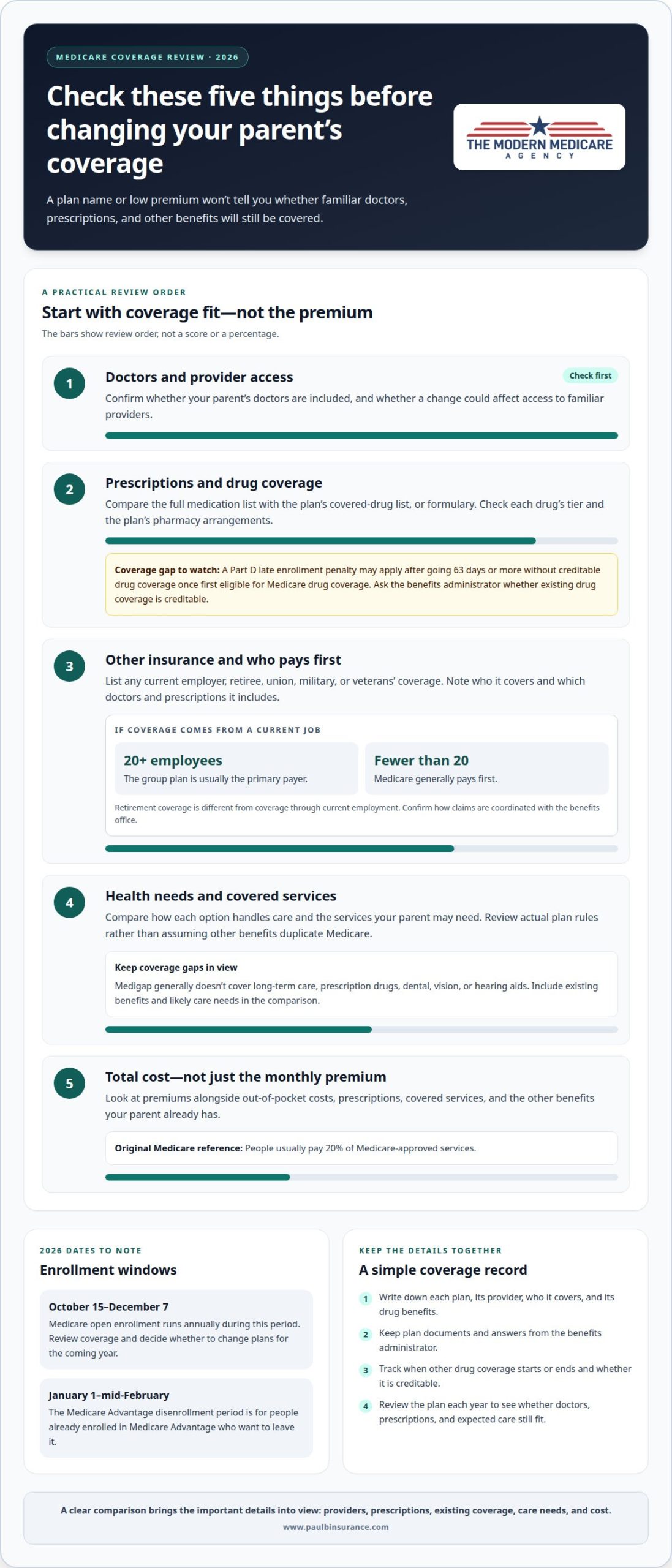
Before changing your parent’s Medicare coverage, identify every active policy. Ask about current employer insurance, retiree or union benefits, and military or veterans’ coverage. Record each plan’s provider, who it covers, and which doctors and prescriptions it includes. These details help clarify how Medicare coordinates with other coverage and what a change could affect.
Employer size matters when a parent has Medicare and coverage through a current job. If the employer has 20 or more employees, the group plan is usually the primary payer. If the employer has fewer than 20 employees, Medicare generally pays first. Confirm whether the coverage comes from current employment or retirement, since those are different circumstances. Ask the employer’s benefits office how claims are coordinated before your parent changes or drops coverage.
For union, military, or veterans’ benefits, review the actual plan rules instead of assuming they duplicate Medicare. Check the provider list, prescription benefits, and any conditions for keeping the coverage. Then compare those details with Medicare Advantage or other Medicare coverage. A change may affect access to familiar providers or existing drug coverage, so keep the plan documents and note any answers from the benefits administrator.
Medicare Part D prescription drug coverage is purchased through a private health plan. A person may face a late enrollment penalty if they go 63 days or more without creditable drug coverage after first becoming eligible for Medicare drug coverage, according to the Centers for Medicare & Medicaid Services. Ask the employer or benefits administrator whether the current prescription coverage is creditable, and retain the response with your parent’s records.
To compare Part D plans, match every prescription your parent takes against the plan’s covered-drug list, called its formulary. Check each drug’s tier, since lower-cost tiers cost less than higher-cost tiers, and review the plan’s pharmacy arrangements. Consider the full medication list, not just the prescriptions filled most often.
Plan for premiums and out-of-pocket costs alongside coverage gaps. Under Original Medicare, people usually pay 20% of Medicare-approved services. Medigap generally doesn’t cover long-term care, prescription drugs, dental, vision, or hearing aids. Include likely care needs and existing benefits in the comparison, rather than treating a plan’s premium as the whole cost.
If an employer or other plan denies a claim, start by reading the denial notice. Note the reason, the records or explanation needed, and the appeal instructions. Gather relevant bills, plan documents, and medical records, then submit the appeal as directed and keep copies. A clear paper trail helps your parent respond to the specific coverage decision.
If dental needs are also part of the household review, consider dental insurance plan options separately from Medicare coordination.
Can Medicare coverage be combined with other insurance?
Yes, Medicare can work alongside other coverage, but the order in which plans pay matters. People with Medicare may face a Part D late enrollment penalty if they go 63 days or more without creditable drug coverage after first becoming eligible for Medicare drug coverage, according to the Centers for Medicare & Medicaid Services. Keep records showing when other drug coverage starts and ends, and ask whether it counts as creditable before relying on it.
In 2026, Medicare open enrollment runs annually from October 15 through December 7. During this period, your parent can review available coverage and decide whether to change plans for the coming year. Compare the plan’s monthly premium alongside its doctors, prescriptions, and covered services. A premium alone doesn’t show how well a plan fits your parent’s medical needs.
Plan changes have other timing rules. The Medicare Advantage disenrollment period runs from January 1 through mid-February. That period is for people already enrolled in Medicare Advantage who want to leave it. It isn’t a general replacement for open enrollment, so identify your parent’s current plan before looking at which change period applies.
Enrollment timing also depends on why someone qualifies. Medicare generally covers people aged 65 or older and certain younger people with disabilities, according to the Centers for Medicare & Medicaid Services. Work history can affect whether Part A is premium-free, so separate the question of eligibility from the question of what coverage may cost.
Can you enroll on your parent’s behalf? To handle Medicare enrollment for a parent, you need power of attorney or legal guardianship. Before starting, gather your parent’s Medicare details, current insurance information, and documents showing your authority to act. This keeps decisions and enrollment records organized under the right person’s name.
Use a calendar to track your parent’s coverage dates, plan renewal materials, and enrollment windows. Each year, review whether their doctors, prescriptions, and expected care still fit the plan. If another policy remains active, include its benefits and coordination rules. This helps prevent a plan change from disrupting useful coverage.
When weighing a Medicare Advantage plan against other options, look closely at the plan’s provider network and how it handles your parent’s care. The Medicare Advantage plan guide can help explain the coverage structure as you compare choices.
Choosing between Original Medicare and Medicare Advantage
Original Medicare and Medicare Advantage both provide Medicare coverage, but they organize care differently. Original Medicare includes Part A and Part B. Medicare Advantage plans, offered by private health plans, are an alternative to Original Medicare.
With Original Medicare, your parent can use any doctor or hospital in the United States that accepts Medicare. Medicare Advantage plans may limit coverage to doctors in their network. Before comparing other features, check each parent’s regular doctors and preferred hospitals against the plan’s provider list.
With Original Medicare, beneficiaries usually pay 20% of Medicare-approved services. A Medicare Supplement policy, also called Medigap, can help address certain gaps in Original Medicare. Medigap generally requires both Part A and Part B. For policies with the same letter, benefits are the same across insurance companies, though prices can differ.
Medicare Advantage combines Part A and Part B coverage through a private health plan, and a person must have both parts to join. Most Medicare Advantage plans also offer benefits such as vision, hearing, and dental coverage, which Original Medicare doesn’t cover. Focus on the services your parent uses rather than choosing based only on an extra benefit.
How does Medicare Advantage compare with Original Medicare and Medigap? Original Medicare offers broad access to any U.S. provider accepting Medicare, while Medicare Advantage may use a provider network. Medigap supplements Original Medicare, while Medicare Advantage is an alternative to it.
Care needs can reveal differences that a summary of benefits may miss. Medicare Advantage plans generally don’t require a 3-day prior hospitalization for skilled nursing care. If your parent may need skilled nursing services, include that rule in the comparison alongside provider access and covered services.
To compare options, write down your parent’s doctors, preferred hospitals, and likely care needs. Then check provider access, covered services, and how each plan handles care. Under Original Medicare, also consider how the usual 20% share for approved services fits with your parent’s other coverage.
The right fit depends on which trade-offs matter most to your family. A parent who values access to any Medicare-accepting provider may favor Original Medicare. Someone comfortable using a plan’s network may consider Medicare Advantage. If weighing Original Medicare with added coverage, compare Medigap policies by letter and price.
Medicare Parts A, B, C, and D
Medicare divides hospital, medical, and prescription benefits across four parts. Knowing each part’s role helps families understand what a parent’s coverage includes and where gaps may remain.
The Roles of Medicare Parts A, B, and D
Part A covers inpatient hospital and skilled nursing facility stays, hospice care, and some home health care. Part B covers doctor visits, outpatient care, medical supplies, and preventive services. Together, Parts A and B make up Original Medicare. Part D provides prescription drug coverage through a private health plan.
Part B requires a monthly premium paid to the government, deducted from the beneficiary’s Social Security check. Most drug plans also charge a monthly premium, with additional costs when prescriptions are filled. Keep these separate charges in mind when comparing coverage, since medical and prescription benefits may come through different plans.
Original Medicare Coverage and Limits
Original Medicare covers hospital and skilled nursing facility stays, hospice, some home health care, doctor visits, outpatient care, medical supplies, and preventive services. It generally doesn’t include routine dental, vision, or hearing benefits. Prescription drug coverage comes separately through Part D.
This distinction matters when a parent needs services outside those benefits. For example, list any dental care or regular prescriptions, then see how each option would cover them. Medigap can help with certain Original Medicare cost gaps, but generally doesn’t cover long-term care or prescription drugs.
Part C, also called Medicare Advantage, is offered by private health plans as an alternative to Original Medicare. Most Medicare Advantage plans include Part D drug coverage, so review the medical and prescription benefits together. In most types of these plans, a beneficiary can’t also join a separate Medicare drug plan.
For each prescription, compare the drug plan’s covered-drug list and tiers. Plans group covered medicines into tiers, with lower-cost tiers costing less than higher-cost tiers. Check the exact medication and its tier instead of assuming a familiar drug is treated the same across plans.
Start with your parent’s current care: hospital services, doctor visits, supplies, preventive care, and prescriptions. Match those needs to Parts A and B, then consider whether Part C or separate Part D coverage fits. A State Health Insurance Assistance Program offers free, confidential, unbiased counseling in every state, which can help families understand their coverage choices.
Comparing Medicare plans
A useful comparison weighs more than a monthly premium. For 2026, look at premiums, deductibles, copays, covered prescriptions, provider access, and out-of-pocket limits together.
Premiums and Deductibles
A premium is the recurring amount paid to keep coverage, while a deductible is what a member pays before certain coverage begins. Their 2026 amounts depend on the coverage option and plan, so compare the figures shown for each plan rather than relying on one Medicare-wide total.
For a fair comparison, list every premium your parent would pay, including separate drug coverage where applicable. Then note which services or prescriptions require meeting a deductible. For example, a plan with a lower monthly premium may have a deductible that matters more to a parent who regularly fills prescriptions.
Medigap policies with the same letter provide the same benefits, regardless of insurer, but prices can differ. Compare the lettered benefits and premium. Medigap generally requires both Part A and Part B, and it doesn’t cover long-term care or prescription drugs.
Copays and Out-of-Pocket Limits
A copay is an amount a member pays for a covered service, while an out-of-pocket limit sets a plan’s ceiling for certain covered costs. For 2026, compare the plan documents for the applicable copays and limits, since these details can differ between options.
Look beyond a single doctor visit. Consider how copays apply to recurring care, hospital services, and your parent’s prescriptions. Check the out-of-pocket limit and which expenses count toward it. This gives your family a clearer picture of how costs may add up across different care needs.
Medicare health and drug plans receive Star Ratings on a one-to-five scale. Use the rating alongside benefits, provider access, and medication coverage. It doesn’t replace checking whether your parent’s specific doctors and prescriptions fit the plan.
For drug plans, compare each prescription against the plan’s covered-drug list and tier. Lower-cost tiers cost less than higher-cost tiers. For Medicare Advantage, check whether the plan includes drug coverage, as most do. Separate drug-plan enrollment isn’t allowed in most types of these plans.
Finally, compare extras against actual needs. A vision benefit may matter to a parent who uses vision services, while nursing care needs call for attention to the plan’s skilled nursing rules. Free, confidential, unbiased insurance counseling is available through SHIP in every state. To review Medicare Advantage plan features alongside these costs, use this Medicare Advantage comparison guide.
The Modern Medicare Agency: Medicare Advantage Plans
The Modern Medicare Agency can help when you’ve narrowed down your parent’s needs and want to compare plan options. Its independent brokers help seniors and other eligible individuals compare Medicare Advantage, Medigap, and Part D plans from over 40 carriers, with personalized, unbiased guidance.
Bring the priorities you’ve identified, such as preferred doctors, prescription needs, and the coverage trade-offs that matter most. These provide a practical starting point for comparing options with your parent’s circumstances, rather than focusing on a plan label alone.
If you’d like support comparing coverage for your parent, contact The Modern Medicare Agency or visit paulbinsurance.com.
Take the Next Step With Confidence
In 2026, make the decision with your parent, not just for them. Set aside time to talk about what makes coverage feel workable: keeping familiar care, managing prescriptions, or having more predictable costs. Their priorities can help turn a complicated comparison into a choice that feels personal and clear.
Knowing how to make a good decision on Medicare for your parents isn’t about finding a perfect plan on paper. It’s about choosing coverage that reflects their needs and gives your family a clear way to move forward. If you’re ready to discuss the options, contact The Modern Medicare Agency.
Your care and attention can make this process easier for your parent. Take the next step together, at a pace that feels right for your family.
Frequently Asked Questions
What is Medicare?
Medicare is federal health insurance for people aged 65 or older and certain younger people with disabilities, according to the Centers for Medicare & Medicaid Services. It offers different ways to receive coverage, including Original Medicare and Medicare Advantage. Eligibility and enrollment are separate questions: someone may qualify based on age or disability, while the coverage they select determines how their medical and prescription benefits are arranged.
Are there different types of plans available?
Yes. Families can compare Original Medicare, Medicare Advantage, Medigap, and Part D drug plans. Original Medicare is the government-administered combination of Parts A and B; Medicare Advantage is an alternative offered by private health plans. Medigap supplements certain costs in Original Medicare, while Part D covers prescriptions. For example, someone choosing Original Medicare may consider separate drug coverage, while many Medicare Advantage plans include it.
What should I consider when I buy a Medigap policy?
Compare the plan letter, premium, and timing of enrollment. Medigap benefits for policies with the same letter are the same across insurance companies, though prices can differ. According to the Centers for Medicare & Medicaid Services, someone who waits beyond the 6 months after first getting Part A and Part B may be unable to buy a policy or may pay more. Keep the start dates of both parts handy.
What should I consider when deciding to add drug coverage?
Start with your parent’s complete medication list, including each drug’s name and dosage, then compare it with the plan’s covered-drug list and tiers. Lower-cost tiers cost less than higher-cost tiers. Ask whether existing employer or retiree drug coverage is creditable. According to the Centers for Medicare & Medicaid Services, going 63 days or more without creditable coverage after first becoming eligible can lead to a Part D late enrollment penalty.
Who can help me choose the best Medicare plan?
A State Health Insurance Assistance Program (SHIP) provides free, confidential, unbiased insurance counseling in every state. The Modern Medicare Agency also helps families compare Medicare Advantage, Medigap, and Part D options through personalized comparisons and a free consultation. Bring your parent’s medication list, preferred doctors, and current coverage details to make the discussion more useful. If you’re helping a parent enroll, have documentation of your authority to act ready.
How do Medicare Parts A, B, C, and D work?
Parts A and B form Original Medicare: Part A covers hospital and certain post-hospital care, while Part B covers doctor visits, outpatient care, supplies, and preventive services. Part C, or Medicare Advantage, is a private-plan alternative to Parts A and B. Part D provides prescription drug coverage through a private plan. For example, when comparing options, identify whether drug benefits come from a standalone Part D plan or a Medicare Advantage plan.
When can someone enroll in Medicare, switch plans, or change coverage?
People not receiving Social Security benefits can apply for Part A as early as three months before their 65th birthday. Annual Medicare open enrollment runs from October 15 through December 7. The Medicare Advantage disenrollment period runs from January 1 through mid-February. These periods serve different purposes, so note your parent’s current plan and the change they want before deciding which window applies.
How do parents’ doctors, hospitals, and prescriptions affect Medicare plan choice?
Provider access and medication coverage can make a plan workable or difficult for a parent. Check whether their preferred doctors and hospitals accept Medicare or participate in a Medicare Advantage plan’s network. Match every prescription against the plan’s covered-drug list and tier. If you’re considering how to make a good decision on Medicare for your parents, use their actual care needs, not a plan’s general description, as your guide.

Article by
Paul Barrett
Paul Barrett, CMIP is the founder of The Modern Medicare Agency, an independent Medicare-only brokerage based in Melville, NY. With 18 years of Medicare-exclusive experience, a CMIP designation, and more than 5,000 clients served across 37 states, Paul is one of the most credentialed independent Medicare specialists on Long Island — and one of the most direct.
He represents 40+ carriers with no quotas and no allegiances, which means his recommendations are based entirely on what fits each client's specific situation. He is the author of Medicare Mastery Unlocked and host of the Wise Guys Retirement Talk podcast. His content is grounded in primary sources, real carrier intelligence, and 18 years of watching what happens when people get Medicare right — and when they don't.
📞 631-358-5793 | paulbinsurance.com